You've got a product you believe in, a store that works, and some traffic coming in. Yet sales still feel random. One week, a paid campaign works. The next week, the same campaign burns through margin. Customers ask questions your product page should answer, and you keep changing the homepage because you're not sure what message will finally make people buy.
I've seen founders treat this as a traffic problem when the core issue sits underneath it. Buyers don't understand who the product is for, why it deserves their attention, or what will happen after they place an order. More ads can't fix that. A new logo won't fix it either.
Ecommerce brand strategy gives you a working system for those decisions. It connects positioning, product presentation, customer experience, retention, and trust. You use it to make every page, campaign, email, package, and support interaction feel like part of the same promise.
That matters in a crowded mobile-first retail environment. Ecommerce sales were projected to reach about $7.4 trillion in 2026, or roughly 20.5% of global retail sales, while mobile commerce was estimated to account for about 60% of ecommerce sales (New Media ecommerce statistics). Your customer may discover you on a phone, compare you with several alternatives, read reviews, check your return policy, and buy without ever speaking to you.
This guide will help you build the system in order. You'll start with a clear position, connect it to customer evidence, turn it into creative and personalized experiences, then earn repeat purchases through post-purchase trust.
Introduction Why Your Ecommerce Brand Needs Strategy Before Scale
A founder I'll call Maya sells a skincare product for people with sensitive skin. The formula works. Early customers leave thoughtful reviews. Friends tell her the packaging looks good. Still, her store attracts browsers who ask whether the product is for daily use, how it differs from standard moisturizers, and whether they can return it after opening.
Maya responds by testing more ads. One ad talks about clean ingredients. Another focuses on luxury. A third uses a discount. Each campaign attracts a different audience, so the store keeps receiving visitors with different expectations. Her product hasn't changed, but the buying experience feels inconsistent.
That's where brand strategy earns its keep. It gives Maya a decision filter. She can decide that her product is for people who want a simple daily routine without harsh-feeling ingredients, then make that idea visible in the headline, product demonstration, reviews, packaging, email flow, and support replies.
Brand isn't decoration added after the “real” work. Brand is the pattern buyers experience before, during, and after the order. A clear pattern helps people recognize the offer, understand its use, and judge the risk of buying from you.
Trust matters because online shoppers can't inspect the product in person. 87% of consumers say they're willing to pay more for brands they trust, 68% say they'll pay more for products from trusted brands, and 77% say good reviews are a deal breaker or deciding factor (Salsify on brand trust). Those figures don't mean every founder needs a polished luxury identity. They mean your claims need support from the experience you create.
Practical rule: If your ads promise one thing and your product page, delivery, or returns experience suggests another, you don't have a traffic problem. You have a trust gap.
A useful strategy reduces your dependence on constant discounts. It helps you explain value before the buyer reaches the price, so your offer doesn't look like a commodity beside every similar product. It also gives you a foundation for retention, because customers know what they bought and why they should return.
The work starts small. You need a focused customer, a specific problem, a credible promise, and a consistent way to prove it. Scale comes after those pieces work together.
What Ecommerce Brand Strategy Really Means
Think of your brand as a compass and a promise. The compass helps you choose where to go. The promise tells buyers what they can expect when they choose you.
A logo, color palette, and tagline can support that promise, but they don't create it. Your strategy answers six practical questions:
- Who do you serve?
- What problem do you solve?
- Why does your approach fit that problem?
- What proof can a buyer see before ordering?
- How should the experience feel across every touchpoint?
- What should a customer expect after checkout?
Positioning narrows your choices
Positioning tells you which customers should notice you first and why. Suppose you sell travel bags. “High-quality bags for everyone” gives your creative team nowhere to go. “A compact carry-on system for frequent weekend travelers who hate checking luggage” gives you a customer, a situation, and a useful tension.
That narrowing helps you choose product details, photography, pricing language, partnerships, and channels. You don't need to appeal to every shopper. You need to make the right shopper feel understood quickly.
Product-market fit sits underneath the brand. If customers don't need the product, stronger messaging only helps you explain an unwanted offer more efficiently. Use interviews, support questions, reviews, purchase behavior, and small tests to learn whether your product solves a real problem for a defined group.
Brand strategy guides action
Marketing campaigns come and go. Strategy gives those campaigns a shared direction. A social ad, welcome email, product detail page, and package insert should each make sense on their own while repeating the same basic promise.
Write one sentence that your team can use when making decisions:
We help [specific customer] solve [specific problem] with [distinct approach], so they can [desired outcome].
If the sentence sounds broad, make the customer or problem narrower. If it sounds impressive but vague, replace adjectives with a concrete result or experience. That sentence becomes your test for new products, promotions, partnerships, and creative ideas.
Positioning and Storytelling That Make You Memorable
Your customer doesn't remember every sentence on your homepage. They remember a useful explanation that helped them make sense of the product.
Start with the problem in the customer's language. Pull phrases from support tickets, reviews, interviews, product searches, and conversations after purchase. If buyers say, “I need a lunch container that won't leak in my work bag,” use that situation before you talk about materials, design awards, or your founder journey.
Then make three choices:
- Name the customer: Describe the person, routine, or moment you understand best.
- Name the tension: Explain what frustrates them about current options.
- Name your proof: Show how your product resolves that tension.
A strong story doesn't require an exaggerated origin myth. A founder can say, “I kept replacing containers after leaks ruined my laptop bag,” then connect that experience to a tested closure, clear care instructions, and customer demonstrations. The story works because the buyer can follow the cause and effect.
Make the promise easy to repeat
Ask whether a customer could explain your brand to a friend without opening your website. If they can only say, “It's a nice product,” your message hasn't done enough work. Give them a short idea with a visible use case.
A useful test looks like this:
- Show someone your homepage for a brief visit.
- Ask who the product is for.
- Ask what problem it solves.
- Ask why they might trust it.
- Ask what they think happens after purchase.
Their answers expose gaps between your intended identity and the experience you present. You can also use this guide to writing a brand story to turn raw founder and customer material into a clearer narrative.
Use proof wherever your story makes a claim. A product demonstration supports a functional promise. A review supports the customer experience. A clear ingredients list, warranty, delivery explanation, or return policy reduces uncertainty. Trust grows when buyers can verify what you say.
Your story should stay recognizable across the homepage, packaging, product page, paid creative, and email. The words don't need to match exactly. The customer should feel the same point of view in each place.
A short video can help your team think through that story visually:
Avoid turning storytelling into a performance. Buyers care about the problem you understand, the product you built, and the evidence that you'll deliver what you promised. That combination is more memorable than a dramatic claim with no support.
Customer Personas and Product Market Fit in Practice
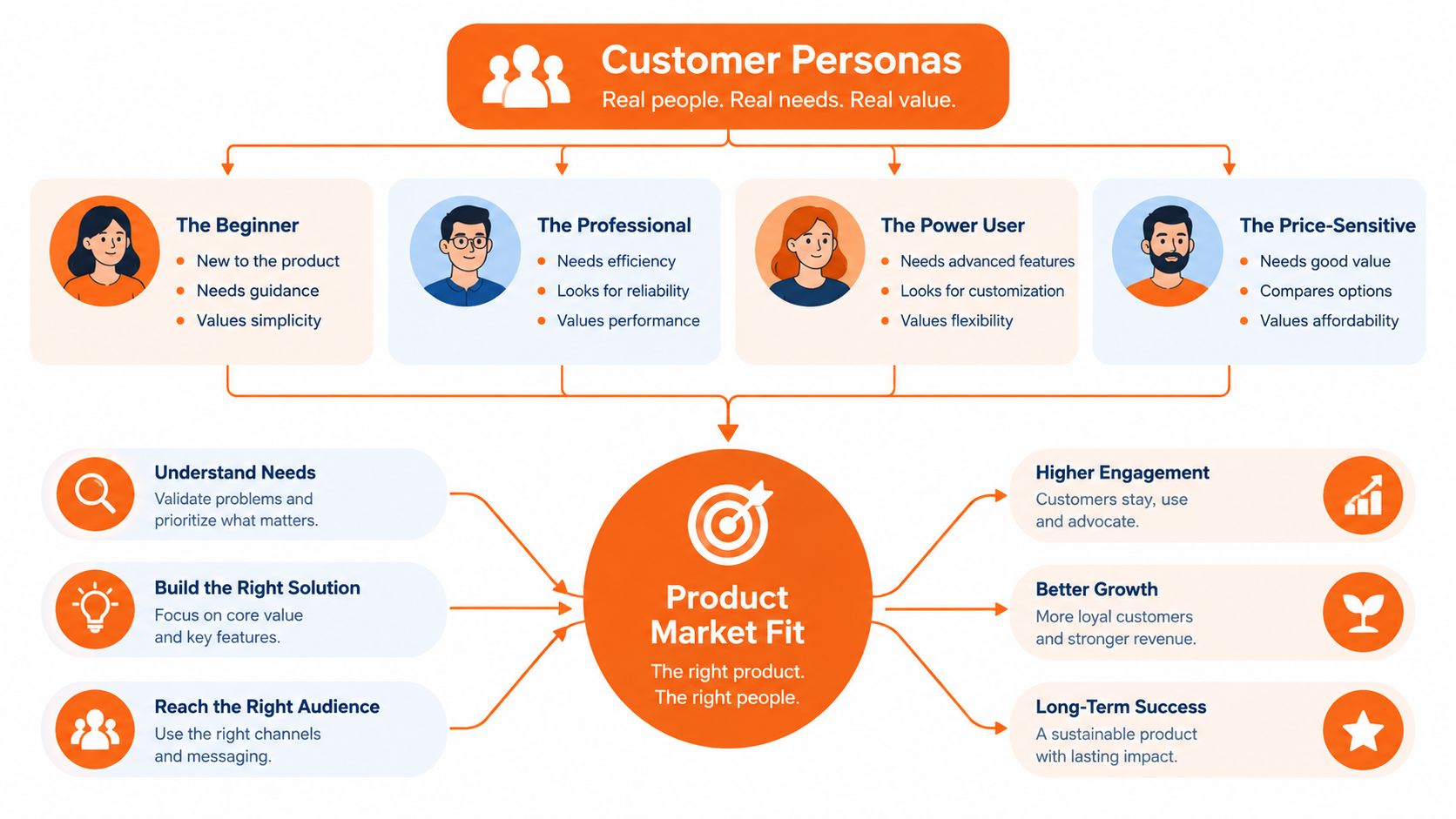
A persona should help you decide what to build, say, and show. It shouldn't become a fictional profile with a favorite coffee order and a made-up morning routine.
Start with real customers or people who recently faced the problem. Ask what happened before they searched, what alternatives they considered, what almost stopped them, and what they needed to believe before buying. Use open questions. “Why did you choose this?” gives you more than “Did you like the product?”
You can organize your notes around four practical areas:
- Job: What does the customer need to get done?
- Pain: What makes the current solution expensive, slow, confusing, or frustrating?
- Trigger: What event causes them to look for an answer now?
- Proof: What evidence helps them move from interest to purchase?
Suppose you sell a meal-planning kit. One customer may want faster weekday dinners. Another may want fewer grocery decisions. Both may buy the same product, yet their messages, product bundles, and onboarding needs differ. You can learn which group responds best before you spend heavily on broad creative.
Turn interviews into decisions
After each conversation, write down the exact phrase that describes the problem. Group similar phrases, then connect each group to a page element, product decision, or test. You can find a practical structure for this work in customer discovery interviews.
Run small tests with a defined audience. Compare whether people click, add to cart, ask for clarification, buy, use the product correctly, and return for another order. No single signal proves fit. Look for a consistent pattern across behavior and conversation.
Your persona should change as evidence changes. If buyers from one group repeatedly understand the offer, use it correctly, leave useful reviews, and return, narrow your messaging toward that group. If another group buys but needs heavy discounting or extensive explanation, investigate the mismatch before expanding your target.
Connect fit to the product page
A persona becomes useful when it changes the page. Put the customer's situation in the opening copy, show the product in that context, answer the main objection near the buy button, and place proof beside the claim it supports.
That structure turns research into a buying path. The shopper doesn't need to translate your internal product language into their own problem. You do that work before they reach checkout.
Creative Strategy and Personalization That Converts
Creative should match the buyer's question at each stage. An unfamiliar shopper needs a clear reason to care. A returning customer needs a reason to choose the next product or complete the next action.
Treat personalization as decision support, not as a gimmick. A recommendation based on browsing behavior can reduce choice overload. A cart reminder can answer a product question. A post-purchase message can explain how to use the item before you suggest another one.
One benchmark report found that personalization increased conversion rate by 45% on average (Netcore ecommerce personalization benchmark). Use that figure carefully. It doesn't mean every personalized module will create the same result. It points to the value of matching content, products, and timing to signals you already have.
| Funnel Stage | Creative Focus | Personalization Tactic |
|---|---|---|
| Discovery | Show the customer problem in a recognizable situation | Serve content based on entry source or broad interest |
| Consideration | Demonstrate use, quality, and proof | Adapt recommendations to viewed products and product category |
| Conversion | Remove objections around price, delivery, and returns | Trigger cart recovery with the item and unresolved question |
| Post-purchase | Teach correct use and reinforce the promise | Send instructions based on product and purchase date |
| Repeat purchase | Make the next order feel timely and useful | Use purchase cadence, location, and prior category behavior |
Build around first-party signals
Start with signals you control: viewed products, purchases, cart events, email clicks, support conversations, and review activity. Keep your segments useful. “Viewed running shoes twice and bought socks” can guide a recommendation. “Interested customer” can't.
Your stack doesn't need to become a maze. A store platform, analytics tool, email service, and product recommendation system can do meaningful work when they share clean event data. Begin with cart recovery, product recommendations, and post-purchase education. Measure whether each message helps the next action.
AI discovery needs the same clarity. Shopify's ecommerce trends and predictions discusses AI-driven personalization, shopping agents, and conversational search as discovery layers in 2026, and says 9 in 10 retail executives expect AI to reshape product discovery by 2027. Treat that as a projection, not a reason to publish generic AI copy.
Write product pages that answer direct questions in plain language. State who the product suits, what it does, what it doesn't do, how to compare variants, and what proof supports each claim. An AI shopping agent can only recommend your product accurately when your positioning and product data give it clear material to work with.
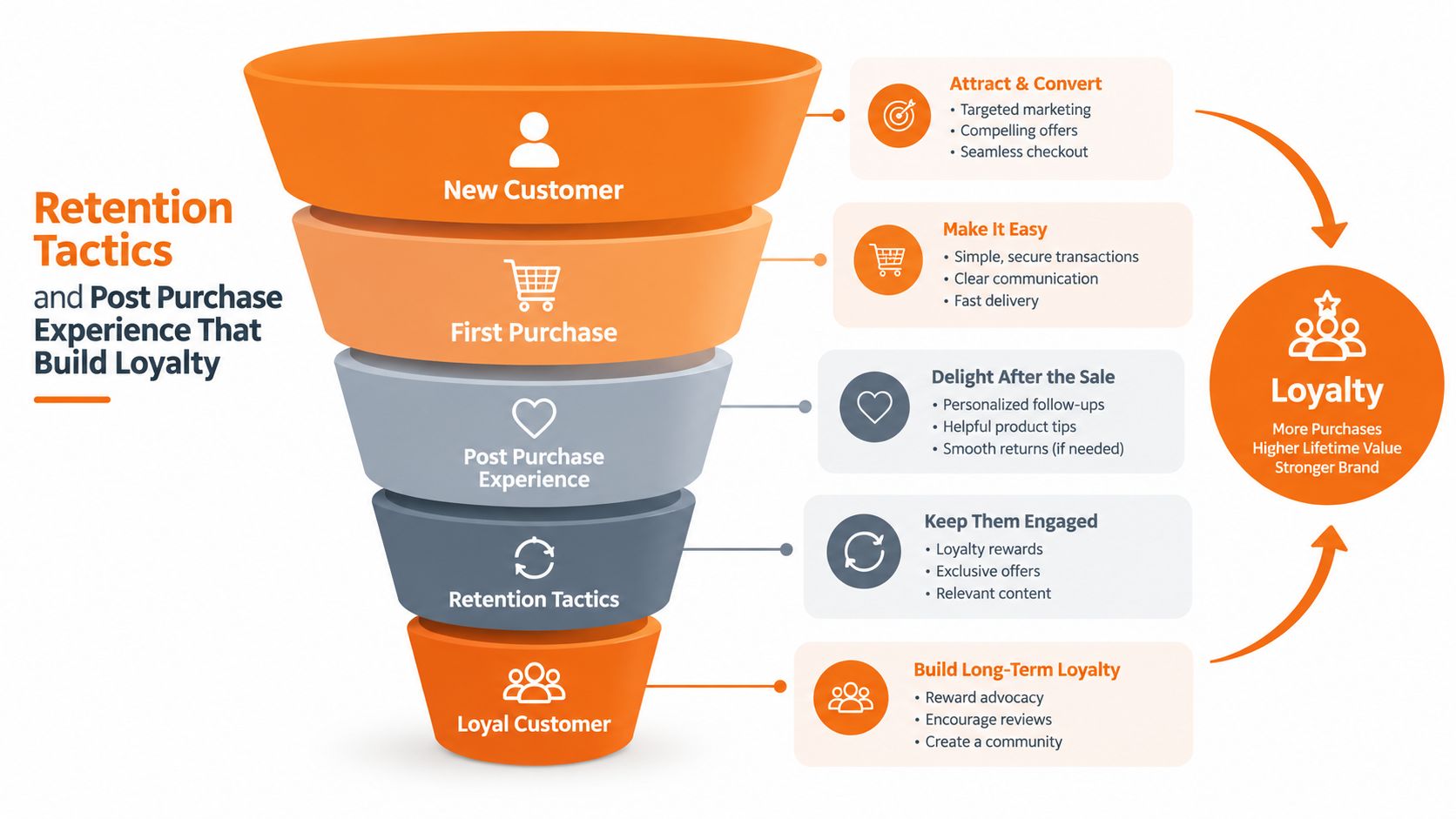
Retention Tactics and Post Purchase Experience That Build Loyalty
The first order gives you permission to continue the relationship. It doesn't guarantee a second order.
I like to map the post-purchase experience as a sequence of customer needs. First, the buyer wants confidence that the order is moving. Then they need help using the product. After that, they decide whether the product delivered the promised outcome. Only then does a second offer make sense.
Design triggers around real behavior
Build event-based flows instead of sending the same quarterly calendar to everyone. A replenishable product needs a different message from a durable product. Geography changes delivery timing, local offers, and service expectations.
Track repeat purchase rate, time to second purchase, and win-back rate. Mixpanel's 2026 ecommerce benchmarks identifies post-purchase experience and localized subscription bundles as useful levers for retention in North America and EMEA. Use those ideas as starting points, then test them against your own cohorts.
A simple flow might look like this:
- Order confirmation: Set expectations for delivery and give support a clear path.
- Arrival message: Explain setup, care, or first use in plain language.
- Usage check: Ask whether the customer has reached the first useful outcome.
- Review request: Request feedback after the customer has enough time to judge the product.
- Next-order prompt: Recommend a refill, companion item, or relevant bundle when the timing fits.
- Win-back message: Address the reason for inactivity with a helpful offer or service question.
Email and SMS can carry these messages at relatively low cost. One source estimates email-driven ecommerce customer acquisition cost at $5 to $15, while another estimates email marketing acquisition cost at $8 to $15 and says email can outperform paid social by roughly 3 to 5 times on acquisition cost (ATTN Agency channel comparison). Treat email as an owned route back to the store, not a place to paste every promotion.
Protect trust after checkout
Returns deserve clear treatment. 67% of shoppers check the return policy before buying, and 49% have abandoned a cart because the policy seemed unclear or unfavorable (WebMedic return policy guide). Put the policy near the product information, checkout, and help navigation. Explain eligibility, timing, fees, and the steps in language a tired shopper can scan.
For ideas on adding relevant products after an order, Shopify post purchase upsell examples can help you compare offers that appear after checkout without interrupting the initial purchase.
Retention also changes your cost structure. One estimate places retention through email and SMS at $5 to $15 per year, compared with $45 to $200 or more to acquire a new customer, depending on vertical and channel mix (Darkroom on retention costs). Your exact economics will differ, but the direction is useful. Improve the experience for people who already chose you before asking paid media to find more strangers.
For more practical ideas, use this guide to customer retention tactics, then choose one post-purchase flow to improve this month.
Aligning Your Brand With Growth Stages From Idea to Seven Figures
Your priorities should change as the business gains evidence. At the idea stage, focus on the customer problem, product promise, interviews, and a small validation test. Don't build a large channel plan before you know which customer understands the offer.
At first revenue, fix the path from ad or search result to product page to checkout. Collect the questions buyers ask, tighten proof, make returns easy to find, and create a basic post-purchase sequence. You need a repeatable experience before you add complexity.
As you scale toward seven figures, connect cohort data, personalization, referrals, community, and owned channels. Your moat comes from knowing customers well and giving them reasons to return, recommend, and talk about the product. You can use e-commerce growth strategies for 2026 as a planning reference while deciding which channels fit your operating capacity.
Run this short audit:
- Can one sentence explain your customer, problem, and distinct approach?
- Does the product page answer the buyer's main doubt?
- Do reviews and demonstrations support your claims?
- Can shoppers find the return policy quickly?
- Do your email and SMS flows react to behavior?
- Do you measure repeat purchase rate, time to second purchase, and win-back rate?
- Can your product information support AI-led discovery?
Choose the next three moves, not fifteen. A useful set might include rewriting the product page, installing a post-purchase flow, and interviewing recent buyers. Chicago Brandstarters is a free, vetted founder community with small private dinner events and a group chat where operators share practical ecommerce and brand-building problems. Visit Chicago Brandstarters to meet peers who can help you test your positioning, improve retention, and grow from an early idea toward seven figures.
Leave a Reply