
You probably have an idea open in one tab, Figma in another, and a notes doc full of product thoughts you want to turn into something real.
I get it. Building feels good. Talking to strangers does not.
But if you're skipping customer discovery interviews because they feel slow, awkward, or fuzzy, you're walking straight into the most common founder trap. You fall in love with your answer before you've proved the problem is worth solving. Then you spend months polishing a thing nobody asked for.
I've done this wrong before. Most founders have. The fix isn't complicated. You need a simple system for three hard things: knowing what you're trying to learn, finding people when you have no network, and keeping your mouth shut when someone says, "Yes, that's exactly my problem."
Why Most Founders Skip This and Fail
Founders skip discovery for one reason. Building looks like progress. Listening feels like delay.
Code ships. Mockups impress people. Supplier calls make you feel serious. A customer interview can feel like you spent an hour and got "it depends" in return. So you avoid it.
That's a mistake.
Building before learning is like buying lumber before checking whether you're building a deck or a boat. You're still spending money. You're still working hard. You're just doing it in the wrong order.
The real risk isn't moving slowly
The risk is building the wrong thing with total confidence.
Most early ideas aren't bad because the founder is lazy or dumb. They fail because the founder guessed wrong about one of these:
- The problem: People say it annoys them, but they won't act on it.
- The user: The person with the pain isn't the person who buys.
- The timing: The pain is real, but it isn't urgent.
- The workaround: Customers already have a "good enough" fix.
Customer discovery interviews are how you catch those bad assumptions before they eat your calendar.
Practical rule: If a wrong assumption could kill the business, talk to humans before you build around it.
Why founders resist the process
I've seen the same excuses over and over:
| Excuse | What's actually going on |
|---|---|
| "I need something to show people first" | You're afraid the raw idea won't survive contact with reality |
| "I already know the customer" | You know a version of them in your head |
| "People can't tell you what they want" | True. They can tell you what they did last week |
| "I'll do interviews after the prototype" | By then you're defending decisions, not learning |
There's also a psychological piece nobody talks about enough. Interviews threaten your ego. A blank product file still lets you imagine success. A real buyer can puncture that fantasy in twenty minutes.
Good. That's the point.
Discovery is your insurance policy
I don't treat customer discovery interviews as a research ritual. I treat them like cheap insurance. They protect me from my own wishful thinking.
If you're early, your job isn't to prove you're right. Your job is to find out where you're wrong while the mistake is still cheap.
Before You Talk to Anyone Define Your Mission
An interview without a mission is just coffee with a stranger.
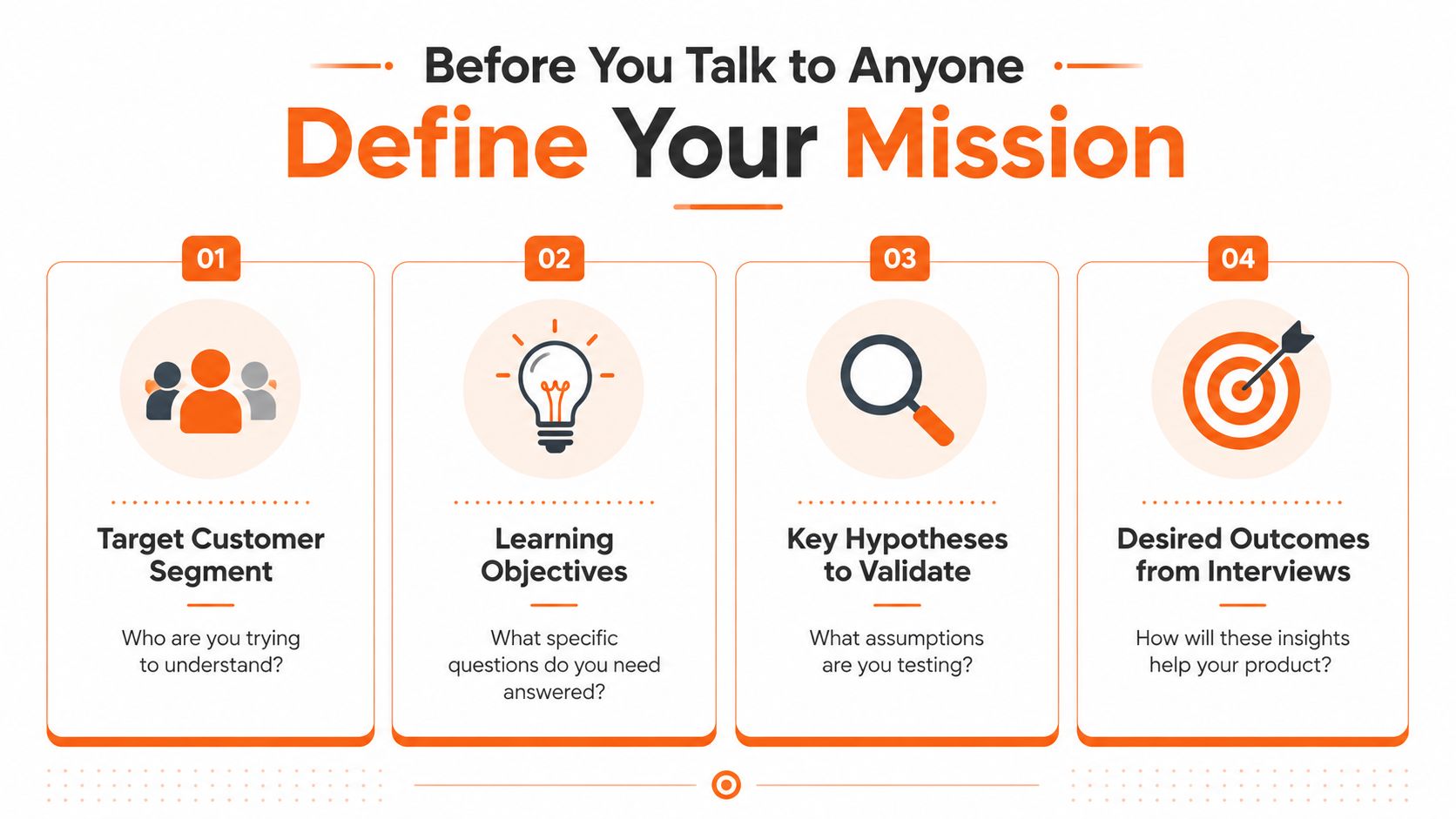
You need only one page. If you can't explain what you're trying to learn on one page, you're not ready to start.
Start with the segment, not the product
Most founders begin with, "I'm building an app that…" Wrong starting point.
Start with who you need to understand. Be painfully specific. "Small businesses" is useless. "Independent coffee shop owners in dense urban areas who handle inventory manually" is usable.
If you need help tightening that definition, read HuntingAlice's guide to defining ICP. It forces you to stop talking about vague audiences and name a real slice of the market. I also like this practical framework for defining your target audience clearly, especially if you're still blending together buyer, user, and influencer.
Build your one-page mission
Your page needs four boxes.
Target customer segment
Write down:
- Job or identity: Who is this person?
- Context: Where do they do this job or behavior?
- Pain area: What problem do you believe they deal with?
- Boundary: Who is explicitly out of scope right now?
That last part matters. If you interview everybody, you'll learn nothing clean.
Learning objectives
Write the questions you need answered, in plain English.
For example:
- Do they experience this problem?
- How do they handle it today?
- Is the current workaround annoying enough to change?
- Who else gets involved when this problem shows up?
Keep it short. If you have twelve learning objectives, you have no priorities.
Hypotheses to validate
Now write your risky beliefs. These are the assumptions that can kill the business if they're wrong.
A simple format works well:
- I believe [segment]
- struggles with [problem]
- often enough that they use [current workaround]
- and care enough to switch if something better exists.
You are not trying to prove your product is smart. You are trying to test whether your assumptions deserve more investment.
A fuzzy idea can survive a tough interview. A fake assumption can't.
Desired outcomes
Decide what counts as a green light, yellow light, or red light before you start talking.
For example:
- Green light: I hear the same painful workflow from multiple people.
- Yellow light: The pain exists, but only for a narrower segment.
- Red light: People shrug, improvise, and don't care enough to change.
Founders love moving the goalposts. If you don't define the signal in advance, you'll interpret every polite conversation as validation.
Standardize the interview before the first call
Your script should stay focused on pain, behavior, and motivation. It should avoid your product completely. That's not my preference. That's the discipline described in Jeff Gothelf's piece on how startups built a customer discovery practice, and I agree with it completely.
No pitching. No demos. No "just to give you some context, let me describe what we're building."
The moment you explain the solution, you contaminate the interview.
How to Find People Who Will Talk to You
Here, advice usually falls apart.
"Go talk to customers" is lazy advice if you don't have customers, don't know anybody, and your LinkedIn network is mostly former coworkers who aren't your buyer.
The hard part isn't writing questions. The hard part is getting strangers to say yes.
One source says 87% of early-stage startups fail to validate assumptions because they can't get enough interviews, not because they ask bad questions. That's from Squadra's article on getting 100 interviews with people you don't know. That tracks with what I see. Scarcity kills discovery way before bad interviewing does.
Use the watering hole method
Don't hunt randomly. Go where people already gather around the problem.
I call these watering holes:
- LinkedIn groups
- niche subreddits
- Slack communities
- Discord servers
- industry newsletters with active comments
- event attendee lists
- trade associations
- vendor webinars where your target audience shows up
You're looking for places where people complain, compare tools, ask for recommendations, or share ugly workarounds.
If you're targeting recruiters, don't search "recruiters." Search for threads about rejected candidates, interview scheduling chaos, and ATS frustrations. If you're targeting ecommerce operators, don't search "ecommerce founders." Search for conversations about returns, inventory mismatches, and ad reporting headaches.
The problem is the magnet.
Write outreach that sounds human
Most cold outreach fails because founders lead with the idea.
Nobody cares about your idea yet.
Lead with their experience. Keep it short. Make the ask small. Remove the pressure to buy. A simple template works:
Subject: quick question about how you handle [problem]
Hi [Name],
I'm speaking with [role/segment] to understand how they currently deal with [specific problem].I'm not selling anything. I just want to learn how people handle it today, what's frustrating, and what workarounds they use.
If you're open, I'd love to ask a few questions in a short call.
Either way, thanks for the work you share on [community/platform/topic].
[Your Name]
No deck. No paragraph about your startup. No breathless mission statement.
Ask for intros without making it weird
Second-degree connections are better than true cold outreach. People are more willing to help than you think, but you need to make the ask easy.
Use a message like this:
- Be specific: "Do you know any operations managers at multi-location clinics?"
- State the purpose: "I'm doing customer discovery interviews and need to understand how they handle patient intake today."
- Lower the burden: "Even one intro would help."
- Give them a forwardable blurb: Write the exact text they can paste.
If you need a good framework for making requests without sounding needy or vague, this guide on how to ask for help in a way people respond to is worth reading.
Build a repeatable pipeline
Treat recruiting like sales. Yes, really.
Keep a simple tracker with:
| Person | Source | Segment | Contacted | Replied | Scheduled | Interview done |
|---|
Once you do that, the process stops feeling mystical. You can see which watering holes produce replies, which segments ignore you, and where your message is weak.
If you're waiting for warm intros only, you'll run out of runway before you run enough interviews.
The founders who get through this phase aren't always the most connected. They're the ones willing to do steady, boring outreach until conversations start compounding.
The Script That Gets People Talking
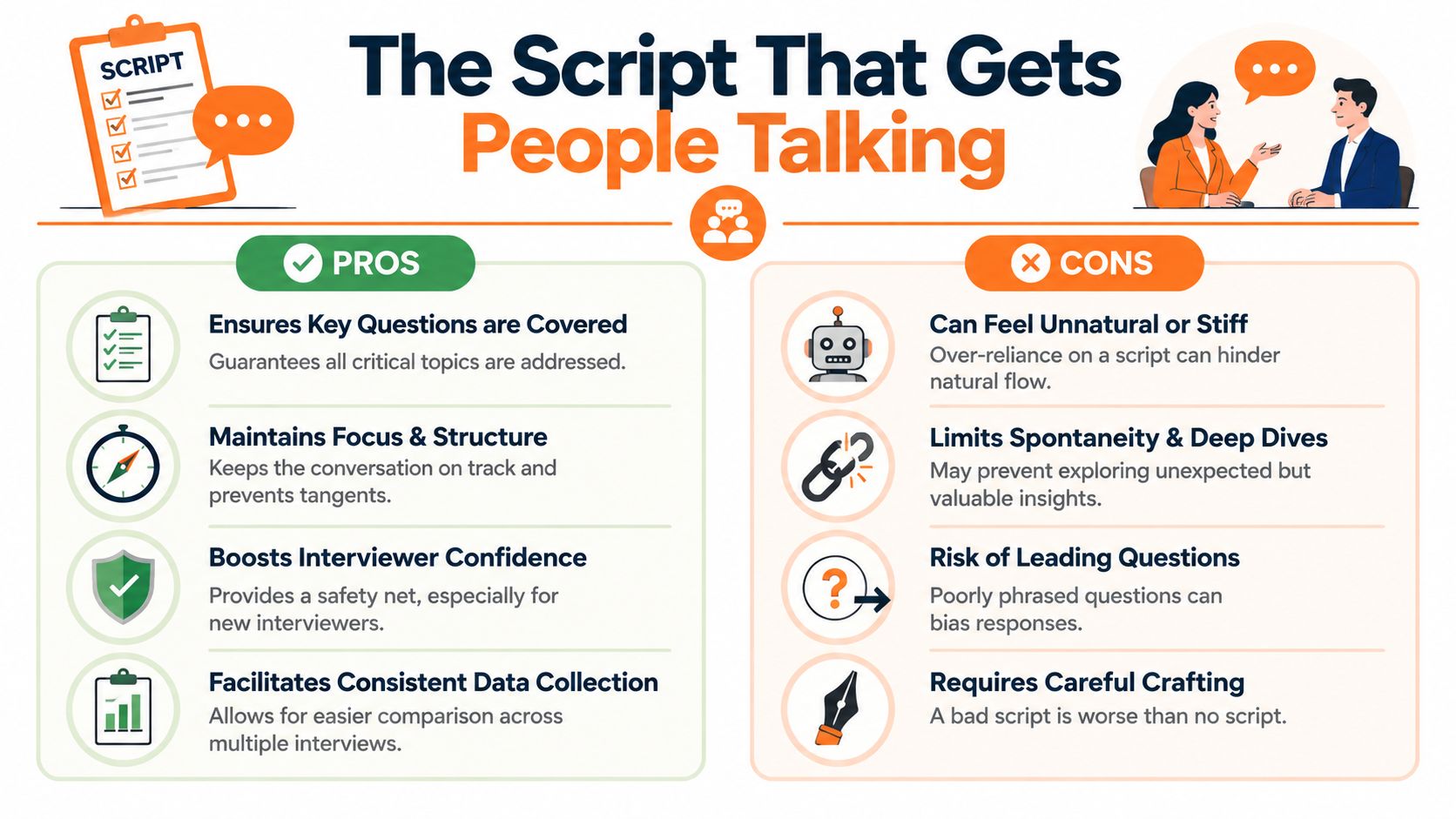
A good script is like guardrails on a mountain road. You can still drive naturally, but you don't fly off the edge.
Most founders either over-script and sound robotic, or they wing it and end up pitching. Both are bad.
Start with a structure, then listen hard.
The question that matters most
The best opening prompt is simple: "Tell me about the last time you [did the thing we are trying to help you with]." That framing comes from CleverX's guide to customer discovery interviews, and it's the right one.
Why it works:
- It pulls people into a real event.
- It avoids vague opinions.
- It exposes actual behavior, not imagined behavior.
- It reveals workarounds, friction, and sequence.
Founders love asking future questions because future questions feel validating.
"Would you use a tool that does X?"
That's junk data. People are generous in theory and ruthless in real life.
Good questions and bad questions
Use this test. If the question invites imagination, approval, or brainstorming, cut it.
| Bad question | Better question |
|---|---|
| Would you use a product that automates this? | Walk me through how you handle this today |
| How much would you pay for a better solution? | What are you using now, and where does it break down? |
| Do you think this problem is big? | What happened the last time this caused trouble? |
| Would this feature help? | What have you already tried? |
A simple script that doesn't sound scripted
I like a loose flow:
Warm-up and frame
Thank them. Tell them you're learning, not selling. Ask permission to record.
Then say something like: "I want to understand how this works in your world today. I won't show you a product."
That sentence relaxes people. It also handcuffs you, which is useful.
Context first
Ask about role, workflow, environment, and who else is involved. You need the map before you can understand the pain.
Specific story second
Move into the "last time" prompt. Stay there longer than feels comfortable. Most of the gold is in the follow-up.
Ask:
- What triggered that?
- What happened next?
- Who got pulled in?
- Where did it get annoying?
- What did you do to fix it?
Shut down your inner salesperson
This is the part nobody teaches well.
The moment someone describes exactly the pain you want to solve, your pulse jumps. You want to say, "That's exactly why I'm building…" Don't.
The second you pitch, the conversation shifts. They stop reporting. They start being polite.
Use a mental script. Mine is blunt: I am here to learn, not sell. If I feel myself leaning in to explain, I ask one more follow-up instead.
"When you hear your dream customer describe the exact problem, that's the moment you need the most discipline."
A few rescue lines help:
- "Say more about that."
- "What made that frustrating?"
- "How often does that happen?"
- "What do you do when that goes wrong?"
- "Why does that matter?"
The SpecStory, Inc. interview templates are useful if you want a starting structure without writing from scratch. Just don't read them like a call center rep.
Here's a solid walkthrough to watch before your first few interviews:
Keep the ratio honest
You should talk less than the other person. A lot less.
If you finish a call and realize you spent most of it explaining your market, your feature, or your theory, that wasn't a customer discovery interview. That was founder therapy.
How to Turn Messy Notes into Clear Signals
You finish six interviews, open your notes, and get hit with a wall of fragments. One person said reporting was slow. Another said the numbers were wrong. A third complained about losing half the day fixing exports. If you treat those as three separate problems, you will build the wrong thing.
Your job now is simple. Turn stories into patterns.
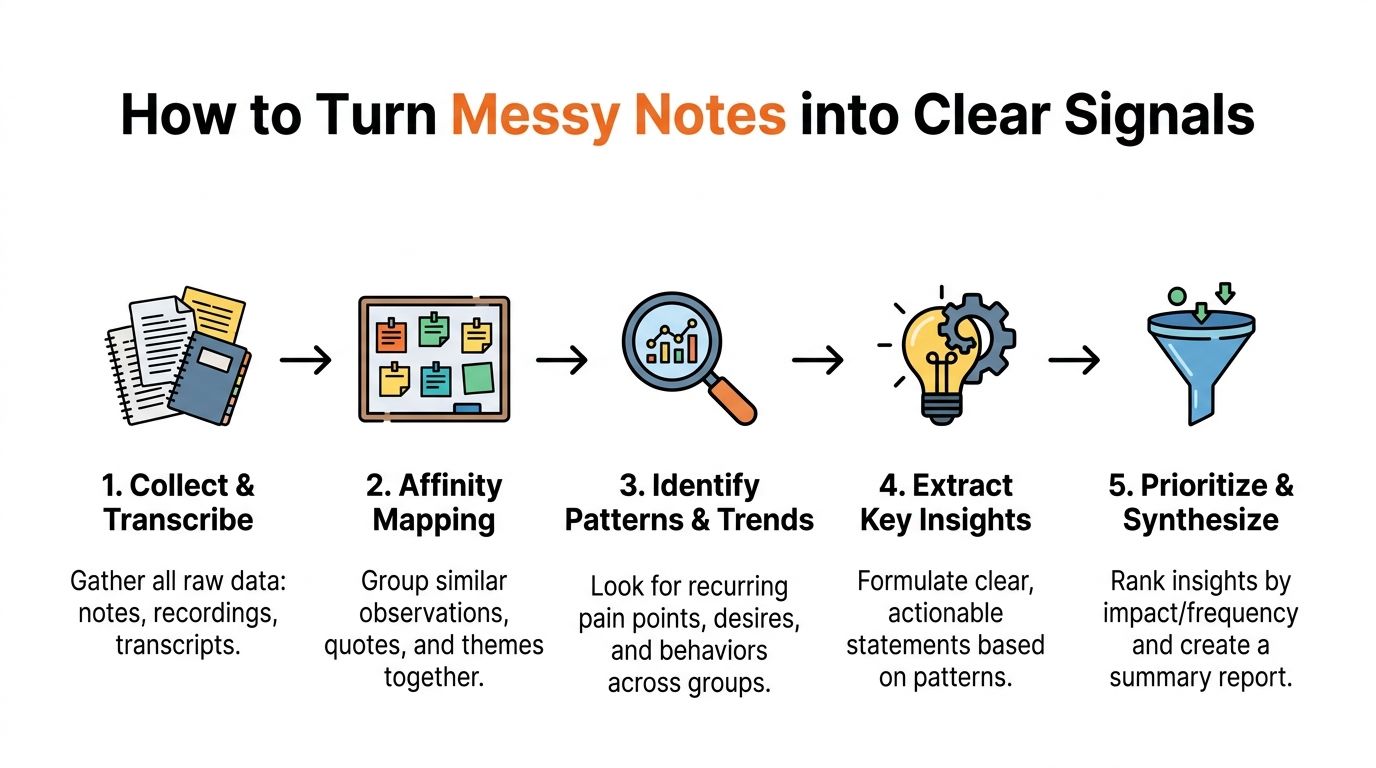
A spreadsheet is enough. Fancy research tools do not save sloppy thinking.
Use one row per interview
Keep one sheet with one interview per row. Force yourself to summarize each conversation the same way, right after the call, while the details are still fresh.
| Name or code | Segment | Trigger event | Main pain | Current workaround | Exact quote | Buying context | Follow-up |
|---|
Two columns matter more than the rest.
Current workaround tells you whether the problem is real. If someone has built a sad little patch with spreadsheets, calendar reminders, interns, or manual exports, the pain has teeth.
Exact quote gives you language you can use. Good founders stop writing copy from their own head and start stealing phrasing from the market.
If you want a clearer framework for turning interview notes into a product decision, this product-market fit validation process lays out the chain from raw feedback to build-or-don't-build calls.
Group the pain, not the wording
Customers rarely hand you clean categories. They hand you messy descriptions.
"Reporting takes forever."
"I lose half my morning reconciling numbers."
"I do not trust the dashboard."
That can be one theme. Slow, unreliable reporting.
Create a second tab for themes. Group repeated pains, common trigger events, failed workarounds, and differences by segment. You are looking for clusters, not clever phrasing.
Do not count every complaint the same way. A vague gripe should not carry the same weight as a detailed story with stakes, frequency, and a visible workaround.
Separate noise from signal
Founders get fooled in two ways.
First, they overvalue compliments. "I would totally use that" belongs in the trash unless the person also described a real problem, a current workaround, and a reason to switch.
Second, they flatten everything into a list of feature requests. That is lazy analysis. Your notes should answer what broke, what it cost, what they tried, and why the current fix still sucks.
Use this test. A strong signal has four parts:
- a specific situation
- a repeated pain
- an existing workaround
- a consequence the customer cares about
Miss one of those, and you probably have interesting chatter, not a product wedge.
Use tools only where they save time
Keep the stack boring.
- Google Meet or Zoom: record the call
- Otter or built-in transcript tools: get searchable text
- Google Form: capture the same summary fields after every call
- Google Sheets: sort by segment, pain, workaround, and urgency
That setup works well because it forces consistency. Random notes create random conclusions.
If you want a practical primer on synthesis, this guide on how to analyze research data is useful because it stays grounded in actual research workflow.
Know what you need to extract
By the end of this process, you should be able to answer these without rambling:
- What job is the customer trying to get done?
- Where does the workflow break?
- What are they doing today instead?
- Who feels the pain and who approves a change?
- Is this problem annoying, expensive, risky, or urgent?
If you cannot answer those cleanly, your interviews were too shallow or your notes are still a mess.
Messy notes are normal. Messy conclusions are expensive.
Your Next Move Deciding What to Build or Scrap
This is the part founders avoid because it demands a real decision.
You did the interviews. You organized the mess. Now you have to decide whether to build, narrow, pivot, or kill the idea.
It's common to drag this out because every idea feels precious. Don't do that. Treat the evidence like a judge treats testimony. Some claims hold up. Some fall apart.
Know when you've heard enough
For early qualitative insight, industry analysis suggests 85% of usability problems show up after just five validated users, which is why 5 to 7 interviews per cohort is a common rule of thumb according to this discussion referencing Jakob Nielsen's user research rule.
That does not mean five interviews total and you're done forever.
It means five to seven can expose early patterns inside one cohort. If you have distinct segments, repeat the process for each one. A buyer at a ten-person company and a buyer at a large enterprise may sound similar on the surface and behave completely differently when money or process gets involved.
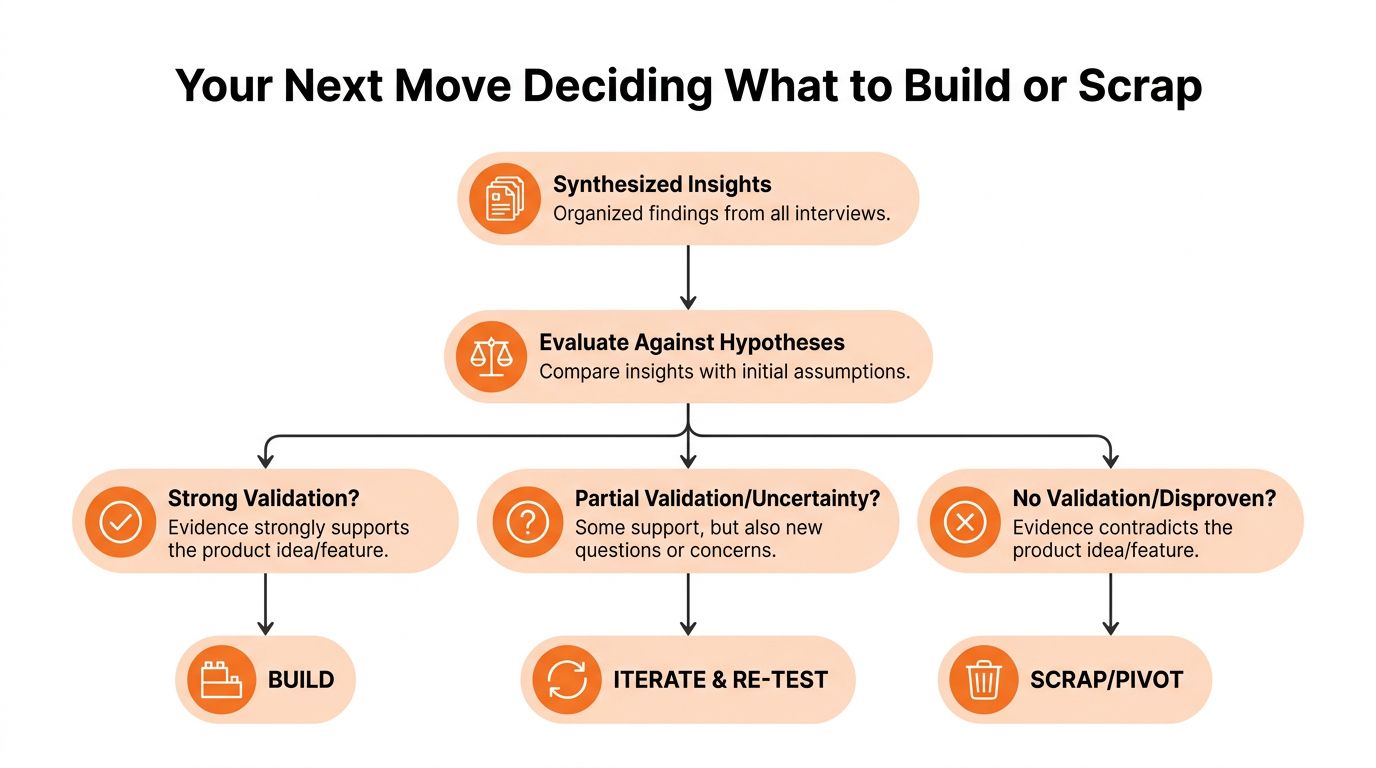
Use a simple decision tree
I like three buckets.
Build
Move forward when you hear a consistent pain point, repeated ugly workarounds, and clear urgency. People don't need to beg you for a product. They need to show you that life already hurts enough without it.
Signs you're in build territory:
- Repeated pain: The same problem keeps showing up.
- Specific examples: People can recall recent incidents fast.
- Existing workaround: They are already stitching together tools, manual steps, or hacks.
- Priority: The problem creates enough friction that change is plausible.
Iterate and re-test
This is the middle bucket. The pain is real, but your segment is too broad, your framing is off, or your original idea only fits a subset.
Most good startups begin here. Not with perfect validation. With sharper focus.
A useful next step is refining the audience, then checking your revised assumptions against a narrower group. If you're in that mode, this guide on product-market fit validation is a practical next read.
Scrap or pivot
Kill the idea when people are polite but unbothered.
That means:
- they don't feel the pain strongly
- they rarely face the issue
- their current workaround is "fine"
- the switch would create more hassle than value
That's not bad news. That's saved time.
Bad discovery feels disappointing. Good discovery is often disappointing too. The difference is that good discovery saves you from building a bad business.
Don't confuse interest with evidence
A founder hears, "Yeah, I'd probably use that," and starts roadmap planning.
Ignore that. Interest is cheap. Behavior is expensive.
Build from repeated evidence. Scrap from repeated indifference. Narrow when the pattern is there but the segment is wrong.
That is the game.
If you're a kind, ambitious founder in Chicago or the Midwest and you want a room full of real operators to pressure-test your idea before you waste months building the wrong thing, check out Chicago Brandstarters. It's a free vetted community for people building from idea stage through seven figures, with small private dinners and honest conversations that cut through the usual networking nonsense.
Leave a Reply