
Most go-to-market advice for startups is bloated, late, and too expensive for the stage you're in.
You do not need a polished deck, a giant funnel map, or six acquisition channels before you've talked to real buyers. You need a sharp guess, a cheap test, and the nerve to hear “no” without rewriting your entire identity around it. That's the playbook I trust.
I've spent enough time around early founders to know this: the prettiest GTM doc usually hides the weakest customer truth. The founders who learn fastest don't act like generals planning a war from a hilltop. They act like street vendors. They try an angle, watch who stops, change the pitch, and keep going.
Your First Go-to-Market Strategy Will Be Wrong (And That's Okay)
Most founders think a go-to-market strategy for startups should look like a miniature corporate plan. That's backward. Your first version is a rough sketch. It is not a legal contract with the universe.
A lot of GTM content misses the reality of tiny teams. One source notes that existing GTM resources mostly aim at B2B tech or national ecommerce, while a gap remains for solo founders and pre-prototype builders without a sales team, formal marketing budget, or established product. It also says this affects 72% of aspiring Midwestern founders at the idea stage and describes GTM as “the least understood part of the startup business plan” because too many guides treat it like a static document instead of a live experiment cycle in peer networks, dinner events, and group chats (Harvard Business School Online blog).
That rings true. The first GTM plan you write is like a treasure map you drew before seeing the island. Useful, yes. Accurate, no.
Treat your GTM like a stack of bets
I like to reduce the whole thing to five guesses:
- Customer guess: Who feels this pain badly enough to care now?
- Problem guess: What job are they trying to get done?
- Offer guess: What simple thing can you sell or test first?
- Channel guess: Where can you reach them without burning cash?
- Economics guess: Can this ever make money, or are you buying fake traction?
If you frame your plan this way, you stop worshipping the document and start testing the assumptions.
Practical rule: Your first GTM plan is good if it helps you learn fast. It is bad if it helps you procrastinate in a prettier font.
When I want a simple outside reference to compare my thinking against, I'll skim the EmailScout guide to market entry. Not because you need another framework. Because sometimes a clean checklist helps you spot the hole in your own thinking.
Your job is feedback, not certainty
The pressure to “get it right” ruins a lot of good founders. They wait too long. They polish messaging before they've earned the right to polish it.
You'll get more truth from a few honest conversations than from a week of spreadsheet theater. If you need a place to sharpen that instinct, read this piece on product-market fit validation. Keep it simple. Talk to people. Make a claim. Watch where they lean in and where they tune out.
A startup GTM is not a cathedral. It's a folding table at a street fair. Set it up. See who walks over.
Who Are You Actually Building This For
If you can't name your buyer in one sentence, your go-to-market strategy for startups is still mush.
Most founders start too wide. “Small businesses.” “Busy moms.” “Creators.” That's not a customer. That's a crowd. You don't need a crowd yet. You need one person at the party who hears your pitch and says, “Wait, that's for me.”
This visual helps clean up the layers.
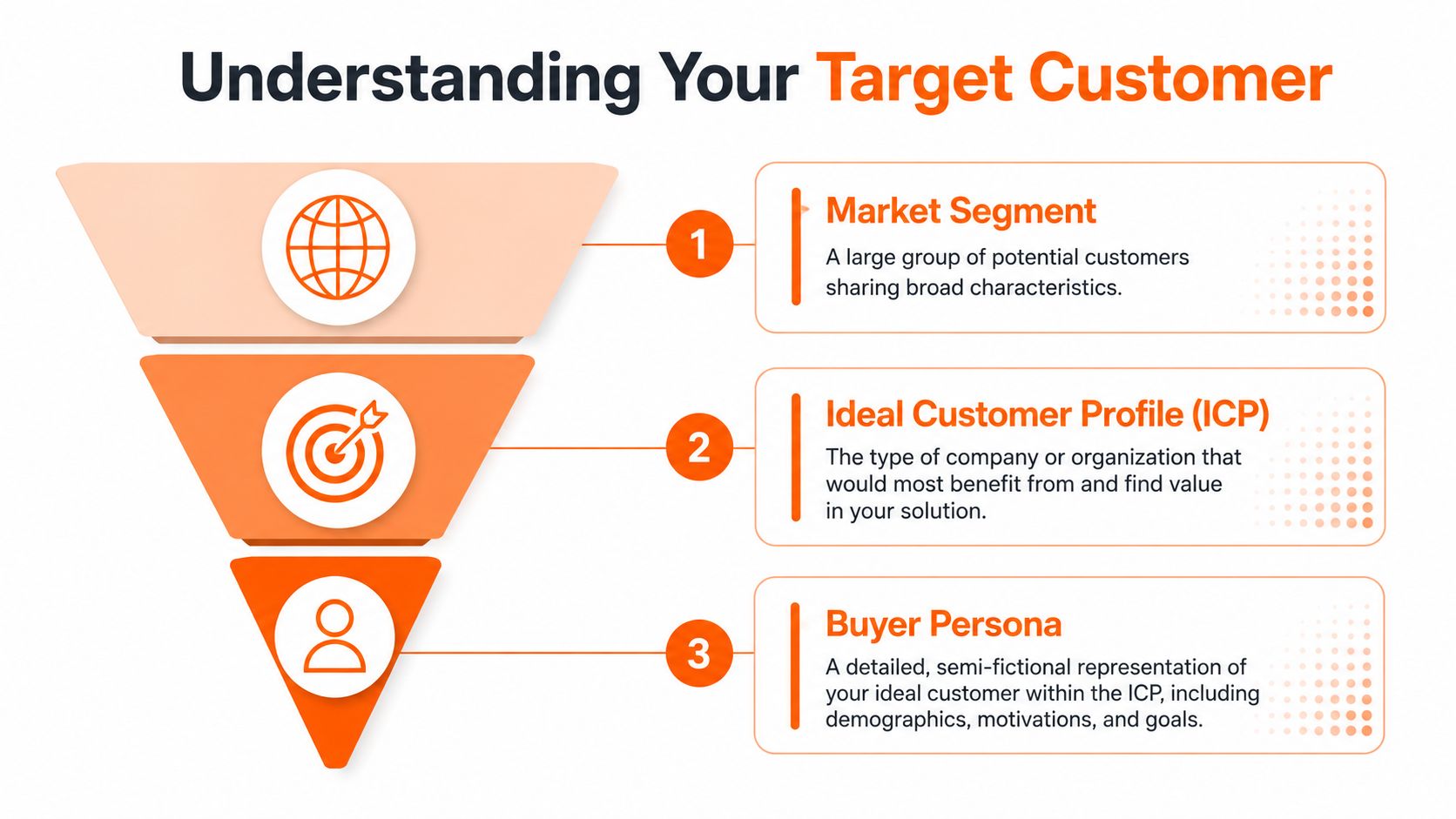
A lot of founders chase scale before they validate the buyer. That's upside down. Data cited in startup strategy literature says about 65% of startups fail within ten years, 20% in the first year, and 50% within five years. The same source argues that the primary early-stage constraint is validation, not scale, and that founders need to confirm the Ideal Customer Profile, or ICP, before spending on channels, headcount, or tools (Lean Labs on startup GTM).
Think party, not parade
Your ICP is not everyone who could buy. It's the person most likely to buy first.
At a crowded party, you do not grab a microphone and shout your life story. You scan the room for the one person who clearly has the problem you solve. Then you start a direct conversation.
That's how I want you to think about customer definition.
Build a proto-ICP in plain English
Start with a rough draft. No fancy persona deck. No made-up names like “Marketing Mary.”
Answer these:
- What is breaking for them right now: What pain wastes time, money, or attention?
- Who feels that pain first: Founder, operator, manager, buyer, parent, student?
- What are they already trying: Spreadsheets, DMs, agencies, manual work, workarounds?
- Where do they already gather: Slack groups, Reddit, neighborhood events, niche newsletters, local shops?
- Why would they act now: New job, new regulation, new season, social pressure, lost sales, rising costs?
Now turn that into one sentence.
I help [specific person] who is dealing with [specific painful problem] and is already trying [current workaround].
That's enough to start.
If your ICP sentence sounds broad enough to fit thousands of different buyers, it's too vague to test.
If you want a better way to pressure-test those guesses, use customer discovery interviews. Ask open questions. Listen for repeated words. Buyers hand you your copy if you stop trying to impress them.
A short explainer can help if this still feels fuzzy.
A fast gut check
Use this table before you move on.
| Your draft | Keep going if… | Fix it if… |
|---|---|---|
| Customer | You can picture a real person | You used a giant category |
| Problem | It hurts enough to matter now | It sounds “nice to have” |
| Urgency | You know why they'd act soon | You need to invent urgency |
| Reachability | You know where to find them | You'd need broad ads to locate them |
I'd rather see you target one narrow pocket of demand than spray weak messaging across a broad market. Precision feels small at first. It usually saves you.
Your Message and Your Offer
Once you know who you're talking to, stop trying to sound smart. Start trying to sound clear.
Founders love clever copy. Buyers love instant understanding. Those are not the same thing.
I've watched good products die behind vague language like “enabling creators” or “redefining modern wellness.” Nobody wakes up looking for that. People wake up wanting a problem gone.
Use this value proposition template
Write this sentence:
For [ICP], who struggles with [problem], our product is a [category] that provides [benefit]. Unlike [alternative], we [differentiator].
That's it. Simple beats stylish.
Here's a non-tech example.
For busy parents who struggle to pack healthy school lunches fast, our product is a weekly pre-portioned lunch kit that cuts weekday prep stress. Unlike generic meal prep subscriptions, we build every box around kid-approved, lunchbox-safe portions.
That message works because it is specific. You can see the buyer. You can feel the pain. You can compare the alternative.
Clarity beats cleverness
One GTM framework I like for this stage is the ARISE® methodology from Paul Sullivan's 2025 book Go-To-Market Uncovered. It breaks the process into Assess, Research, Ideate, Strategise, Execute and ties messaging work to testing, including A/B testing and focus groups to refine the value proposition around customer outcomes (ARISE GTM methodology).
That matters because your first message is a draft too. You shouldn't marry it. You should run it.
Try three message angles:
- Pain-first angle: Lead with what's broken now.
- Outcome-first angle: Lead with what life looks like after the fix.
- Difference-first angle: Lead with why your approach beats the default option.
Then put those angles in front of real people. A landing page. A cold DM. A local event pitch. A simple signup form. You're not hunting for applause. You're watching for comprehension.
Buyers don't reward originality first. They reward clarity first.
Tighten the offer until it feels easy to say yes
Bad offers are bloated. Good offers make a small promise and keep it.
I usually pressure-test an offer with these questions:
- Can I explain it in one breath?
- Can the buyer tell what happens next?
- Does it solve one painful thing well?
- Would someone buy this before I build the full dream version?
If the answer to any of those is no, the offer is still too foggy.
A lot of founders want to sell the whole vision. I get it. The vision is fun. But early buyers don't fund your imagination. They fund relief. Sell relief first.
A quick rewrite exercise
Take a weak line like this:
We help modern brands enhance customer experience through thoughtful product innovation.
Now rewrite it:
“We help first-time candle founders create small-batch packaging that looks giftable without ordering huge minimums.”
One sounds like a conference panel. The other sounds buyable.
Choosing Channels and Testing Your Bets
Most founders spread themselves thin because being everywhere feels productive. It isn't. It's camouflage for fear.
If you're early, pick one or two channels. Learn them hard. That focus gives you signal. Too many channels give you noise.
I think about channels like fishing. You'll catch more by learning one lake well than by dropping one line into ten lakes you don't understand.
Start with channels that talk back
Here's the kind of channel I like early:
- Private communities: Slack groups, Discord servers, group chats, alumni circles
- Local rooms: meetups, dinners, trade events, pop-ups
- Direct outreach: email, LinkedIn, Instagram DMs, personal intros
- Search intent pages: one focused landing page tied to one problem
- Small paid tests: only after your message makes sense in direct conversations
This infographic captures the tradeoff well.
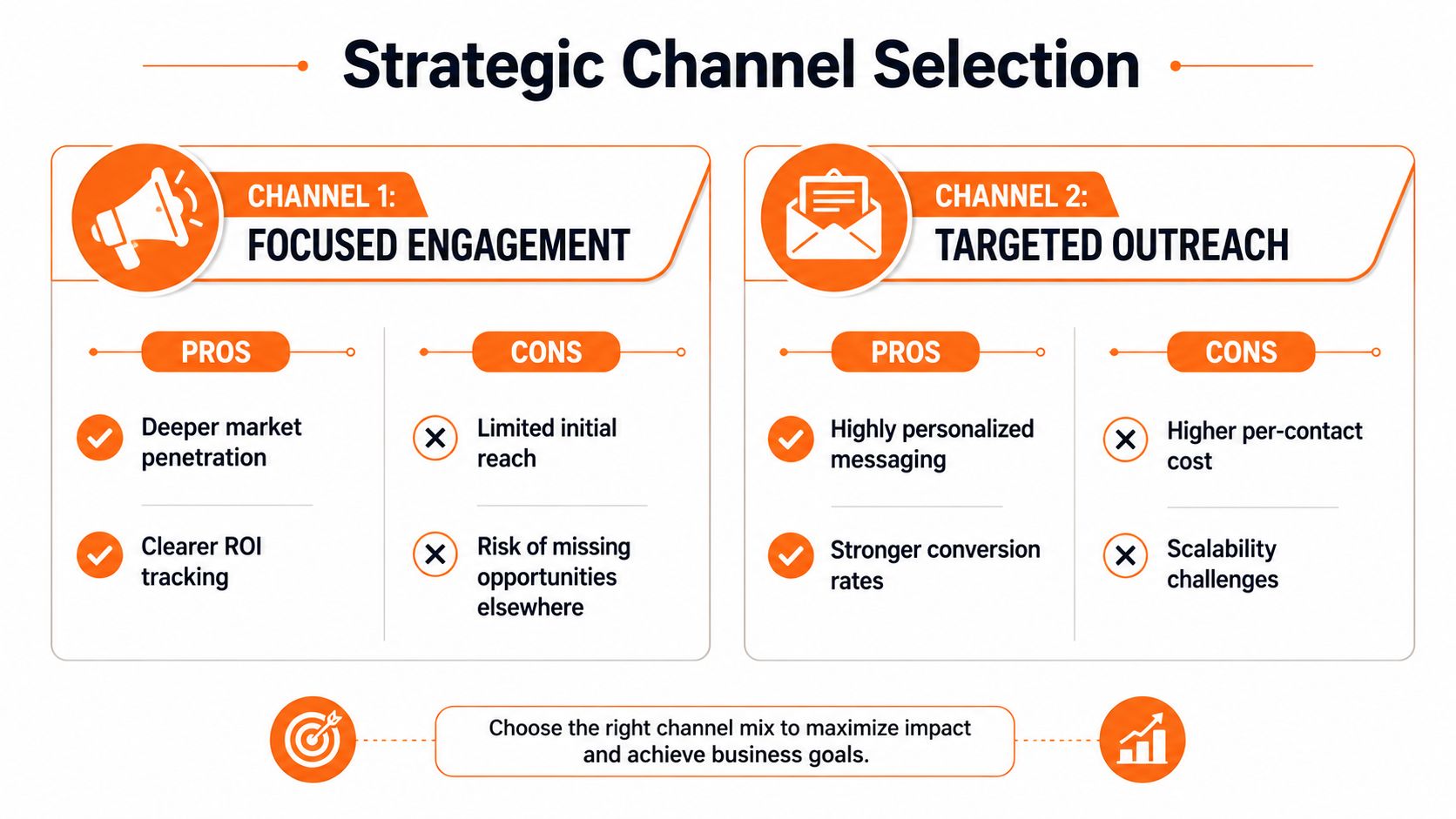
One benchmark I take seriously says startups should run small tests, like a $500 test campaign, before spending heavily. The same source says that discipline can prevent $50,000 mistakes by forcing CAC limits and creativity in channel selection (FullFunnel on why GTM fails).
That's the whole point. Cheap tests buy expensive lessons for less.
A simple way to pick your first two channels
Use this filter:
| Question | Good sign | Bad sign |
|---|---|---|
| Can you reach buyers directly | You can message or meet them | You need mass awareness first |
| Will they reply fast | You can get feedback this week | You may wait months |
| Can you test messaging easily | You can swap copy and offers quickly | Every change needs a full campaign |
| Can you afford the experiment | The test is cheap | The test burns runway |
If a channel scores well on speed, feedback, and cost, it belongs in your first batch.
Run tiny tests with real goals
Let's say you sell a premium organizer for craft fair vendors. Don't launch on every platform. Start with two bets:
- Bet one: message local vendor groups with a pain-first offer
- Bet two: run a tiny paid test to one narrow audience after direct outreach teaches you the right language
If you want a clean way to think about channel planning after you've done that founder-led work, I'd look at AdStellar's strategy framework. Use it to structure the test. Don't use it to skip the test.
Track one success signal per channel. Keep it plain:
- Replies
- Calls booked
- Qualified interest
- Preorders
- Deposits
- First sales
My rule: If a channel gives weak feedback and slow learning, I kill it fast.
The early game is not reach. It's learning velocity. Go where buyers answer back.
Pricing, Economics, and Your Launch Plan
A lot of founders avoid pricing because it feels awkward. That's a mistake. Pricing is not a final declaration. It is another hypothesis.
You need to know one thing early. If you spend money to get a customer, does enough money come back?
The easiest way to think about it is dollar in, dollars out. If you spend one dollar to acquire a customer, your business needs to earn enough back over time to make that math worth repeating.
Know your unit economics before you get cute
For a sustainable model, your LTV:CAC ratio should be 3:1 or higher. In plain English, each customer should generate at least three times what it cost you to acquire them. If it's lower, your channel or message is probably draining you before scale even starts (GoElastic on startup GTM economics).
That doesn't mean your first tiny test must be perfect. It means you should not ignore the math because a campaign “looked promising.”
Many early founders deceive themselves. They celebrate clicks, nice comments, and email signups. Then they realize they bought attention, not customers.
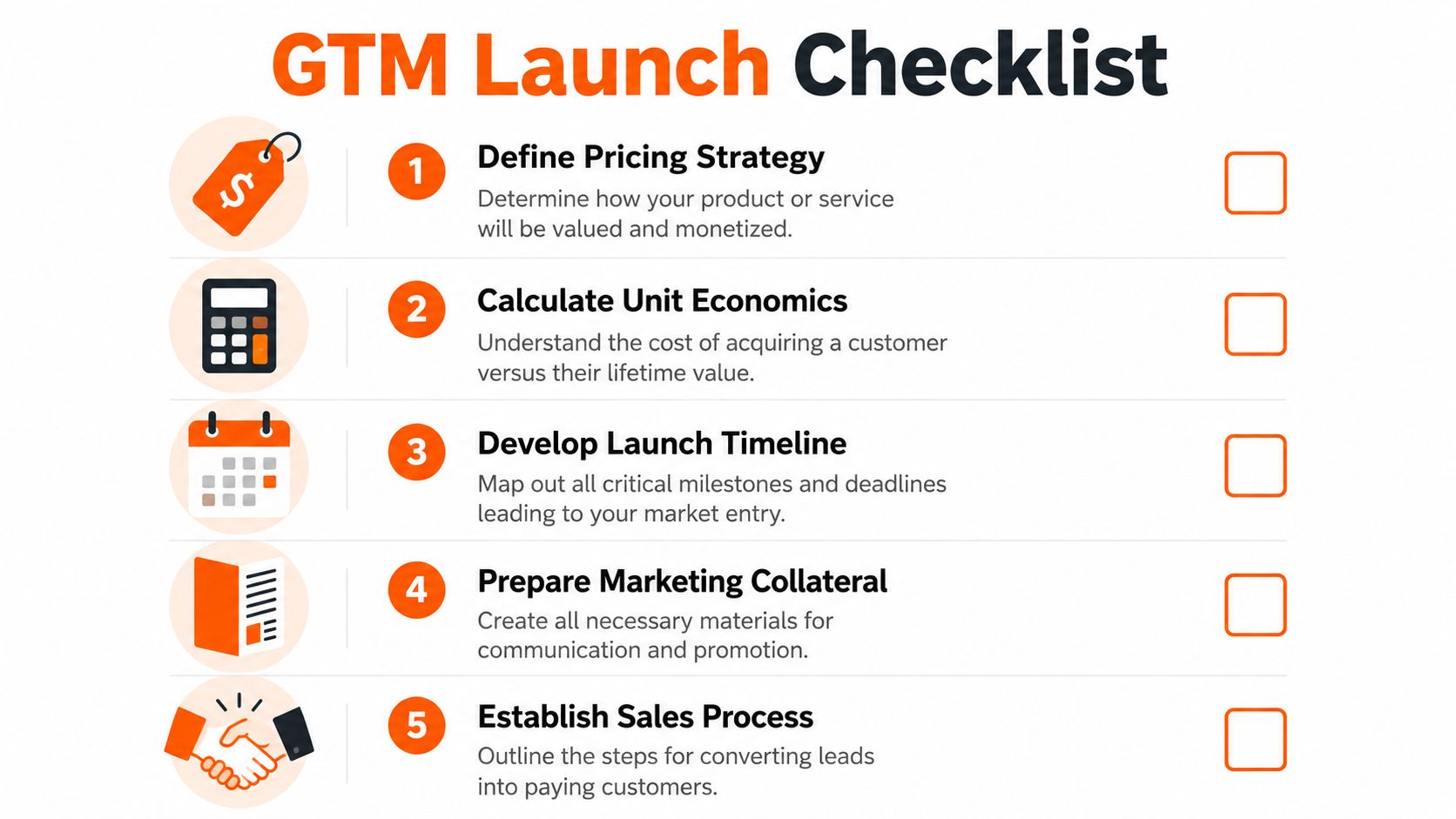
Here's the checklist I use before launch.
My minimum viable launch checklist
- A price you can say out loud: No “contact us” unless your sale requires it.
- One clear offer: One product, one service, or one paid pilot.
- One page to send people: A landing page, checkout page, or even a tight Notion page.
- One way to collect interest or payment: Stripe, Shopify, Gumroad, Typeform, whatever fits.
- One outreach script: Email, DM, in-person pitch. Keep it short.
- One feedback loop: A call, survey, or post-purchase question.
- One sales path: What happens from first contact to paid customer?
That's enough to launch and learn.
Price earlier than feels comfortable
Most founders price too low because they want an easy yes. Cheap can help in some cases, but cheap also muddies the signal. People often say yes to low prices for the wrong reasons.
Use early pricing to test perceived value. If buyers flinch, ask why. If they buy fast, ask what they expected to pay. If you need help thinking through your first version, this guide on pricing strategy for new products is a useful gut check.
I also tell founders this: don't start hunting investors to rescue a weak GTM. Fix the GTM first. If you later need a map of the funding world, you can discover venture capital investors after you've got a cleaner story. Money doesn't repair confused demand.
Your launch is not a Broadway opening night. It's a controlled test with a checkout button.
Ship the minimum. Learn from the first buyers. Then improve what they care about.
Common Pitfalls and How I Have Dodged Them
I've messed up GTM in the same boring ways most founders do. I've fallen in love with the product. I've chased channels because they sounded sexy. I've ignored ugly economics because I wanted momentum to be real.
Those mistakes taught me more than any polished framework ever did.
A smart corrective is to pick a beachhead market inside your Serviceable Obtainable Market, or SOM, and use that to get first revenue before you broaden. One guide makes that case directly and ties it to TAM, SAM, and SOM work grounded in who you sell to, what you sell, how you reach them, and how you make money (ClimateHaven on beachhead markets).
Here are the traps I see most.
I built for myself instead of the buyer
I once got excited about a product detail buyers barely cared about. I kept polishing it because I liked it. Sales conversations kept drifting back to a completely different pain point.
My fix was blunt. I stopped pitching features and asked every prospect what they were doing now, what annoyed them most, and what they'd already tried. Their answers rewrote the offer.
Recovery tactic: Ask better questions before you add more product.
I chased too many channels
I've done the founder panic move. LinkedIn one day, Meta ads the next, then events, then partnerships. It felt busy. It was sloppy.
The fix was to cut back to two channels and track actual buyer response. Once I focused, patterns got obvious fast.
Recovery tactic: Kill channels that don't produce fast learning.
Early GTM failure often looks like activity. It rarely looks like honesty.
I accepted bad economics because the top of funnel looked good
A campaign can look healthy and still be poison. I've seen strong click volume hide weak buyer intent. That kind of traction flatters your ego and drains your cash.
The fix was simple. I tracked what happened after the click. If buyers didn't move toward revenue, I stopped counting the channel as a win.
Recovery tactic: Follow the money, not the vanity.
I waited too long to talk to people directly
This one is common because it stings. Founders avoid outreach because rejection feels personal. But silence is more expensive than rejection.
The fix was to make direct contact a routine, not a referendum on my self-worth. A few honest calls gave me better direction than endless internal debate.
Recovery tactic: Put outreach on the calendar before inspiration shows up.
If you're building in Chicago or the Midwest and want honest feedback from founders who share what's working and what's breaking, join Chicago Brandstarters. It's a free community for kind, bold builders who want real war stories, small private dinners, and practical help from idea stage through growth.
Leave a Reply