

You're probably doing what most founders do at this stage. You've got a Figma file open, a half-built prototype, a notes app full of feature ideas, and a quiet belief that if you just keep pushing, the market will eventually reward you.
I get it. Building feels productive. Talking to customers can feel slow, awkward, and messy.
But product market fit validation is where founders stop playing startup and start doing the actual job. If you skip it, you're driving at night with the headlights off. You might move fast. You're still guessing.
Are You Building Something Nobody Wants
I've seen this movie too many times. A smart founder disappears for months, comes back with a polished product, gets a few polite compliments, and then hits the wall. Nobody buys fast enough. Users don't come back. The founder starts tweaking copy, pricing, onboarding, branding, anything except the actual issue.
The core issue is usually simple. They built from assumption, not evidence.
That trap is common because building gives you emotional relief. A new feature feels like progress. A customer interview can feel like exposure. You might hear that your big idea isn't painful enough, urgent enough, or worth paying for. So a lot of founders hide in execution.
That's expensive avoidance.

Why this goes wrong so often
A lot of founders confuse interest with demand. Someone says, “Cool idea,” and you hear, “I need this now.” Those are not the same thing. One is a compliment. The other is a buying signal.
If you want a fast gut check before you burn more time, read this guide to pre-launch market research. It's useful because it pushes you back toward evidence instead of wishful thinking.
And the stakes are real. 42% of startups fail because they build products nobody wants, according to VivaTech's write-up on testing product market fit.
Don't treat validation like a box to check before launch. Treat it like rent. You keep paying it or you lose the business.
The founder lie you need to stop telling yourself
The lie is, “I know my customer because I am the customer,” or “I already talked to a few people.”
That's not enough. Your experience might give you a starting point. It does not give you a market. A few friendly chats do not give you signal either. Early-stage founders can talk themselves into almost anything if the sample is tiny and the feedback is vague.
Here's the hard truth. If you can't clearly explain who has the problem, how they solve it now, why current options annoy them, and what would make them switch, then you're not validating. You're hoping.
Hope is fine for morale. It's terrible for product decisions.
Stop Building and Start Asking Questions
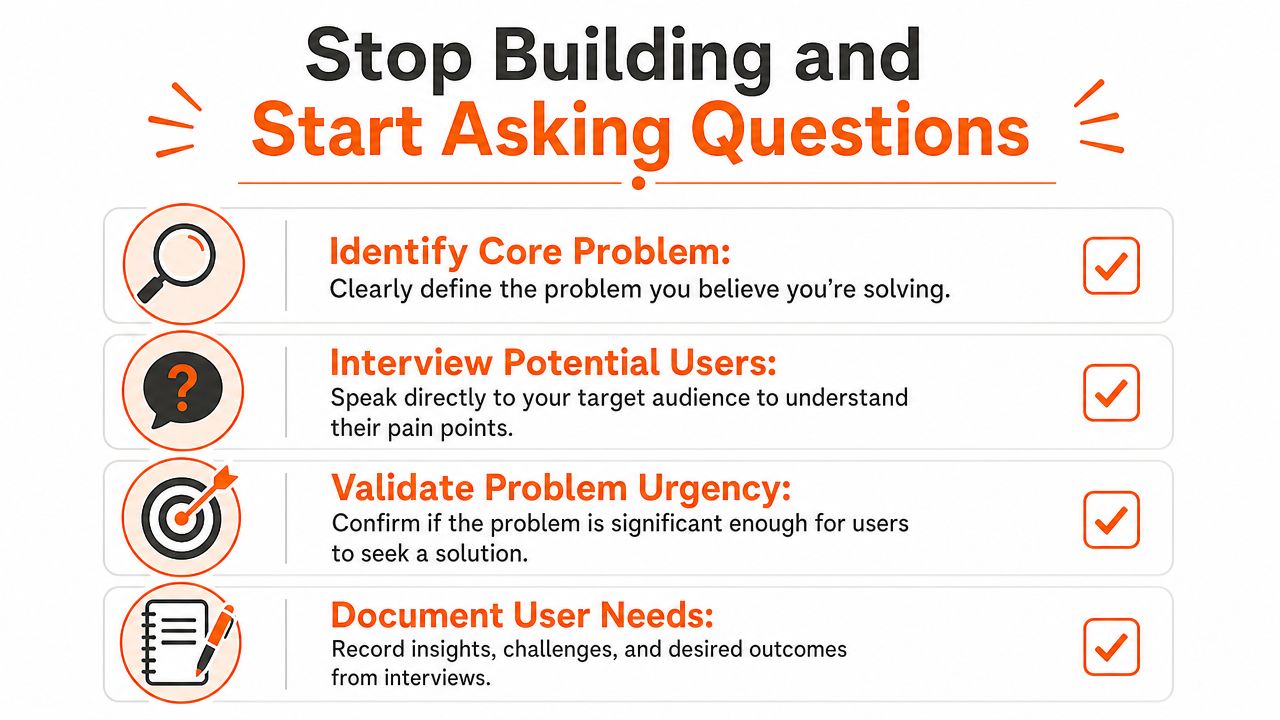
Put the roadmap down for a minute. Before you write another line of code, I want you to do something less comfortable and more useful. Get on the phone.
The best early product market fit validation I know is brutally simple. Secure 30 phone meetings with decision-makers and ask them five questions about the problem, according to First Round's interview with Michael Sippey. Not random people. Not your startup friends. The actual buyer.
Your only job in these calls
Listen harder than you want to.
You're not there to pitch your brilliance. You're there to find out whether the problem is sharp enough to make someone change behavior. That's the bar. If the pain doesn't change behavior, it usually won't create a business.
Ask these five questions:
- Do they face the problem
- How acute is it
- How do they solve it today
- How much do they spend
- How does it impact their business
That framework sounds basic. Good. Early-stage founders usually need basic more than clever.
How I'd run the process
Start with a narrow customer profile. Don't say “small businesses.” Say “operations managers at specialty food brands” or “heads of customer success at B2B SaaS companies with small teams.” Narrow gets you truth. Broad gets you blur.
Then do this:
- Build a list: Pull names from LinkedIn, your network, Slack groups, industry directories, and warm intros.
- Write a short outreach note: Keep it plain. You're researching a problem, not selling software.
- Track patterns, not one-off comments: One person's complaint is noise. Repeated phrasing is gold.
- Record exact language: Their words should shape your landing page, pitch, and product copy later.
If you need help structuring outreach and follow-up, these practical steps for gathering feedback are worth your time. For a wider view of how to collect and compare early signal, I also like this roundup of market research methods.
Practical rule: If you leave the call having talked more than the buyer, you wasted the call.
What good interviews sound like
Good interviews are specific and a little uncomfortable. The buyer says things like, “We patch this with spreadsheets,” or “This breaks every month-end,” or “I have to chase three people to get this done.” That's real.
Bad interviews are fluffy. “Yeah, I'd probably use that.” “Interesting concept.” “Keep me posted.” Founders love hearing this because it sounds positive. It usually means nothing.
I'd rather hear, “We have this problem, but it's not painful enough to switch.” At least that gives you something honest to work with.
Run Cheap Experiments for Real Answers
Once you've heard the pain directly, don't rush into full product mode. Test the solution with cheap experiments first. You're trying to buy signal, not build a monument.
I like three scrappy moves here. A survey, a landing page test, and a concierge MVP. Each one answers a different question.
Compare the fastest validation options
| Method | Best for | What it tells you | Main weakness |
|---|---|---|---|
| Survey | Sharpening the problem and message | What people dislike, what feels broken, what they want fixed | People are generous with opinions |
| Landing page test | Testing demand for a clear promise | Whether people take an action when the offer is framed well | Clicks can overstate intent |
| Concierge MVP | Testing delivery by hand | Whether people will trust you to solve the problem in real life | It doesn't scale, and that's fine |
Start with a survey if your message is still fuzzy
A survey is good when you need to sort your assumptions before you spend more time. Keep it short. Ask about pain, current workarounds, and what still feels broken. Don't ask, “What do you love?” Ask what annoys them, what slows them down, and where current tools fail.
That's not just my preference. Eleken's guide to product market fit makes the same point clearly. Survey questions should focus on what's wrong or what could be improved, because you're testing your value hypothesis.
For example, if you're testing a snack subscription brand, don't ask, “Would you buy healthy snacks online?” Ask, “What's frustrating about how you buy snacks now?” You'll learn more from irritation than from praise.
Use a landing page when you need behavioral signal
A good landing page test is a fake storefront for demand. You describe the outcome, show who it's for, and ask the visitor to do something with a little friction. Join a waitlist. Request a demo. Start a preorder flow. Anything that asks for more than a casual nod.
This works well for software and physical products. A B2B SaaS founder can test a page aimed at finance teams buried in manual reporting. An ecommerce founder can test three different product angles before paying for inventory.
If you want a clean walkthrough of that style of test, I like Otter A/B's guide to idea validation. And if you want examples of how founders turn rough ideas into fast tests, this page on a product MVP example is a good companion.
A landing page is a movie trailer. It doesn't prove the movie is good. It proves whether people care enough to watch.
Use a concierge MVP when the problem is messy
This is my favorite for early truth. A concierge MVP means you do the work manually before you automate anything.
Say you want to build software that helps wholesale brands predict low stock and reorder timing. Don't build dashboards first. Offer a manual service. Ask a few brands to send you their sales and inventory exports. Then send back a simple recommendation report every week. Maybe you do it in Google Sheets. Maybe you use Airtable. Doesn't matter.
If customers act on the output, keep asking for it, and trust you with more work, that's strong signal.
My rule of thumb
Use the experiment that answers your biggest uncertainty.
- If you don't understand the pain well enough: run interviews and a short survey.
- If you understand the pain but doubt demand: build a landing page.
- If people want the outcome but you don't know if your solution works: run a concierge MVP.
Most founders pick the experiment they enjoy most. Don't do that. Pick the one that kills the riskiest assumption fastest.
The Only Metrics That Actually Matter
You spend a week driving traffic to a landing page. Sign-ups come in. A few people tell you the idea is smart. Slack feels optimistic for a day. Then nobody comes back, nobody pays, and you are left with the number that mattered from the start. Did you build something people would hate to lose?
That is the filter I use.
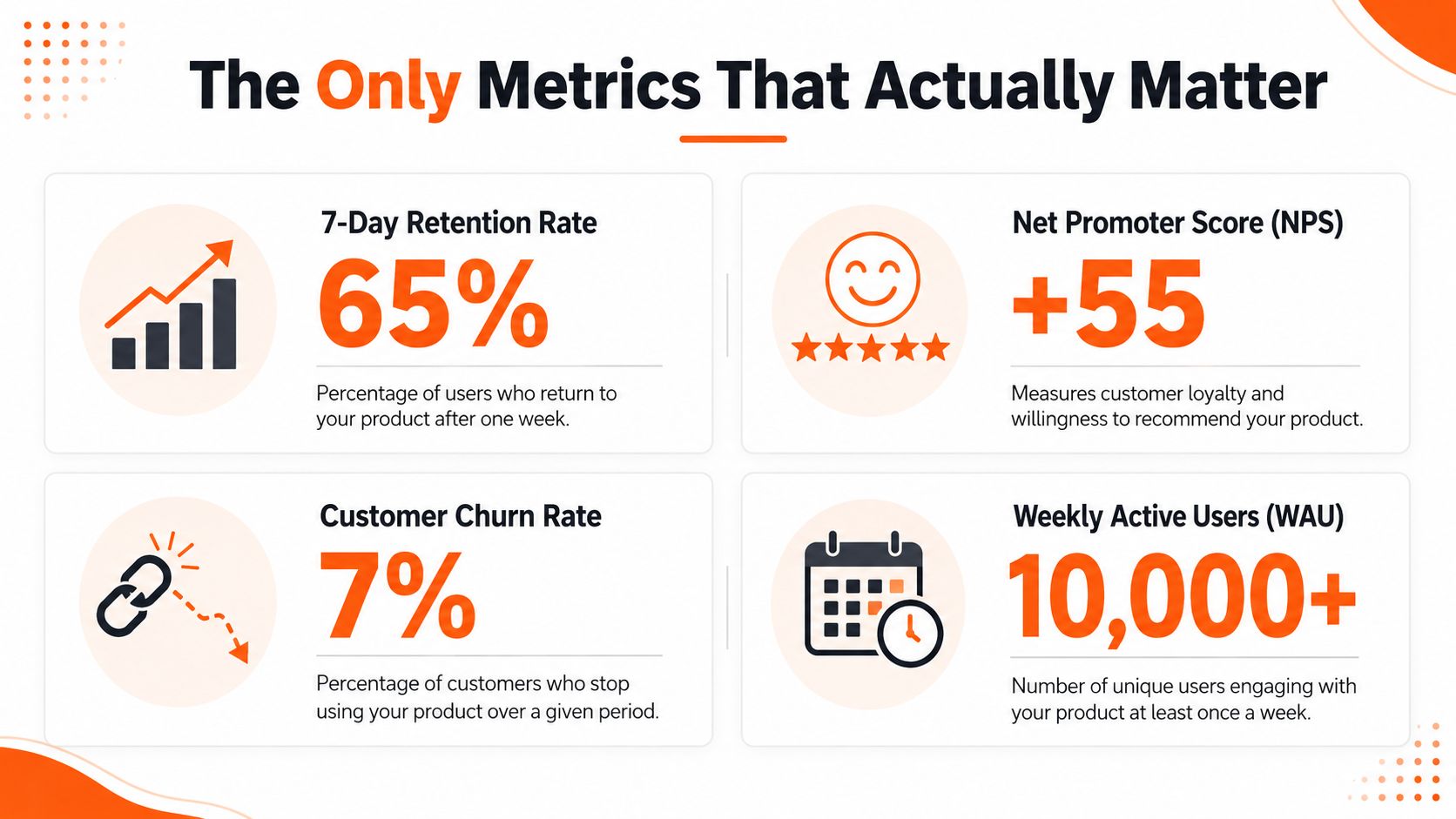
The Sean Ellis Test asks users, “How would you feel if you could no longer use this product?” If over 40% answer “very disappointed,” you are getting close to product market fit, based on Qubit Capital's explanation of the benchmark.
Why I trust this question
Founders get lied to early. Not because customers are malicious. Because people want to be nice, and nice feedback can waste six months of your life.
“Very disappointed” is different. It points to dependence. Your product solved something painful enough that losing it would create real friction, missed work, stress, or lost money.
That is the standard.
If you are working with early users at an early-stage company, this question helps you separate curiosity from pull fast. I have found it far more useful than a pile of surface-level compliments.
The supporting numbers I watch
I keep the dashboard small because bloated dashboards protect your feelings.
Here are the numbers worth checking:
- Retention: Do users come back without being chased? Retention is the clearest proof that the problem matters and your product fits into real behavior.
- Churn: If customers leave fast, your value is weak, your audience is wrong, or your onboarding is broken. Salesforce's product market fit benchmarks are a useful reference point for churn, NPS, and LTV:CAC ranges.
- NPS: I do not treat this as gospel, but high scores can confirm that users get clear value and are willing to recommend you.
- LTV to CAC: If it costs too much to acquire customers compared with what they are worth, you do not have a business yet. You have a hobby with invoices.
That is enough.
You do not need twenty charts. You need a few numbers that force you to tell the truth.
What I ignore early on
I ignore any metric that makes you feel progress without proving demand or stickiness.
A short blacklist:
- Raw traffic: Traffic measures attention. Attention is cheap.
- Top-of-funnel sign-ups: Low-commitment actions create fake confidence.
- Social engagement: Likes and shares do not fix a painful problem.
- Praise from non-buyers: Feedback from people outside your target customer can pull you off course fast.
If users say they love the product but do not come back, trust behavior over compliments.
Product market fit validation is a fight against self-deception. Use metrics that expose the truth, even when the information is unwelcome.
How to Read the Signals and Decide Your Next Move
You finish a week of customer calls feeling oddly hopeful. A few people say the idea is great. One user keeps coming back. Another signs up, pokes around, and disappears. You check the numbers and they refuse to tell a clean story.
Good. That is normal.
The job now is not to hunt for perfect certainty. The job is to make a hard call with imperfect evidence and protect yourself from founder fantasy.
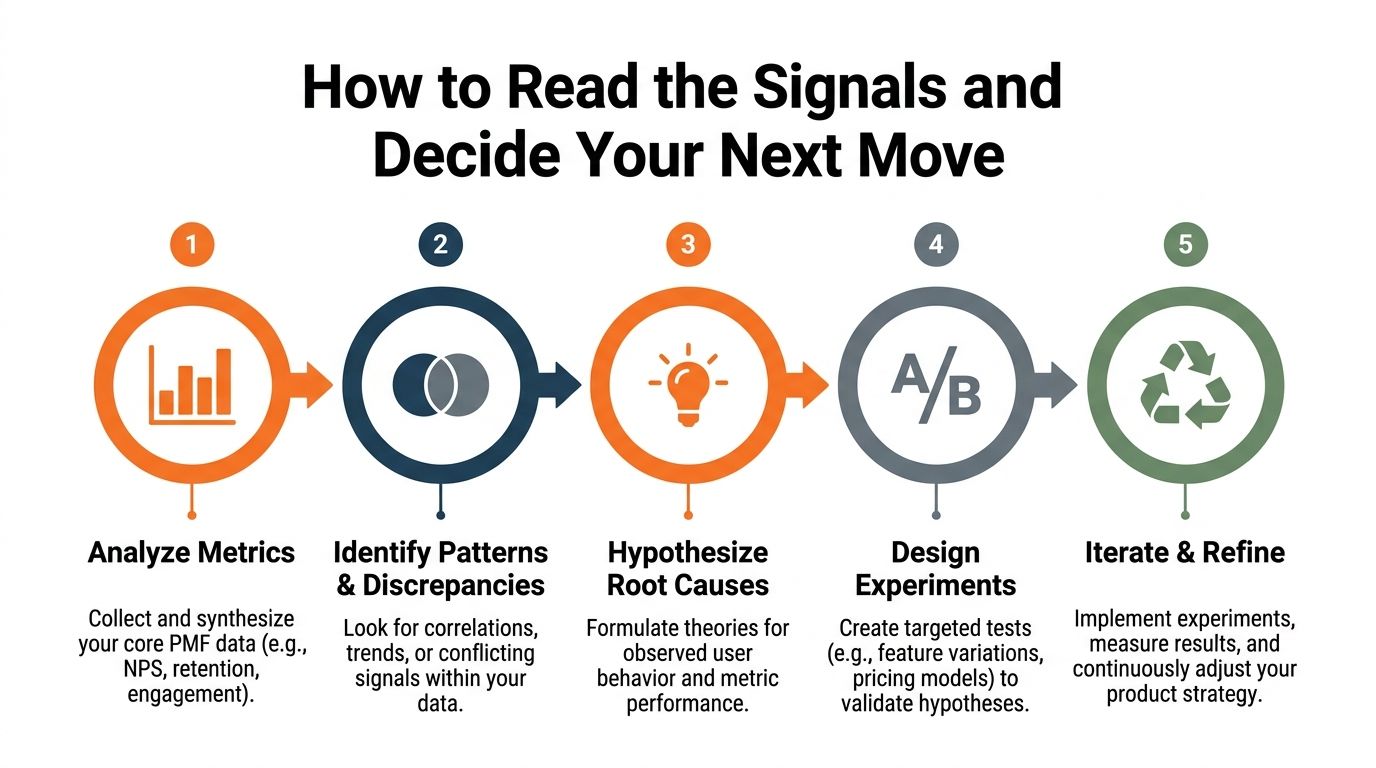
Use this simple decision table
| Signal | What it usually means | What I'd do |
|---|---|---|
| Users stay, refer others, and economics work | You're close to real fit | Commit to the customer and message that already work |
| Users praise the idea but don't stick | The promise is strong, but the experience disappoints | Fix onboarding, workflow, or the main use case |
| A small segment loves it and everyone else shrugs | You have a real niche | Narrow the target and serve that group better than anyone else |
| People engage only when pushed or discounted | Demand is weak | Rework the problem, audience, or offer |
| Economics are weak despite happy users | The value is real, but the business model is off | Test pricing, acquisition channels, or a different segment |
I use one rule here. Follow behavior, not sentiment.
If someone says they love the product but will not pay, return, or introduce you to another buyer, treat that as weak evidence. If a smaller group uses it, asks for more, and gets annoyed when it breaks, pay attention.
Read patterns, not isolated signals
A single good sign can fool you. So can a single bad week.
What matters is alignment. Strong validation looks like several signals pointing in the same direction at the same time. People understand the pitch quickly. The right users come back without reminders. Some tell other people. The path to acquiring them does not look absurdly expensive.
If only one piece works, do not call it product market fit. Call it a clue.
I read early signal like a mechanic listening to an engine. One odd noise might be nothing. Three at once means you need to open the hood.
The three moves you can make
Persevere
Do this when one customer group keeps pulling you forward.
They use the product with little hand-holding. They come back. They ask for specific improvements instead of vague wishes. They do things that cost them time, money, or reputation, which means the problem is real to them.
Your move is simple. Tighten the product around that use case. Cut side quests. Improve the parts that increase repeat usage and conversion.
Pivot
Pivot when the energy is real but aimed at the wrong place.
I've seen founders target one buyer, then discover the actual buyer is a manager two layers up. I've seen a broad product become useful only for one narrow workflow. I've seen customers want the outcome but hate the way the product gets them there.
That is not failure. That is progress with bruises.
Change the audience, the problem framing, the workflow, or the pricing. Keep the part buyers already proved they care about.
Pull the plug
Sometimes the right move is to stop.
If interviews stay soft, cheap tests go nowhere, usage never turns into habit, and buyers keep dodging commitment, end it. Do not keep funding a story because you are attached to the effort. Time is your scarcest asset. Protect it.
You do not need total rejection to quit. You need enough honest evidence that this problem, customer, and solution combination is not working.
The traps that fool smart founders
Smart people are excellent at explaining away bad news. I know because I've done it.
Watch for these traps:
- Compliments over commitments: Polite interest is not demand. Paid pilots, referrals, and repeat use are demand.
- Early adopter distortion: Some users love trying new tools. They are helpful, but they can make weak products look stronger than they are.
- Feature panic: Mixed feedback often triggers a building spree. Usually you need sharper focus, not more product.
- Selective hearing: Ten buyers say one thing, one friendly advisor says another, and founders latch onto the safer story.
Your next move should come from the strongest repeated pattern, not the feedback that protects your ego.
That is how scrappy validation works in real life. You run cheap tests, collect imperfect signal, and make the clearest decision you can. Keep going where the market pulls. Change direction where the pull is real but off-center. Stop where nothing solid forms.
Your First Step Is the Only One That Counts
Most founders don't need more startup content. They need one honest move.
If I were sitting across from you at dinner and you asked what to do next, I wouldn't tell you to redesign your homepage or polish your deck. I'd tell you to book conversations with real buyers this week and listen for pain, workarounds, and spending. Then I'd tell you to run one cheap experiment that forces a clearer answer.
That's it.
Keep the loop simple
Product market fit validation doesn't need to become a giant research project. Keep the loop tight:
- Hear the problem clearly
- Test a simple promise
- Watch behavior
- Adjust fast
Then repeat.
A lot of founders make this harder than it is because they want certainty before they move. You won't get certainty. You'll get signal. Then stronger signal. Then a point where the market starts pulling the product forward instead of you dragging it uphill.
What I'd do this week if I were you
Pick one of these and do it today:
- Book five customer calls: Don't wait until you have the “perfect” script.
- Write a one-page landing test: One promise, one audience, one call to action.
- Manually deliver the result: If software is the end goal, fake the backend and do the work yourself.
- Send the must-have question: Ask current users how they'd feel if they could no longer use the product.
That first step matters because action creates clarity. Thinking rarely does.
You do not need a full system today. You need one real conversation, one useful survey, one simple page, one uncomfortable answer. Founders who win don't avoid bad news. They get to it faster.
And if the signal is weak, good. You just saved yourself months.
If you want a place to sanity-check your idea with kind, blunt founders who've lived this grind, take a look at Chicago Brandstarters. It's a free community for Chicago and Midwest builders who want honest feedback, real operator conversations, and a better way to build than guessing alone.
Leave a Reply