
At 11:42 p.m. on Tuesday, your laptop is still warm from a full day of work. Shopify is open on one side of the screen, a Slack thread with a contractor in another time zone sits on the other, and your partner's unanswered text waits on your phone. Dinner has gone cold. The dog fell asleep hours ago. You tell yourself you'll close the laptop after one more reply.
The phone is the last thing you touch before sleep and the first thing you grab at 6 a.m. You call the routine flexibility because you chose the business. In practice, you've built a job with no closing time.
Work life balance for entrepreneurs has less to do with escaping work than with deciding when work gets access to you. Your stage, revenue, runway, and headcount should shape that decision. A solo founder with little cash needs a different week from a founder with a team and enough runway to step away. Balance is an operating choice, not a motivational quote.
The Late-Night Default Most Founders Don't Notice
The late-night pattern feels temporary at first. You're answering one customer because the order problem matters. You're fixing one product page because the campaign launches tomorrow. You're replying to one contractor because waiting until morning feels expensive.
Then Tuesday starts looking like Wednesday. Your kitchen table becomes a second office. The half-eaten dinner becomes evidence that you worked through another meal, but you barely register it because every founder peer you know seems to do the same thing.
That's why the problem stays hidden. You don't compare your week with a healthy operating model. You compare it with other overloaded founders. If everyone answers messages at midnight, midnight starts to look normal.
A salaried professional usually has an agreed work window, a manager who owns some decisions, and a contract that separates working time from personal time. You may have none of those protections. Customers can contact you directly, contractors can work across time zones, and every unanswered question can feel like a threat to revenue.
The blunt diagnosis: You haven't created freedom yet. You've removed the boundary that used to protect your evenings.
A major 2024 survey found that entrepreneurs averaged almost 50 hours of work per week, while more than half rated their work-life balance poorly and over one third described it as “very poor,” according to Adobe's survey of work-life balance trends for entrepreneurs. The finding doesn't mean every founder should work fewer hours immediately. It does show that self-employment rarely produces control by default.
Your late-night routine isn't a personal defect. It's the operating mode of an unstructured solo business. You need rules for access, ownership, recovery, and cash. Once you treat balance as a business design problem, you can make decisions that fit the company you run.
Why Entrepreneurs Struggle With Balance in the First Place
Many founders leave employment to gain freedom, then build a company that consumes every hour their job once occupied. You replace a manager with customers, a payroll team with cash anxiety, and a defined schedule with an endless list of possible improvements.
Revenue volatility drives the first problem. When sales feel uncertain, you stretch the workday to chase the next sale, repair the funnel, answer every lead, or finish another launch task. The extra hours feel rational because the business has no guaranteed paycheck.
Delegation creates the second problem. If you handle customer complaints, fulfillment, bookkeeping, sales, product decisions, and support, every issue lands in your head. The company may have contractors, but you still act as the emergency department.
Identity fusion makes the pattern harder to challenge. You stop seeing a missed meal as a missed meal. You see it as proof that you care. Founder circles can reward that behavior too, especially when people treat long hours as evidence of ambition.
The numbers show how durable this pattern is. A historical entrepreneur survey reported that one in five small-business owners worked 80 hours or more per week, two-thirds exceeded 40 hours, 47% worked during family time, and 21% worked through dinner at least four to five times per week, as summarized by AIN's coverage of founder work-life trade-offs. A qualitative study also found participants worked an average of 13 hours per day, including weekends and bank holidays, because they accepted blurred boundaries between work and life, according to the Brunel University study on entrepreneurial boundarylessness.
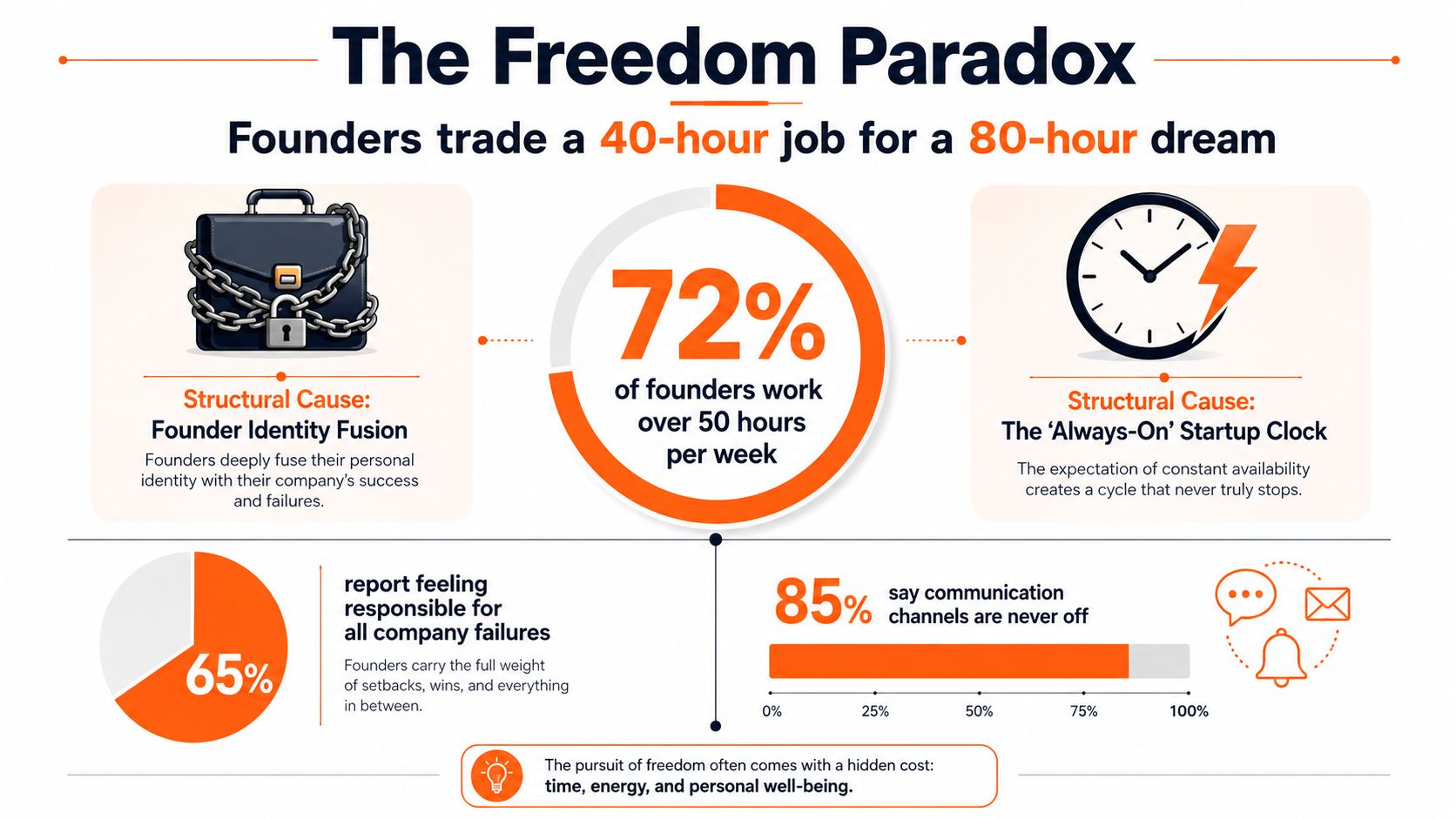
Recent founder coverage reports 54% experienced burnout, 75% reported anxiety, 83% reported high stress, and 67% worked more than 50 hours per week in the prior year, according to Sifted's reporting on founder mental health. That's why you should treat sleep and recovery as operating inputs. If you're rebuilding your routine, this practical guide to how sleep boosts productivity can help you connect recovery with the quality of work you expect from yourself.
The mental shift is simple: stop treating balance as a freedom problem and start treating it as a boundary design problem. Decide which hours belong to revenue, which belong to recovery, and which belong to relationships. You aren't choosing less ambition. You're choosing where ambition gets used.
Four Mental Models That Actually Move the Needle
You don't need another philosophy to admire. You need operating rules you can test this week.
Set boundaries before your inbox sets them
Choose a hard shutdown hour. A customer Slack channel might go unanswered after 7 p.m. Contractor messages might receive replies during an 11 a.m. communication window. Put the rule in your email signature, customer help center, and team chat.
A boundary without communication creates confusion. A boundary with a published response window creates a system.
Block time for the work that pays
Protect a 90-minute morning block for the one task most likely to create revenue. Don't open Slack first. Don't check dashboards for emotional reassurance. A SaaS founder might reserve Tuesday mornings for sales calls only, with product questions pushed into a later block.
Reactive work expands until it occupies every open space. Time-blocking gives revenue work first access to your attention.
Use your calendar as a fence: If the block isn't protected from meetings, messages, and errands, it isn't a plan.
Delegate the work that teaches you nothing
Write down the three tasks only you can do. Those might include product direction, high-value sales, and hiring. Everything else deserves a delegation test.
A solo direct-to-consumer founder who still packs orders three nights a week could hire a part-time fulfillment coordinator. The first goal isn't perfect efficiency. It's to remove a recurring responsibility that keeps the founder physically tied to the business.
Let runway shape the week
Hours worked tell you how busy you are. Runway tells you how aggressive your operating decision can be. A 60-hour week with six months of cash remaining demands a different response from the same week with 18 months of runway.
With short runway, concentrate on the few activities that produce cash or preserve the business. With more runway, spend time building processes, hiring carefully, and reducing founder dependence. Balance improves when you stop using exhaustion as your only measure of commitment.
These models compound. Boundaries reduce interruptions, time blocks protect output, delegation removes repetition, and runway keeps the trade-offs honest.
What Balance Looks Like at the Idea, Growth, and Scaling Stages
The word “balance” changes meaning as the company changes. At the idea stage, you may need founder effort because the product still depends on your direct learning. During growth, you need documentation and delegation. During scaling, you need policies that keep the business from routing every decision back to you.
| Stage | Revenue / Headcount | Runway | Right Balance Move |
|---|---|---|---|
| Idea | $0 to $5K per month, no team | Under six months | Protect one non-negotiable block each week and focus the rest of your effort on learning and revenue |
| Growth | $15K to $100K per month, 1 to 5 hires | Six to 12 months | Document recurring work and delegate until your evenings stop depending on your personal availability |
| Scaling | $250K or more per month, 10 or more employees | 12 or more months | Set policies, audit adherence, and let the organization run without you on a chosen weekday |
At the idea stage, don't pretend you can build a mature executive schedule. Your output still depends heavily on your hours. Protect one block for health, family, or recovery, then use the remaining time with discipline. Your immediate job is to find evidence that someone wants what you're building.
At the growth stage, founder heroics become expensive. If you still approve every refund, answer every support question, or rewrite every deliverable, your team can't take ownership. Document the task while you perform it, then hand it over with a clear definition of done.
At the scaling stage, balance becomes a governance problem. If employees can reach you at any hour, they'll keep routing uncertainty to you. Set decision rights, meeting rules, and escalation paths. Then stay away long enough to see whether the system works.
Find your row before you borrow someone else's routine. A founder with no team shouldn't copy an executive calendar. A founder with 10 or more employees shouldn't keep packing every box personally.
Two Founder Scenarios and the Week That Works for Each
Maya runs a solo ecommerce business at $15K per month. She has 18 months of runway, no employees, and still packs orders three nights a week. Her problem isn't a lack of effort. She has enough room to buy back time, but she keeps treating fulfillment as a personal duty.
Maya's operating week
- Monday morning: Protected admin block for inventory, cash review, and supplier follow-up.
- Monday afternoon: Marketing and customer acquisition work.
- Tuesday: Shipping block, followed by customer support and sales work.
- Wednesday: Product development, supplier calls, and content.
- Thursday: Second shipping block, with no packing after the scheduled window.
- Friday: Financial review, campaign planning, and one process she can document.
- Saturday: Personal time, with no routine order checking.
- Sunday: Planning ritual. Maya lists the three jobs only she can do and assigns everything else to a later delegation test.
Maya's hard cutoff is 6 p.m. Her failure mode is letting urgent orders erase the boundary. She should track the backlog, set customer expectations, and test a part-time fulfillment coordinator before another quarter passes.
Dev is approaching $1M ARR with four hires and 12 months of runway. His calendar looks like his employees' calendar because he attends every working session and answers every internal question.
Dev's operating week
- Monday: One-on-ones with direct reports, followed by written decisions from the prior week.
- Tuesday: A single three-hour deep work block for product decisions.
- Wednesday: Customer and sales conversations, with no internal meeting sprawl.
- Thursday: Team review of metrics, blockers, and ownership.
- Friday: Written SOPs handed off before the day ends, plus a short review of decisions that still depend on Dev.
- One full day each week: Dev is unreachable by staff. The team uses documented escalation rules.
Dev's failure mode is calling availability leadership. If the team can't operate during his offline day, the missing asset isn't more founder effort. It's a process, owner, or decision rule.
Quiet Burnout Signals You Keep Mistaking for Dedication
Founders often keep shipping while their judgment, sleep, and relationships deteriorate. Recent reporting found that 74% of entrepreneurs said business demands left little room for self-care, according to coverage of entrepreneur self-care pressures. Use these signals before your output forces the issue.
Decision fatigue. At a 4 p.m. meeting, you agree to anything because you want the conversation to end. Ask yourself whether you've made three reversible decisions today without checking Slack. If you haven't, start a written decision log and batch low-risk choices.
Sleep compression. You begin calling six hours “plenty” because you can still answer email. Track your sleep for a week, then put your phone outside the bedroom by 10:30 p.m.
Irritability. You snap at a customer, cofounder, or employee over a small issue. Ask your team, “Have I become harder to work with lately?” Schedule one full day offline each week and accept the uncomfortable silence.
Sunday dread. The feeling follows you into Tuesday morning. Write down the first emotion you notice when you wake, then remove one recurring meeting from the calendar.
Skipping your body. Meals and movement go first whenever the day gets crowded. Count your intentional movement across the last seven days and book it before email enters the calendar.
For a broader prevention plan, review strategies to prevent burnout with Kohru and use Chicago Brandstarters' burnout prevention strategies as a prompt for your next operating review.
These signals don't prove you've failed. They show that your current system keeps charging your body for business expenses.
Why Peer Communities Fix What Productivity Apps Can't
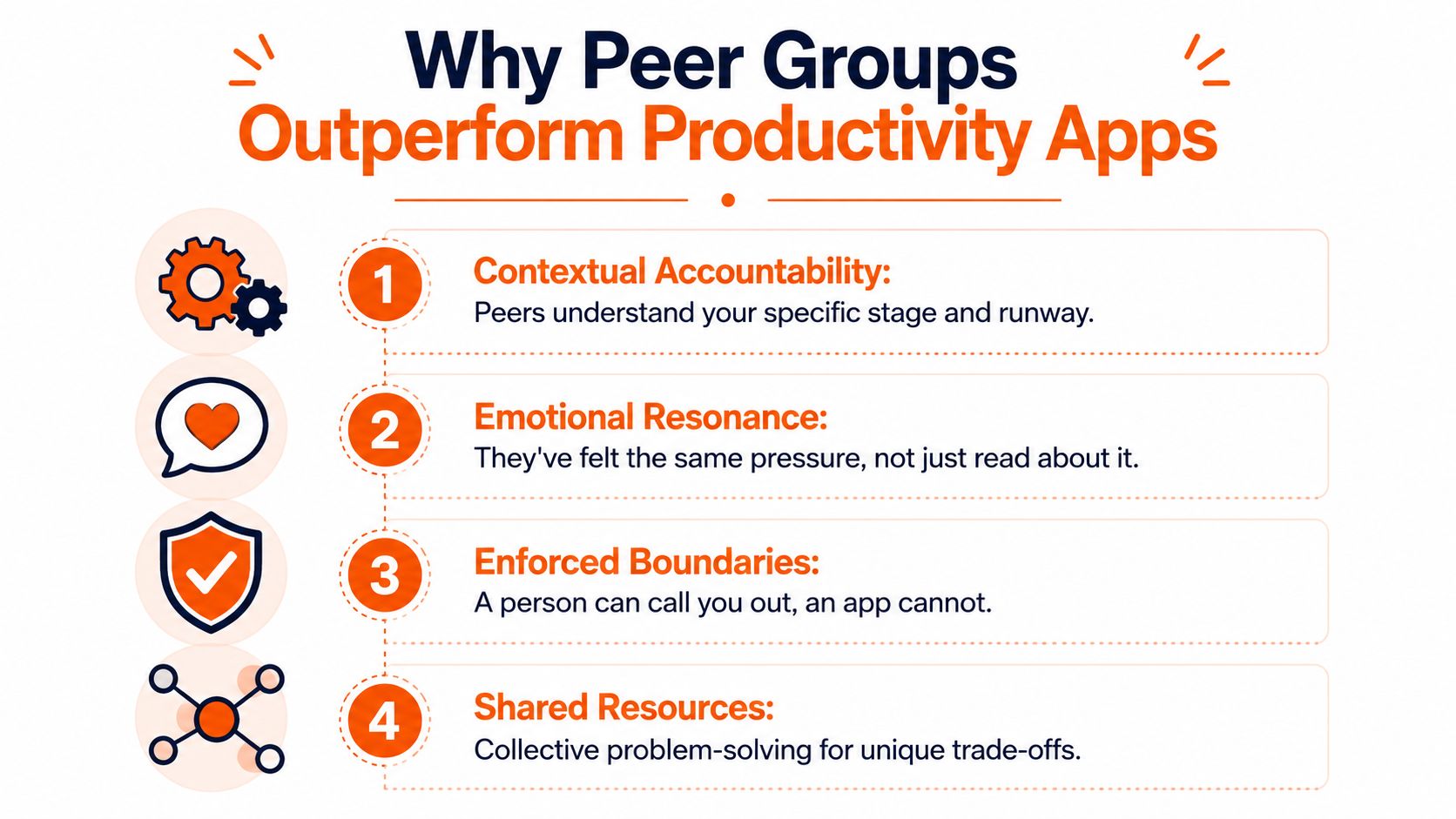
A productivity app can remind you to stop. It cannot decide whether your current stage calls for another sales push, a contractor, a vacation, or a project cut. That choice depends on runway, headcount, revenue pressure, and the work only you can do.
Software organizes execution. A peer group tests judgment. Alone, you can justify nearly any trade-off. A founder who understands your context can ask why you still handle fulfillment, why your team needs access to you at night, or why a project still receives time without earning it.
Choose a group with three traits:
- Stage specificity: Members understand the constraints facing founders at a similar level.
- Accountability: People ask what you decided and what happened, instead of swapping business cards.
- Regular cadence: Meetings happen often enough for decisions to stay visible.
Chicago Brandstarters gives Chicago-based founders in the idea-to-growth window small private dinner groups and an active group chat for hard calls, operating pressure, and practical tactics with vetted peers. Chicago Brandstarters also offers mastermind groups for entrepreneurs matched to different operating needs.
Use the first 90 days deliberately. Bring a real calendar problem, share your runway and responsibilities, make one change after each conversation, and report the result. The group should make decisions visible before they become expensive, not become another meeting to manage.
Your First 30 Days of Real Balance
Use the next month as an operating reset.
Week one: Audit your hours, sleep, interruptions, and revenue-generating work. Your deliverable is one honest weekly record.
Week two: Set a shutdown time, publish communication windows, and remove work apps from your bedroom. Your deliverable is a written boundary policy, using this guide to set boundaries at work.
Week three: Choose one recurring task to delegate. Your deliverable is a named owner, a written process, and a scheduled handoff.
Week four: Book one conversation with a peer, advisor, or therapist outside your own head. If stress has moved beyond an operating problem, Interactive Counselling online therapy can provide a private place to work through it. Your written review should answer what gave you time back and what boundary failed.
At day 30, look for one protected weekday morning, one delegated recurring task, and one booked outside conversation. Revisit the system monthly. Balance won't stay fixed while your revenue, team, and runway change.
Chicago Brandstarters gives Chicago and Midwest founders a vetted peer community, private dinner groups, and an active group chat for discussing hard business decisions without performative networking. Visit Chicago Brandstarters to meet founders who can help you build a business that doesn't require constant availability.
Leave a Reply