You're halfway through a launch. The demo is queued, investor introductions are going out, and a freelancer is waiting for homepage copy. Then someone asks, “Who do you help?” You start with one answer, add four qualifiers, mention three integrations, and finish with a sentence nobody can repeat.
I've watched founders get trapped here because they know the product too well. Their internal map contains features, workflows, edge cases, competitors, and technical decisions. Customers see none of that at first. They see a problem, a risk, and a hoped-for result.
That's why building a StoryBrand book works best as a founder's operating tool. You're not writing a glossy marketing document. You're making a compact message system that a contractor, hire, salesperson, or investor can read and use without calling you for translation.
Why Founders Get Stuck on Their Own Message
A founder I worked with had a launch date, a polished demo, and a homepage that began with a sentence about infrastructure orchestration. The product helped operations teams prevent missed handoffs, but the copy opened with the technology behind it.
The team had spent so long building the product that the product had become the story. Customers had to dig through technical language to find their own problem. Sales calls wandered into architecture. New hires repeated different versions of the pitch. The founder blamed the website, then the sales team, then the audience.
The issue sat earlier in the process. Nobody had chosen the customer, the desire, or the problem that the whole company would describe in the same words.
The symptoms are easy to spot
Your message probably needs work if you see any of these patterns:
- Mission-statement prose: Your headline could belong to a nonprofit, a consulting firm, or a software company.
- Competitor vocabulary: You borrow terms because they sound familiar, even though they say little about the customer's day.
- Technology-first copy: You lead with machine learning, automation, integrations, or a proprietary system before naming the outcome.
- Qualifier stacking: You serve startups, enterprises, agencies, creators, and nonprofits, each with a different reason to buy.
- Feature-led sales calls: Your team explains what the product does before asking what the buyer needs to change.
A vague message creates practical drag. The landing page buries the offer. A sales conversation follows whichever feature the prospect mentions. A new hire invents a pitch from memory. A freelancer produces clean copy that still sounds like five companies sharing one homepage.
A short positioning sentence gives everyone a rail to run on. Use this marketing positioning statement template to force the customer, outcome, and distinction into one working line.
Founder rule: If a new hire can't repeat your message after one conversation, your brand book hasn't done its job.
The StoryBrand method gives you a useful sequence for fixing this. Donald Miller's Building a StoryBrand first appeared on October 10, 2017, from HarperCollins Leadership, and retail records still list the original 2017 edition alongside the revised 2025 reissue in the book's retail listing. The framework has had time to become familiar, but familiarity isn't the same as execution.
Treat it as a one-week sprint. Choose one primary customer, write the message, test it with real people, and turn the result into a PDF. Don't spend a quarter discussing brand personality while your homepage still makes buyers work.
The StoryBrand Framework in Plain Language
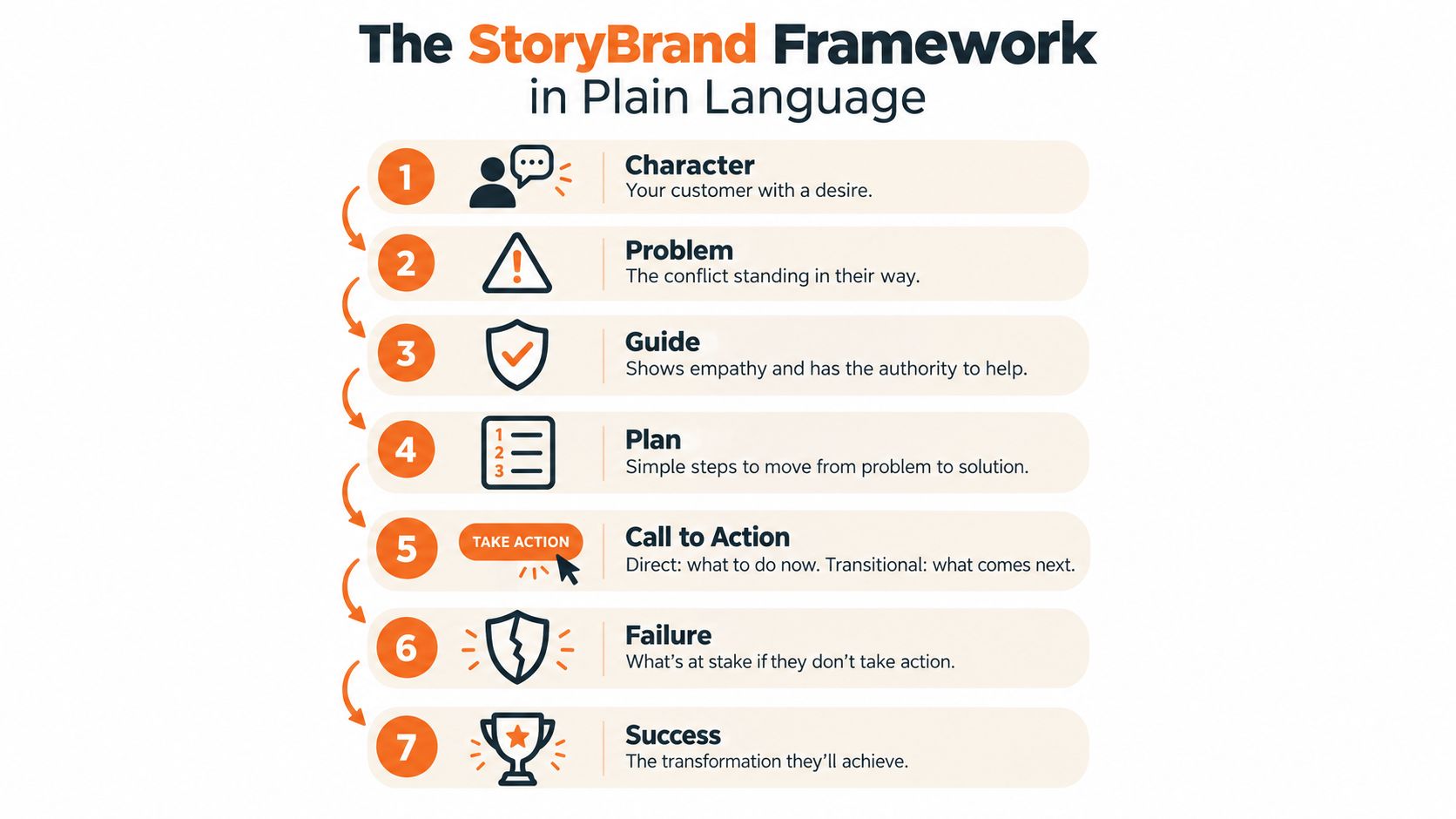
The SB7 framework contains character, problem, guide, plan, call to action, failure, and success as outlined in this framework summary. I fill it in on a whiteboard in the order that helps a founder make decisions, rather than copying the order from a book page.
Start with the customer
1. Character. Name one customer and the desire they carry into the buying decision. Don't write “modern businesses.” Write, “A SaaS founder wants reliable visibility into cash flow.”
2. Problem. Name the friction blocking that desire. “The founder spends Friday afternoons combining exports from three tools.”
3. Guide. Put your company beside the customer, not above them. The guide brings empathy and authority. “We've helped finance teams replace manual reporting with one dependable view.”
Miller's central position is simple. The customer plays the hero, while the brand acts as the guide in this published summary of the book. Founders often resist this because they built something difficult and want credit for the difficulty. Buyers care about what changes in their own working life.
Make the next step easy
4. Plan. Give the customer a path that feels small enough to start. A process plan might say, “Connect your tools, review your dashboard, share the report.”
5. Call to action. Ask for the decision you actually want. “Book a cash-flow review” is direct. “Download the reporting checklist” is transitional when the buyer needs more proof.
6. Failure. State the cost of staying stuck. “The team keeps making decisions from stale numbers.”
7. Success. Describe the desired future in the customer's language. “The founder opens one report before the leadership meeting and knows what needs attention.”
A useful brand narrative development guide can help you connect these pieces when your story still feels like disconnected copy blocks. I use the framework to create one sentence for each element, then remove anything the customer wouldn't recognize.
The structure should feel like a bridge. The character stands on one side with a problem. Your plan gives them the first plank. The call to action asks them to step forward. Failure and success explain why the crossing matters.
Don't write seven paragraphs of brand philosophy. Write seven lines your team can use.
The Three Layers of the Customer's Problem
Founders usually identify the external problem quickly. They see the queue, the broken workflow, the spreadsheet, the missed handoff, or the expensive manual task. Then they stop.
That produces copy that sounds transactional. “Our platform centralizes project data” may be accurate, but it doesn't tell the buyer why they care today. The customer also feels the problem, and they carry a belief about why the problem shouldn't exist.
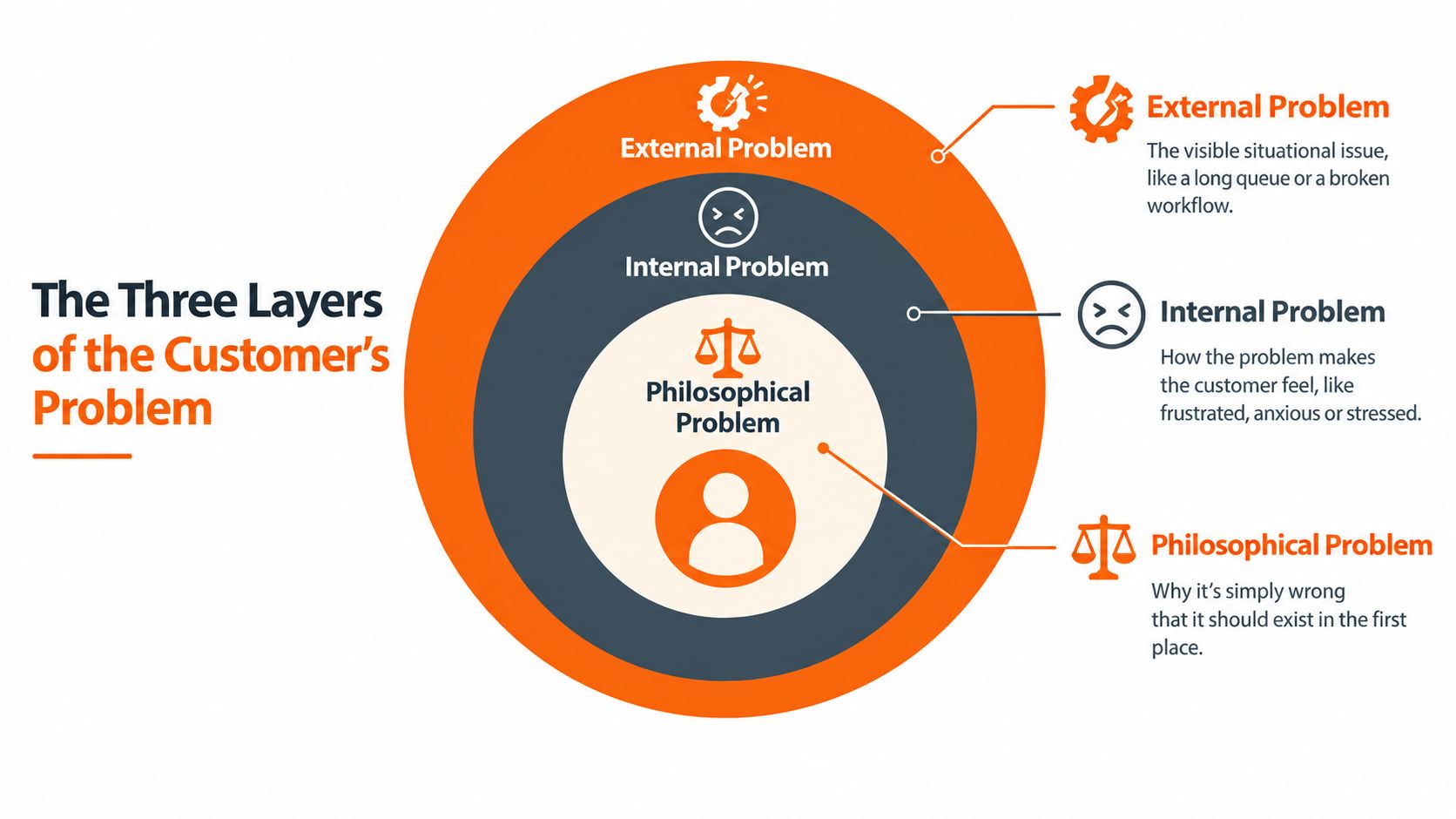
The StoryBrand framework divides the problem into external, internal, and philosophical layers in this StoryBrand explanation.
Write the problem from the buyer's side
The external problem is visible and situational. A support lead has a queue that keeps growing. A finance manager reconciles numbers across separate files. A security team receives alerts without a clear response path.
The internal problem describes the feeling underneath. The support lead feels behind. The finance manager dreads the reporting meeting. The security lead worries that a missed alert will expose a gap nobody can explain.
The philosophical problem answers why the situation feels wrong. Small teams shouldn't lose to larger competitors because their reporting tools waste time. A security team shouldn't need heroic effort to protect ordinary customer data.
Here's the useful compression:
Problem statement: “Operations leaders shouldn't have to make important decisions from scattered, outdated information.”
That sentence combines the visible issue, the emotional cost, and the customer's sense of fairness. It gives your copy a human center without turning the brand into a therapy session.
Avoid the founder's villain
Your frustration isn't automatically the customer's frustration. You may hate legacy software, slow procurement, poor APIs, or a competitor's pricing model. Your buyer may care about missing a deadline, looking unprepared in a meeting, or losing control of a process.
Name the failure mode the customer experiences. “Manual reporting creates decision delays” works better than “Old technology is holding businesses back.”
You can then position the brand as a guide with empathy and authority. Empathy says, “You shouldn't have to work this way.” Authority says, “We know how to change it.” The combination creates trust faster than a list of capabilities.
Turning the Framework Into a One-Page Brand Book
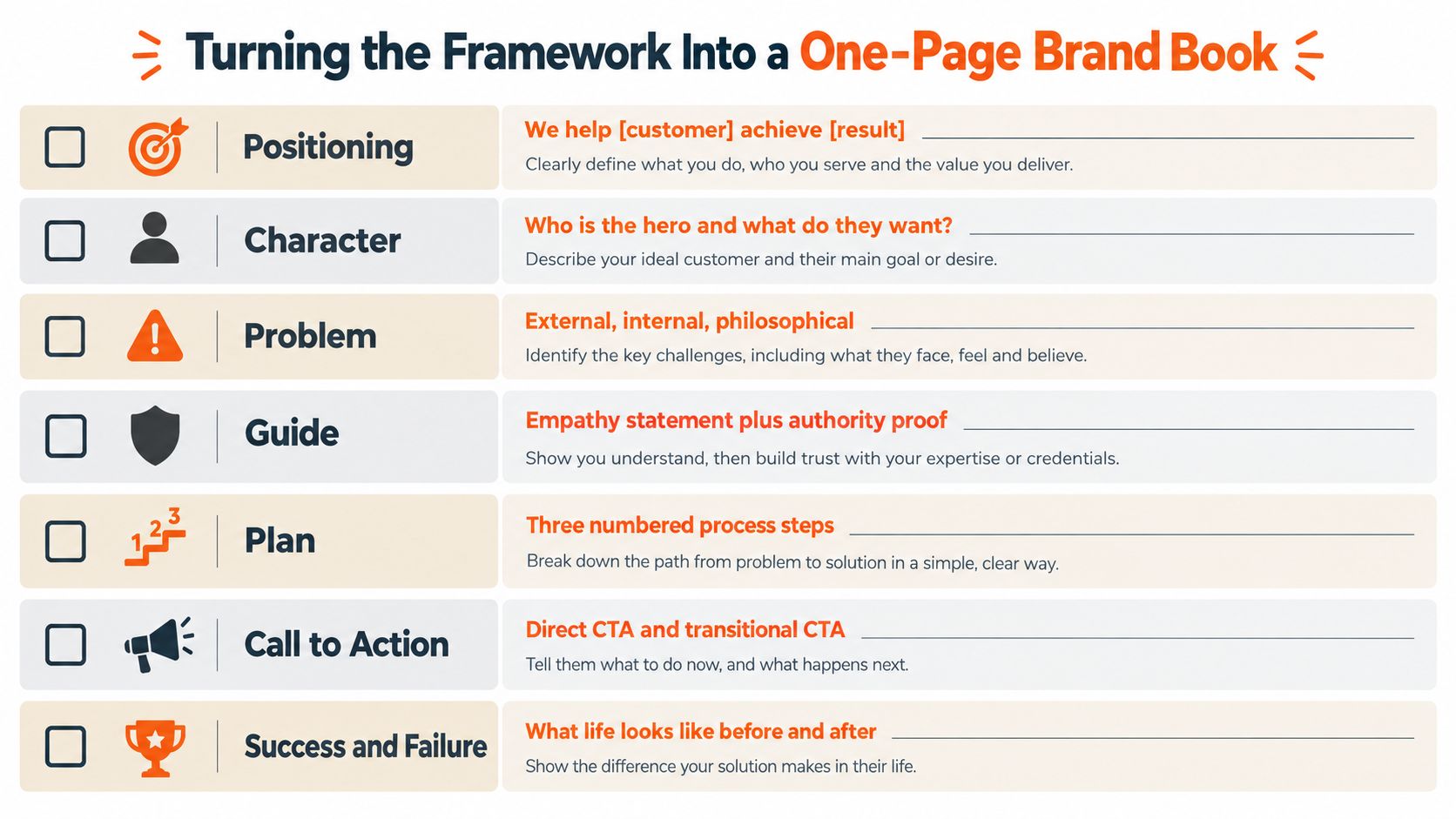
A useful brand book has one page that people can use. Give each StoryBrand component one fixed slot, one prompt, and one answer. If a contractor needs a meeting to understand your message, the page is unfinished.
Use seven working slots
Slot 1, positioning. Write: “We help [customer] achieve [external success] by [internal transformation] without [cost or fear].” For example, “We help agency owners deliver client work on time by giving them calm control of production without adding another full-time coordinator.” This line earns space because every headline, pitch, and campaign needs a starting point.
Slot 2, character and problem. Name the primary buyer, then list the external, internal, and philosophical problems. Keep the customer specific enough that a real person recognizes the situation.
Slot 3, guide. Write the guide persona and three proof points. The guide might be your company, founder, product specialist, or implementation team. Proof can include relevant experience, a clear process, or a customer result you can verify. Don't turn this into a biography.
Slot 4, plan. Write a failure plan and a success plan, each in 25 words. The failure plan shows what continues if the buyer delays. The success plan describes the customer's changed routine.
Slot 5, call to action. Write one call to action with eight words, then add three transitional calls to action. Your direct CTA might be “Book your workflow review with our team.” Transitional CTAs might include “See how the process works,” “Read the implementation guide,” and “Watch the product walkthrough.”
Slot 6, objections. List five to seven common objections and pair each with one sentence that dissolves it. If a buyer worries about migration, explain the migration path. If they worry about adoption, explain who guides the first rollout.
Slot 7, customer language. Write a descriptive paragraph using phrases customers already use. Pull those phrases from sales calls, support tickets, interview notes, and review conversations. Your vocabulary should describe their day before it describes your software.
A guide to turning knowledge into a profitable book can help if your one-page document starts expanding into a longer founder book. Keep the operating version short. The long version can hold examples, proof, voice rules, and channel notes.
Use your brand story writing resource when you need to turn the one-page message into a fuller narrative. The brand book itself should remain easy to print, send, and quote.
Test the page with three strangers in under ten minutes. Give each person the document without explaining it. Ask:
- Who is this for?
- What problem does the company solve?
- What should the customer do next?
Write down their answers. If they disagree with your page, don't defend the page. Rewrite it.
The final test is operational. Send the PDF to a contractor before the first copy call. If the contractor can draft a headline, describe the offer, and choose the right CTA without inventing language, the document works.
Watch the practical translation from framework to execution here:
When the Framework Bends and How to Adapt It
Simpler messaging helps buyers understand you. It doesn't mean every purchase can fit into one cheerful sentence and a three-step button sequence.
The standard framework works best when one person understands the problem, controls the decision, and can act quickly. It bends for B2B SaaS, regulated healthcare, security platforms, and hardware. Those buyers often need to explain the purchase to a champion, an approver, an end user, legal counsel, or an implementation team.
Take a CTO buying a security platform. The CTO wants fewer blind spots, but the security lead wants operational control, the finance approver wants predictable cost, and the procurement team wants a defensible contract. One character and one bright success statement leave too much out.
Adapt the slots instead of abandoning them
| Framework Slot | Standard SB7 | Adapted for High-Consideration |
|---|---|---|
| Character | One primary customer | Stakeholder map with champion, approver, and end user |
| Problem | One external, internal, and philosophical problem | Separate risks and objections by stakeholder |
| Guide | One brand with empathy and authority | Coalition of product, security, implementation, and customer experts |
| Plan | Three simple steps | Phased rollout with owners, milestones, and review points |
| Call to action | Book a demo or buy | Request an assessment, review security materials, and plan evaluation |
| Failure | Customer stays stuck | Business, operational, compliance, and adoption risks remain visible |
| Success | One customer transformation | A measured rollout that each stakeholder can defend |
The adapted BrandScript for the CTO might begin like this: “Security leaders need to detect and respond to threats without forcing analysts to work across disconnected tools.” The guide becomes a team, not a single founder. The plan becomes discovery, technical validation, pilot, and rollout. The CTA becomes “Plan your security evaluation,” supported by a risk review and implementation outline.
Add a risk-reversal slot beside the CTA. State what the buyer can inspect, test, or confirm before making a larger commitment. This doesn't remove every objection. It gives serious buyers material they can carry into an internal review.
Treat success as a rollout with milestones. A healthcare buyer may need workflow approval, staff training, data review, and an adoption check. A bright promise about transformation won't answer those questions.
The original SB7 framework remains a strong default. Use it as a map, not a religion. When several people must approve the purchase, expand the map so each person can locate their concern.
Why a Written Book Beats a Notion Doc for Consistency
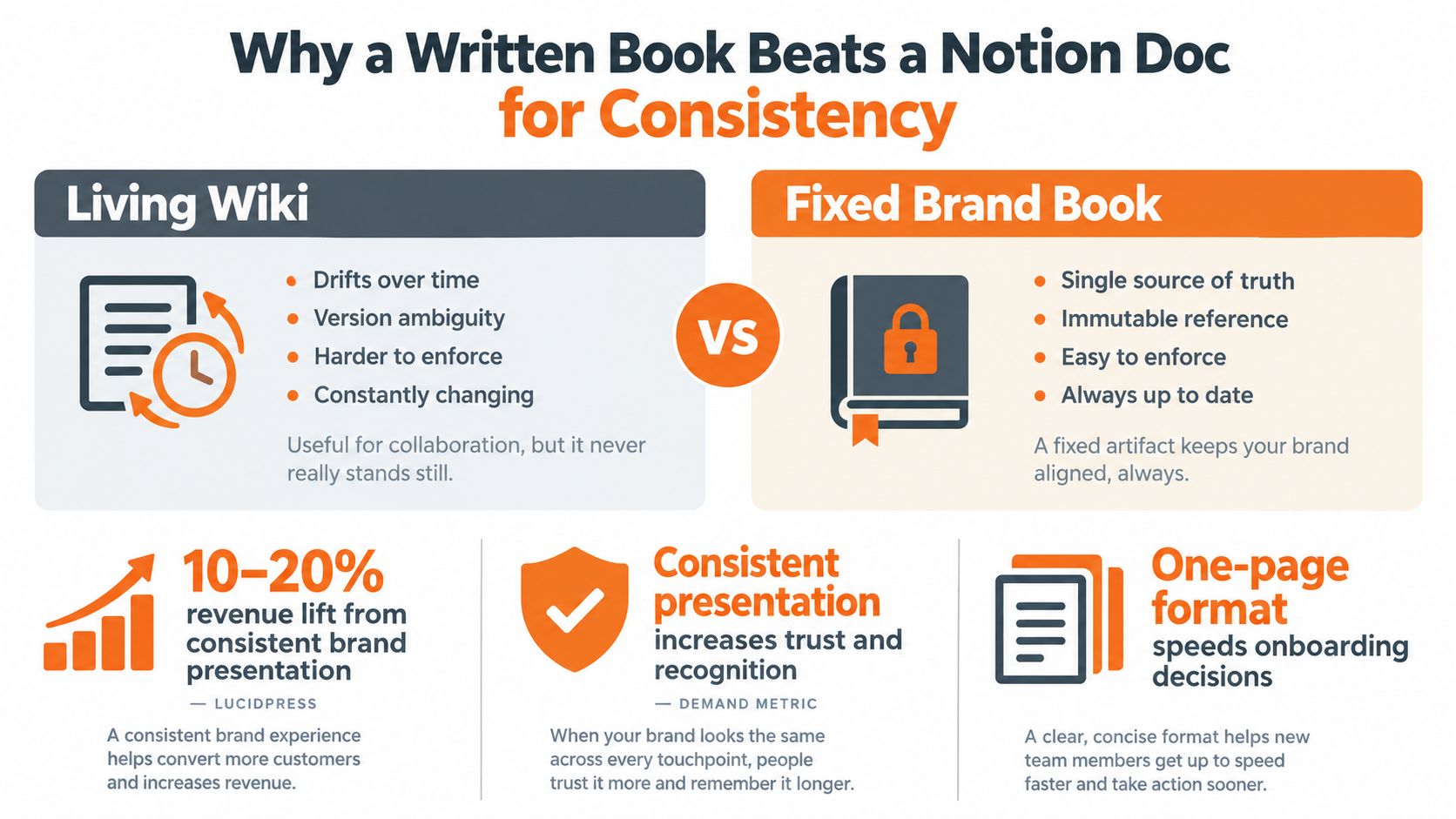
A living wiki feels efficient because everyone can edit it. That flexibility creates a problem. Your tagline changes in a sidebar, a contractor copies an old paragraph from Slack, and a sales deck keeps the version that made sense six months ago.
A written brand book forces decisions. When the document has a title page, a version date, approved language, and a founder's sign-off, edits feel deliberate. That friction helps you protect the message.
A 2026 survey of large digital organizations found brand consistency ranged from moderate to good, with weaker visual and cross-channel consistency. It also connected stalled conversion improvements with weak alignment, limited data, and limited resources in the survey's findings. Your team doesn't need another abstract brand discussion. It needs a repeatable system for web, email, social, and sales material.
Give the message one home
Imagine the handoffs:
- A contractor rewrites the tagline: The new line sounds polished but targets a different buyer.
- A new hire pitches the wrong customer: They describe the product to a broad audience and create weak leads.
- A landing page drifts from the sales deck: The page promises speed while sales promises control.
- An email uses a different CTA: Buyers move between channels and lose the next step.
Consistency has commercial consequences. Industry summaries report that consistent branding can raise conversion likelihood by 33%, with some reports describing up to twice the conversion rate compared with inconsistent cross-channel content. They also report 19% lower conversion rates for brands with inconsistent online presence in this summary of brand consistency data. Treat those figures as directional evidence for repeatable execution, not as a promise for your company.
Practical rule: The PDF is sacred text. The Notion doc is scratch paper. Never reverse those roles.
Use the written book for the story spine, approved customer language, voice rules, proof points, CTA structure, and adaptation rules. Use Notion for workshop notes, rejected options, research, and future ideas.
Your operating process should also have a simple approval rule. A new campaign can adapt the message for its channel, but it can't change the primary customer, problem, guide position, or CTA without founder approval.
That is how you create standard operating procedures for brand work. Keep the brand book stable. Let experiments happen around it.
Your First Week With the StoryBrand Method
Don't schedule a brand workshop next quarter. Run a seven-day sprint before your next standup cycle.
Day 1: Handwrite your one-sentence value proposition. Test it with three customers. Ask what they think you do and who they think it helps.
Day 2: Draft the external, internal, and philosophical problems for your primary buyer. Delete every line that describes your frustration instead of theirs.
Day 3: Name the villain. Don't write “inefficiency.” Write the specific failure mode, like scattered handoffs, stale reports, or unanswered security alerts.
Day 4: Write the guide section and the plan. Show empathy in one sentence, authority in three proof points, and the first customer step in plain language.
Day 5: Assemble the one-page brand book from the positioning, character, problem, guide, plan, CTA, objections, failure, and success sections.
Day 6: Rewrite the homepage, sales deck, and email signature from the page. Remove language that doesn't match the chosen customer or problem.
Day 7: Send the PDF to the first contractor or hire who touches your copy. Ask them to read it in ten minutes and repeat the message from memory.
Sign the final version. Put it in the onboarding folder. Give it to sales, design, growth, and anyone who writes customer-facing material. Review it when the customer changes, the offer changes, or the company learns something that invalidates the current story.
Your first deliverable isn't a workshop deck. It's one PDF that tells the whole team what to say, what to avoid, and what the customer should do next.
Chicago Brandstarters gives founders a place to pressure-test messages, share working drafts, and learn from other builders who are moving from idea to revenue. Visit Chicago Brandstarters to join the community and bring your one-page brand book into a room where people will tell you whether they understand it.
Leave a Reply