
You know this moment. Someone asks what your business does, and you give them the version you practiced in your head. It lands like wet cardboard.
The problem usually isn't your business. It's that you're trying to sound like a brand instead of a human being. You borrowed a polished story shape from a startup podcast, an agency deck, or some founder on LinkedIn who writes like he sleeps in a blazer.
If you want to learn how to write a brand story, stop trying to manufacture charisma. Start telling the truth in a way people can follow. That's the game.
Why Most Brand Stories Feel Fake and What to Do About It
Most brand stories feel fake because they start in the wrong place. They start with image.
You see this everywhere. A founder says they want to 'strengthen communities through innovation.' Nobody talks like that over coffee. Nobody believes it on a website either. It sounds like it came from a committee that was scared to offend anyone.
A real brand story does two jobs. It tells people what you believe, and it helps the right people say, "Yep, that's for me."

Most founders write for approval
That's the first mistake.
You write a story that sounds respectable instead of one that sounds true. You scrub out the rough edges. You hide the frustration. You remove the strong opinions. Then you wonder why the result feels dead.
A brand story without tension is like a movie where nothing goes wrong. Nobody cares.
Harvard Business School analysis highlighted in Terakeet's piece on brand storytelling points to a simple truth. Brands with strong, authentic narratives consistently reach higher valuations, and brands that position the customer as the hero can see average revenue increases of 30 to 50 percent within the first year of implementing a clear story framework.
That matters. Not because stats are magical, but because they remind you this isn't fluffy marketing theater. Story changes how people understand your value.
Practical rule: If your story could belong to your competitor with two nouns swapped out, it isn't a story. It's wallpaper.
Generic advice breaks down for early founders
A lot of brand advice was written for companies that already have a team, traction, customers, and a clean founder narrative.
That isn't most of you.
Maybe you're a solo operator. Maybe you built your first product after work. Maybe your story isn't glamorous. Maybe your real edge is that you care more, work harder, and don't want to become a shark just to win. Good. That's usable.
Here's the shift I want you to make:
- Stop inventing a brand persona. Use your actual convictions.
- Stop copying coastal hustle language. Write the way your best customers talk.
- Stop polishing away the struggle. The struggle is often the point.
- Stop making yourself the center. Your customer needs to see their own life in your story.
Your story isn't something you create from scratch
You uncover it.
Brushing dust off an old street sign reveals the words that were already there. Your job is to make them readable.
The best stories usually come from a few plain truths. What pissed you off enough to build this? What do you believe that others in your space don't? What kind of person are you trying to help? What kind of behavior are you subtly rejecting?
Answer those honestly and your story gets sharper fast.
Your brand story should sound less like a Super Bowl ad and more like something you'd say across a table to a smart friend who asked, "Why this business?"
That's where trust starts.
Find Your North Star Before You Draw the Map
Before you write a sentence for your website, you need to get honest about motive.
Not the polished motive. The authentic one.
Why this business? Why now? Why you? If you can't answer those cleanly, your brand story will wobble because it's built on mush. A lot of founders skip this part because it feels slower than writing copy. It's not slower. It's the work.
Start with your own why
I don't mean your mission statement. I mean the thing under the thing.
Use the Five Whys. Write one sentence answering why you started. Then ask why that answer matters. Do it five times. By round three, the fake business-school language usually starts to die. By round five, you're close to the nerve.
Here’s a simple example:
- I want to build a coffee brand.
- Why? Because I think most coffee brands feel interchangeable.
- Why does that bother me? Because they all talk about beans, not mornings.
- Why does that matter? Because my customer isn't buying beans. They're trying to feel human before work.
- Why do I care? Because I grew up watching tired people carry too much, and small rituals mattered.
Now we have something. Not perfect. But alive.
Run the dinner party test
If your story only works on a website, it doesn't work.
Try this. Explain what you do to someone at dinner in three parts:
- What you make or offer
- Who it's for
- Why you care enough to keep going
Keep it under a minute. No buzzwords. No "leveraging." No "ecosystem." If the explanation makes the other person lean in, you're onto something. If their face goes flat, start over.
If a stranger can't repeat your story back in simple language, you didn't clarify it. You performed it.
Then ask your audience what they actually feel
Founders can swing too far in the other direction. They do the personal soul-searching, then assume they know the customer perfectly. Bad move.
Your story gets stronger when your inner truth meets customer reality.
According to Dotdigital's 2023 report on using data to tell a compelling brand story, brands that use customer-centric data collection, like simple surveys and feedback polls, to shape their narratives achieve 23 percent higher customer retention rates and see 35 percent faster growth in loyalty metrics compared to competitors.
That should change how you work. You don't need a giant research budget. You need curiosity and a few well-asked questions.
Ask customers things like:
- What were you struggling with before you found us?
- What were you tired of hearing from other brands?
- What nearly stopped you from buying?
- What do you want more of in this category?
- What kind of brand feels trustworthy to you?
Don't ask them to write your positioning for you. Ask them for language, friction, and emotional truth.
Serve first, sell second
The strongest founders I know don't begin with "Who can I close?"
They begin with "Who can I help without becoming fake?"
That shift matters. It changes your tone. It changes what stories you tell. It changes the promises you make. When you write from service, your story gets cleaner because you're no longer trying to impress everyone.
A product brand, for example, shouldn't say, "We make premium kitchen tools for modern households." That's category mush.
It should say something closer to, "We make simple kitchen tools for people who are done buying flimsy junk twice."
That sentence has a spine. It has an enemy. It has a human.
If you want help tightening the connection between story and offer, this guide on how to brand a product is a useful next step.
Write your North Star in one paragraph
Once you've done the work, draft one paragraph with these parts:
| Part | What to write |
|---|---|
| Belief | What you believe about the world or your category |
| Problem | What frustrates your customer right now |
| Mission | What you're building to change |
| Values | How you'll do it without becoming someone you hate |
A rough example:
"We believe ambitious people shouldn't have to choose between success and decency. Most brands in this space talk big and treat customers like transactions. We're building tools that help hardworking people move faster without getting manipulated, oversold, or talked down to. We do it with clarity, honesty, and a high bar for usefulness."
That paragraph isn't your final brand story. It's your compass.
Without it, you'll drift.
The Hero's Journey Where Your Customer Is the Hero
Most founders blow this part by making themselves the main character.
You're not.
You're the guide. You're Yoda. You're not Luke. You're the person handing over the map, the sword, the flashlight, or the plan. Your customer is the one taking the risk.
That shift sounds small. It changes everything.
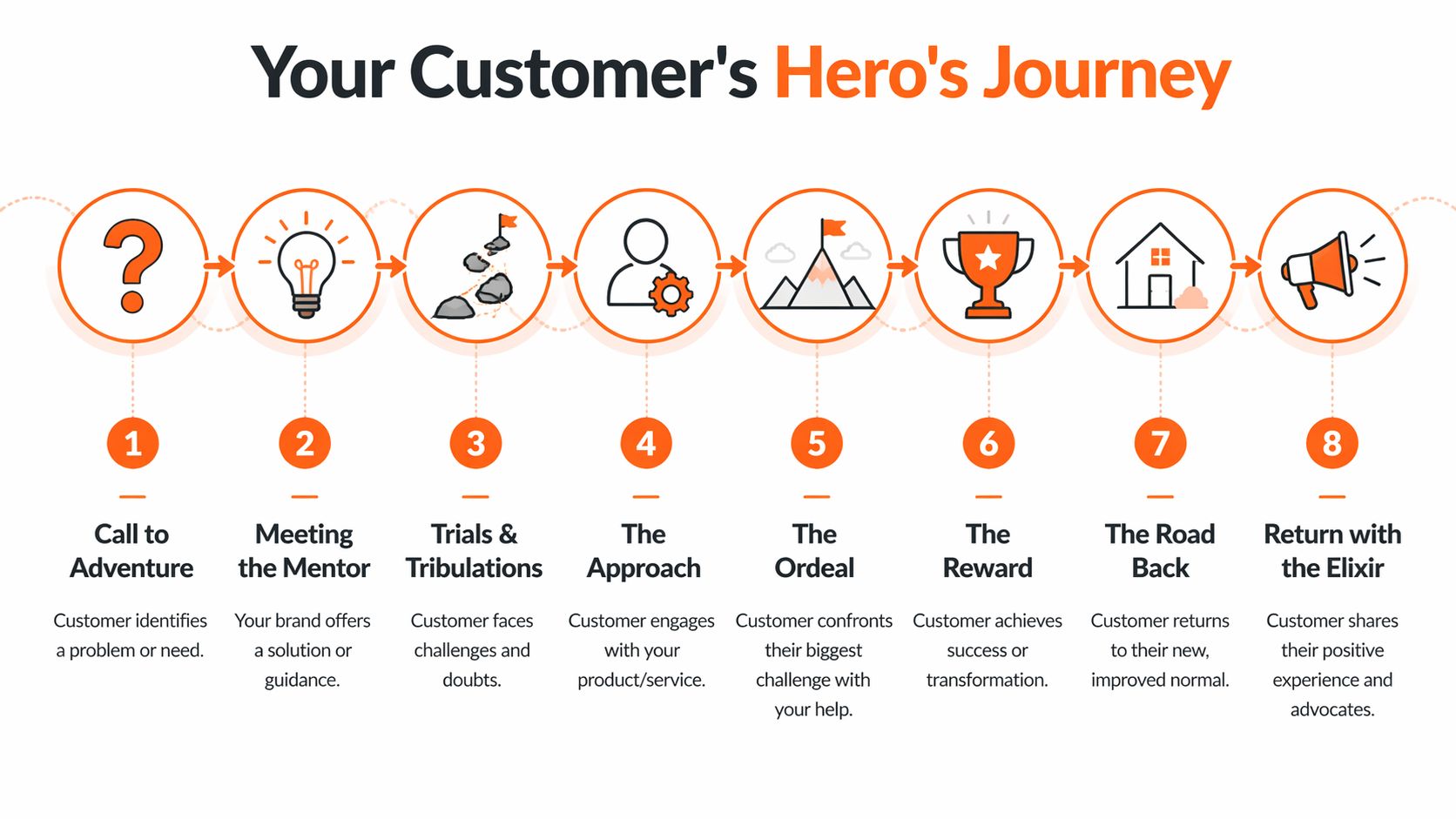
Why this framework works
People pay attention when they recognize themselves in the story.
According to the HeroGuide Brand Story Method overview, brands using the Hero's Journey framework, where the customer is the protagonist and the brand is the guide, report 22 percent higher customer loyalty and a 15 percent uplift in repeat purchases. The same source says this method leads to a 92 percent lift in comprehension.
That last point is the one I care about most. If people don't quickly understand where they are in the story, they bounce.
The eight moves that make the story click
You don't need to write a novel. You need to answer eight questions.
1. Who is the hero
Pick one real person, not a broad market.
Not "women 25 to 44." Not "small business owners." Write one living, breathing type of customer. Give them a job, a headache, a desire, and a sentence they mutter to themselves.
Example: "She's a solo skincare founder packing orders at night and trying to look confident during the day."
That works because I can see her.
2. What dragon is chasing them
This is the problem beneath the problem.
If you sell bookkeeping software, the dragon is rarely "bad spreadsheets." It's fear. Chaos. Shame. The creeping sense that they're losing control.
Name the dragon plainly. Your customer should feel exposed in a good way. Like you finally said the thing they hadn't put into words.
3. Why should they trust the guide
Here, you show empathy and authority, without chest-thumping.
Empathy says, "I get why this is hard."
Authority says, "I know how to help."
Most founders overdo authority and forget empathy. They list years of experience, logos, and features, then skip the human part. Big mistake.
People don't follow guides who only brag. They follow guides who understand the terrain.
4. What magic tool do you give them
This is your product, service, or method.
Don't describe it with jargon. Say what it helps them do. Better yet, say what pain it removes.
"An inventory dashboard" is weak.
"One place to see what to reorder before you stock out again" is better.
5. What action should they take
A good story moves.
Tell them what to do next. Buy. Book. Start. Join. Try. Apply. Don't make people decode your site like it's an escape room.
6. What bad future are they avoiding
Every strong story has stakes.
What happens if they stay stuck? More wasted time? More bad hires? More guesswork? More embarrassment? More customer churn? Don't use fear as a cheap trick. Use it to tell the truth about inertia.
7. What win do they get
Describe the transformation, not just the transaction.
The hero doesn't want your coaching package. They want confidence in sales calls. They don't want a new candle. They want their apartment to feel calm after a brutal day.
8. How do they spread the story
Great brand stories end with advocacy.
When customers win, they tell people. Reviews, referrals, reposts, texts to friends. Make your story easy to retell. If it's too abstract, it dies in the mouth.
A quick example
Here's a stripped-down version for a founder-friendly accounting service.
| Story part | Example |
|---|---|
| Hero | A first-time founder who hates finance and avoids the numbers |
| Dragon | Cash confusion and the fear of making a dumb tax mistake |
| Guide | A calm accounting team that explains things in plain English |
| Magic tool | Monthly bookkeeping and simple dashboards |
| Action | Book a cleanup call |
| Stakes | Keep guessing and lose sleep every month |
| Win | Know where your money is and make decisions without panic |
| Spread | Tell another founder, "These people finally made the numbers make sense" |
That's the structure.
If you need help turning this into a sharper one-liner, homepage message, or positioning statement, use this guide on writing a branding positioning statement.
What to cut
A few things wreck this framework fast:
- Long founder autobiography. Your customer cares less than you think.
- Feature dumping. A list of tools is not a story.
- No conflict. Without tension, your copy feels sleepy.
- Vague success. "Achieve your dreams" means nothing.
Write the story so your customer can say, "That's me, that's my problem, and that's the next step."
That is enough.
Craft Your Voice from War Stories Not Fairy Tales
A good structure helps. A real voice closes the gap.
Most founders write like they're applying for permission. They smooth every sentence until it says nothing. They remove any line that might sound too direct, too specific, too opinionated. Then they wonder why nobody remembers them.
People remember edges. They remember detail. They remember honesty.

Your best material is usually uncomfortable
Your strongest brand voice often lives inside the stories you'd rather skip.
The shipment that arrived wrong. The supplier call that made your stomach drop. The launch that flopped. The month you almost quit. The customer email that forced you to admit your offer was confusing. That's the stuff.
Not because pain is glamorous. It isn't. But because struggle proves you earned your point of view.
According to the AMA's piece on creating a signature brand story, David Aaker's framework says stories need to be intriguing and authentic, and brands that substantiate claims and build involvement through emotional hooks see 28 percent higher market share growth over 5 years. The same source notes that a lack of authenticity can trigger skepticism in 62 percent of consumers.
That should sober you up. If your story sounds airbrushed, people feel it.
Use the ABT pattern
One of the cleanest storytelling tools I know is And, But, Therefore.
It works because it forces momentum.
- And sets the scene
- But introduces tension
- Therefore gives the response
Here’s a weak version:
"We started this company because we care about quality and innovation."
Here’s a better one:
"We loved buying products online, and we believed small brands could beat giant retailers on taste and care, but we kept getting burned by weak packaging and lazy quality control, therefore we built a brand that tests every batch like our name is on the line, because it is."
Now we have movement. We have conflict. We have a reason to exist.
Field note: If your story has no "but," it usually has no pulse.
Add sticky details
"Sticky details" are small, concrete specifics that make a story believable.
Not "we worked hard."
Try "I was packing orders on my kitchen floor with a borrowed label printer."
Not "we listened to customers."
Try "I screenshotted the same complaint five times in one week and realized the problem wasn't the customer. It was our instructions."
Those details do heavy lifting. They give texture. They make your story sound lived in.
Swap these weak phrases out
- "We're passionate about excellence" becomes "We got tired of replacing cheap versions of the same tool."
- "We're customer obsessed" becomes "We answer support emails like a confused cousin wrote them."
- "We believe in community" becomes "We built this for people who are done pretending they have it all figured out."
One sounds like brochure copy. The other sounds like a person.
Keep boldness and kindness in the same sentence
Some founders hear "be bold" and turn into a cartoon. They pick fights for attention. They confuse swagger with clarity.
Don't do that.
The best voice combines spine with warmth. You can reject bad norms without sounding cruel. You can be sharp without being smug. You can say, "We think most networking is performative nonsense," and still sound like someone worth trusting.
That mix matters. Especially if you want customers, partners, and teammates who value decency but still want to win.
A simple test helps. Read your story aloud and ask:
- Does this sound like me on a good day?
- Would I say this to a customer face-to-face?
- Did I hide the hard parts to look impressive?
- Did I make any claim I can't back up?
If the answer to that last one is yes, fix it now.
A short lesson on storytelling craft can help when your writing feels stiff:
Write like someone with dirt on their boots
That's the voice you want.
Not sloppy. Not rambling. Not fake-casual. Just earned.
Here’s a simple contrast:
| Fairy tale voice | War story voice |
|---|---|
| We set out to revolutionize the category | We got fed up with the category and built what we couldn't find |
| Our mission is to empower customers | We help people stop wasting money on overhyped junk |
| We value transparency | If something breaks, we don't hide behind policy language |
| We are driven by innovation | We keep fixing what annoys customers instead of chasing shiny ideas |
The second column wins because it's concrete and it costs you something. It reveals a standard. It shows what you believe.
A brand voice worth reading isn't manufactured. It's compressed experience.
Five Storytelling Traps That Make You Sound Generic
You can have a decent business and still tell a lifeless story. I see it all the time.
The problem usually isn't effort. It's that founders fall into the same traps, and those traps flatten everything that made the business interesting in the first place.

Trap one. You cast your brand as the hero
Your customer doesn't wake up wanting to admire your journey. They wake up wanting help with theirs.
Tell your founder story when it earns its place. Don't build the whole narrative around your bravery, your grind, or your vision. That's ego in a nice jacket.
Trap two. You write in empty praise words
Passionate." "Authentic." "Premium." "Purpose-driven.
These words are so overused they've lost muscle. If you use one, prove it with a scene, a policy, or a choice. Otherwise cut it.
Most weak brand stories aren't wrong. They're unfalsifiable.
That is why they slide right past people.
Trap three. You remove the villain
A story needs friction.
The villain doesn't have to be a company. It can be a broken norm, a bad assumption, a frustrating customer experience, or a belief you reject.
If you sell planning tools, maybe the villain is chaos. If you run a local service business, maybe it's being treated like a number. If you're building in the Midwest, maybe it's the idea that you need to mimic New York, LA, or SF to look legitimate.
That last point matters more than a lot of founders realize. According to Branding by Garden's discussion of brand storytelling, Google Trends data from 2025 to 2026 shows "Midwest brand story" queries are up 150 percent, yet 90 percent of top articles remain coastal-centric. The same source says region-specific stories can boost loyalty by 55 percent in heartland markets.
So stop flattening your voice into generic startup mush. Regional values are not a limitation. They're a differentiator.
Trap four. You tell a perfect origin story
Nobody buys perfection. They buy credibility.
If your story sounds too neat, people smell the edit. Real businesses zigzag. They start for one reason and survive for another. They mess up. They learn. They sharpen.
Use that. The wrinkle is often the memorable part.
Trap five. You borrow someone else's cultural tone
This one is brutal because it often happens unconsciously.
You read enough founder content and start sounding like everybody else. Same pacing. Same jargon. Same posturing. Suddenly your candle brand sounds like a venture-backed software startup. Your coffee company sounds like a performance coach. Your consulting business sounds like a robot who got promoted.
Don't borrow tone from people whose customers you don't even want.
A fast gut-check
Run your story through this filter:
- Could this line appear on ten competitor sites?
- Did I hide where I'm from, what I value, or what I reject?
- Did I swap a real detail for a fancy adjective?
- Would my ideal customer feel seen, or just marketed at?
- Am I trying to sound important instead of useful?
If two or more answers make you squirm, your story needs surgery.
The fix is rarely more cleverness. It's more honesty.
Your Story Is Alive Use It Everywhere
A brand story is not an About page artifact. It's a working tool.
Once you've got the core story right, use it everywhere a person touches your business. Not by copy-pasting the same paragraph into every channel. By letting the same truth show up in different forms.
If your story only exists on one page, it isn't doing its job.
Put it in the places people feel first
A lot of founders hide their best story where almost nobody looks. That's backwards.
Start where people make snap judgments.
Your homepage
Lead with the customer problem, your belief, and the promised transformation. Don't force visitors to scroll through vague lifestyle copy before they know what you do.
Your product pages
Add short story signals. Why this product exists. What frustration it solves. What standard you refused to compromise on.
Your email welcome sequence
This is one of the best places to sound human. Tell the short version of why you started, what you stand for, and what kind of experience people should expect from you.
Your social bios and pinned posts
Don't waste these on category labels alone. Give people a sentence with a point of view.
Use the story as a filter, not just a message
This is the part people miss.
A living story doesn't just attract customers. It helps you make decisions.
When you're hiring, ask whether the candidate fits the values in the story.
When you're choosing a partnership, ask whether the other brand strengthens the story or muddies it.
When you're building a new offer, ask whether it fits the promise your story makes.
A good brand story saves you from dumb growth.
It keeps you from chasing revenue that costs you your identity.
Translate the same core into different channels
Different places need different versions. Same truth. Different outfit.
| Touchpoint | What the story should do |
|---|---|
| Investor pitch | Show conviction, category insight, and why this team will stick with the problem |
| Packaging | Reinforce taste, care, standards, or worldview in a few crisp lines |
| Customer support | Prove your values under pressure |
| Founder interviews | Add war stories and decisions that shaped your standards |
| Job descriptions | Signal what kind of teammate will thrive with you |
That consistency builds trust. People don't need every sentence to match. They need the business to sound like itself.
Keep updating it as you earn new truth
Your first brand story won't be your final one. Good.
You learn by selling. By shipping. By hearing objections. By seeing what customers repeat back to you. By surviving rough patches. The core belief often stays. The language gets sharper.
A simple maintenance habit helps:
- Review customer feedback regularly
- Save exact phrases customers use
- Notice which stories people repeat back
- Cut parts of your story that no longer feel earned
- Strengthen the parts that reflect lived experience
If your brand has multiple channels, this guide to an omnichannel marketing strategy can help you carry one story across all of them without sounding repetitive.
What I’d do this week
If I were in your seat, I'd do five things.
- Write the ugly draft first. No polishing. Just truth.
- Circle every vague adjective. Replace it with a detail, a choice, or a belief.
- Rebuild the story around the customer. Make yourself the guide.
- Read it out loud. If you sound like a brochure, rewrite it.
- Use it in one real place. Homepage, sales page, email, packaging. Don't let it sit in a doc.
Your story is your declaration of intent. It tells people how you win, who you serve, and what you refuse to become along the way.
Write it with kindness. Write it with backbone. Then live up to it.
If you're a kind, bold, hard-working founder in Chicago or the Midwest and you want a room full of people who'll help you sharpen your story without the usual networking nonsense, check out Chicago Brandstarters. It's a free, vetted community where founders share honest war stories, get useful feedback, and build real relationships while growing from idea stage toward seven figures.
Leave a Reply