You’re probably here because you’ve tried to explain your business and felt the room go soft.
Someone asks what you do. You start strong, then you drift into features, edge cases, maybe your origin story. Two minutes later, you can hear yourself losing them. That’s not a charisma problem. It’s not a logo problem either.
It’s a clarity problem.
I’ve seen a lot of early founders waste months polishing visuals before they’ve nailed the sentence that tells the truth about who they serve, why they matter, and why anyone should care. Big companies can afford that kind of sloppiness for a while. You can’t. You need a branding positioning statement early, and you need it to be sharp.
I don’t treat this like a corporate worksheet. I treat it like a survival tool. If you’re a kind, serious founder in the Midwest, you already know the game can feel lonely. You don’t need more performative advice from people who’ve never shipped anything. You need language that helps you make decisions when things are messy.
That’s what this is.
Your Brand's North Star Why Positioning Matters More Than Your Logo
You don’t need a prettier brand first. You need a clearer one.
A branding positioning statement is the sentence that keeps your business from turning into a junk drawer. It tells you who you’re for, what lane you’re in, what outcome you deliver, and why people should believe you. It’s internal first. Your customers may never see it word for word, but they’ll feel it in everything you do.

Why I care more about this than your visual identity
Founders love to tweak colors because colors don’t force hard choices.
A positioning statement does. It forces you to answer questions that sting a little. Who are you not for? What problem are you solving? Why should someone trust you if they’ve never heard of you? If you can’t answer those, your brand won’t hold together.
And when your brand doesn’t hold together, your channels drift. Your website says one thing. Your packaging says another. Your Instagram tries to be funny. Your sales call sounds cautious. People leave confused, not convinced.
That confusion costs money. Forms.app’s brand positioning statistics cite Marq showing that brands with a consistent identity see average revenue increases of 10% to 20%.
Practical rule: If your brand takes five minutes to explain, you don’t have positioning. You have scattered thoughts.
What this sentence actually does for you
Think of your positioning statement like a lighthouse, not a billboard.
A billboard tries to attract attention. A lighthouse helps you find your way. When you’re deciding what feature to build, what retail pitch to make, what creator to partner with, or what copy to put above the fold, this sentence keeps you from drifting into random acts of marketing.
It also makes you calmer. I mean that seriously.
A founder with clear positioning says no faster. That matters. Most early-stage pain comes from chasing too many almost-right opportunities. A solid positioning statement lets you reject customers, channels, and partnerships that don’t fit. That kind of restraint looks boring from the outside. It’s how durable brands get built.
Forget 'Target Audience' and Find Your People
I don’t care about your fake persona named “Sarah, 33, urban professional.”
That stuff can help a big company organize a spreadsheet. It usually doesn’t help a founder build a brand people feel. A real brand starts when you stop asking, “Who could buy this?” and start asking, “Who do I want to build this for?”

Demographics are lazy. Patterns matter.
Age, income, and ZIP code don’t tell me enough.
I want to know what your people believe. I want to know what they’re tired of. I want to know the moment when they put their head in their hands and say, “I can’t keep doing it this way.” That’s where positioning starts.
Cleverize’s breakdown of positioning mistakes says up to 70% of underperforming brands miss their commercial potential because they rush the insight phase and don’t understand the customer’s core problem. I buy that. I’ve watched founders skip the hard listening part and then wonder why their messaging feels thin.
Find the people you’d actually enjoy serving
I like values-based filters because they make your brand human.
If you’re building for kind, bold, hard-working people, say that. If you don’t want to serve status-chasing tourists, say that too. Positioning gets stronger when you define the social and emotional shape of your audience, not just the market segment.
A few prompts I use:
- Shared frustration: What pattern keeps making your people angry, embarrassed, or stuck?
- Shared value: What do they respect that the market around them ignores?
- Shared language: What exact phrases do they use when they describe the problem?
- Shared identity: What kind of person are they trying to become?
That last one matters more than most founders think. People don’t just buy solutions. They buy identity reinforcement.
Your best customers aren’t “everyone who needs this.” They’re the people who feel seen when you describe the problem.
Good audience work sounds specific
Here’s weak audience language:
- Too broad: Small business owners
- Too shallow: Women aged 25 to 40 who shop online
- Too generic: Busy professionals who want convenience
Here’s stronger audience language:
- Problem-led: First-time consumer founders who feel outmatched by packaging vendors
- Values-led: Midwestern operators who hate transactional networking and want honest feedback
- Moment-led: Side-hustle builders who have traction but still can’t articulate their brand
That kind of language gives you something to work with. You can write copy from it. You can build product features from it. You can decide what conversations to join and which ones to skip.
This video does a good job showing how sharper brand thinking changes the way you talk about your business.
A simple way to pressure-test your audience definition
Read your audience line out loud and ask yourself three questions:
- Would that person recognize themselves in it?
- Does it include a real problem, not just a category label?
- Does it exclude people who aren’t a fit?
If the answer is no, you’re still describing a market. You haven’t found your people yet.
And yes, this part can feel vulnerable. It means choosing. It means admitting you’re not for everybody. Good. That’s the whole point. A brand that tries to welcome everyone usually ends up resonating with nobody.
Crafting Your One-Sentence Superpower
Writing the statement isn’t the hard part. Choosing the core message is.
Most branding content hands you a formula and leaves you alone with a blinking cursor. That’s why so much startup positioning sounds like it came from a committee that fears personality. Brandwatch’s guidance on brand positioning statements notes that only 12% of articles even touch community-driven feedback. That gap matters because founders rarely get to strong positioning in isolation.
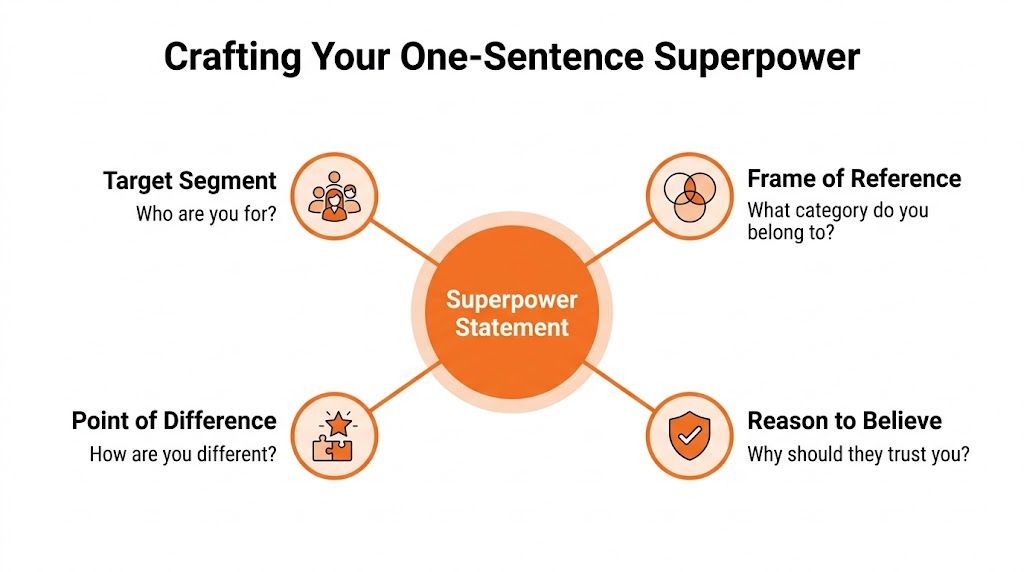
Use the recipe, not the corporate voice
I use this structure:
For [your people], who [have a problem], [your brand] is the [category] that [unique benefit] because [proof].
It’s simple on purpose. It's similar to cooking. You need four ingredients. Not seventeen. If one ingredient is weak, the dish tastes flat.
| Ingredient | What it does | The mistake I see most |
|---|---|---|
| Target | Anchors the statement in a real person | Going broad to avoid excluding anyone |
| Category | Gives buyers a mental shelf to place you on | Inventing a weird category nobody understands |
| Benefit | Creates desire | Listing features instead of outcomes |
| Proof | Makes the claim believable | Writing hype with no reason to trust it |
Ingredient one is your people
Don’t write “for everyone.” Don’t even think it.
Write the smallest meaningful group that can create momentum for you. Early on, narrow beats broad. A tight audience gives you stronger word of mouth, clearer messaging, and more honest feedback.
Bad:
“For busy consumers”
Better:
“For first-time skincare founders selling online who feel overwhelmed by packaging and compliance decisions”
That second one gives you friction, stakes, and context.
Ingredient two is the category
This part gets weird fast because founders want to sound original.
Don’t be original here before you’re clear. Category tells people what kind of thing you are. If buyers can’t place you mentally, they have to work too hard. And people don’t work that hard for a new brand.
You don’t need the biggest pond. You need the right one.
A few examples:
- A solo operator might be a fractional brand strategist
- A food startup might be a small-batch pantry brand
- A software product might be a customer research tool for ecommerce teams
If you need help getting sharper on differentiation inside your category, this guide on examples of product differentiation is useful because it pushes you past generic “quality” claims.
My advice: Choose a category that customers already understand, then sharpen your difference inside it.
Ingredient three is the benefit
At this point, founders usually hide behind features.
Nobody cares that your product uses a proprietary workflow, a custom dashboard, or premium materials until they understand what that means for them. Translate the feature into a change in their life or work.
A simple trick helps. Finish this sentence:
Which means that they can…
For example:
- “We use a guided intake process,” which means that clients can make decisions faster and stop second-guessing every brand choice.
- “We roast in small batches,” which means that customers get a fresher, more distinct flavor they will notice.
- “We organize scattered customer interviews,” which means that teams can spot patterns without rereading a dozen transcripts.
The benefit should hit both function and emotion. Better outcomes matter. Relief matters too.
Ingredient four is proof
Early founders get stuck here because they think proof only means revenue, case studies, or a giant customer list.
That’s false.
Proof can be process, expertise, lived experience, testing rigor, waitlist interviews, pilot feedback, technical credibility, sourcing discipline, or a strong point of view that came from real pain. You don’t need fake polish. You need believable evidence.
Here are legit forms of proof when you’re early:
- Founder credibility: You worked in the problem space long enough to know the traps.
- Method: You built a repeatable process instead of winging every engagement.
- Access: You have supplier relationships, technical skill, or community trust others don’t.
- Signals: Beta users, pilot conversations, testimonials from early collaborators, or strong qualitative feedback.
Three rough drafts that get better fast
Let’s make this practical.
Weak draft
For small businesses, Acorn helps with marketing by using smart tools and personalized service.
Stronger draft
For service businesses that rely on referrals and have outgrown DIY marketing, Acorn is a hands-on marketing partner that clarifies their message and turns expertise into consistent content because the founder builds every strategy from direct customer interviews and operator experience.
Weak draft
For people who like hot sauce, River Flame is a sauce brand with bold flavor.
Stronger draft
For home cooks who want depth, not just heat, River Flame is a small-batch hot sauce brand that adds layered flavor to weeknight meals because each recipe is built around real ingredients and tested for both spice and food pairing.
You can feel the difference. The strong versions create a picture in your head. They sound like they belong to someone.
Real-World Positioning Statements from the Trenches
Theory is cheap. Examples help.
Most articles grab household brands because they’re easy to admire from a distance. That doesn’t help when you’re building from your kitchen table or trying to get your first ten customers. So here are realistic before-and-after examples for the kinds of founders I meet all the time.
Good vs. Bad Positioning Statements
| Brand Type | Weak Statement (Before) | Strong Statement (After) |
|---|---|---|
| DTC hot sauce brand | We make premium hot sauce for spice lovers who want quality ingredients. | For home cooks who are bored with one-note heat, Ember Pantry is the small-batch hot sauce brand that adds depth and character to everyday meals because we build every recipe around whole ingredients and real food pairings, not shock-value spice. |
| Solo freelance consultant | I help businesses grow with marketing, branding, and strategy support. | For founder-led consumer brands that have traction but muddled messaging, Lena Ortiz is the brand strategist who turns scattered ideas into a clear story customers can repeat because she combines operator experience with structured customer interviews and message testing. |
| Pre-revenue SaaS tool | We use AI to help companies understand their customers better. | For small ecommerce teams drowning in interview notes and survey responses, Signal Loop is the customer research tool that turns messy feedback into usable positioning insights because it organizes recurring themes and helps founders compare language across conversations. |
What changed in each example
The weak statements all have the same disease. They’re technically fine and emotionally dead.
They use broad words like “premium,” “grow,” and “better.” Those words aren’t lies. They’re just empty without context. The stronger versions do three things better:
- They name a sharper person. Not all spice lovers. Not all businesses. Not all companies.
- They define the pain. Bored meals. Muddled messaging. Drowning in feedback.
- They offer proof that feels grounded. Whole ingredients. Operator experience. Organized recurring themes.
That’s the whole game. Clear person, clear pain, clear promise, clear reason to believe.
One fast editing exercise
Take your current statement and underline every vague word.
Words like these usually need fixing:
- Premium
- Original
- Integrated
- Quality
- Enabling
- End-to-end
Now replace each one with a concrete truth.
If you wrote “premium,” what do you mean? Better materials? Slower production? More thoughtful design? A higher trust standard? State it precisely.
If you need more inspiration, these brand positioning examples show how different businesses sharpen the same basic framework in different directions.
A strong statement feels like it could only belong to your brand. A weak one could be copied onto ten competitors’ websites without anyone noticing.
How to Know If Your Statement Is a Winner or a Dud
You’re in a founder meetup. Someone asks what your company does. You say your positioning statement out loud, and the table goes polite. A couple nods. Nobody asks a follow-up. That’s a dud.
A winning statement creates traction. The right customer feels seen. A peer who knows your market can repeat it back in plain English. Your team starts using the same words without forcing it.
Put it through a real stress test
I use five questions.
Is it true?
If your product, service, or customer experience can’t back up the claim, cut it.Is it specific enough to exclude people?
Good positioning leaves some people out. If everybody can nod along, you have not made a choice.Does the right person care right away?
A real advantage matters to buyers. Internal jargon does not.Can someone else in your category say the same thing?
If yes, keep rewriting until the sentence sounds like it belongs to you and only you.Can your team use it to make decisions?
A strong statement helps you choose what to build, how to talk, and what to ignore.
That last one matters more than founders admit. Pretty language is cheap. Decision-making language is what changes a business.
Test it with people who will tell you the truth
Skip the giant survey. You need a small circle of honest humans.
For kind, community-minded founders, this part should not be a sterile brand exercise. It should feel more like a kitchen-table conversation with people who want you to get clearer, not just look polished. I trust feedback from customers, peers, and operator friends who are willing to say, "I still don’t get it," without making you feel stupid.
Ask them questions that force clarity:
- What do you think we sell?
- Who does this sound like it’s built for?
- What part feels generic?
- What claim do you doubt?
- What would make this easier to believe and repeat?
If people give you soft praise and no sharp reaction, press harder. Midwestern nice can hide confusion. I’d rather hear an awkward truth now than pay for fuzzy messaging for the next year.
Use AI to spot patterns, then bring the answer back to humans
AI is useful for comparison work. HBS Online’s article on brand positioning statements covers how founders are using AI tools to draft and refine positioning.
Use it for the grunt work. Ask it to line up your statement against competitor copy, flag repeated category clichés, or show where your wording sounds broad. Then review those outputs with actual people who know your customer.
AI can tell you what sounds similar. Your community can tell you what feels honest.
One practical test most founders skip
Try to use your statement in three places this week: a sales call, your homepage draft, and a short founder intro at an event. If the sentence keeps getting shortened, translated, or abandoned, that is useful information. It means the statement still has too much corporate air in it.
If you want help turning a positioning line into messaging people can understand, this guide on how to brand a product clearly and consistently will help.
Bringing Your Positioning to Life
A branding positioning statement sitting in a doc is dead weight.
You have to use it. Daily. In small decisions, not just big brand projects. That sentence should shape your homepage headline, your product roadmap, your outreach, your packaging language, your sales deck, and the people you hire.
Where the statement should show up
Run every major brand choice through it.
- Website copy: Does the first screen speak to your actual people and their problem?
- Product decisions: Does the next feature strengthen your core promise or distract from it?
- Partnerships: Will this collaboration reinforce your position or muddy it?
- Hiring: Does this person understand how your brand should sound and behave?
This is why alignment matters so much. Kedraco’s article on branding positioning statements says strong, internally aligned positioning can lead to up to 33% higher marketing ROI.
Clarity saves you from expensive drift
When your positioning is clear, your “no” gets cleaner.
You stop chasing customers who drain your team. You stop posting content that gets attention from the wrong crowd. You stop building side features that don’t fit your core promise. That kind of discipline compounds.
If you’re figuring out how to translate the statement into actual customer-facing brand choices, this practical guide on how to brand a product is a useful next step.
Your positioning statement is the source code. Everything visible in your brand is just the interface.
Your Burning Positioning Questions Answered
Is a branding positioning statement the same as a tagline
No.
A branding positioning statement is an internal strategic sentence. A tagline is public-facing copy. Your statement guides decisions. Your tagline grabs attention. Sometimes a tagline grows out of the statement. They are not the same thing.
Is it the same as a mission statement
Also no.
Your mission is about why your company exists at a big-picture level. Your positioning is about the specific place your brand wants to occupy in a buyer’s mind. Mission is broad. Positioning is sharper and more tactical.
How long should it be
Short enough that you can say it without gasping for air.
Usually one sentence is enough. Two is fine if the first version still feels cramped. Once you hit paragraph length, you’re explaining around the truth instead of stating it.
What if I’m pre-revenue and have no proof
You still have proof options.
Use founder credibility, process, pilot feedback, interviews, prototypes, sourcing discipline, or a clear method. Don’t make up traction. Use what’s real. Believable beats impressive.
Should I position around features or values
Start with the customer problem and the outcome. Then bring in values if they shape how you solve it.
Values alone can sound soft. Features alone can sound cold. The sweet spot is a clear promise delivered in a way your people respect.
How often should I revisit it
Revisit it when the business changes meaningfully.
New market, new product line, new customer behavior, new competitive reality. Don’t rewrite it every week because you’re anxious. Rewrite it when the facts on the ground change.
What’s the fastest way to improve a weak statement
Cut broad language. Add friction.
Replace “small businesses” with the specific group. Replace “high-quality solutions” with the actual outcome. Replace “cutting-edge” with the actual proof. Strong positioning usually comes from subtraction before addition.
If you want a place to pressure-test your branding positioning statement with kind, serious founders who’ll give you honest feedback instead of networking theater, take a look at Chicago Brandstarters. It’s a free vetted community for Chicago and Midwest builders working from idea stage through growth, with private dinners and real operator conversations.
Leave a Reply