

You’ve probably done this already. You found a product that looks promising, opened up Amazon, searched the category, and thought, “I can sell this.” Then the second thought hit you harder: “After Amazon takes its cut, will there be anything left?”
That’s the right question.
Too many new founders obsess over launch tactics, listing images, or logo colors before they understand the cost of selling on amazon. That’s backwards. If the math is bad, better branding just helps you lose money faster.
I’ve seen people treat Amazon like a gold rush. It’s not. It’s more like renting a booth inside the busiest mall in the country, except the landlord also controls the checkout, traffic, shipping rules, and customer relationship. You can build a real business there. You can also get squeezed from every side if you walk in blind.
The founders who last are the ones who respect the fee stack early. They know Amazon is a tool, not a savior. They also know one policy mistake can create headaches that have nothing to do with product quality, which is why it’s worth learning from real Amazon account suspension stories and prevention lessons before you scale.
So You Want to Sell on Amazon
A new founder usually starts with the same movie playing in their head. You get a sample in your hands. The product looks solid. You imagine the listing going live, the first reviews coming in, the Prime badge doing its thing, and your phone buzzing with orders.
Then reality shows up with a calculator.
Amazon doesn’t take one fee. It takes a series of cuts. Some are obvious. Some are quiet. Some only matter after you’ve already wired money to a supplier and committed to inventory. That’s where people get hurt. They think, “I’m selling a product for a healthy retail price, so I must have margin.” No. Revenue is not margin. A product can look great on a listing and still be a terrible business.
You don’t have an Amazon business until you know what’s left after every toll, every shipment, every return, and every ad click.
I want you to approach Amazon like an operator, not a fan. Don’t ask whether Amazon can generate sales. Of course it can. Ask whether your unit economics survive the platform. Ask whether your product can carry the weight of fees, shipping, storage, and competition without folding.
That’s the unfiltered truth about the cost of selling on amazon. If you learn the tolls, you can use the platform well. If you ignore them, Amazon will turn your side hustle into an expensive lesson.
Understanding Amazon's Main Tolls
You can lose money on Amazon before fulfillment, ads, or returns even enter the picture. I’ve watched founders price a product, see room for margin, and still get blindsided because they never got clear on the two platform charges that hit first.

Get these wrong and everything else sits on a bad foundation.
Your selling plan
Amazon gives you two seller plans: Individual or Professional. Amazon’s own Seller Central fee pages lay out the structure. Individual sellers pay $0.99 per item sold. Professional sellers pay a monthly subscription fee instead of that per-item charge, as shown on Amazon’s selling plan overview.
Here’s my advice. Use Individual only if you are testing demand and expect low volume. If you plan to build a real brand, switch to Professional as soon as the math justifies it.
The break-even is simple. Once you get near 40 units a month, the Individual fee starts costing about the same as the Professional subscription. Past that point, staying on Individual is penny-wise and operator-stupid. You save a little cash while giving up tools you need to run the account properly.
Professional matters for another reason. It gives you access to features serious sellers use, including bulk listing and advertising access. If you want to manage Amazon like a business, not a weekend experiment, stop treating the monthly plan like an optional luxury.
The plan decision is really an operating decision
Founders get this wrong because they frame it as a “save money” choice. It isn’t. It’s a capability choice.
- Choose Individual for a controlled test. Use it when you are validating a product and want the lightest fixed cost.
- Choose Professional once volume is real. The per-item fee becomes dead weight fast.
- Choose Professional earlier if you need the tools. Better controls and workflow matter before your sales volume looks impressive.
I’ll put it bluntly. Cutting the subscription while slowing down your operations is not discipline. It’s self-sabotage.
Practical rule: Pay for the tools that help you protect margin and make decisions faster.
Referral fees are Amazon’s built-in commission
Every sale also gets hit with a referral fee. This is Amazon’s commission for putting your product on its marketplace. The rate depends on the category, and Amazon lists category-specific percentages in its referral fee schedule.
That category detail matters more than new sellers expect. You cannot assume the same margin structure works across products just because the retail price looks similar. A product in one category can carry Amazon’s cut just fine. A nearly identical product in another category can get squeezed hard.
Referral fees come off the top. Before you pay your supplier. Before freight. Before packaging. Before ads. Treat that percentage like fixed rent on every order and bake it into your price from day one.
The simple mental model
Use this order when you check whether a product has a shot:
| Toll | What it does | Why you should care |
|---|---|---|
| Selling plan | Charges per item or per month | Changes your break-even and your access to operating tools |
| Referral fee | Takes a category-based cut of each sale | Cuts into every order before any other business cost |
Know these two numbers cold. If you don’t, you are not evaluating a product. You are guessing.
The FBA Versus FBM Fulfillment Debate
You make your first few sales, feel the momentum, then spend your evening printing labels, answering where-is-my-order messages, and realizing Amazon is not just a marketplace decision. It is an operating model decision.
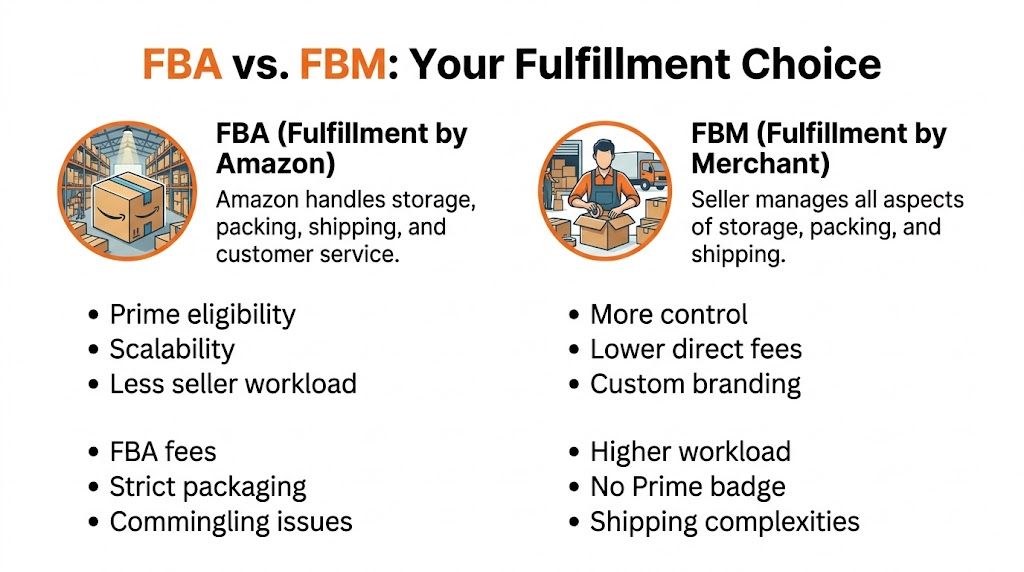
FBA buys speed and labor, but it charges for both
With FBA, Amazon stores your inventory, ships orders, handles customer service, and processes returns. Amazon publishes its current FBA fulfillment charges in the Fulfillment by Amazon fee schedule, and those fees rise fast once your product gets bigger, heavier, or slower to move.
That trade can be worth it.
FBA usually gives you a cleaner customer experience, better Prime alignment, and less day-to-day operational drag. If you are trying to build a real business instead of a part-time packing routine, that matters. Time has a cost. Missed focus has a bigger one.
But I see new founders make the same mistake over and over. They compare FBA to their current postage cost and call it expensive. That is the wrong comparison. FBA replaces warehouse space, pick and pack labor, shipping software, customer service workload, and a lot of avoidable chaos. You still need to check whether the math works, but at least compare it to the full job Amazon is taking off your plate.
FBM can protect margin, if you run operations well
With FBM, you hold the inventory and fulfill orders yourself or through your own warehouse or 3PL. You control packaging, carrier choice, and the post-purchase experience more directly.
That control can be valuable if your product is oversized, fragile, bundled, made to order, or awkward for Amazon’s warehouse system. SellerApp’s breakdown of FBA vs. FBM differences also points out the practical tradeoff. FBM gives sellers more control, while FBA reduces fulfillment work.
Control is not the same as efficiency.
If your team is small, your processes are loose, or your shipping volume is inconsistent, FBM gets messy fast. Late shipments, support tickets, replacement orders, and your own time all hit margin. Amazon’s fee is visible. Your operational sloppiness is harder to see, so founders underestimate it.
How I would decide
I would not choose based on ideology. I would choose based on what breaks first in your business.
Use FBA if:
- You want Prime-friendly fulfillment without building your own shipping operation
- Your product is standard-size and simple to pack
- Your time is better spent on sourcing, pricing, and conversion than on warehouse work
- You need a system that can handle growth without turning your week into manual fulfillment
Use FBM if:
- Your product is bulky, fragile, custom-packed, or slow-moving
- You already have strong fulfillment operations or a reliable 3PL
- You need tighter control over packaging or the customer experience
- FBA fees would crush your margin because of size, weight, or storage profile
The other decision that sits beside this one is your selling plan. Amazon’s own selling plan comparison shows the Individual plan works for lower volume sellers, while the Professional plan is built for sellers who want ads, more reporting, and broader selling tools. If you plan to push volume, treat the Professional plan as part of your operating stack, not a nice-to-have upgrade.
If your product wins because it arrives fast and without friction, fulfillment is part of the offer, not back-office admin.
My blunt advice for new founders
Start with FBA if your product is simple, margin can support it, and you want to learn Amazon before building a mini logistics company.
Start with FBM if your product economics clearly favor it and you already know how you will ship accurately, quickly, and without draining your week.
Do not pick FBM because it feels scrappy and hands-on. Scrappy is overrated when it creates shipping errors and steals your time. Do not pick FBA because Amazon makes it look easy either. Easy can still be expensive.
Pick the model that leaves you with more profit after all the necessary work gets counted. That is the standard. Not convenience. Not ego. Not vanity revenue.
Hidden Costs That Silently Kill Your Margin
You launch a product at a price that looks profitable on paper. Amazon takes its referral fee. Fulfillment gets paid. Sales start coming in. Then your margin keeps shrinking anyway.
That’s usually the moment a founder realizes the obvious fees were never the full story.

Customer acquisition belongs in your unit economics
I see new sellers make the same mistake over and over. They treat Amazon traffic like free demand instead of paid attention.
On a crowded listing page, visibility costs money. If your product needs Sponsored Products, coupons, or launch discounts to get moving, those costs belong in your margin model from day one. Not later, after you’ve already convinced yourself the SKU works.
The practical rule is simple. If a product cannot survive with realistic ad spend attached, it is not a healthy Amazon product.
Storage fees usually start with bad forecasting
Storage is not just a warehouse charge. It’s the bill you pay for over-ordering, shipping too much too early, or refusing to admit a SKU is slow.
I’ve watched founders send in months of inventory because they were scared of stocking out. Then the listing converts worse than expected, ad costs rise, and the units sit. Amazon keeps charging while you wait for a turnaround that may never come.
This gets worse when inbound planning is sloppy. If you are still figuring out shipping and prep, get clear on the logistics before you flood FBA with inventory. A guide to freight forwarders for Amazon FBA can help you set up inbound flow without creating expensive stock problems.
Returns and removals hit harder than founders expect
Returns are part of the business. Pretending your category will be different is lazy forecasting.
Every return can pile on extra costs. You may eat the return processing fee, lose sellable inventory, pay for repackaging, or discover the product comes back damaged and unsellable. Then come removal or disposal fees if the stock is not worth keeping in Amazon’s network.
These charges feel small one by one. Across a weak SKU, they stack up fast.
The founders who keep margin usually are not the loudest marketers. They are the operators who catch bad inventory decisions early.
Peak season changes the math
Holiday demand can lift revenue and still hurt profit.
Amazon adds peak season surcharges to fulfillment during the holiday window, as noted earlier. If your product already runs on thin contribution margin, that extra cost can wipe out the upside from higher volume. This matters even more for bulky or low-priced items, where a small fee increase has an outsized effect on profit per unit.
Do the math before Q4, not during it.
A quick explainer can help if you’re still wrapping your head around how these layers stack.
What new sellers usually miss
Hidden costs rarely show up alone. They travel in groups.
- Ads raise the breakeven point. A listing with weak conversion needs more spend to stay visible.
- Slow sales create storage drag. Inventory sits longer and ties up cash.
- Returns expose weak products. Confusing listings, bad sizing, and quality issues all get expensive.
- Peak surcharges squeeze thin-margin SKUs. Volume goes up while per-unit profit gets worse.
I tell founders to ask a better question. Don’t ask what Amazon charges in isolation. Ask what your SKU triggers after it goes live.
That is how you protect margin.
How to Calculate Your Real Amazon Profit Margin
You launch a product at $24.99, watch the first orders roll in, and assume you’re making money. Then the payout hits, ad spend lands, freight gets booked, and the margin you thought you had turns out to be thin or nonexistent.
I’ve seen this mistake over and over. Founders obsess over revenue screenshots and ignore the fee stack. Amazon gets paid first. You get what survives.
The fix is simple. Build your margin from the sale price down, and force every cost into the sheet before you place the next reorder.
What belongs in the model
Use one tab per SKU. Keep it blunt and ugly. Pretty spreadsheets hide bad businesses.
Your sheet should include:
- Sale price
- Amazon referral fee
- Selling plan allocation
- FBA fee or true FBM fulfillment cost
- Inbound freight to Amazon or your warehouse
- Packaging and prep
- Landed product cost
- Storage allowance
- Advertising allowance
- Returns allowance
That’s your real starting point. If a cost touches the unit, it goes in the model.
A lot of new sellers sabotage themselves with one lazy shortcut. They use the factory quote as COGS and stop there. That number is incomplete. Your real product cost includes freight, duties, prep, and any packaging changes you needed to make the product sellable.
Use a contribution margin view first
I care about contribution margin before I care about net business profit.
Why? Because SKU decisions happen at the unit level. If one item can’t carry its own fees, ad spend, and landed cost, it does not deserve more inventory. You do not fix weak unit economics with optimism.
Here’s the basic formula I use:
Contribution margin per unit = Sale price – Amazon fees – fulfillment cost – inbound freight – packaging/prep – landed product cost – ad allowance – returns allowance – storage allowance
Then calculate margin percentage:
Profit margin % = Contribution margin per unit / Sale price
That gives you a number you can manage.
A simple example
Let’s say you sell a kitchen gadget for $30.
Your sheet might look like this:
| Line Item | Amount |
|---|---|
| Sale price | $30.00 |
| Referral fee | $4.50 |
| Fulfillment fee | $5.25 |
| Selling plan allocation | $0.20 |
| Inbound freight | $1.10 |
| Packaging and prep | $0.65 |
| Landed product cost | $8.40 |
| Storage allowance | $0.35 |
| Advertising allowance | $3.00 |
| Returns allowance | $0.80 |
| Net profit per unit | $5.75 |
That leaves you with a margin of about 19%.
Now consider the key lesson. Nothing in that example is outrageous on its own. The problem is the stack. Amazon businesses rarely die from one giant fee. They die from six ordinary costs that the founder treated like rounding errors.
Why your first estimate is usually wrong
Early models are almost always too generous.
Founders undercount freight. They ignore prep. They assume ad costs will come down fast. They model return rates as if customers will behave exactly the way the product team hoped. They forget that one packaging choice can push a product into a worse fulfillment bracket.
That is why I want you to use conservative assumptions on the first pass. If the SKU still looks healthy, keep going. If it only works with best-case numbers, walk away.
One more thing. Build your model before inventory is on the water, not after. If you need help pressure-testing shipping assumptions, talk to people who understand freight forwarding for Amazon FBA. Bad freight math can wreck a product before the listing has momentum.
Model each SKU, not some fake average
A compact beauty item and a bulky kitchen product do not deserve the same template assumptions.
Small products usually give you more room for error. Larger products punish mistakes fast. More size means more fulfillment pressure, more storage exposure, and less tolerance for sloppy forecasting. That changes what a “good” margin looks like.
I want you to model the exact SKU in front of you. Use its actual dimensions, actual packaging, actual freight path, and realistic ad dependence. Generic averages are how founders talk themselves into weak products.
My rule for saying yes
I approve a SKU when the margin still looks solid after I’ve added the annoying costs people like to leave out.
If your product only works on a clean spreadsheet, it does not work. If it can survive fees, freight, ads, returns, and slower sell-through, then you have something worth building around.
That’s the bar. Use it.
Your Playbook for Lowering Amazon Fees
You won’t beat Amazon by complaining about fees. You beat Amazon by designing your business around them.
That means you stop treating cost control as bookkeeping and start treating it like strategy. Every lever matters. Packaging matters. inventory timing matters. Ad discipline matters. Even your willingness to remove a bad SKU matters.
Start with the product itself
The easiest dollars to save are often built into the physical product before it ever hits a warehouse.
- Trim packaging aggressively. Smaller, lighter products usually create less pressure on fulfillment economics.
- Avoid unnecessary complexity. Fancy inserts, oversized boxes, and clunky bundles can make a product feel premium while wrecking margin.
- Design for clean prep. The less fiddly your product is to label, bag, or bundle, the fewer operational headaches you create.
A lot of founders try to market their way out of bad unit economics. I’d rather fix the object.
Treat inventory like cash in a different outfit
Inventory is not a trophy. It’s cash you can’t spend.
The founders who stay healthy on Amazon usually develop boring habits. They reorder with discipline. They watch sell-through closely. They don’t send in giant piles of inventory just because the factory minimum made them nervous.
Here’s a working checklist I’d use:
- Forecast conservatively. Optimism belongs in branding, not purchasing.
- Watch aging inventory weekly. Don’t wait until stale stock becomes a fee problem.
- Remove weak products fast. A mediocre SKU can keep charging rent long after you’ve emotionally moved on.
Run ads like an investor, not a gambler
Advertising is where many sellers unwittingly give back whatever margin they thought they had.
You do need visibility. But visibility without profit is vanity. If a campaign is teaching you, fine. If it’s just burning money to preserve your hope, kill it.
The best ad strategy for a weak product is usually not better ads. It’s a better product, a sharper listing, or a lower-risk SKU.
I like simple rules here:
- Separate testing from scaling. Don’t pretend every spend is strategic.
- Judge campaigns by contribution to profit. Clicks don’t pay invoices.
- Fix conversion before increasing spend. More traffic into a bad listing just multiplies waste.
Audit the account like someone owes you money
Sometimes they do.
Amazon is a giant machine. Units get lost. Inventory gets damaged. Processes fail. If you never review what happened in your account, you leave money sitting on the table.
This is not glamorous work, but it’s operator work. Review what was received, what became sellable, what sat too long, and what should come back out. The founders who do this consistently usually keep more of their own cash.
Keep your setup flexible
One of the smartest things you can do is avoid overcommitting to any single fulfillment arrangement or prep workflow before the product proves itself.
That might mean testing a SKU conservatively. It might mean using partners who can help with FBA prep center decisions when your own setup stops making sense. The goal is not to look elaborate. The goal is to preserve margin while staying operationally sane.
My blunt closing advice
If you’re new, don’t chase the biggest category, the heaviest product, or the coolest looking opportunity. Chase simple economics.
Choose products that are easy to understand, easy to ship, and hard to misunderstand. Build your sheet before you build your listing. Assume fees will bite harder than you want. Then leave yourself room anyway.
That’s the playbook for the cost of selling on amazon. Not fee memorization. Not guru hype. Just sober math, good operating habits, and fast decisions when the numbers don’t work.
If you’re building a product brand and want honest feedback from people who’ve lived these decisions, check out Chicago Brandstarters. It’s a free community for kind, serious founders who want real operator conversations, not performative networking.
Leave a Reply