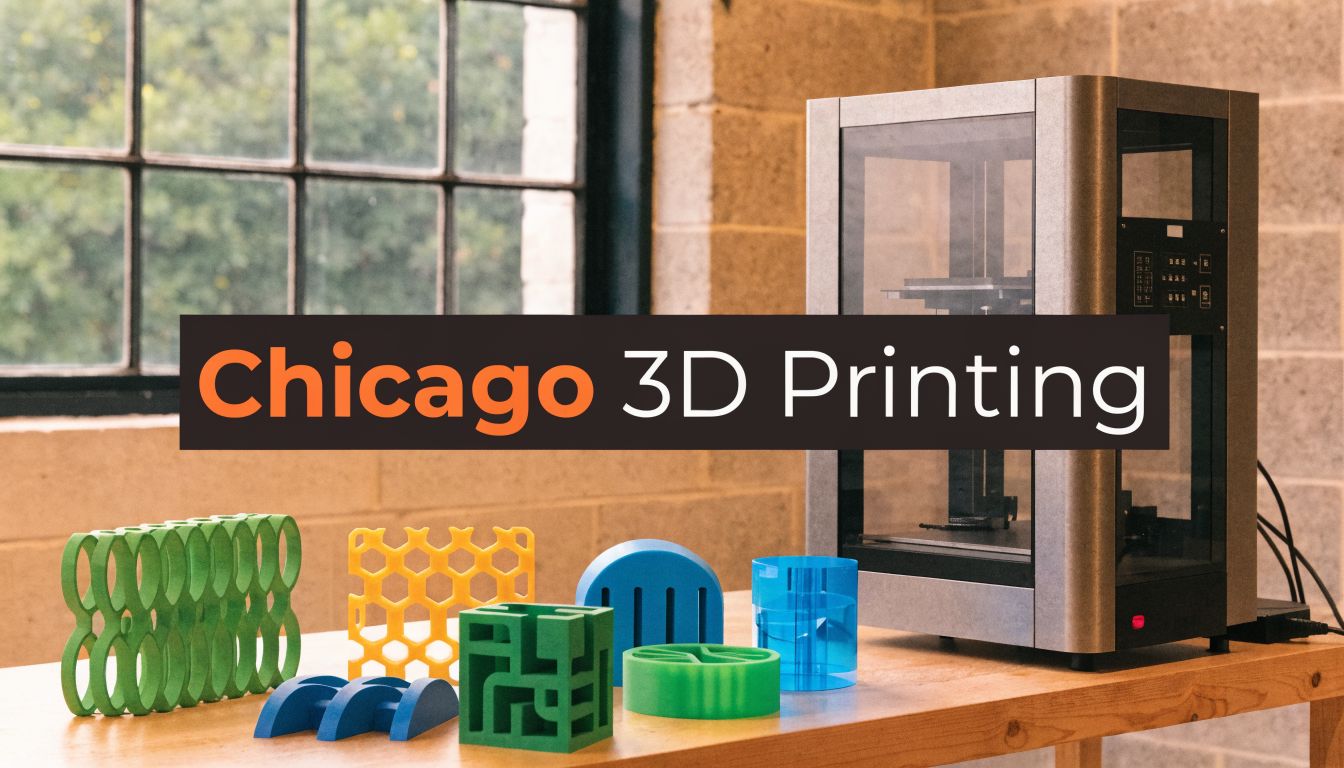
A founder I know burned two weeks polishing a pitch deck before he printed anything. The first rough prototype took ten minutes to expose three design flaws the slides had hidden. That is the primary value of 3d printing in chicago. You get to fail in your hands instead of in a customer meeting.
Chicago is a strong city for that kind of speed. You can start with free or low-cost access at the library, get hands-on help at makerspaces, and move into serious production shops once the part has to perform like a real product. If you need a clear primer on how that process works, read this guide to what rapid prototyping means. It will help you make better calls in this list.
Here is the part founders usually miss. Chicago is not just a collection of printer owners. It is a practical ladder. You can go from a cheap first draft to a production-ready run without leaving the metro, if you choose the right shop at the right stage.
That is the angle I want you to use.
Do not treat this like a directory. Treat it like a playbook. I am going to show you who to call when you need a first ugly model, who to use when your CAD is still messy, and who deserves the budget once fit, finish, tolerances, and repeatability start to matter.
My rule is simple. Match the shop to the stage.
If you are still learning, start free or cheap. If you need guidance, go local and hands-on. If the part needs to work like a real product, pay for a professional lab. That sequence saves money, cuts rework, and keeps you from hiring an industrial partner before you have earned the complexity.
1. SyBridge formerly Fast Radius, Chicago West Loop
If you already know your product has legs, I’d put SyBridge near the top of your call list. This is not where I’d send someone who just wants a cute desk mockup. I’d use them when the print needs to behave like a real product, not just look like one.
SyBridge gives you a serious menu: Carbon DLS, SLS, MJF, FDM, SLA, plus select metal additive work and downstream services like CNC, molding, casting, and finishing through its Chicago-area locations and services. That matters because once your prototype works, the next bottleneck usually isn’t printing. It’s everything after printing.
Best fit
I like SyBridge for founders building consumer hardware, medical-adjacent housings, tools, fixtures, or end-use parts where repeatability matters. If you think you may later need tooling, CNC, or low-volume production, start the relationship early.
That’s the advantage. You don’t want to rebuild your vendor stack every time the product matures.
- Use them for functional parts: SLS, MJF, and Carbon-style workflows are better for parts that need more professional mechanical performance than a basic hobby print.
- Use them for scale-up planning: If you know injection molding or CNC may come next, they can help you avoid dumb geometry choices early.
- Skip them for casual experiments: The quote process and economics make more sense for professional users than for a first-time side project.
If your part will eventually touch customers, shelves, or a supply chain, think beyond the print itself. Think about the manufacturing path.
If you’re still sorting out your early prototype strategy, read Chicago Brandstarters’ take on what rapid prototyping means. It’s the right mental model before you spend real money.
2. BluEdge, 3D Printing Services, Chicago
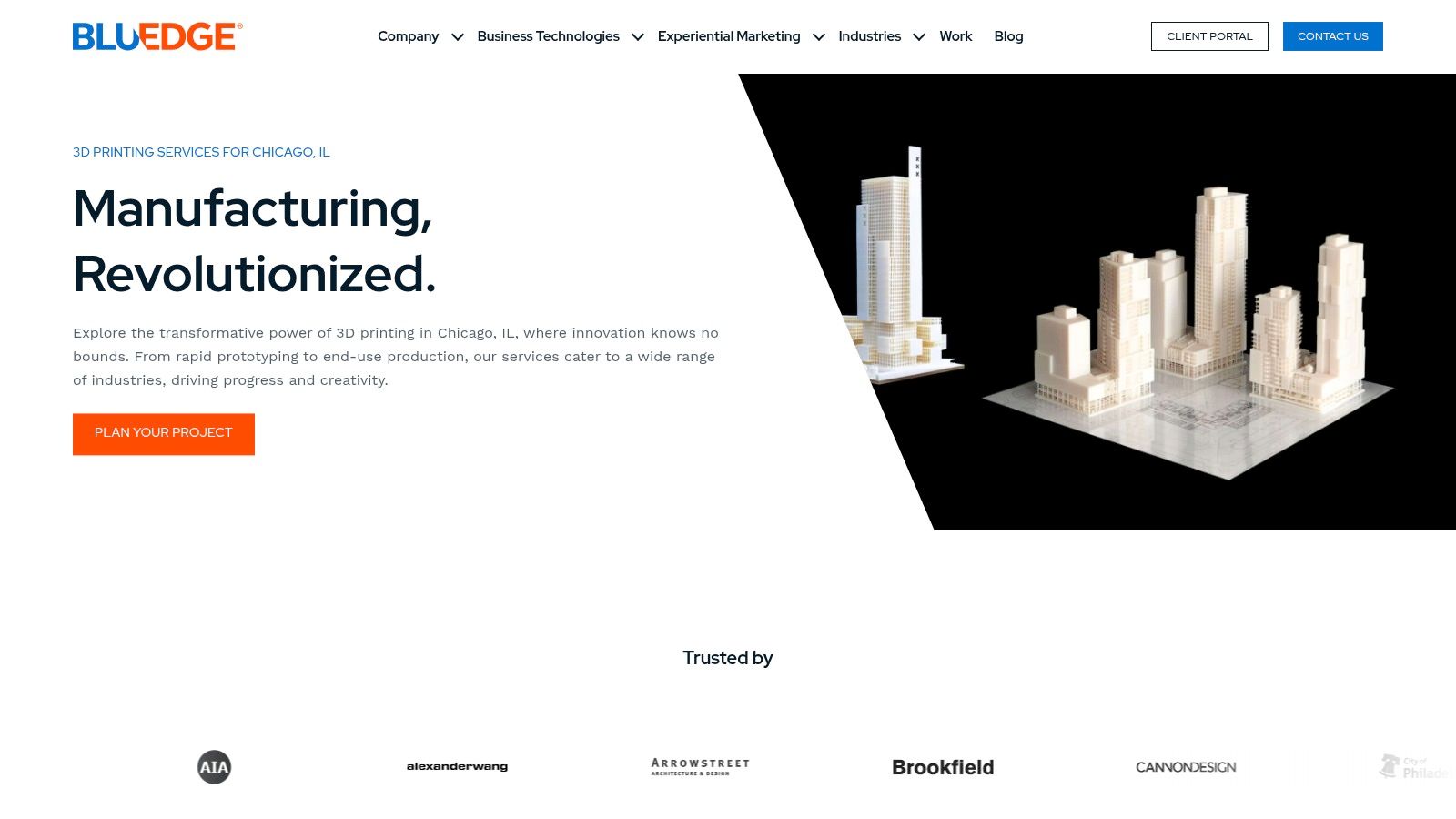
A founder once asked me where to print a prototype for an investor meeting. My first question was simple. Does the part need to survive a stress test, or does it need to make the room care? BluEdge fits the second job.
BluEdge offers 3D printing, 3D modeling, scan-to-BIM, rendering, model-making, and laser cutting. That stack matters if you're selling a concept, pitching a space, or presenting a branded environment. You are not buying a print alone. You are buying clarity.
That makes BluEdge a smart call in the early visual stage of a product or space concept, especially when your biggest risk is confusion. If investors, landlords, retail partners, or internal stakeholders need to understand the idea fast, a polished physical model can do more work than another slide deck.
Where I’d use BluEdge
I’d send you here for architectural models, showroom pieces, retail mockups, exhibit concepts, and presentation-ready prototypes. They are especially useful when one project needs several outputs at once, such as a rendering for approval, a laser-cut element for display, and a printed model for the table.
I would not start with BluEdge if your main question is material performance, tolerance testing, or whether a part can handle real abuse in the field. Other shops are better for that.
- Use them for persuasion: Investor pitches, design reviews, retail concepts, and client presentations.
- Use them for mixed-format deliverables: Good fit when physical models, renderings, and cut components all need to stay aligned.
- Skip them for engineering-first validation: If failure points, fit, and mechanical behavior are the primary questions, spend your money elsewhere first.
Chicago has a real market for this kind of work. The city has long treated physical models as part of how ideas get approved, funded, and shared. BluEdge understands that world well, and that makes them useful in this playbook. Call them when the model's job is to sell the vision, not just prove the geometry.
3. Custom Color 3D Printing, Hermosa on the West Side
A founder sends over a rough sketch, a half-finished CAD file, and a deadline that already hurts. That is the job smaller local shops handle well, and it is exactly why I keep places like Custom Color 3D Printing in a Chicago founder's playbook.
Custom Color 3D Printing offers design and engineering help, rapid prototyping, production nylon options, and local pickup. I like that mix because it solves a specific problem. You are past the napkin stage, but not ready for a big service bureau that expects clean files, firm specs, and a bigger budget.
Where I’d use Custom Color 3D Printing
I’d call them in the middle stage, when you need a functional part fast and still need someone to help clean up the path from idea to printable object. That makes them a smart stop before you commit to a larger production partner or start figuring out how to manufacture a product at scale.
They make sense for nylon parts, short prototype runs, display pieces, figurines, and founder-led projects where quick local communication saves days. If your file is messy, your specs are still changing, and you want pickup instead of shipping delays, this is a strong option.
My rule is simple. If the file is ugly, pay for responsiveness.
That is the true value here. Custom Color sits between DIY maker access and enterprise-grade production. For Chicago founders, that middle tier matters. You get a local operator who can talk through design issues, print the part, and keep the project moving without turning every revision into a process headache.
The tradeoff is clear. You will not get the broadest material catalog or the scale of a major bureau. Use them when speed, communication, and practical prototype help matter more than having every industrial option on the menu.
4. Concept Parts Studio, Chicago
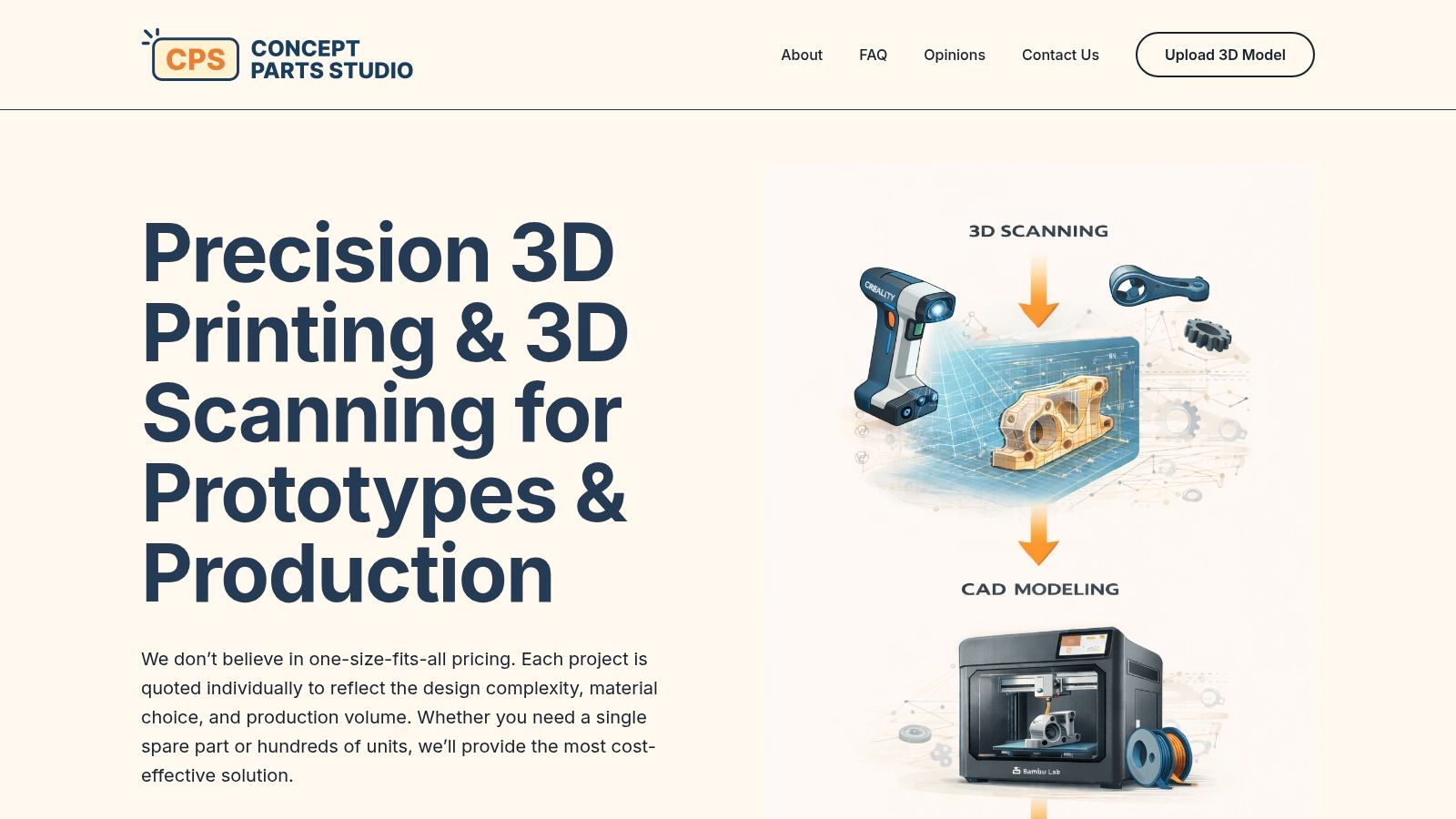
When I hear “I need a part, not a sculpture,” I think of shops like Concept Parts Studio. This is a mechanical founder’s option. Brackets, enclosures, jigs, fixtures, replacement parts. Things with a job.
Their industrial FDM focus, engineering-grade materials, 3D scanning, reverse engineering, and local production workflow make sense for practical parts work. I like this because many early founders overpay for pretty processes when plain old functional FDM would answer the essential question.
Where I’d use it
Use Concept Parts Studio when you need to test fit, mounting, enclosure layout, or replacement geometry. If you’ve got a broken part and need to scan and recreate it, that’s especially useful.
Their build limits are more practical than huge, and they’re FDM-centric. That’s not a flaw. It just means you should use them for the right job.
- Best for real-world utility: Great for brackets, housings, shop aids, and fit checks.
- Best for reverse engineering: Helpful when you need a physical part turned into a usable digital file.
- Not best for fine cosmetic finish: If the product has to wow a buyer visually, another process may be stronger.
If you’re trying to move from idea to a part someone could manufacture, Chicago Brandstarters has a helpful primer on how to manufacture a product. Read that before you obsess over tiny print details that won’t matter later.
5. Chicago Public Library Maker Lab, Harold Washington Library in the Loop
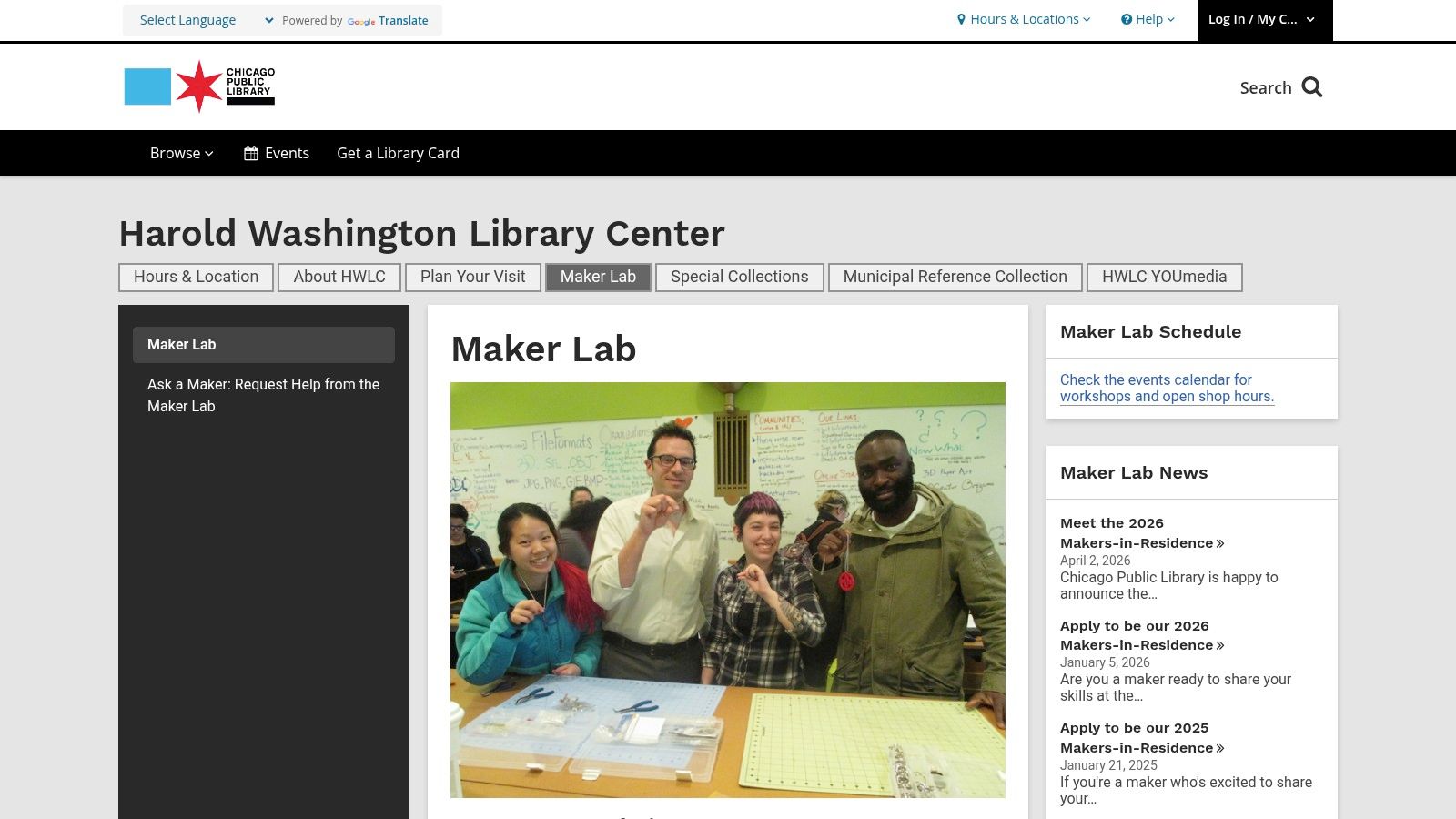
A founder once told me he was about to spend hundreds on a polished prototype before he had even held a rough version in his hand. I sent him to the library instead.
That’s how you should use the Chicago Public Library Maker Lab. It’s the right first move when your product is still a question mark and you need fast answers on size, grip, layout, or basic fit without burning cash.
The Chicago Public Library Maker Lab gives you workshops, open-shop sessions, staff support, and Bambu P1S printers. For early-stage founders, that is enough. You do not need premium service at this stage. You need feedback from a real object you can touch, break, and revise.
Where I’d use it
Use the Maker Lab for the ugly first draft. I mean the version that helps you catch dumb mistakes early, before you pay a shop to make them look expensive.
If you are still working through product shape or usability, start here, then tighten the concept with a more formal prototyping and product design process once the basic geometry makes sense.
- Best first stop for new founders: You learn more from one hands-on session than from ten speculative quotes.
- Best for low-cost early validation: Good for rough housings, simple fixtures, ergonomic checks, and basic fit tests.
- Weak for polished presentation models: Shared equipment, limited material choices, and public access constraints put a ceiling on finish and repeatability.
Here’s the insider point. This is not just a cheap option in Chicago. It’s a strategic one. The library handles the earliest stage of product development better than many paid services because it forces you to answer the right question first: what do I need to learn from this print?
Start there. Save the higher-end vendors for the moment when accuracy, materials, cosmetics, or production planning matter.
6. mHUB Chicago, Prototyping Lab in the Kinzie Industrial Corridor
A founder I’d back with my own money would use mHUB once the project stops being a sketch and starts becoming a machine with dependencies. You are no longer testing one printed part. You are trying to make several parts, materials, and functions work together on a deadline.
The mHUB Prototyping Lab gives you access to 3D printing alongside laser cutting, CNC, metals, electronics, finishing, and other build capabilities. That setup matters because physical products fail at the handoff points. A housing fits until the board interferes. A bracket works until the fastener choice changes. A decent prototype gets expensive fast when every revision requires a different vendor.
mHUB solves that by keeping the work in one place and around people who understand hardware. For a Chicago founder, that is a serious advantage.
Where I’d use it
Use mHUB when your product has crossed from rough validation into integrated prototyping. If your next questions involve fit, assembly, wiring, finish, and repeat builds, this is the right stage to step up.
- Best for hardware systems, not isolated parts: Strong choice for products that combine enclosures, mechanisms, electronics, and finishing work.
- Best for founders who will iterate often: Membership pays off when you expect multiple build cycles and need faster learning loops.
- Weak for simple one-off prints: If you only need a single cosmetic model or a fast outsourced part, this is more infrastructure than you need.
I also like what mHUB represents in this city. The culture around 3d printing in chicago tends to be practical. People are building, testing, and learning, not just talking about innovation in a pitch deck.
If you are heading into that middle stage where concept turns into a real product, read this guide to prototyping and product design for physical products before you spend another week revising files blindly. It will help you choose the right next step instead of paying for the wrong kind of prototype twice.
7. Pumping Station One, Avondale
A founder once told me he kept paying shops to fix problems he should have learned to spot himself. Bad tolerances. Weak part orientation. Files that looked fine on screen and failed in plastic. A place like Pumping Station One corrects that fast.
Pumping Station One is where I’d send you if you need hands-on reps more than polished service. You get access to 3D printers, other fabrication tools, open houses, and a member community that will help you work through problems. That matters at the stage between a free first draft and a paid production partner. If Chicago Public Library helps you start, and mHUB helps you integrate a serious hardware build, Pumping Station One helps you become dangerous in the middle.
Who should join
Join if you plan to show up, test often, and learn the equipment well enough to make better decisions later. Skip it if you want a vendor to hand you finished parts with predictable turnaround and zero troubleshooting.
I like this option for founders who are still shaping the product and need cheaper learning loops. You will make mistakes here. Good. Mistakes made in a makerspace cost less than mistakes made in a production quote.
- Best for self-directed founders: You can run more iterations once you know the tools and the shop norms.
- Best for mixed-build products: Access to wood, metal, and digital fabrication helps when your prototype involves more than one material or process.
- Weak for deadline-driven outsourcing: If the priority is speed, consistency, and someone else doing the work, hire a service bureau instead.
Chicago has room for both polished industrial providers and scrappy community shops. Pumping Station One earns its place in this guide because it teaches founder judgment, not just file submission. If you want to waste less money later, spend time in a space that forces you to understand how parts get made.
8. South Side Hackerspace Chicago, Bridgeport
Not every founder needs the biggest shop. Sometimes you need a welcoming room, a shared printer, and people who’ll tell you why your part keeps failing. South Side Hackerspace does that job.
The South Side Hackerspace Chicago site points people toward open houses, meetings, and a member-run environment with shared tools. I like spaces like this for early founders who live nearby and want low-friction access without crossing the city every time they need help.
Why local beats perfect
Consistency beats theoretical capability. If a nearby community space gets you printing every week, that will help you more than an elite lab you barely use.
This matters even more for underserved founders. There’s growing interest in practical, community-based fabrication pathways, including collaborations around assistive devices at UIC and social-impact product development, covered in Trend Hunter’s writeup on custom assistive devices. The business lesson is simple. Local fabrication access can become a real brand-building path, not just a hobby outlet.
A smaller makerspace can beat a bigger shop if you actually show up and keep building.
The downside is obvious. Member-run spaces evolve with volunteer energy, so capabilities shift. But if you want community, access, and honest feedback on the South Side, this is a smart place to start.
9. ARC Document Solutions, Chicago on LaSalle Drive
A lot of founders pick the wrong vendor here. They hunt for a flashy 3D printing shop when the underlying problem is review prep, stakeholder communication, and getting physical models to fit into an existing project workflow.
That is where ARC earns its spot on this list. Their Chicago location page points to 3D printing quote requests, 3D laser scanning, and BIM modeling. If your product or project touches buildings, interiors, site plans, facilities, or client presentations, that mix matters more than exotic print options.
When to use ARC
Call ARC when your print is part of a larger package. I mean boards, drawings, renderings, marked-up plans, and a model that needs to show up on time for a meeting downtown.
This is a smart choice for architecture firms, developers, contractors, real estate teams, and founders selling into the built environment. You get a vendor that already understands documentation-heavy work. That saves time and cuts coordination mistakes.
I also like ARC for later-stage founders who need a reliable downtown operator, not a tinkering space.
- Good for AEC-heavy projects: Scan-to-BIM and 3D print support belong in the same workflow.
- Good for presentation deadlines: Wide-format output and physical models under one roof make review prep easier.
- Less ideal for advanced additive strategy: If you need deep guidance on materials, tolerances, or manufacturing handoff, use a more specialized shop.
For the founder playbook, ARC fits in the middle-to-late prototype phase. Start cheap at the library or a hackerspace when you are still proving the idea. Move to a place like ARC when the model needs to support a client pitch, design review, permit conversation, or internal approval process. That is how you avoid paying an advanced fabrication shop to solve an operations problem.
10. Intagly, Chicago page with remote service
A lot of founders hit the same wall. You have a product idea, maybe even a rough sketch, but no CAD file and no desire to spend two weeks figuring out software before you test anything. That is where Intagly earns a spot on this list.
Intagly offers Engineer on Demand help, 3D modeling support, print quotes, and a stated turnaround of 1 to 4 business days with UPS shipping. I like that the site shows a visible modeling starting price of about $50. That matters. You can gauge the risk fast and decide whether this is a smart first spend or a distraction.
Best use case
Use Intagly when speed matters more than process depth. If you need someone to turn a rough concept into a printable file and get a first prototype moving without a long sales call, this is a practical choice.
This is a good fit for early founders, solo operators, and side-hustle teams validating a physical product. You get guided CAD help and a remote workflow that is easy to start. You are buying momentum.
I would use Intagly at the sketch-to-first-sample stage.
- Good for founders without CAD files: Modeling support removes the biggest early bottleneck.
- Good for quick learning cycles: A fast turnaround helps you test shape, size, and basic usability before you spend more.
- Less suited for later-stage production decisions: If you need material strategy, tolerance control, or a manufacturing handoff, move to a more technical shop.
For the founder playbook, Intagly fills a specific gap. Start at the library if you want the cheapest first draft. Use Intagly when you are ready to pay a modest amount to get a real file and a real part in your hands. Move up to an industrial shop once the prototype needs to survive engineering review, investor scrutiny, or small-batch production. That sequence saves money and keeps you from using a high-end vendor too early.
Chicago 3D Printing: Top 10 Labs & Services Comparison
| Service | Core Capabilities ✨ | Quality & Reliability ★ | Value & Price 💰 | Best For 👥 | Standout 🏆 |
|---|---|---|---|---|---|
| SyBridge (Chicago West Loop) | Carbon DLS, SLS, MJF, metal AM, CNC/molding | ★★★★★ Enterprise-grade repeatability | 💰 Premium; tooling-ready, pro volumes | 👥 Engineers & production teams | 🏆 Production QA & DFMA support |
| BluEdge, 3D Printing Services (Chicago) | 3D printing + model-making, scan-to-BIM, rendering | ★★★★ Presentation-quality outputs | 💰 Consultative RFQ; mid–high | 👥 Architects, designers, retail | 🏆 End-to-end visualization → physical models |
| Custom Color 3D Printing (Hermosa) | Design/engineering help, nylon (PA), color prints | ★★★★ Hands-on, locally responsive | 💰 Small-run friendly; local pickup saves time | 👥 Founders needing CAD help & quick turns | 🏆 Local pickup + design support |
| Concept Parts Studio, Chicago | Industrial FDM (ABS/ASA/PC/nylon blends), scanning, inspection | ★★★★ Mechanical & tolerance-focused | 💰 Practical pricing for functional batches | 👥 Mechanical prototypes, jigs & enclosures | 🏆 Inspection & reverse-engineering |
| Chicago Public Library Maker Lab (Harold Washington) | Free workshops, Bambu P1S printers, staff guidance | ★★★ Good for learning & early tests | 💰 Free/very low cost; session limits | 👥 Beginners, students, early-stage founders | 🏆 Free access + staff-supported learning |
| mHUB Chicago, Prototyping Lab | 3D printers + CNC, metals, electronics, textiles | ★★★★★ Professional shop + mentorship | 💰 Membership/accelerator fees required | 👥 Hardware startups & team prototyping | 🏆 Multi-discipline labs + mentorship |
| Pumping Station: One (Avondale) | Community 3D printers, laser, wood/metal shops, events | ★★★ Variable; user-skill dependent | 💰 Low-cost membership | 👥 Makers, DIY founders, learners | 🏆 Strong peer support & shop culture |
| South Side Hackerspace, Bridgeport | Member-shared printers, weekly open houses, knowledge-sharing | ★★★ Community-run reliability | 💰 Affordable dues; volunteer-run | 👥 Local founders & collaborators | 🏆 Welcoming, grassroots community |
| ARC Document Solutions, Chicago | 3D print quotes, 3D laser scanning, BIM modeling | ★★★ AEC-focused workflow | 💰 Project-quote pricing; downtown convenience | 👥 Architects, contractors, AEC teams | 🏆 Combine wide-format + 3D deliverables |
| Intagly, Chicago Page (remote) | "Engineer on Demand" CAD, instant print quotes, shipping 1–4 days | ★★★★ Fast turnarounds & guided CAD | 💰 Modeling from ~$50 + shipping | 👥 First-time founders needing CAD help | 🏆 Quick quotes + guided CAD support |
Go Make Something Real
A founder once told me he was "still refining the CAD" six weeks after our first call. I told him to stop polishing a guess and print the ugly version by Friday. He did. By Monday, he found two problems that would have burned another month. The handle pinched. The mount missed the clearance. One cheap prototype saved him from expensive confusion.
That is the primary advantage of 3d printing in chicago. You do not need to treat this city like a directory of random shops. You need a route. Start with the cheapest way to learn, move to the right place for iteration, then hand the job to a serious production partner when the part has earned it. That sequence saves time, cash, and momentum.
As noted earlier, this market is growing fast. Good. That matters less than your next decision. Your job is to get answers from a physical object, not to admire industry forecasts.
Ask better questions:
Does the grip feel right?
Does the lid close cleanly?
Does the bracket clear the motor?
Will anyone pay for this?
Print to learn first. Print to sell second. Print to scale only after the first two are working.
Don’t romanticize the prototype. Use it like a wrench.
Here is the play I recommend. If you have almost no budget and need a first draft, go to the Chicago Public Library Maker Lab. If you need repetition, feedback, and a builder community, use Pumping Station One or South Side Hackerspace. If your product is turning into a real hardware business, spend time at mHUB. If you need polished parts, color, presentation models, or help bridging CAD to print, call one of the service shops on this list. If the part is now tied to manufacturing risk, customer delivery, or a production program, talk to SyBridge.
That is the Chicago advantage. You can move from free access to production-grade capability without leaving the city.
The harder part is not always the print. It is deciding whether the product deserves another cycle, finding suppliers you can trust, and getting honest feedback before you waste another quarter. Chicago Brandstarters is one place to get that peer support. It is a free, vetted community for Chicago and Midwest founders building brands and products.
Now do the only thing that counts. Pick one shop. Send the file. Book the session. Walk in and make something real.
If you’re building a product and want honest feedback from founders who ship things, apply to Chicago Brandstarters. It’s a free, vetted community for Chicago and Midwest builders who want practical support, real war stories, and less lonely progress.
Leave a Reply