

Nearly half of adults who recognize a good business opportunity say fear of failure would stop them from starting, according to the Global Entrepreneurship Monitor. Seeing a path forward does not always make it easier to take the first step.
Advice about fear of failure in business often treats it as a mood to change: be confident, reframe the thought, visualize success. That can feel distant at 11 p.m., when you have rewritten a pricing page four times and still cannot publish it.
A more useful approach is to treat fear as a decision system. Set a spending cap, a time limit, and a stop rule before emotions take over. Then test your idea within those limits and let the results guide your next move. Fear may remain, but your decisions can become clearer.
What Fear of Failure Means for Founders
Fear of failure is the expectation that an attempt will end in loss, embarrassment, or lost control, plus the reaction that expectation sets off in you. The loss can be money. It can be status, a partner's patience, or the picture you hold of yourself as someone with good judgment.
That expectation is common, and it has widened. In 2019, 44% of adults said they would not start a business because they feared it might fail, and by 2024 that figure had reached 49%, according to the Global Entrepreneurship Monitor, which compared more than 150,000 adults surveyed in 2019 across 50 economies with more than 150,000 adults surveyed in 2024 across 51 economies. The deterrent also spread: at least two in five opportunity-recognizing adults reported it in 34 of 50 economies in 2019, and in 43 of 51 economies in 2024.
The smoke alarm comparison
A well-calibrated smoke alarm wakes you for a real fire. A faulty one screams every time you make toast, so you disconnect it, and then you sleep through the one that matters. Founders run both failure modes. Some silence the alarm and take bets they cannot survive. Others obey it and never cook at all.
Some founders hear that alarm all night and still cannot move.
The alarm is doing its job in both cases. It is warning you about something real, and it is terrible at grading risk. Fear works the same way: useful as a signal, unreliable as a judge of how large the bet should be.
Caution that helps and fear that blocks
Healthy caution checks your cash balance before you sign the lease, and reads the exit clause twice. Blocking fear never sends the first offer, because a reply might say no. Caution changes the size of the bet. Fear cancels the bet.
Run a two-minute self-check. Name the one loss you dread most and say it out loud: "I'd burn my savings," or "My brother-in-law would find out," or "I'd have to go back to the job I told everyone I was leaving." Then ask whether that loss is reversible. Most first tests are. Your alarm cannot tell the difference. You can.
Write the grading the alarm will not do. Give the test a spending cap: the most you will lose, an amount you can replace, not the whole savings account. Give it a time limit: the date you will read the result, so the test cannot drift. Give it a stop rule: the result that ends it, named before you start, so a bad feeling at midnight does not get to cancel the test or enlarge it. Fear stays in the room. The written limits decide.
Stories travel with that fear. Someone else's shutdown can make your own risk feel larger, even when their cash, market, and mistakes were nothing like yours. Choose whose war stories you absorb. You can browse the founder profile and then set those stories next to the cap, the date, and the stop rule you already wrote.
How Fear Bends Business Decisions
Fear can narrow your choices. A study of 65,782 early-stage entrepreneurs across 31 countries found that fear of failure was negatively related to the originality of the opportunities they pursued, with a coefficient of β = −0.045 and p < 0.001, according to the Entrepreneurship Research Journal.
The effect was small, but its direction matters: as fear rose, the ideas entrepreneurs pursued tended to be safer and more familiar. The study also found that entrepreneurial self-efficacy moderated this relationship. Confidence in your ability to do the work can help counter the pull toward caution, even when the outcome remains uncertain.
The six decisions fear touches first
Fear often shapes decisions before a launch. Use the checks below to replace vague worry with evidence, then set a spending cap, a time limit, and a stop rule before acting.
| Decision | How fear distorts it | Check to run |
|---|---|---|
| Whether to start | Makes you wait for certainty that may never arrive | Count qualified customer conversations |
| Choosing an idea | Pulls you toward safer, familiar ideas | Name the specific problem the idea solves for one buyer |
| Setting prices | Encourages a low price to avoid rejection | Test two prices with real buyers and compare their responses |
| Hiring | Delays a hire until the workload becomes difficult to manage | Write a hiring trigger as a number, such as weekly orders |
| Leaving a job | Keeps you employed after the evidence points toward a change | Set a savings and revenue threshold before giving notice |
| Pivoting or stopping | Keeps you tied to a failing plan to avoid admitting a loss | Compare results with success signals set in advance |
A useful check turns an internal debate into a count. “Am I ready?” can stretch on indefinitely. “I've had six qualified conversations, and three asked about price” gives you something concrete to assess.
What the intent research adds
Fear also appears alongside differences in entrepreneurial intent. A study using 2015 Global Entrepreneurship Monitor data from 2,364 people in Senegal found that 54.34% of respondents without fear of failure reported entrepreneurial intent, compared with 50.81% of those who feared failure, according to the Quality and Quantity study. Across the models, coefficients ranged from −0.065 to −0.0803, and the association held regardless of gender.
That is an association, not proof that fear alone makes someone abandon an idea. Still, it offers a reason to notice when a decision keeps being postponed. Choose one delayed decision and run its check this week. For pricing, for example, offer two numbers to two real buyers and record their responses. Use a written decision framework to set the test's spending cap, time limit, and stop rule before you begin.
Run Your First Test Before Betting Everything
Fear grows in proportion to what feels irreversible. Three experimental studies with nascent entrepreneurs found that perceived obstacles, such as resource constraints, market barriers, and weak social capital, activated fear of failure, which then reduced both opportunity evaluation and opportunity exploitation, as reported in the Journal of Business Venturing. Notice the order. The obstacles came first, the fear rose second, and the judgment fell after that.
The lever you control is the size of the irreversible part. Cap what you can lose, and fear has less material to work with. The five steps below are the whole method, and you can run them this month.
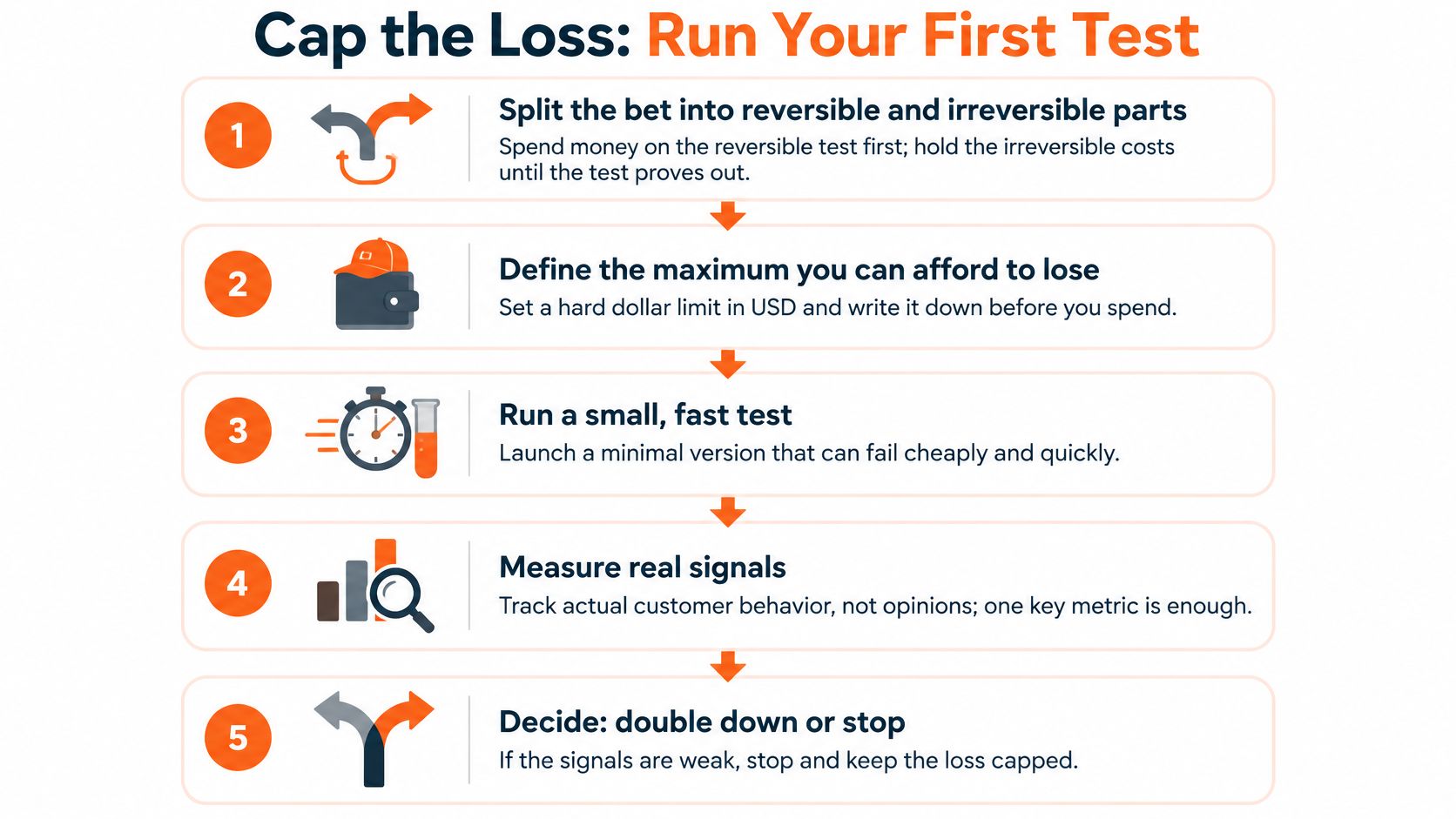
Five steps that keep the loss small
- Split the bet into reversible and irreversible parts. A landing page, ten interviews, and a sample order can all be undone or absorbed. A lease, an inventory container, and a trademark filing can't. Spend on the reversible side first, because you can walk it back without a negotiation.
- Set a loss limit in dollars and hours. A fixed number tells you when to stop, so the decision stops being a nightly argument with yourself. Write the number where you'll see it, not in a notebook you open monthly.
- Choose one test that could prove you wrong. If your claim can't fail, the test teaches you nothing. "Customers want this" can fail. "Customers are nice to me" cannot.
- Write the success signal before you start. You can't judge a result fairly once you've already hoped for one. Ten interviews means ten, not "a few good chats."
- Decide in advance which result ends the test. A failed test returns information, and information is cheaper than the alternative. It isn't a verdict on your character, and treating it as one is what keeps founders stuck.
Starting limits you can copy
These figures are examples, not rules handed down. Adjust them to your savings, your rent, and how much you can lose without changing your life.
| Test type | Spending cap | Time limit | Evidence to continue |
|---|---|---|---|
| Customer interviews | $0 | 2 weeks | 10 interviews where the problem comes up without prompting |
| Landing page or waitlist | $150 | 3 weeks | 50 signups from your own outreach or a small ad test |
| Pre-sale or deposit | $400 | 4 weeks | 5 paid deposits or signed orders |
| Small pilot with one client | $1,000 | 6 weeks | A repeat purchase or a signed letter of intent |
If your test involves two versions of a page or two subject lines, change one variable at a time, the way this Otter A/B marketing testing guide lays it out. Testing two things at once tells you something moved, never which thing moved it.
When you want the interview script and the demand test spelled out, our guide on how to validate a business idea takes you through it. Founders who bring these capped tests to a table tend to get further than the ones who bring a pitch. As Nathan put it: "This friendly group helped me solve some problems in my business that had been troubling me for a long time." People can apply to join Chicago Brandstarters when they want that kind of room.
Here's the action for this week, and it takes one page. Pick the decision you keep postponing. Write four lines: spending cap, time limit, success signal, stop rule. Send that page to one person who will ask you about it in two weeks.
Sorting Controllable Causes From Bad Luck
Fear spreads through other people's outcomes. An empirical study using representative Global Entrepreneurship Monitor data from Germany examined 10,915 respondents surveyed during 2014 to 2017, as reported in the Journal of Economic Geography. 23.1% knew someone who had started a business in the prior two years, and among those respondents, 20.7% knew an entrepreneur who had failed. Knowing a failed entrepreneur raised fear in people who had never failed themselves, and a higher regional prevalence of business failure was associated with greater perceived fear.
Say you run an e-commerce brand in Chicago and your paid campaign flopped. Before you touch the creative, split the outcome into causes. Was it the product, the channel, the timing, or the cash runway? Each cause earns a label and one written rule.
Four causes and what to do with each
| Cause | Example | Controllable | Rule to write down |
|---|---|---|---|
| Weak customer validation | Built a product nobody asked for | Yes | Interview 10 buyers before building |
| Poor cash runway | Ran out of money before the second sale | Yes | Keep a fixed cash reserve before launch |
| Lost channel or partner | A main distributor stopped carrying the product | Partly | Keep at least two active sales channels |
| Market shock | Demand dropped after a rule change | No | Set a pause trigger tied to an early signal |
Weak validation and a thin cash reserve sit inside your control. A lost channel is partly yours. A market shock isn't, and no amount of planning changes that. You can't fix the shock, though you can fix the reserve that let it sink you.
A room of people who've already made the mistake earns its keep. Members who have experienced early-stage mistakes are happy to share their experiences with other members, which turns "be careful out there" into an actual checklist.
Answer one question in writing this week: which cause was mine to control?
Restarting After a Failed Business Without Freezing
A second start feels heavier than a first one. The weight is normal. It does not have to freeze the next decision. The Global Entrepreneurship Monitor's latest global report shows that people who have previously exited a business are more likely to start again, even where fear of failure runs high. Experience loosens the freeze when you can read the old result. It tightens the freeze when that result stays a blur.
A restart works like a kitchen timer on a stove you already burned. The timer does not erase the burn. It sets how much heat you allow, when you look, and when you turn the burner off.
Five steps to restart without pretending
- Write the postmortem before the new plan. List the assumptions you made, the decisions you took, the outside shocks you did not cause, and the behaviors you would repeat or avoid. You want a page you can argue with later, not a memory you keep flinching from.
- Turn what you can read into three written limits. Give the next test a spending cap (what you will pay to learn), a time limit (when you will look), and a stop rule (what result ends it). One small test, 30 days, and "stop if there are zero paid orders" is a decision. "Try harder this time" is only a mood.
- Stabilize income or clear the most urgent debt first. Fear gets quieter when rent is covered. A restart paid for by panic makes worse calls than one paid for by a boring paycheck. The paycheck buys the patience to stay inside the cap.
- Tell the plain facts in two sentences. Customers, lenders, and employers do not need a speech. "I closed the storefront in March. I'm testing a wholesale model with three accounts now." A long apology asks for pity, and pity is a hard thing to sell.
- Run one small validation step within 30 days. One paid order, one interview, or one quote request. Stay inside the spending cap. A result you can point at is what turns the alarm down.
Once that page exists, learning from failure is the next read before you spend again. It does not replace the cap, the date, or the stop rule.
The stop rule: quit when the evidence says the model is wrong, not when the failure feels painful. Those are two different signals, and only one of them is data.
A restart with a written cap, a date, and a stop rule costs less fear than one built on vague hope. Carry the parts of the last business that still hold. Leave the rest on the page.
A Monthly Fear Check-In for Your Business
Fear comes back with bigger numbers. A payroll of four people, a contract with a penalty clause, a competitor copying your listing: the stakes grow and the alarm gets louder. A standing review keeps it from steering.
Set the date: last Thursday of the month, 30 minutes, same chair, one page.
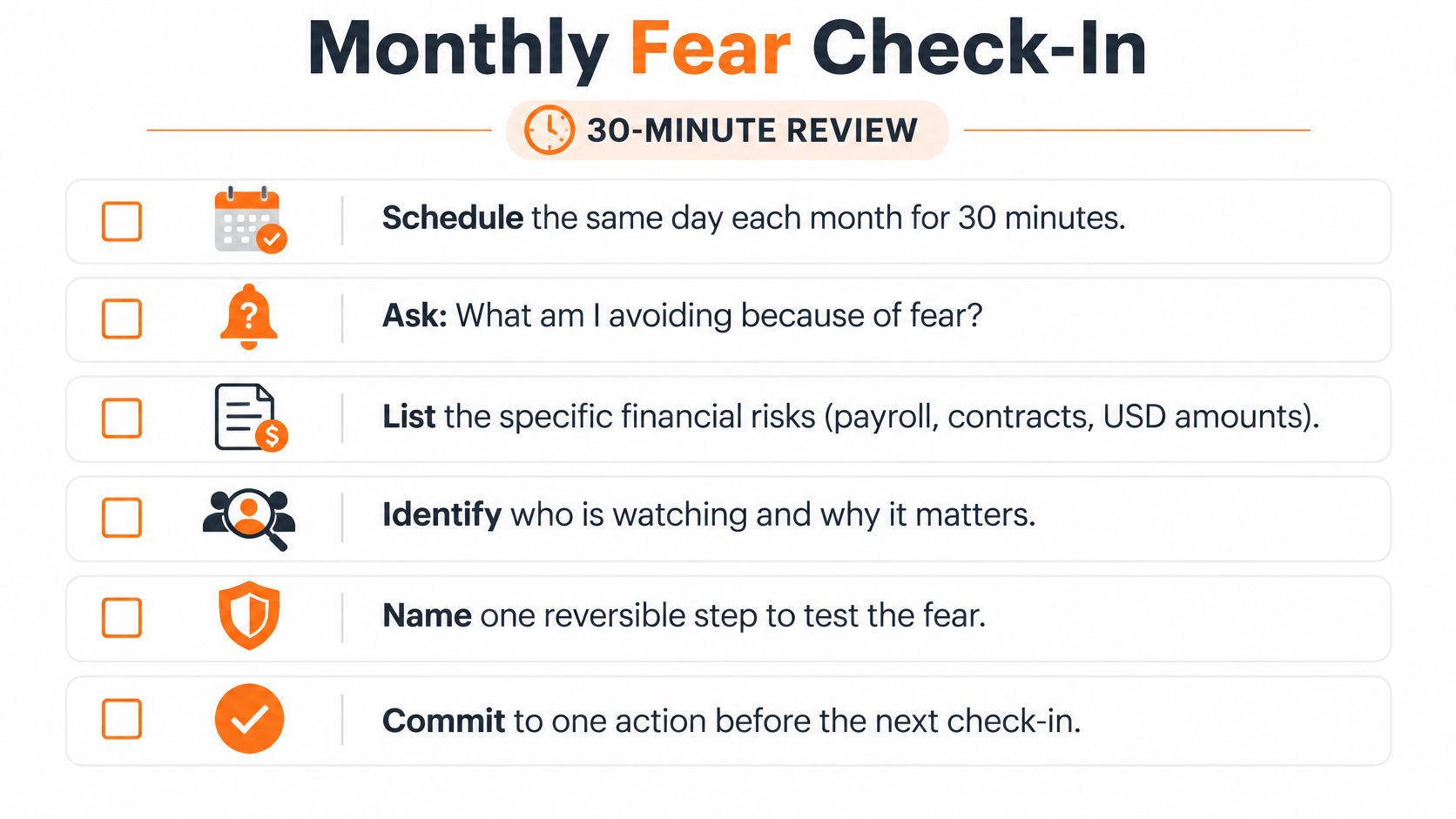
Six questions and the action each no triggers
| Checklist question | If the answer is no, do this |
|---|---|
| Did you make every decision on time this month? | Run the check for the delayed decision within 7 days |
| Did you decide every test with a written result? | Write the decision for each open test before starting another |
| Is your savings floor still intact? | Pause new spending until the floor is rebuilt |
| Did you ask one person for an honest view of your plan? | Send the current plan to one person this week |
| Is each fear you named tied to a real risk? | Rewrite the fear as a risk with a specific trigger |
| Did your loss limit grow with your revenue? | Reset the spending cap to match current revenue |
A no answer isn't a character report card. It's a task with a deadline attached, which is why the right column is specific enough to do badly and still finish.
Change one thing per month, not six. A review you dread gets skipped by March, and a review that takes half an hour survives.
If you want a room where you can say the numbers out loud, Chicago Brandstarters runs private dinners for 6 to 8 founders every two weeks, plus a group chat where people answer the question you're stuck on that week. Bring the test you capped, the cause you're still sorting, or the restart you're planning, and you'll find members who have been in the same chair. Visit Chicago Brandstarters to apply and see how the dinners work.
Leave a Reply