
You open the dashboard after launch and wait for the line to move. It doesn't. The campaign cost money, the team worked late, and the customers you expected never arrived. By midnight, you're no longer asking whether the product failed. You're asking what the failure says about you.
That question wastes time. Learning from failure starts when you separate the result from your identity, then turn the result into a decision. The useful work lives in the post-mortem, the restart decision, the hard conversations, and the weeks that follow.
Why Every Founder Fails And Why That Is Fine
A failed launch can feel personal because you made hundreds of personal choices. You picked the customer, approved the product, spent the budget, and told people it would work. When the numbers stall, your brain compresses all of that into one harsh sentence: “I was wrong.”
You were wrong about something. That's different from being a failure.
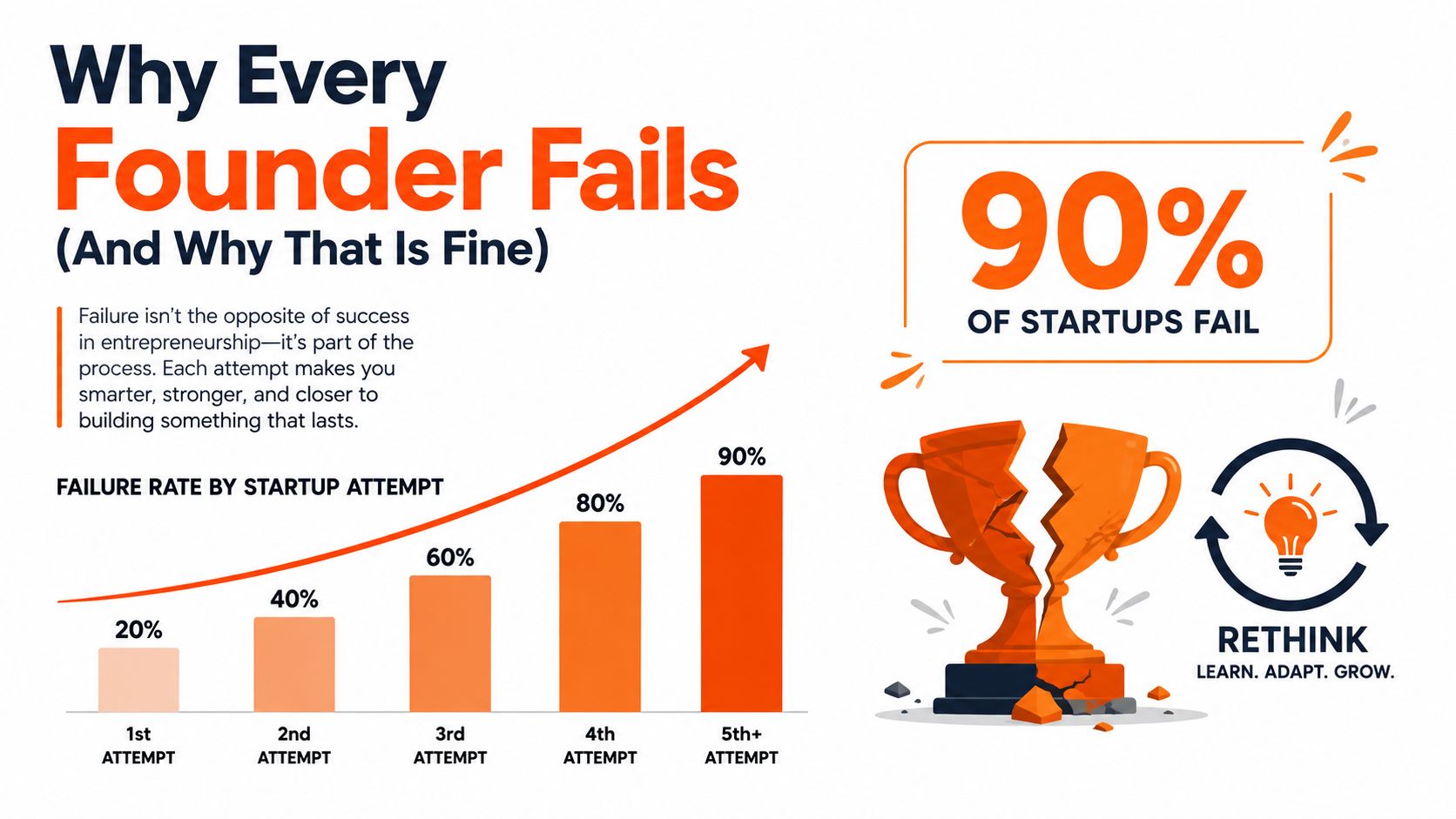
OECD business demography data gives founders a more accurate frame. In most countries, more than half of start-ups fail within the first five years, with survival ranging from less than one in five firms in Lithuania to about two-thirds in Sweden. Across OECD countries, survival averages just above 60% after three years, about 50% after five years, and a little over 40% after seven years. The OECD defines survival as a firm remaining active in turnover and/or employment across consecutive years, so these figures track operating continuity rather than a company merely staying registered. OECD business demography data
Failure belongs in the operating model
The lesson isn't that you should accept sloppy execution. It's that early setbacks sit inside the normal curve of starting a company. Standardized business demography work from Eurostat and the OECD made it possible to compare firm births, deaths, and survival across countries and industries. That work found one-year survival around 85% to 90% in manufacturing and 75% to 80% in services, while five-year survival fell to roughly 50% overall. Eurostat and OECD business demography manual
So don't use “fail fast” as permission to avoid discipline. Use failure as a signal that demands a better question:
What changed in my understanding of the customer, product, channel, team, or timing?
The rest of the work is practical. You'll need a neutral post-mortem, rules for restarting or walking away, a way to process shame without pretending it doesn't exist, clear messages for investors and customers, and a 30-60-90 day rhythm that turns one painful event into company knowledge. If the emotional weight has become unmanageable, find help for despair before making another major business decision.
The Five-Step Post-Mortem You Can Run Tonight
Run the post-mortem after the acute reaction settles, but don't wait until the details become folklore. Open a shared document, invite the people closest to the work, and state one rule first: the document studies decisions and conditions, not personalities.
A product launch that missed its revenue target by 80% gives you enough material. Don't write, “The marketing team failed.” Write what happened, what the team believed, and what evidence it missed.
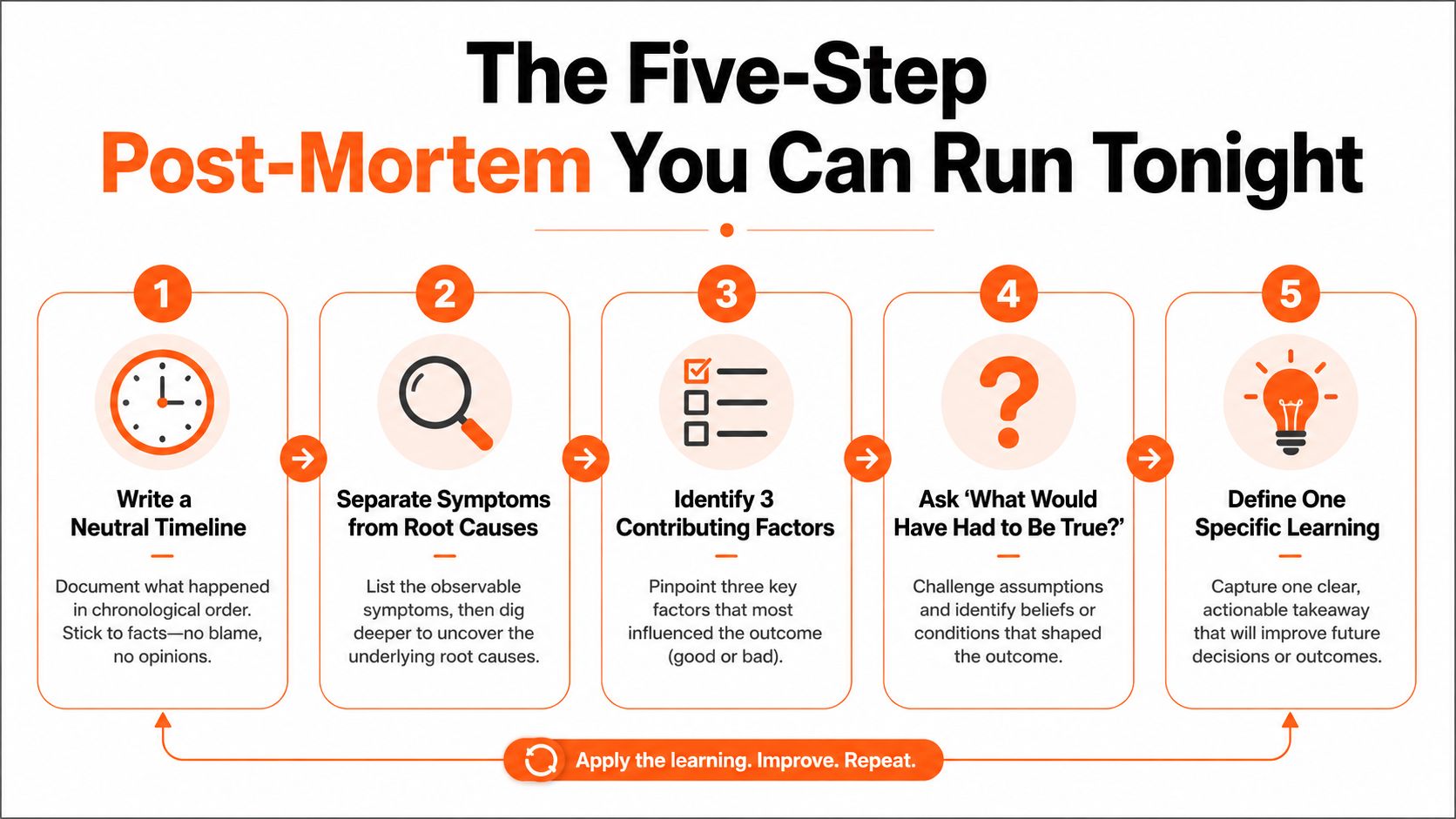
1. Write the timeline like a neutral observer
Record dates, decisions, tests, customer responses, and changes in sequence. Remove adjectives and motives.
Prompt: “What happened, in order, from the first decision to the final result?”
Example: “The team interviewed users, built the feature, ran paid acquisition, saw weak activation, changed the landing page, and continued spending before checking whether the original audience had a strong buying reason.”
2. Separate symptoms from root causes
A symptom tells you what appeared. A root cause tells you what produced it. Low revenue is a symptom. A weak purchase reason, poor targeting, or a broken onboarding path might sit underneath it.
Prompt: “What did we observe, and what condition could have produced that observation?”
3. List every assumption that broke
Write assumptions as testable statements. “Customers will pay” is too vague. “This buyer will pay for this outcome through this channel” gives you something to examine.
Prompt: “What had to be true for this plan to work, and which part proved false?”
The research on failure learning in Canadian manufacturing SMEs connects learning with problem-solving, blaming strategies, psychological safety, trust, and personal mastery. Research on learning from innovation failure If people expect punishment, they'll protect themselves instead of giving you the information you need.
4. Score control without pretending you control everything
Create two columns: we could change and we couldn't change. Put pricing, research quality, launch sequencing, and spending limits in the first column when they belong there. Put a sudden regulation change or an unexpected supply interruption in the second.
Prompt: “Which conditions could we have changed before launch, and which conditions could we only have responded to?”
5. Capture one durable rule
A post-mortem becomes useful when it changes behavior. Choose one rule that someone can apply without needing the whole story.
Prompt: “What will we do differently next time, and what evidence will tell us to do it?”
For example: “We won't increase acquisition spend until new users complete the core action without assisted onboarding.”
| Step | Core Prompt |
|---|---|
| Write a neutral timeline | What happened, in order? |
| Separate symptoms from root causes | What did we observe, and what caused it? |
| List broken assumptions | What had to be true, and which part proved false? |
| Score control | What could we change, and what could we only absorb? |
| Define one rule | What will we do differently next time? |
Use a separate problem-solving reference if the team gets stuck on causes, including this guide to problem-solving methods for founders. Keep the final document short enough that a future teammate will read it. A detailed archive can help, but a memorable rule changes more behavior than a perfect record.
Better Questions Beat Better Failures
“Fail fast” sounds practical until you notice how often founders repeat the same failure with a new logo. Speed helps only when you collect evidence, interpret it accurately, and change the next decision.
The research record supports that caution. One study of learning from failure argues for a sliding window of prior attempts rather than a full cumulative history, because old experience can dilute current learning and produce biased estimates when the environment changes. It also recommends modeling failures or successes separately rather than mixing both in one specification. Research on sliding windows for failure learning
In plain language, recent evidence usually deserves more weight than a story from a different market, product, or team. Your first failed launch might teach you about pricing. Your latest failed launch might teach you that the buyer changed.
Ask questions that force a decision
Skip the journal entry that says, “This was painful.” Write answers to questions that can alter your next move:
- Belief: What did I believe would happen, and what evidence contradicted it?
- Avoidance: What did I see but explain away because I wanted the plan to work?
- Outside view: What would I advise a friend who had my exact facts?
- Experiment: What small test can I run next week to challenge the new belief?
- Threshold: What result would make me stop, change direction, or continue?
A useful reflection produces a changed action. If you write three pages and still make the same decision, you processed emotion but didn't learn enough to operate differently.
Practical test: A lesson counts only when you can name the next behavior it changes.
You also need to watch for overcorrection. A failed paid campaign doesn't prove that paid acquisition never works. A rejected feature doesn't prove customers don't want the broader outcome. Keep the conclusion as narrow as the evidence. Good reflection reduces certainty where certainty failed, then creates a cheaper way to learn.
Restart, Modify, or Walk Away
Founders often treat the next move as a test of courage. It isn't. Restart, modify, and walk away are operating choices, and each one depends on different evidence.
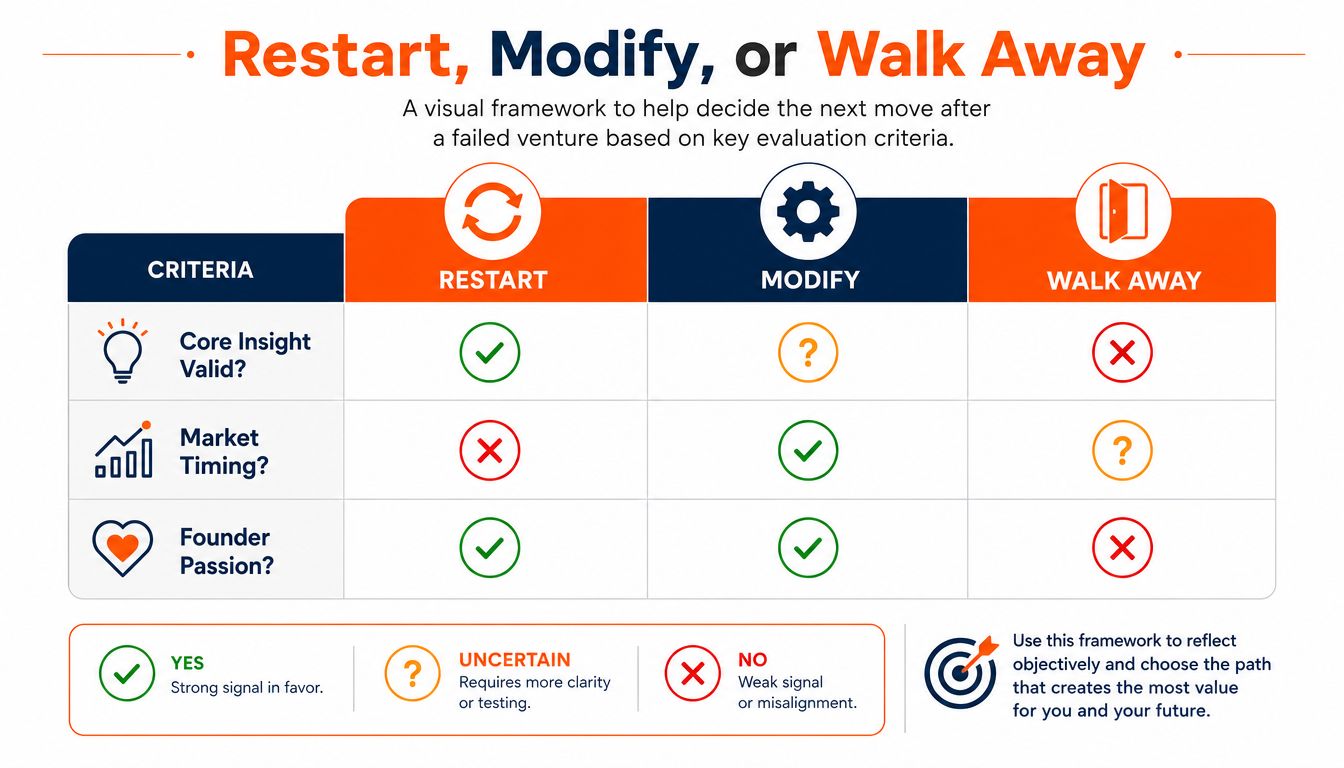
Restart when the insight survived
Restarting makes sense when customers had a real problem, the product direction made sense, and execution or timing created the failure. A founder I know once paused a launch because the product worked in testing, but the sales cycle collided with a seasonal budget freeze. The second attempt kept the core product, changed the timing, and tightened the sales process.
Choose restart when:
- Customer pain: You have direct evidence that the problem matters.
- Execution gap: You can name the specific delivery mistake.
- Timing: The external condition has changed or you can work around it.
- Capacity: You still have the energy and resources to execute properly.
Kill question: “If someone else owned this idea, would I still believe the evidence justified another attempt?”
Modify when the pain is real but the model broke
Modification fits when customers care about the outcome, yet your audience, pricing, channel, or product shape failed. One ecommerce operator may discover that customers want the result but won't buy a subscription. The company can keep the product promise while changing the purchase model.
Choose modify when:
- Problem: Customers describe the same pain without being prompted.
- Model: One major assumption failed, while the underlying need remains.
- Test: You can run a narrow experiment before rebuilding everything.
- Trade-off: You know what you'll stop doing to fund the new direction.
Kill question: “What is the smallest change that could disprove this revised model?”
Walk away when the arithmetic or fit no longer works
Walking away makes sense when the unit economics don't add up, regulation blocks the model, or the work consistently drains the founder's judgment and attention. A founder who keeps cutting costs while each sale loses money isn't showing grit. They're delaying a decision.
Choose walk away when:
- Economics: Each additional sale worsens the business.
- Rules: Compliance requirements remove the original advantage.
- Founder fit: You no longer want to spend years solving this problem.
- Alternatives: Your skills and capital can produce more useful work elsewhere.
Kill question: “What evidence would I need to see before I gave myself permission to stop, and do I have it?”
The right answer may hurt in every branch. Make the decision with written criteria, then set a date to review the evidence. Emotion belongs in the decision because founder energy matters. It shouldn't get the only vote.
The Part Nobody Talks About Shame Identity and Recovery
The first stage after failure often looks like anger. You blame the market, the agency, the cofounder, or yourself. Then shame arrives. You stop replying quickly, avoid former customers, and edit the story before you tell it.
After that comes identity loss. If “founder” became your main answer to who you are, closing the company can feel like losing a social position, a routine, and a future in one blow. Confidence then decays steadily because each ordinary task reminds you of the decision that didn't work.
Academic work on entrepreneurial learning after failure treats meaning-making, emotional processing, and resilience-building as part of recovery. A founder survey cited by Wilbur Labs found that over 80% said failure made them more likely to start again, while 54% said their biggest lesson involved product-market fit. Wilbur Labs on why startups fail That combination matters. Optimism can bring you back, but optimism alone doesn't tell you what to change.
Give the experience somewhere to go
Start by naming the story in your head. “I made a bad bet” gives you a decision to examine. “I'm incompetent” turns one result into a permanent identity.
Then build a small circle. Find two or three peers who can hear the unedited version without turning it into a sales opportunity or a motivational speech. Solo founders often need a room where people discuss cash mistakes, customer rejection, and bad hiring decisions with ordinary language. Chicago Brandstarters describes its founder mental health support through small dinners and private conversations, which can give founders a place to talk through the period between ventures. Chicago Brandstarters founder mental health resources
Write a failure résumé
Keep it to one page:
- Bet: What did you try?
- Evidence: What did you learn?
- Cost: What did the attempt consume?
- Capability: What can you do now that you couldn't do before?
- Rule: What will you refuse to repeat?
Don't rush into the next launch inside 30 days. Use that period to sleep, repair relationships, and regain enough distance to distinguish ambition from avoidance. If you need professional care, seek it. A peer group can reduce isolation, but it can't replace a clinician when your mental health needs clinical support.
How to Tell Your Investors Team and Customers
Silence creates a vacuum, and people fill vacuums with guesses. Speak once you know the basic facts, the immediate risk, and the next decision. You don't need a polished redemption story.
Investor update
Lead with the result and preserve the evidence.
“The launch missed our revenue target by 80%. We learned that our original audience showed interest but didn't convert through this channel. We've stopped the current spend, completed a post-mortem, and will test a narrower buyer and offer before deciding whether to continue.”
Send the update when you can explain the change in behavior. Don't hide behind a long list of activity. Investors need to know what happened to the plan and what you'll do with the remaining resources.
Team message
Your team needs honesty without theatrical optimism.
“The launch didn't work. We made a targeting and sequencing mistake, and I approved both. We'll protect the team from blame, document the learning, and pause the next release until we test the revised assumption.”
Then open the floor. Ask what people saw, when they saw it, and why they didn't feel safe or authorized to act. A founder who says “be honest” but punishes inconvenient information teaches the team to stay quiet.
Customer note
Customers don't need your internal drama. They need a clear explanation of what changes for them.
“We're ending this version of the product because it didn't deliver the outcome we promised. We'll support your transition through [specific action], and we'll contact you before any service change affects your account.”
Use crisis management planning guidance to prepare drills, assign owners, and review what happened after an incident. Speak publicly when customers, employees, or partners need an answer. Stay quiet when a public statement would expose private information or create confusion before you know the facts. When someone asks, “Should we be worried?” answer with the known risk, the control you've put in place, and the next date for an update.
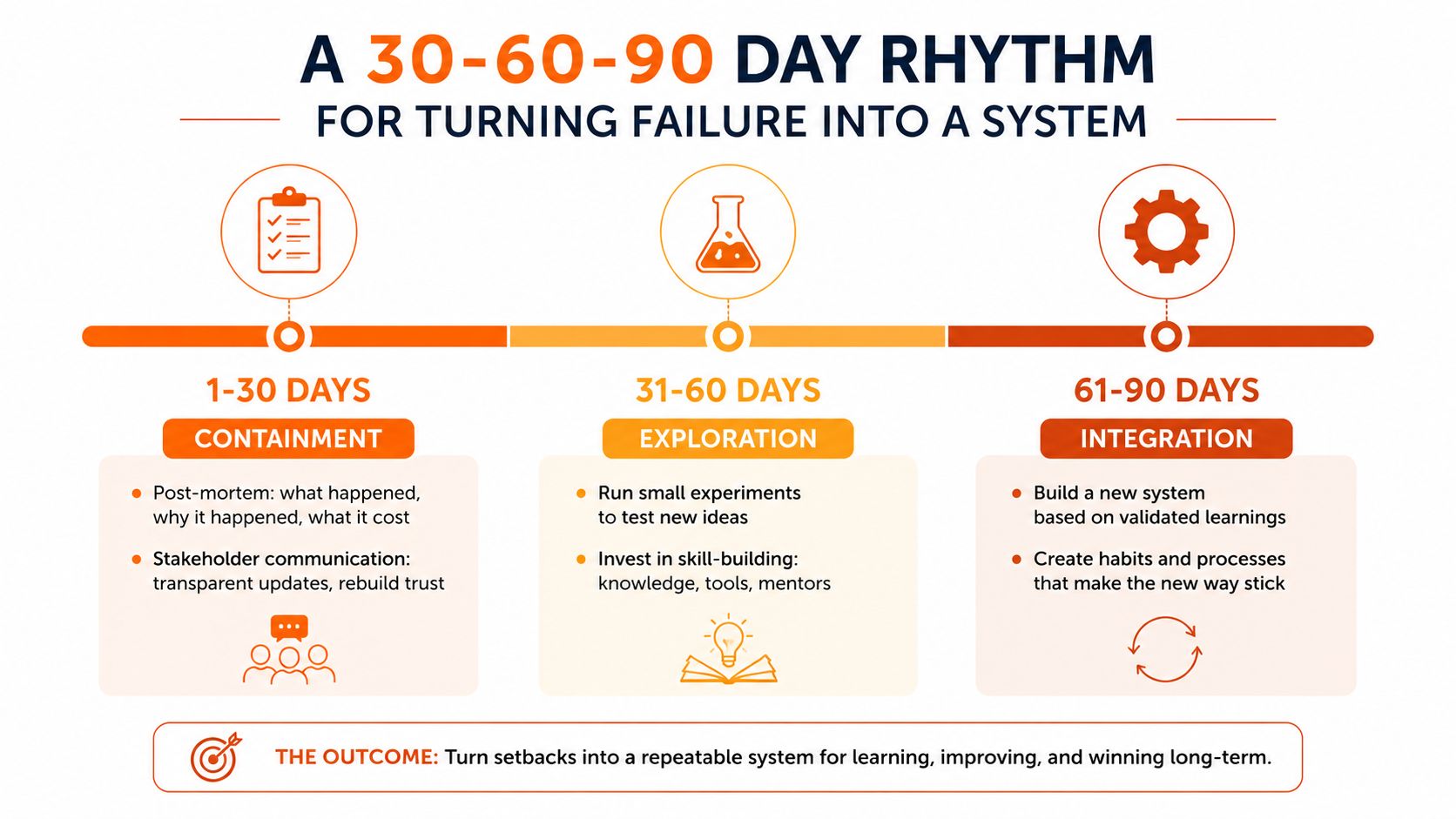
A 30-60-90 Day Rhythm for Turning Failure Into a System
A failure becomes company knowledge only when you put it on the calendar. Use the first month to contain the damage, the second to test the new belief, and the third to make a decision.
Days 1 to 30
Finish the post-mortem, inform affected stakeholders, stop spending tied to the failed assumption, and write the one-page failure résumé. Hold one short weekly meeting with a fixed agenda: evidence, emotional state, open risks, and the next decision.
Days 31 to 60
Run small experiments rather than another moonshot. Test a revised buyer, offer, channel, or workflow with limited scope. Record the prediction before you run the test, then record what happened without changing the rule after the fact.
Days 61 to 90
Choose restart, modify, or walk away. Put the decision criteria and outcome in the company playbook, assign an owner, and tell the team what future project should use the lesson.
Your checklist is simple:
- Contain: stop avoidable loss and communicate clearly.
- Learn: test the broken assumption with a cheap experiment.
- Decide: choose a path using written criteria.
- Install: turn the lesson into a repeatable rule.
The goal isn't a clean narrative. It's a company that makes a different decision next time because someone cared enough to document what happened.
Chicago Brandstarters gives founders a free, vetted community built around small private dinners and a group chat where members share war stories, tactical fixes, and support. If you want candid peer discussion while you process a failed launch or decide what to try next, visit Chicago Brandstarters and learn how to join.
Leave a Reply