You do not need a theory problem. You need a Friday-night problem. The payment processor goes down, a customer posts a screenshot that gets traction, or a supplier says your shipment won't land. You open Slack and everyone is asking the same question, who decides, who replies, and what do we say now?
That's where crisis management planning stops being paperwork and starts being survival. I've watched teams with polished binders freeze because nobody knew the first move. I've also watched smaller, scrappier teams recover faster because they had a simple plan, a few clear roles, and the discipline to rehearse before the fire started. The difference is not size. It's whether the plan works when people are tired, scared, and missing facts.
Why Most Crisis Plans Fail Before the Crisis Even Hits
A founder gets the alert at 9:07 p.m. The warehouse team says a product might be defective. Support is already seeing angry emails. Marketing wants to pause ads. Legal wants facts. The founder opens the crisis doc and finds a tidy folder full of templates nobody has used in months.
That is the trap. A written plan only helps if people know how to use it under stress. The Business Continuity Institute's 2021 global survey found that only 48.8% of organizations said their crisis plan was effective during the pandemic, while 43.3% said their plan was either ineffective or they had no plan at all, even though 75.1% still rated their crisis management capabilities as “good” or “excellent” (BCI 2021 crisis management report). Confidence is cheap. Execution costs real money, time, and sleep.
The binder is not the system
A lot of founders treat a plan as finished once it exists. It is not. A plan that sits in Drive is like a fire extinguisher locked in a closet, technically present, practically useless.
Practical rule: if your team cannot name the first three actions without hunting through a doc, you have a file, not a working response system.
During COVID, many teams learned that pressure exposes the truth fast. Centralized response mattered too, because the BCI reported that 42.5% of respondents managed crisis response through a centralized process. If you run a small brand, that should land hard. The plan has to be operational, not decorative.
If you are trying to protect ad spend and brand trust while pressure is high, start with protect ad spend and brand trust. That is the operating logic behind crisis work.
Running a Risk Assessment Your Team Can Actually Use
Start with one sheet of paper. Put likelihood on one axis and impact on the other. Then list the crises that can hit a small brand without warning, like cyber breach, key supplier collapse, founder health event, social media firestorm, product safety issue, and payment or platform outage. That's enough to make decisions without turning this into a fake academic exercise.
You do not need a grand scoring model. You need a list your team will read. For a small DTC brand, I'd score each scenario from low to high on both axes, then circle the ones that can stop orders, trigger refunds, or force public statements. If you want a deeper method for scoring and sorting risks, this guide on scoping and scoring risk methods is useful because it keeps the process practical instead of theoretical.
A simple grid for founders
| Scenario | Likelihood | Impact | Trigger to Activate |
|---|---|---|---|
| Payment or platform outage | High | High | Orders fail, checkout stops, or support sees repeated complaints |
| Social media firestorm | Medium | High | A post starts spreading fast or customers ask the same question in volume |
| Product safety issue | Medium | High | A defect, injury, or quality failure reaches customers or staff |
| Cyber breach | Medium | High | Login issues, data exposure, or suspicious account activity appears |
| Key supplier collapse | Medium | Medium to High | Stock dates slip and no backup exists |
| Founder health event | Low to Medium | High | The founder can't make decisions for a day or more |
The point is not perfect scoring. The point is speed. If a scenario sits in the high-impact column, you need a trigger that tells the team to move. That trigger can be a failed checkout, a confirmed safety complaint, a public post gaining traction, or a supplier missing a critical date.
What I'd watch every week
- Warning signs from support: repeated complaints about the same issue, refund spikes, or account access problems.
- Warning signs from operations: delayed shipments, damaged inventory, missing vendors, or system alerts that don't clear.
- Warning signs from comms: strange mentions, angry comments, media questions, or a customer thread getting shared.
- Warning signs from leadership: the founder is unreachable, overloaded, or the decision path keeps bouncing back to one person.
If you set these cues now, nobody has to wait for a Slack message while the room burns. The team switches the moment the trigger hits.
Naming the Crisis Team and Decision Roles
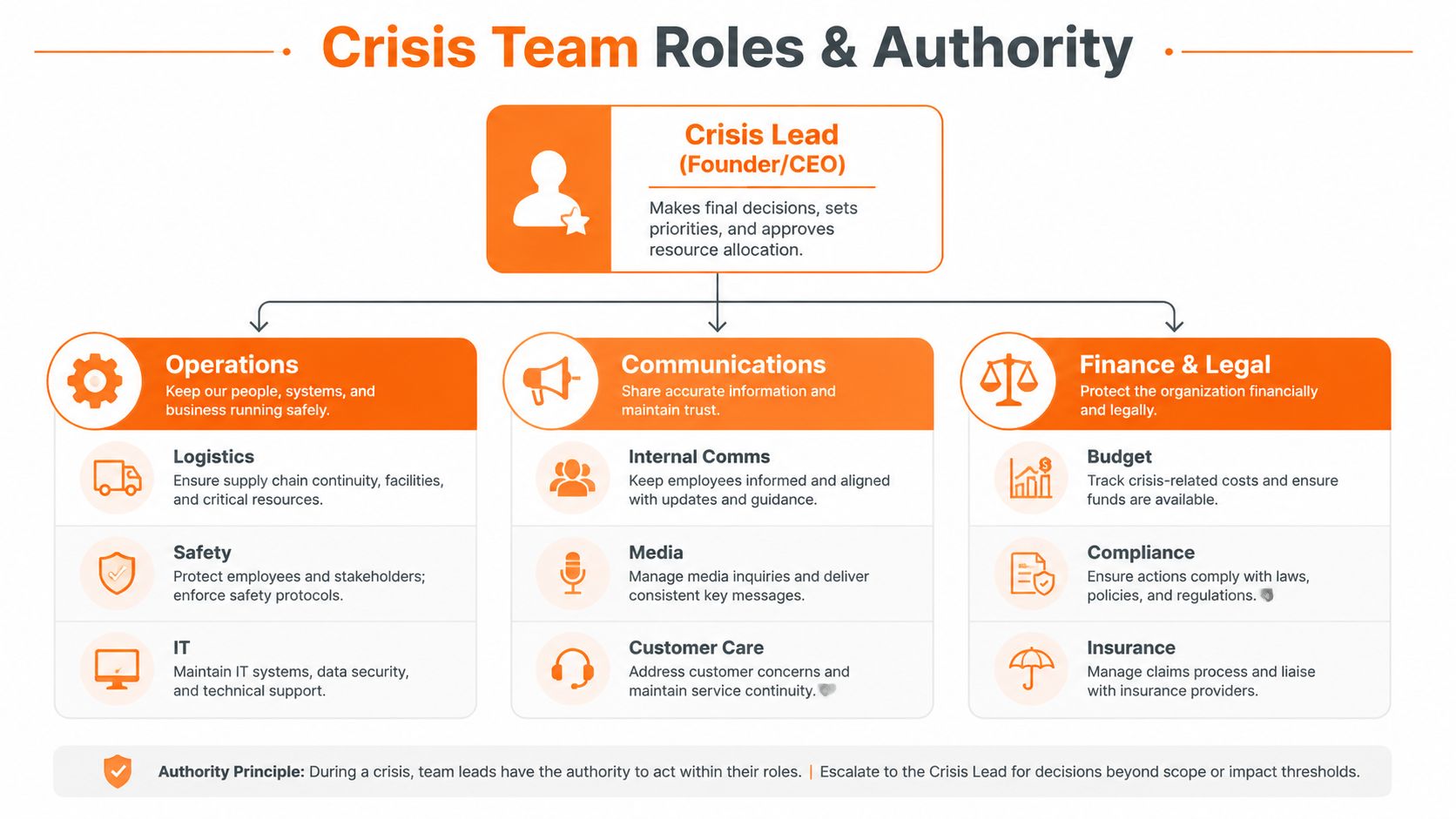
A crisis team should be small enough to move fast and wide enough to cover the basics. I'd start with four to six people, no more. You need an incident commander, a comms lead, an operations lead, a finance or legal contact, and backups for each role. If you have a founder-led company, the founder can be the incident commander, but the role still needs to exist on paper.
Write role cards, not vague job titles
Each person needs a one-page role card. On that page, spell out three things, who they decide for, what they escalate, and what they can approve without asking the founder. If you want a clean decision model for that structure, I'd use the logic in this framework for making decisions, because crisis work breaks when authority is fuzzy.
Here's what I'd put on each card:
- Incident Commander: calls activation, assigns owners, and ends crisis mode.
- Comms Lead: drafts internal and external messages, controls tone, and keeps one source of truth.
- Operations Lead: checks inventory, systems, vendors, and fixes execution blocks.
- Finance or Legal Contact: reviews spend, risk, compliance, and any statement with legal weight.
- Backups: take over if the primary role holder is asleep, traveling, or offline.
The founder doesn't need to approve every sentence. The founder needs to set the rules before the sentence gets written.
Build for the ugly case
You also need a path for when the founder is the problem, absent, panicking, or unavailable. If the founder is traveling, sick, or too close to the issue, the crisis lead should still be able to run the playbook. That means pre-approving emergency spend limits, statement approval rules, and escalation paths before anything goes wrong.
A good crisis team can work while the founder sleeps. That's the whole point. If the system needs one person awake and calm at all times, it's not a system yet, it's a bottleneck.
Building Communications and Response Playbooks
Once the team and triggers are set, write the actual words you'll use. Do it before the pressure hits. The three scenarios I'd prepare first are cyber or data incident, supply chain or product quality issue, and public reputation storm. Those are the ones that make small brands bleed attention fast.
The core rule is simple, say what you know, say what you're doing, and don't promise a fix you can't ship. For structure, I like the practical shape in this crisis communications plan guide, because it keeps messages short and usable.
Cyber or data incident
Internal message within 30 minutes:
We've identified a possible security issue affecting [system or data type]. Stop work in the affected system, preserve logs, and send any unusual activity to [owner]. We'll share the next update at [time].
Customer-facing message within 4 hours:
We're investigating a security issue that may affect some customer data or account access. We've paused the affected process, started containment steps, and will update you as soon as we confirm the facts.
Holding statement for press or partners:
We're aware of an incident and we're investigating it now. Our team is focused on containment, facts, and clear updates.
Supply chain or product quality issue
Internal message within 30 minutes:
We have a possible supply or quality issue with [product or vendor]. Pause related shipments, flag affected inventory, and report what you see by [time]. Do not guess.
Customer-facing message within 4 hours:
We're checking a product quality issue that may affect a limited set of orders. We've paused shipments on the affected batch and we'll update customers once we confirm the scope.
Public reputation storm
Internal message within 30 minutes:
A public post or complaint about [issue] is spreading. Do not reply individually. Route screenshots, links, and customer questions to [owner]. We'll post the approved response from one channel only.
The channel matters. Use email for direct customer notice, in-app or SMS when timing matters, and public post when the issue already lives in public. Keep the tone calm and plain. No spin. No drama. No fake certainty.
Pre-stage all three playbooks in a shared doc with version dates at the top. That way, nobody wastes time asking which draft is current when the clock is already loud.
Running Simulations That Change How Your Team Acts
A plan without rehearsal is decoration. I've seen good people freeze because they never practiced making a decision with half the facts and a noisy inbox.

Run drills that are short, awkward, and real. A 15-minute tabletop works because it forces people to talk fast. Give the founder one curveball, like a vendor delay mixed with a public complaint, and watch who owns the next move. A no-notice comms drill works too. Give the comms lead 30 minutes to draft a public statement without warning. Then run one full Saturday morning simulation for a named scenario end to end.
Measure what matters
Track the time to first decision. Track the time to first external message. Track who got stuck and which issue nobody owned. Those three signals tell you where the plan breaks.
After the drill, edit the plan within 48 hours. If you wait longer, people forget the pain and nothing changes. That's how bad habits survive.
If the drill felt too comfortable, it probably failed.
The point is to make the team feel the friction now, when the stakes are low. That discomfort is useful. It shows you where your language is vague, where your authority is weak, and where your people still need practice. MIT's crisis leadership discussion points in the same direction, because leaders who practice under pressure make better calls when the actual event hits (MIT crisis leadership).
Maintaining the Plan So It Does Not Rot in a Drive
Plans go stale fast. People leave. Vendors change. New channels appear. If you don't maintain the plan, it turns into a museum piece. I'd rather have a lean plan that's current than a thick one nobody trusts.
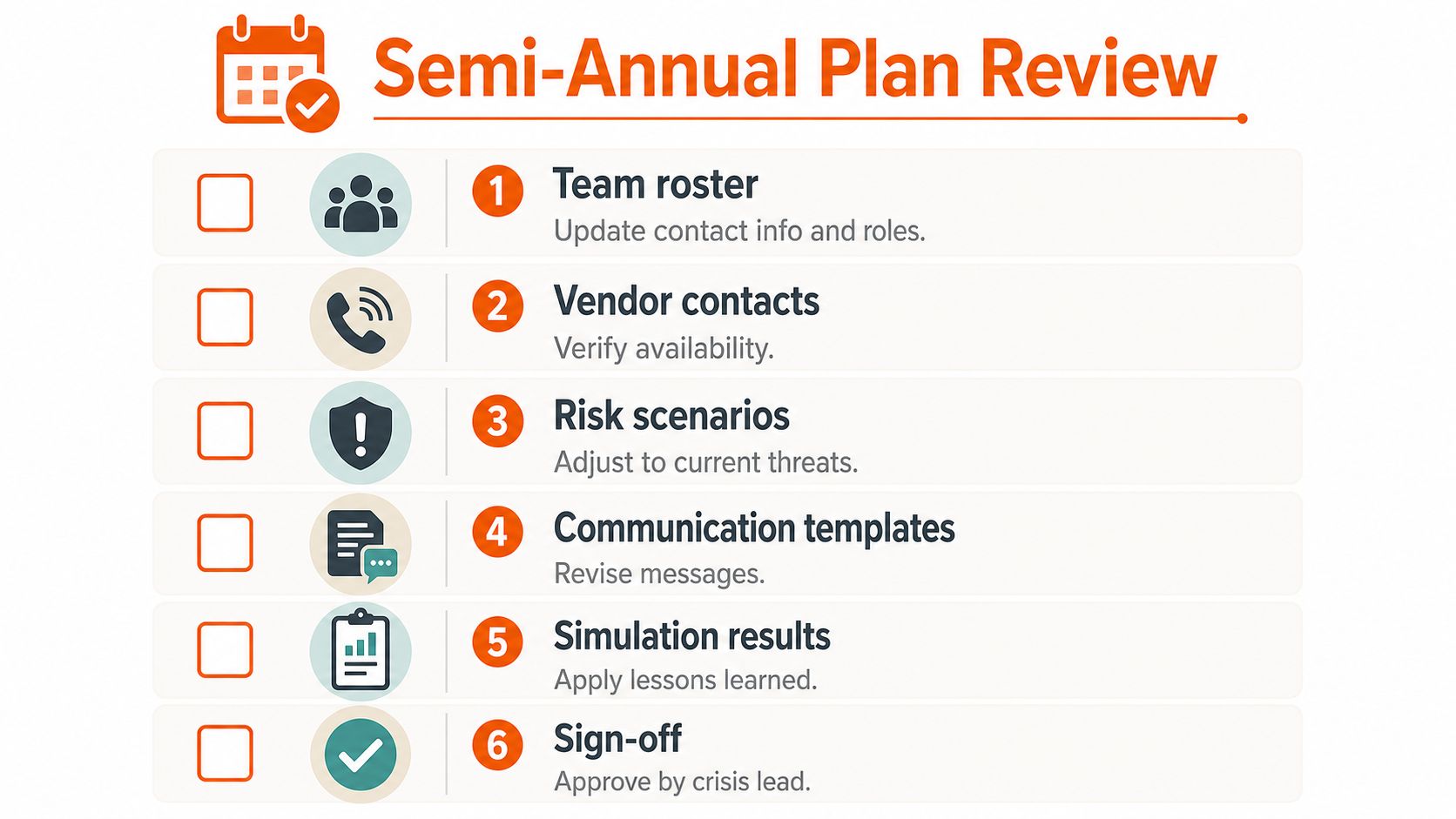
Keep a 30-minute quarterly review on the calendar. Check contacts, roles, triggers, and vendors. Then write a one-page changelog at the top of the plan so anyone opening it can see what changed and why. That matters because people don't have time to hunt for the latest version when a real issue lands.
Make learning part of the process
After every drill or incident, write a short review and name one owner for each lesson. No orphan lessons. If nobody owns the fix, it won't get fixed. Then do a full annual refresh where your team rewrites the top three playbooks from scratch, not by copy and paste, but by asking whether the wording still fits how you operate now.
If you keep an SOP system for the rest of the company, this should live next to it. The discipline is the same. The process for keeping standards current is outlined well in how to create standard operating procedures, and crisis work needs that same habit.
Watch for these warning signs:
- Drill fatigue: people rush through exercises and stop treating them like real events.
- Missing backups: a role only has one name on it.
- Stale language: templates sound like a different brand.
- Broken contacts: a vendor, lawyer, or platform rep no longer exists in the system.
Fix those fast. A plan that doesn't match reality makes people hesitate, and hesitation is expensive when the clock is running.
Your First 30 Days as a Founder
Your first month should work like an operating system, not a folder of notes. The point is to put pressure-tested habits on paper before a bad quarter turns into a bad day. Start with the three things that change how your team behaves under stress: what can break, who decides, and how you respond.
Week 1, run the risk assessment and pick the top three scenarios. Week 2, name the crisis team and write the role cards. Week 3, draft the three response playbooks. Week 4, run the first drill and book the next three before you lose momentum.
If you are building from zero, a first-time founder framework helps you keep the work simple enough to finish. Use it to keep the crisis plan tied to the rest of your startup habits, hiring, finance, communication, and decision-making. If those pieces are scattered, your crisis plan will be scattered too.
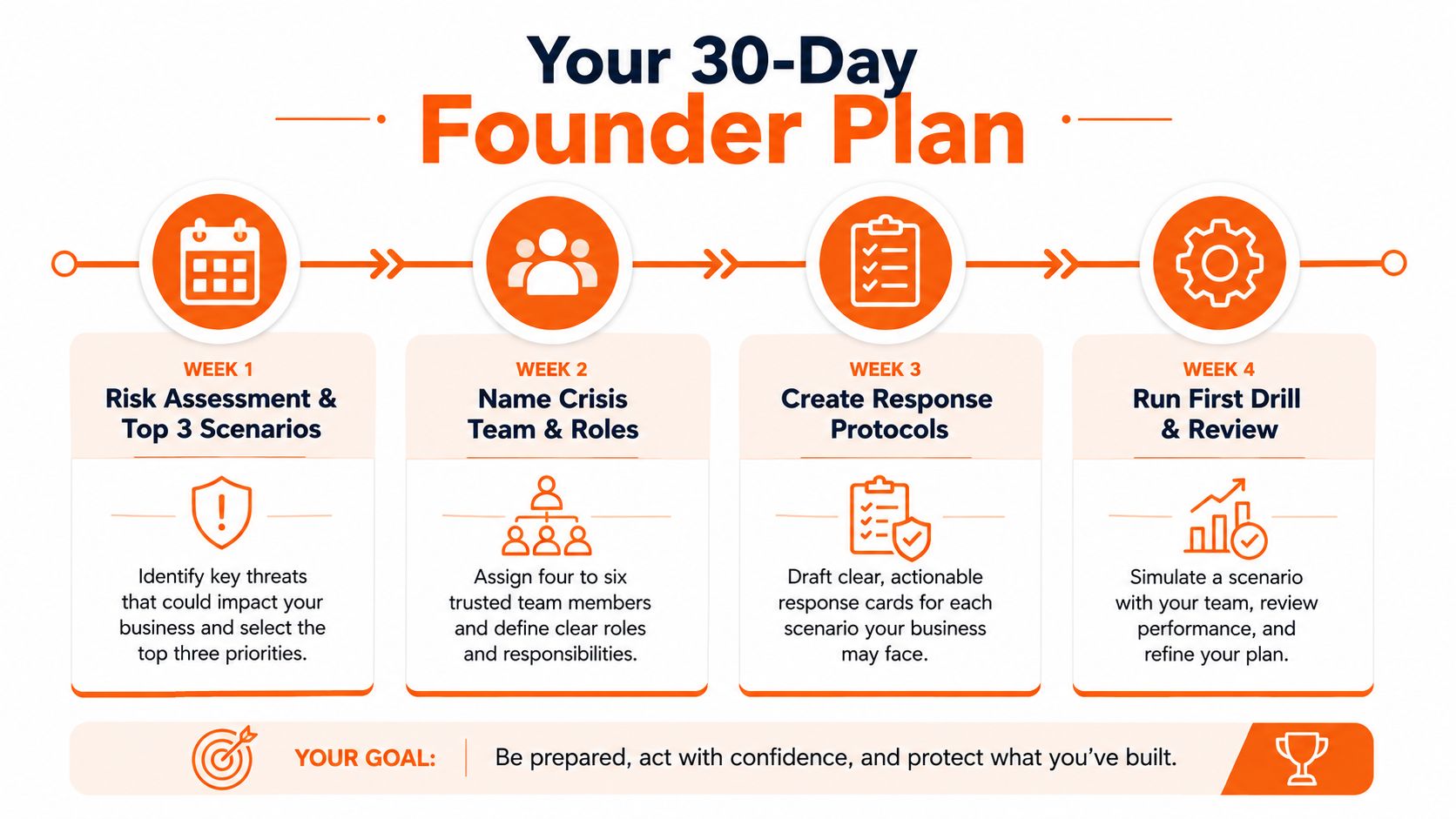
A clean founder checklist
- Week 1 owner: founder or operator. Time budget, 60 minutes. Done means the top three scenarios are ranked and triggers are written.
- Week 2 owner: founder plus ops or finance lead. Time budget, 90 minutes. Done means each role has a name, a backup, and a one-page card.
- Week 3 owner: comms lead. Time budget, 2 hours. Done means the three playbooks exist in a shared doc with version dates.
- Week 4 owner: whole crisis team. Time budget, 45 minutes for tabletop. Done means one drill happened and the next three are on the calendar.
Do not wait for the plan to feel finished. Book the first drill now, then make the team use the same words, the same owners, and the same escalation path every time something breaks. After rehearsal, the plan becomes the thing that keeps you moving when the bad quarter turns into a bad day.
Chicago Brandstarters is where founders who care about honesty, speed, and accountability can trade hard-earned lessons with people who run businesses. If you want a sharper way to build your crisis habits, strengthen your operating rhythm, and learn from other Midwest founders who've been in the room when things break, visit Chicago Brandstarters.
Leave a Reply