Higher prices don't automatically create higher profits. They create higher profits only when enough buyers believe the added value is real, remember why it matters, and keep buying after the price reaches the shelf.
That sounds obvious, yet many founders start with the wrong question. They ask, “How much more can we charge?” They should ask, “What evidence says customers will keep choosing us when a cheaper substitute sits beside us?”
A price premium strategy works as a diagnostic before it works as a growth tactic. You need to test Pricing Power, category fit, and actual purchase behavior. Surveys can tell you what people say they might pay. Checkout data tells you what they tolerate.
Why Most Premium Pricing Advice Fails Before It Starts
Most premium pricing advice begins with packaging, storytelling, and a confident price increase. That sequence feels attractive because it puts marketing in control. In practice, the price often exposes a brand weakness that packaging can't repair.
A higher price can increase gross margin per unit while reducing total contribution. If customers switch to private labels, remove add-ons, delay purchase, or leave altogether, the extra margin on each remaining sale won't save the model. You need to treat the price increase as a test of customer belief, not as a reward for better presentation.
The evidence gives you a useful warning. A review of 26 experiments on healthier foods found that 23 studies, or 88.5%, reported a willingness to pay a premium, with reported premiums ranging from 5.6% to 91.5% and an average of 30.7%. Yet the same review found a large market difference, with average willingness to pay at 34.8% in Europe versus 16.4% in the United States (review of willingness to pay for healthier foods). A survey response can look encouraging while still hiding a narrow, highly conditional buyer segment.
Practical rule: Treat stated willingness to pay as a hypothesis. Treat repeat purchase at the new price as evidence.
Before you change the shelf price, answer three questions:
- Brand equity: Do customers recognize your reason for charging more without a long explanation?
- Substitution risk: Can buyers replace you with a private label or cheaper challenger in one click?
- Proof at purchase: Does the customer see the benefit at the exact moment they decide?
If you can't answer those questions, delay the broad rollout. Test a narrow cohort, a premium version, or a limited channel first. A premium move should tell you whether your brand can carry a higher reference price. It shouldn't gamble the entire customer base on a better-looking label.
What a Price Premium Strategy Actually Means
A price premium strategy means charging above the category benchmark because buyers perceive extra value in the offer. NielsenIQ describes premium pricing as positioning an offer as superior in quality, function, or value, so the higher price feels justified (NielsenIQ's explanation of premium pricing).
That definition separates premium pricing from three tactics that founders often confuse.
Price skimming starts high and moves down as early adopters buy. You use it to capture initial demand, recover development costs, or learn which customers value the product first. Prestige pricing uses an extreme price to signal exclusivity to a narrow audience. Premium pricing sits between those approaches. You set a sustained gap above mainstream alternatives and defend it through product quality, service, distribution, trust, or meaning.
Think about two coffee purchases. A gas station sells basic drip coffee at a low price. A specialty shop sells a carefully prepared pour-over at a much higher price. The specialty shop earns the gap when customers value the beans, preparation, setting, ritual, and confidence that the drink will meet their expectations. The seller has built a system around the price, rather than typing a larger number into the point-of-sale system.
Build the system around the price
Your system needs four parts:
- A defined buyer: Choose the segment that values the upgrade. Don't ask the whole market to fund a product built for a narrower group.
- A pricing corridor: Set a defensible range instead of pretending one exact price is correct.
- Visible proof: Show the quality, function, service, or outcome that explains the gap.
- Operational support: Deliver the experience consistently through sourcing, fulfillment, support, and distribution.
Operations directors need to connect pricing with capacity, service levels, inventory, and channel economics. A practical resource on pricing for operations directors can help frame that connection. You can also use this guide to define premium pricing before you build the offer.
If your team can't explain what changes for the customer after the price rises, you don't have a premium strategy. You have a price increase.
The Psychology Behind Willingness to Pay More
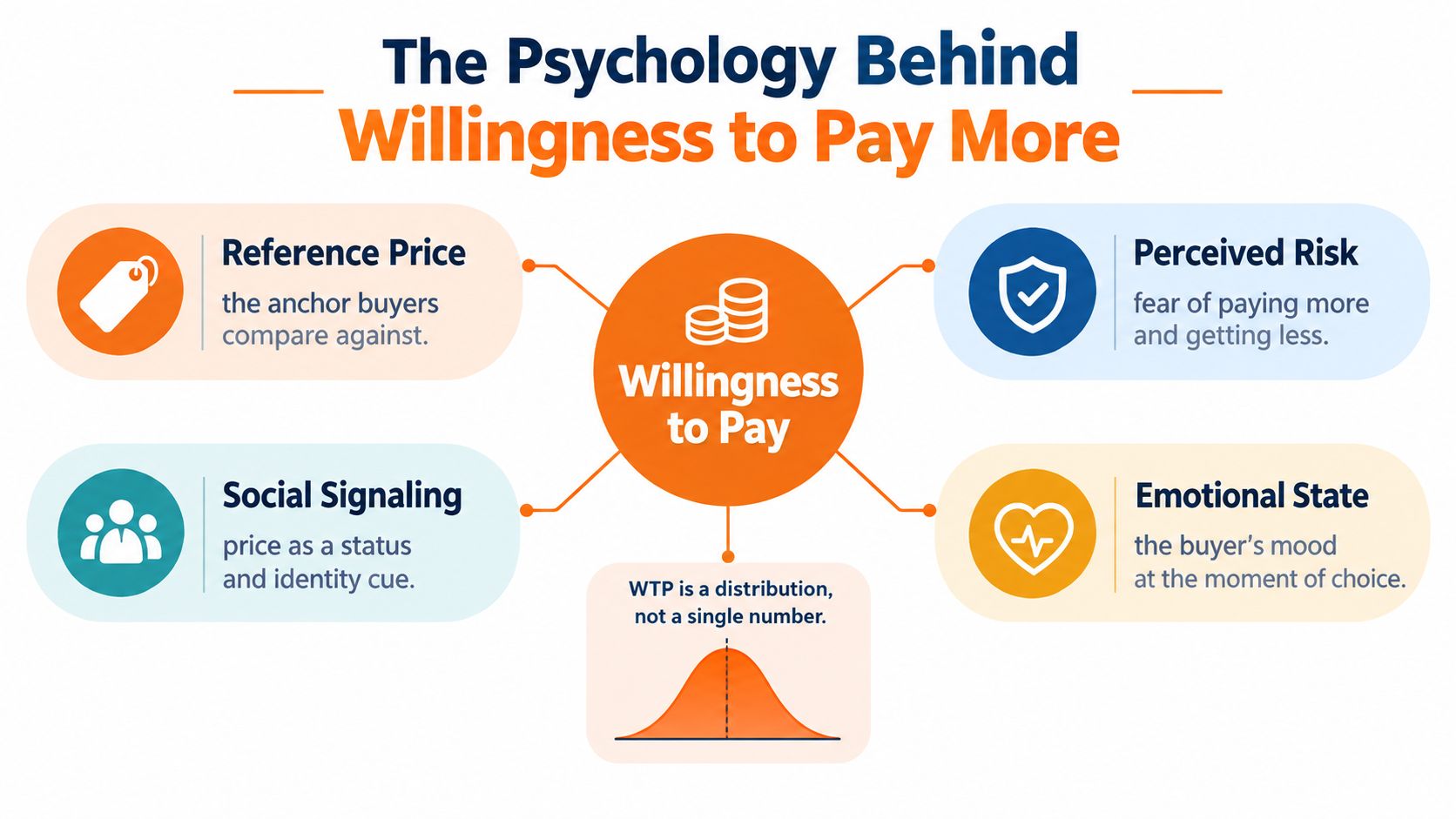
Willingness to pay isn't one fixed number. It forms a distribution shaped by the buyer's reference price, perceived risk, social context, and emotional state at the moment of choice.
A buyer compares your price with something. That comparison may be a competitor, a previous purchase, an internal budget, or a mental idea of what the category should cost. If you raise the price without changing that reference point, the buyer experiences the move as a loss.
Four forces usually shape the decision:
- Reference price: Buyers anchor on the alternatives they already know. A premium claim must give them a new comparison point.
- Perceived risk: A guarantee, return policy, familiar brand, or credible demonstration reduces the fear of paying more and receiving less.
- Social signaling: Some products help buyers express taste, identity, status, or belonging. That public meaning can carry more weight than a functional specification.
- Emotional state: People judge an optional pleasure differently from an essential replenishment purchase. Timing, mood, urgency, and context alter the decision.
The market rarely splits into “premium buyers” and “everyone else” with a clean line. A peer-reviewed study of premium-service subscriptions found a large segment strongly willing to pay and a similarly large segment strongly opposed, while a majority judged current subscription prices too heavy to afford (study of willingness to pay for premium-service subscriptions). That pattern makes a single offer dangerous. You may need tiers, stronger value communication, or targeted incentives for the undecided middle.
Design for the segment you can actually win
Start with the buyer who already demonstrates commitment. Look at repeat orders, full-price purchases, feature usage, referrals, and support behavior. Don't average these customers with people who only buy on promotion. A blended willingness-to-pay result can hide the group that will carry the premium.
Brand attachment also matters. A 2024 study using 323 valid questionnaires from Algerian households found that brand strength, attachment, and loyalty each had a positive effect on willingness to pay a price premium, with attachment and loyalty mediating the link between brand strength and willingness to pay (study of brand strength and willingness to pay). The operating lesson is simple. Familiarity and repeat preference give buyers a reason to trust the upgrade before they inspect every detail.
This video gives a useful visual introduction to the behavioral side of pricing:
Use psychology to decide who should see the premium, not to manipulate everyone into accepting it. The right segment should understand the difference quickly and feel confident that the extra cost changes the outcome.
Pricing Power as the Decisive Gatekeeper
A premium concept can win approval in research and still fail at checkout. Brand aesthetics attract attention, but Pricing Power determines whether buyers keep paying after that attention fades.
Kantar reports that shoppers are willing to pay about two times more for brands with high Pricing Power than for brands without it. Kantar also offers operators a practical rule of thumb: every 4% increase in relative price requires about 1 point of Pricing Power to remain credible (Kantar's Pricing Power guidance).
Treat that rule as a testing threshold, not a promise. Weak salience, limited repeat purchase, and little perceived difference leave a brand with insufficient support for a price lift. More shelf space, louder advertising, or a redesigned package will not close that gap. Buyers may interpret the increase as extraction because they cannot connect the higher price with a better result.
The key test is simple: does stated willingness to pay survive the register? If customers praise the idea but switch to a cheaper option at purchase, the brand has interest, not Pricing Power.
Compare two operators
Operator A sells a category product with strong recognition and habitual repeat purchase. Customers know what it does, trust its consistency, and can explain why they choose it. When the operator tests a higher price, some buyers leave, but the remaining base still sees enough value to continue.
Operator B sells a similar product with low awareness and weak loyalty. Its package looks polished, yet buyers compare it with a cheaper challenger within seconds. After a price increase, shoppers have no reason to revise their reference price. They trade down, wait for a promotion, or choose another brand.
The products may share ingredients, specifications, or manufacturing quality. The commercial result differs because buyers grant the brands different levels of permission.
The price ceiling belongs to the brand that buyers remember and prefer, not to the founder who wants a better margin.
Test the threshold before a broad launch. Ask whether customers can name the advantage without prompting, then compare consideration, full-price purchase, repeat behavior, and price recall with the category. Weak signals call for stronger proof and preference before asking buyers to fund a premium.
Where Premium Pricing Works and Where It Breaks
Premium pricing works best when the buyer experiences the upgrade as optional, emotional, sensory, or identity-related. It breaks when the buyer sees the purchase as a routine necessity and checks the price every time.
A large 2025 U.S. survey found willingness to pay more for a premium experience at 46% in entertainment and leisure, 45% in restaurants and fast food, and 45% in travel and hotels. The figures fell to 37% for grocery, 35% for the public sector, and 23% for utilities (survey of premium experiences by category). The same survey found that 85% of consumers aged 18 to 34 were open to paying more, compared with 49% of consumers aged 65 and older. Category and audience both shape the ceiling.
Consider two brands launching an expensive functional beverage. The first brand sells hydration with familiar ingredients and frequent replenishment. Buyers can compare serving cost, switch flavors, and test a cheaper substitute on the next trip. The second brand sells a craft coffee experience with distinctive sourcing, preparation, atmosphere, and ritual. Its buyers may judge the purchase through taste, identity, and occasion. The second offer has more room to make the premium feel like an experience instead of a surcharge.
| Category Archetype | Premium Outcome | Underlying Buyer Behavior |
|---|---|---|
| Experience-led leisure | Buyers may accept a higher price when the upgrade changes the occasion | Emotion, identity, and memory matter during choice |
| Specialty food and drink | A premium can hold when taste, origin, preparation, or ritual are easy to notice | Buyers judge sensory pleasure and trust |
| Essential grocery | Price pressure usually rises quickly | Buyers compare substitutes and price per use |
| Utilities and basic services | A broad premium often struggles | The purchase feels necessary, so function dominates |
| Commodity replenishment | Premium demand stays narrow | Buyers can delay, switch, or trade down with little friction |
This doesn't mean essentials can never carry a premium. It means you need a concrete difference, such as better convenience, lower risk, or a service layer that customers use often. If you sell a commodity, ask one hard question: Does the customer experience your upgrade, or do they merely read your claim?
For more context on the difference between premium and prestige positioning, review these examples of prestige pricing. Then decide whether your offer belongs in an emotional category, a functional category, or an uncomfortable middle.
How to Build and Test Your Own Premium Move
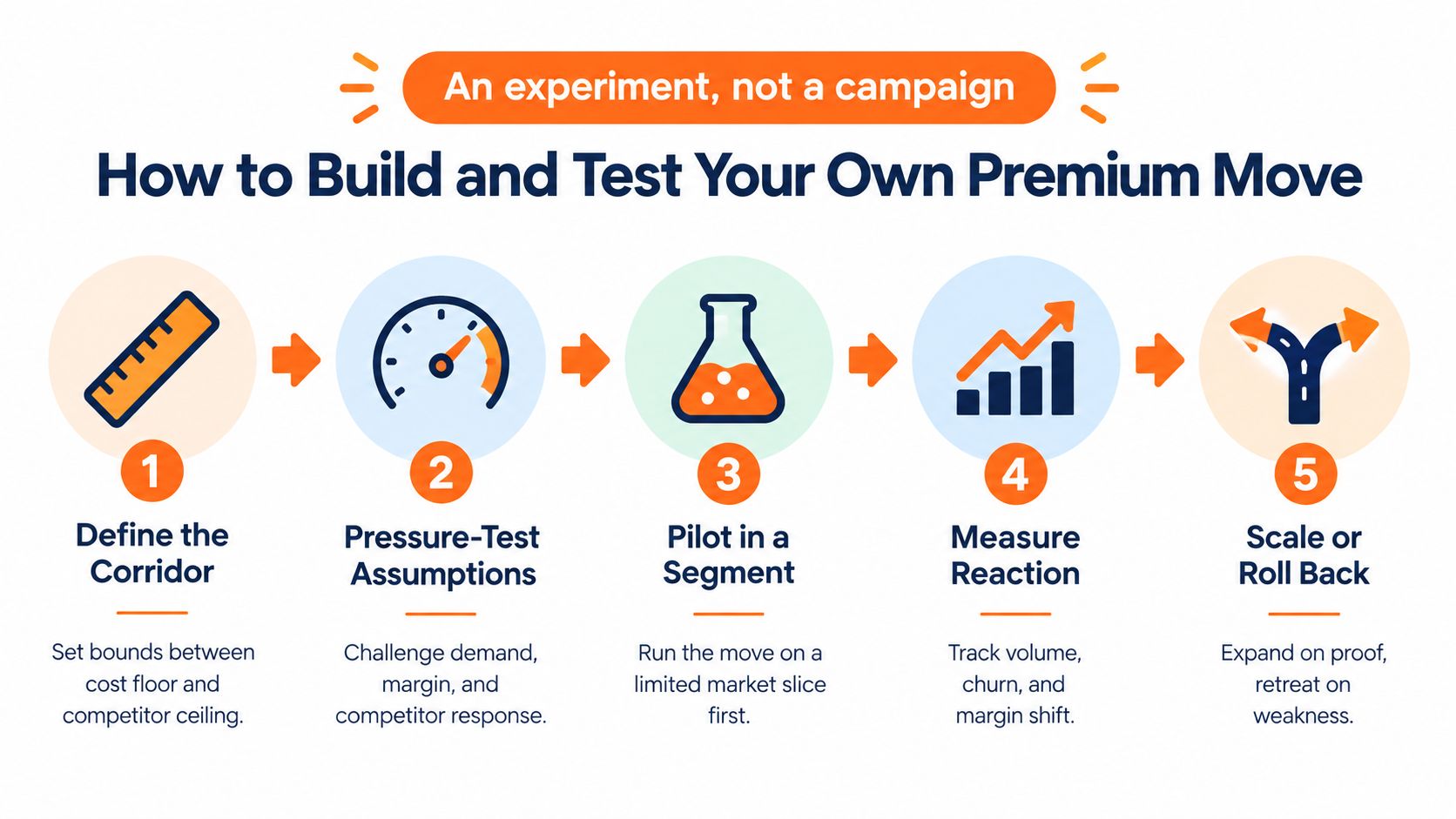
A premium move is an experiment, not a campaign. Build the test so that you can learn which customers accept the price, which benefits they value, and where demand starts to leak.
Define a corridor before choosing a price
Umbrex recommends building a pricing corridor instead of guessing one exact premium. Its starting range is about 12% to 25% above the market median, adjusted by segment and channel, and it recommends methods including conjoint analysis, discrete choice, Van Westendorp, and deal data to test tolerance (Umbrex pricing framework).
Set the bottom of the corridor with your cost floor and required contribution. Set the top with competitor prices, buyer expectations, and the proof your brand can deliver. Don't treat the corridor as an automatic answer. Treat it as a testing boundary.
Van Westendorp can map the range where buyers see a price as too cheap, acceptable, expensive, or too expensive. Conjoint analysis can show which attributes make buyers choose the premium option. Use both to separate “I like the idea” from “I would sacrifice another purchase to buy this.”
Test the richest cohort first
Segment before rollout. Start with customers who buy at full price, repeat frequently, use the highest-value version, or respond to the specific benefit you plan to charge for. Keep the rest of the base unchanged while you learn.
Use controlled waves across audience, channel, or product version. Hold out a comparison group where possible. Track the signals that appear before cancellation:
- Repeat purchase: Do buyers return at the new price?
- Basket behavior: Do they remove add-ons, choose smaller quantities, or use more coupons?
- Switching: Do they move to private label or a cheaper tier?
- Elasticity: Does volume change stay within the tolerance you set before launch?
- Margin quality: Does contribution improve after support, promotions, refunds, and fulfillment costs?
Set a kill criterion before you see the results. For example, you might stop the test if repeat purchase weakens, trade-down rises, or contribution falls below the level needed to justify the risk. The exact threshold belongs to your economics. Decide it in advance so hope can't rewrite the rules.
A successful pilot doesn't prove that the whole market will pay. It proves that one defined segment accepts one defined value proposition at one tested price. Scale only after observed behavior supports the survey result.
You can also use this guide on how to price a new product to structure the initial assumptions and test design.
A Founder Scenario Putting the Framework to Work
Consider a specialty coffee subscription founder preparing to raise the price of a flagship roast. The founder has strong brand signals, repeat customers, and a product that sits inside an experience-led category. Conjoint analysis and Van Westendorp research suggest that a group of buyers sees room for a premium.
The founder makes one smart decision first. Existing subscribers keep their current price while new acquisition sees the higher offer. That protects the most loyal cohort and isolates the test. The team tracks weekly churn, net revenue retention, first-order conversion, add-on selection, and the share of shoppers who choose the lower-priced option.
The surveys remain positive. Buyers continue to say they understand the premium and would consider paying it. Checkout behavior tells a different story. New-customer conversion falls, first orders contain fewer add-ons, and acquisition becomes more expensive because the higher entry price makes the first decision harder.
That gap matters more than the survey headline. A buyer can believe your coffee deserves a premium in an abstract questionnaire and still choose the cheaper basket at checkout. The buyer may admire the sourcing story, accept the product's quality, and decide that this particular purchase doesn't justify the extra cash.
Watch the basket before you watch churn. Customers often reveal resistance through smaller orders, fewer upgrades, and more promotion use before they cancel.
The founder should respond by testing the offer, not by defending the original price. The team could keep the flagship premium for buyers with strong repeat intent, create a smaller entry package, make the upgrade benefit clearer, or give new customers a lower-risk first purchase. Existing subscribers can remain on their current terms while the team learns which promise changes behavior.
This scenario shows why a price premium strategy needs a register-level measurement plan. Stated willingness to pay tells you whether the story sounds reasonable. Conversion, basket composition, repeat purchase, and switching tell you whether the price survives contact with the buyer's budget.
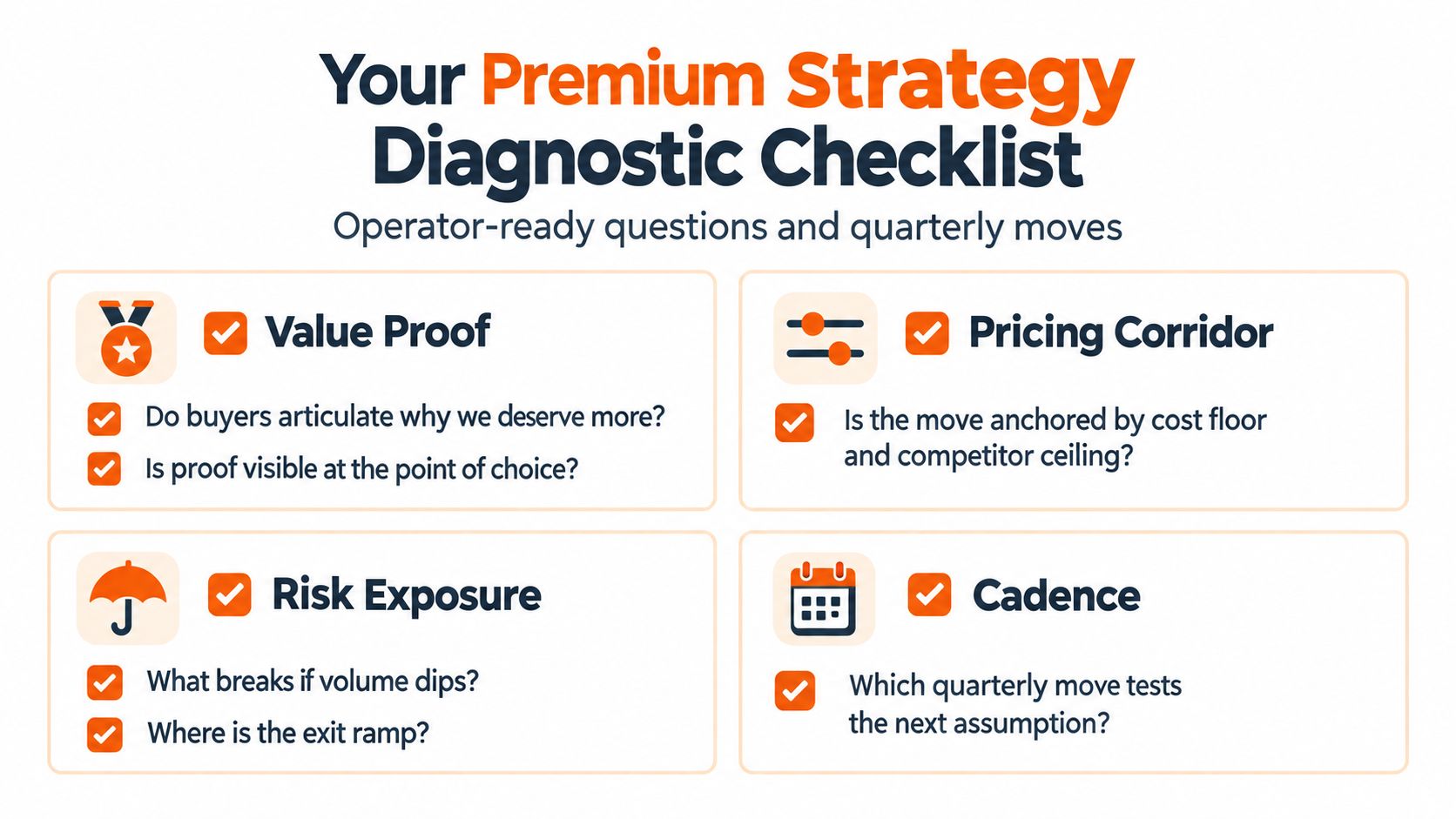
Your Premium Strategy Diagnostic Checklist
Use this checklist before you approve a price increase. Write the answers down, assign an owner, and revisit them on a fixed cadence.
Proof of pricing power
- Brand memory: Can buyers explain why you deserve more without help from a sales representative?
- Preference: Do repeat customers choose you at full price when a cheaper substitute remains available?
- Price recall: Do customers remember your brand as a deliberate choice rather than an accidental purchase?
- Proof at choice: Can the buyer see the benefit on the product page, shelf, proposal, or checkout screen?
Willingness-to-pay validation
- Segment results: Did you separate loyal, occasional, promotional, and new buyers?
- Attribute testing: Did conjoint analysis show which product or service attributes carry the premium?
- Acceptable range: Did Van Westendorp or deal data show where the price starts to feel excessive?
- Behavior check: Did you compare stated answers with conversion, repeat purchase, basket size, and switching?
Category fit
- Experience test: Does the upgrade change an occasion, feeling, ritual, identity, or perceived risk?
- Substitution test: Can a buyer replace you quickly with a cheaper option?
- Comparison frequency: Does the customer check your price every purchase?
- Operational proof: Can your team deliver the promised difference consistently?
Rollout mechanics
- Corridor: Have you set a floor, ceiling, test prices, and contribution requirements?
- Cohort isolation: Can you test the move without exposing every customer at once?
- Trade-down guardrail: Will you catch smaller baskets, coupon use, downgrade behavior, and private-label switching?
- Exit ramp: What result makes you roll back, revise, or stop the move?
Run the work in this order this quarter. First, measure brand and category permission. Second, test the corridor with segmented research and a controlled offer. Third, compare actual purchase behavior with stated willingness to pay, then scale only where the evidence holds.
Chicago Brandstarters gives founders a free, vetted community with small private dinner groups and an active chat where members discuss real operating decisions, including pricing and positioning. Visit Chicago Brandstarters to meet kind, hard-working Midwest builders who can challenge your premium assumptions before you put the new price in front of every customer.
Leave a Reply