

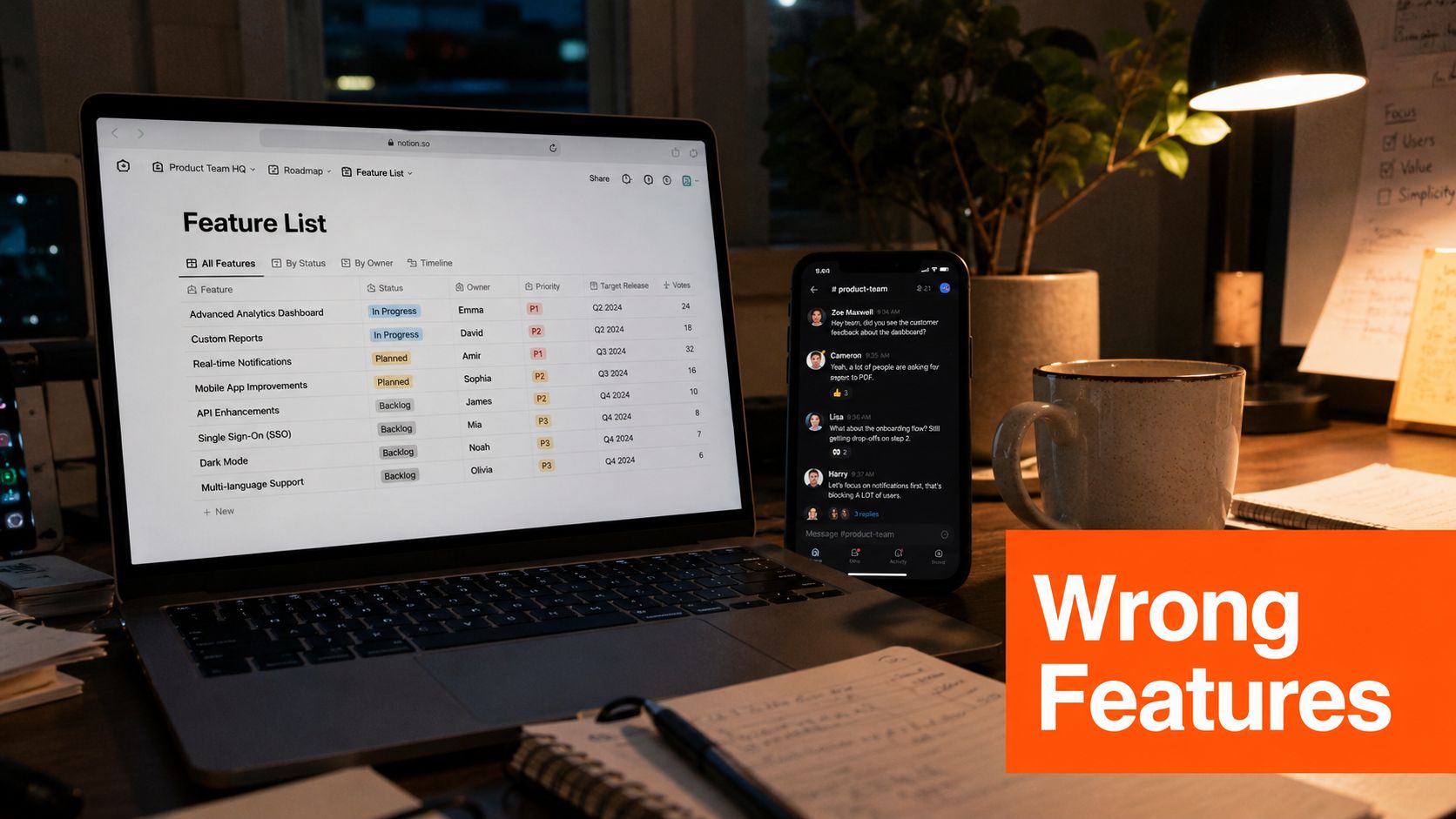
Thursday, 9 p.m. You have a Notion page packed with 40 feature ideas, a Slack thread full of customer requests, and a co-founder who thinks every request needs to ship by Monday. You picked three features for the sprint. By Friday, one has disappeared, another has grown twice as large, and the third came from a conversation nobody can find.
I've lived through that kind of product planning. The issue wasn't laziness or a lack of ambition. We had too many inputs and no reliable way to turn them into a decision. Feature prioritization only works when your team can decide together, record the decision, and keep working after the meeting ends.
Why You Keep Shipping the Wrong Features
The first trap is treating every customer request as a vote. A customer asks for gift cards, another asks for a better search bar, and a third wants a mobile app. You collect each request in a backlog and assume the most repeated idea deserves the next slot. That logic breaks because customers describe solutions, not always the problem behind them. One buyer may ask for gift cards because they can't find a suitable bundle. Another may ask for search because product categories make browsing painful.
The second trap is choosing what feels easy to build. Small teams naturally prefer a clean, familiar task over a messy customer problem. A contractor can add a filter in two days, so the filter jumps ahead of a retention problem that needs interviews, instrumentation, and testing. You feel productive, but your business hasn't moved.
The third trap is shiny-object planning. A competitor launches a feature, an investor sends a suggestion, or you get an idea during a shower. The new thought enters the backlog with fresh energy, while older ideas lose attention because they look familiar. Your roadmap becomes a weather vane.
Replace the wishlist with a ranked list
I'd make one change before touching any framework. Stop asking, “What should we build?” Ask, “Which customer problem has the strongest connection to the outcome we need?”
A widely cited product analytics benchmark found that 6.4% of features drove 80% of click volume across the studied products, leaving 93.6% with relatively little engagement, as summarized in this feature prioritization matrix guide. Treat that pattern as a warning, not a law. Shipping more features doesn't automatically create more value.
Practical rule: Every feature needs a problem, an expected outcome, and a reason to ship now.
For a small ecommerce brand, “add loyalty points” is a weak backlog item. “Help first-time buyers understand why they should return” gives your team something to test. Once you rank problems against a shared outcome, the frameworks become calculators. They stop acting like a substitute for judgment.
Set the Goal Before You Touch the List
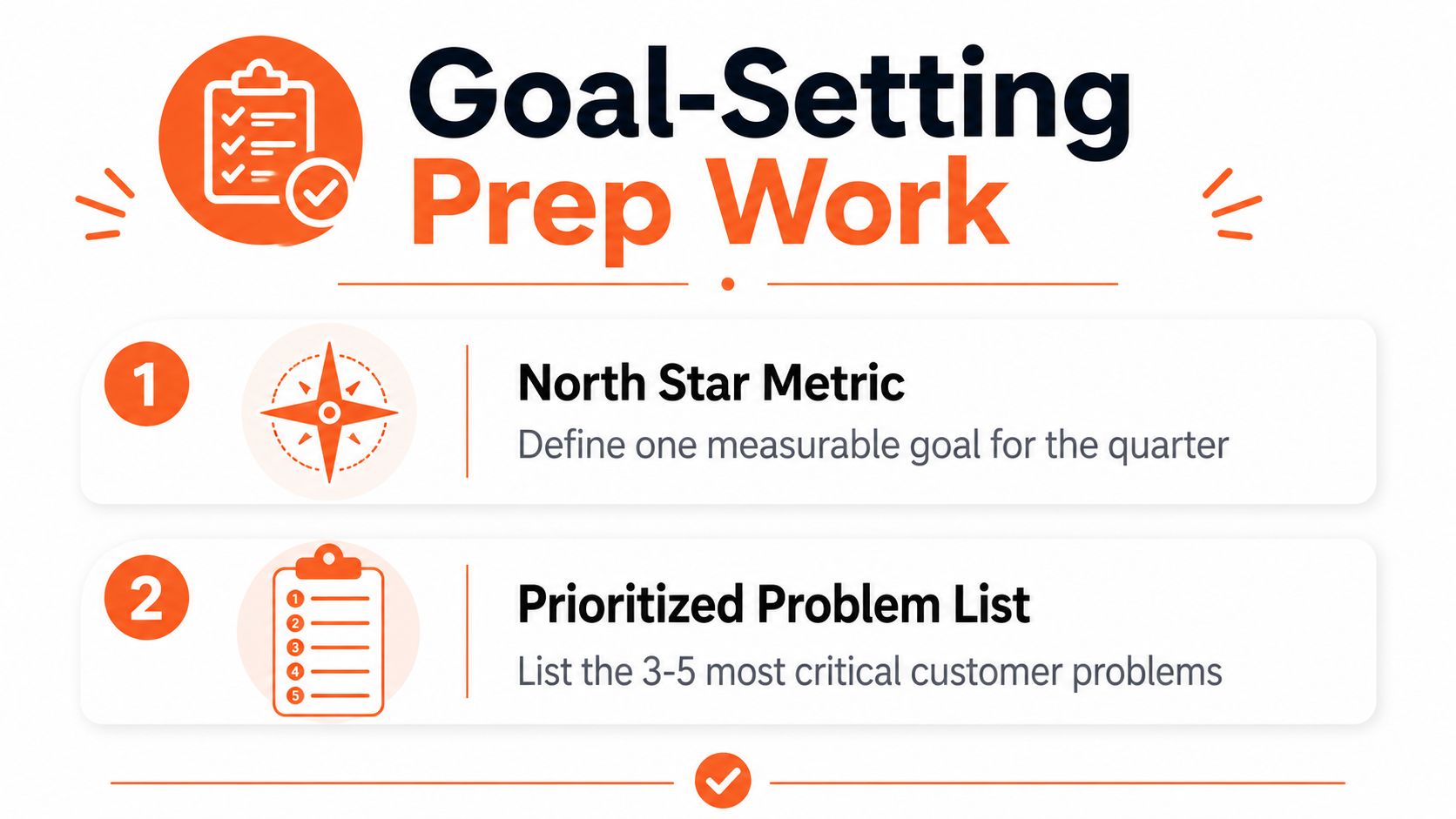
Every scoring system gives you nonsense when you feed it an unclear goal. Before you compare features, choose one North Star metric for the quarter and write a short list of customer problems that might move it.
Your metric should describe customer behavior close enough to the product that you can learn from it. Revenue can matter, but it often arrives after the behavior you need to change. Depending on your model, you might choose weekly active buyers, repeat purchase rate, or activation to a second order. Pick one. If you name five North Stars, you've created five competing roadmaps.
Draft the two artifacts in under an hour
Start with a sentence: “This quarter, we want to move [metric] by helping [customer group] do [behavior].” Keep the wording plain. “Increase repeat purchase rate by helping skincare buyers choose their next product” gives you a better filter than “grow retention.”
Then write a problem list. Keep it short, usually five to eight problems, and phrase each one around a blocked customer action:
- Choosing the next product: Buyers finish their first order but don't know what to try next.
- Managing a subscription: Subscribers need to skip a month without canceling.
- Understanding rewards: Returning buyers can't see whether loyalty activity benefits them.
- Finding a suitable bundle: Shoppers struggle to combine products for a specific routine.
- Reordering at the right time: Buyers forget to return when they run out.
The exact count matters less than the discipline. A long problem list becomes another wishlist. Each problem should include an outcome you can observe, like completing a reorder, returning for a second purchase, or avoiding cancellation.
Pressure test the list
Call a customer before you score anything. Ask what they tried to do, where they got stuck, and what they did instead. Don't ask whether they like your proposed feature. That question invites politeness and rewards your own assumptions.
A 2026 roundup reports that product teams most often use customer impact or value, business impact or ROI, strategic importance or differentiation, effort or technical feasibility, and business OKR alignment when they prioritize features. The same roundup reports that 66.9% of product managers spend between 6% and 25% of their time on feature prioritization, while 4.9% spend more than half their time on it, according to Product-Led Alliance's product management statistics. Your prep work earns that time back because you compare ideas against a fixed target instead of your mood.
Pick One Framework and Actually Use It
Frameworks don't create agreement. They give your disagreement a shape. Pick one, use it for a quarter, and change it only when the method fails to help you decide.
| Framework | Best For | Inputs You Need | Weak Spot |
|---|---|---|---|
| MoSCoW | A first meeting with a small team | Must have, Should have, Could have, Won't have | Teams label too many items Must have |
| RICE | Ranking several ideas with usage evidence | Reach, Impact, Confidence, Effort | Estimates can look more precise than they are |
| WSJF | Sequencing work around delay and duration | Cost of Delay and job duration or size | Small teams often lack dependable delay inputs |
MoSCoW keeps day-one decisions simple
MoSCoW sorts work into Must have, Should have, Could have, and Won't have for now, as described in this product prioritization framework glossary. Use it when your founders, designer, and contractor need a shared language quickly.
For a small shop, a broken checkout belongs in Must have. A subscription skip button may land in Should have. A bundle builder could sit in Could have. A gift-card system might go into Won't have for now if it doesn't connect to the quarter's target.
RICE ranks ideas with a formula
RICE uses Reach, Impact, Confidence, and Effort. The formula is (Reach × Impact × Confidence) / Effort, and this RICE framework comparison defines Reach as users affected during a period, Impact as the strength of movement toward a target metric, Confidence as belief in the estimates, and Effort as team time or person-months.
RICE makes trade-offs visible. A feature with broad reach and high impact can still fall behind when your team has little confidence or needs too much effort. Start using it once you have enough usage evidence to make those inputs less fictional.
WSJF belongs later
Weighted Shortest Job First divides Cost of Delay by job duration or size. Cost of Delay usually combines business value, time criticality, and risk reduction or opportunity enablement, according to this Cost of Delay and WSJF guide.
I wouldn't start there. WSJF can help a larger organization sequence work, but a young brand usually lacks clean inputs for time criticality and delay cost. Start with MoSCoW for two meetings, then move to RICE when your product generates useful behavior data. For a broader decision process, pair this approach with a framework for making decisions. The OKR Hub's backlog prioritization resource also gives you another way to connect backlog choices to goals.
Run a 45-Minute Prioritization Meeting
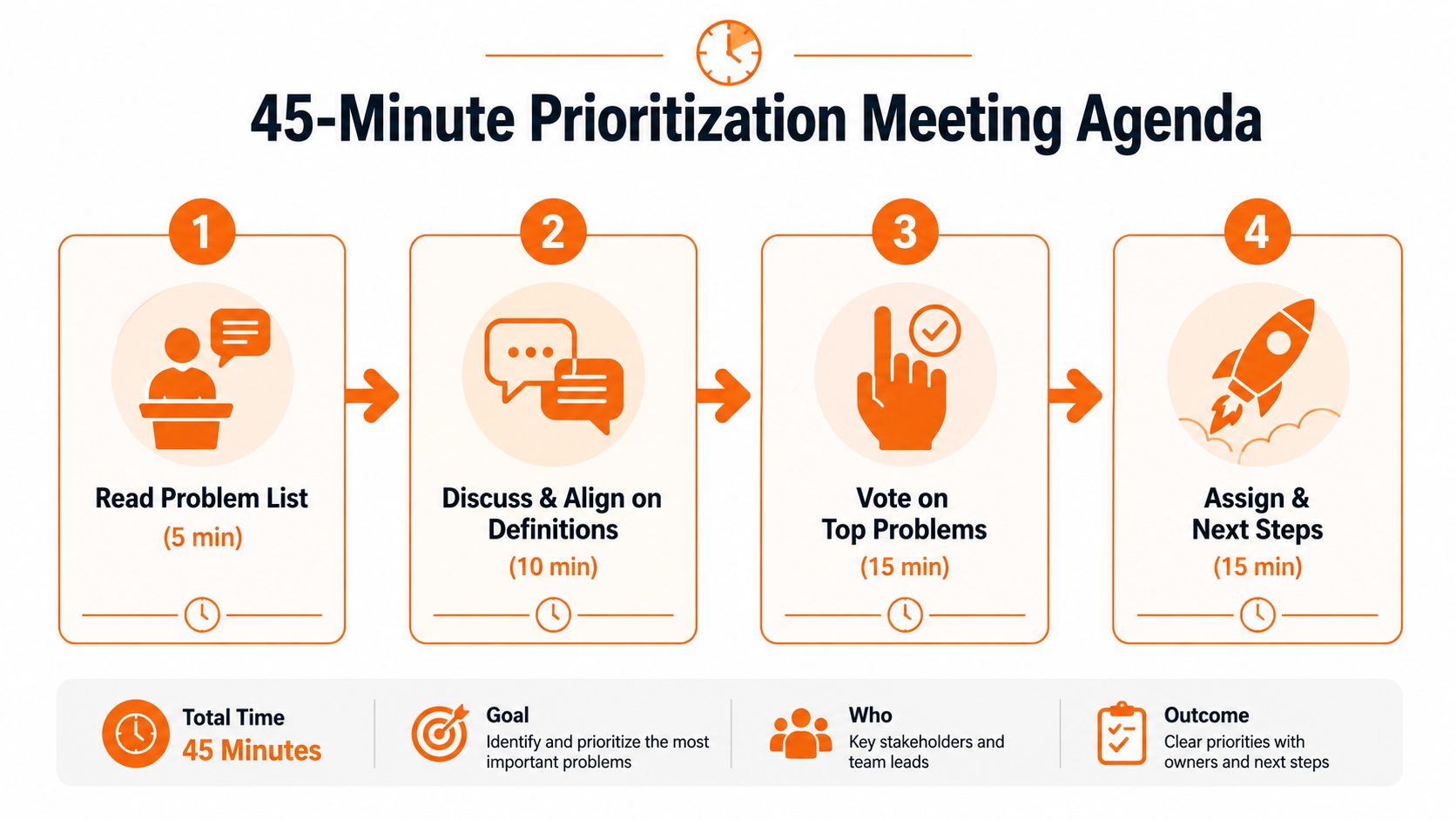
Your team doesn't need another spreadsheet. It needs a meeting with a clock, a decision owner, and a rule against reopening settled questions every week.
Run this session every two weeks. A solo founder can do it alone with written notes, while two co-founders and a contractor can use a shared board in Linear, Notion, or FigJam.
- First five minutes, read the problem list. Read it aloud or without speaking. Don't edit the wording yet. Ask, “Are we still solving these customer problems this cycle?”
- Next ten minutes, collect candidate features. Put one feature on each sticky note. Pull ideas from support messages, usage data, bugs, deadlines, and the existing backlog.
- Next ten minutes, vote in silence. Give each participant three votes. Ask, “Which candidates have the strongest connection to our target metric?” Silence prevents the first confident speaker from steering the room.
- Next ten minutes, score the top five. Use MoSCoW or RICE. Write every assumption where everyone can see it. Ask, “What do we know, and what are we guessing?”
- Last ten minutes, choose the next one to three items. Ask, “What can we ship within this cycle without creating support or measurement debt?” Then assign an owner and define the expected metric movement.
The meeting's most useful output is the decision log, not the board. Use this template:
Date:
Feature chosen:
What we said no to:
Reason:
Metric we expect to move:
Owner:
Review date:
That record gives you an answer when an angry customer asks why you haven't built their request. It also lets you compare your predictions with what happened. If you want a ready-made structure for this practice, review these decision log resources.
A short video can help your team understand the meeting rhythm before you run it:
Build a Living Roadmap and a Decision Log
A quarterly roadmap becomes stale as soon as your assumptions change. You wrote it as a forecast. A living roadmap records what you have decided to do now, what you have queued next, and what you have deliberately left alone.
Use three columns:
- Now: Work you expect to ship in the next two weeks.
- Next: Work you chose but haven't started.
- Later: Ideas you considered and deferred, with a one-line reason.
Keep the Later column. Deleting every deferred idea creates the same argument again when someone rediscovers it. “Later, because we can't measure adoption yet” tells your future self more than a vague backlog card.
Record the trade-off, not only the winner
Your decision log should sit in a separate document. Use these columns: date, feature, what you chose, what you rejected, the reason, and the metric you expect to move. Review it monthly.
One sample entry for a DTC brand might read: 2026-03-04, loyalty points page, chose to ship, said no to gift cards, reason: 38% of churned buyers asked about rewards, metric: repeat purchase rate. Because that 38% is a supplied example, keep it labeled as an example rather than presenting it as your own research.
A second entry might say: “2026-03-18, subscription skip-a-month button, chose to ship, said no to bundle builder, reason: clearer path to reducing cancellation, metric: repeat purchase rate.” The sentence forces you to name the sacrifice.
I once let a small launch absorb a feature too early because the team had already spent time on it. The launch needed a simpler onboarding path, but we kept polishing an account dashboard. A decision log would have exposed the mismatch before the work consumed the release window. For templates and practical examples, these top decision log resources can help you set up the document.
A Sample Scoring Matrix for a Small Brand
Take a small DTC skincare brand with repeat purchase rate as its North Star metric and an eight-week planning window. The team uses RICE, with Reach estimated as buyers per month, Impact scored at 0.5 for low, 1 for medium, and 3 for high, Confidence expressed as a percentage, and Effort measured in person-weeks.
| Candidate feature | Reach | Impact | Confidence | Effort | RICE score |
|---|---|---|---|---|---|
| SMS reorder reminders | 700 | 3 | 90% | 1 | 1890 |
| Subscription skip-a-month button | 800 | 3 | 80% | 2 | 960 |
| Loyalty rewards page | 600 | 1 | 60% | 3 | 120 |
| Bundle builder | 400 | 3 | 50% | 6 | 100 |
| Quiz-based product finder | 500 | 1 | 40% | 4 | 50 |
| Wholesale inquiry form | 20 | 1 | 70% | 1 | 14 |
The formula explains the ordering. SMS reorder reminders reach 700 buyers, carry high impact at 3, have 90% confidence, and need only 1 person-week, producing a score of 1890. The subscription control reaches 800, also carries impact of 3, has 80% confidence, and needs 2 person-weeks, producing 960.
Read the bottom of the table correctly
The bottom three ideas aren't bad. The quiz has low confidence and a moderate effort estimate. The bundle builder has high potential impact but requires much more effort with lower confidence. The wholesale form has little reach against a repeat-purchase goal.
That distinction matters. You aren't killing ideas. You're deferring them because they don't fit this target, this evidence level, or this delivery window. Put the reason in the roadmap so a future team can revisit the assumption instead of restarting the debate.
Inputs to Throw Away and Inputs to Keep
Your scoring system can't rescue a backlog built from wishes. Founders often re-prioritize every week because a fresh request feels like new evidence, even when it contains no information about behavior, urgency, or the target metric.
Throw these inputs away:
- The loudest inbox message: One angry customer can reveal a problem, but volume alone doesn't prove broad demand.
- A competitor's new feature: Copying their surface solution doesn't tell you whether your customers share the same problem.
- The shower idea: Capture it, then make it earn a place on the problem list.
- The investor request: Treat it as a hypothesis until it connects to your customer and business evidence.
- An unconnected feature: If you can't trace it to a listed problem, defer it.
Keep these signals:
- Product or store usage: Look for actions customers take, abandon, or repeat.
- Repeated customer conversations: Track patterns across at least five conversations before treating a request as a recurring signal.
- Activation blockers: Fix a bug that prevents a customer from reaching the first useful moment.
- Hard deadlines: Include holiday launches, contractual commitments, and other dates you can't move.
- Metric-linked bets: Prefer work with a clear path to your North Star metric.
- Execution clarity: Favor ideas your team can measure, support, and ship with the skills and time available.
A 2025 PhD thesis argues for using structured product telemetry in feature prioritization, while newer work on AI decision support and NLP-based prioritization points toward scoring from usage data instead of relying only on manual opinions. A separate decision-support summary argues that data readiness, implementation constraints, strategic timing, ROI, and time-to-value belong in the decision, so the clearest execution path can beat the loudest demand. Treat those as design principles, not permission to automate judgment.
Use a deliberate system for customer feedback collection, then bring only the strongest signals into your meeting. If you add a new input category, remove one. A small, honest input set beats a giant backlog that lets every opinion demand a vote.
Chicago Brandstarters gives early-stage founders a free, vetted community with small private dinner groups, a founder group chat, and practical peer conversations about decisions like feature prioritization. Visit Chicago Brandstarters to meet other kind, hardworking builders and bring your next roadmap decision to people who understand the cost of shipping the wrong thing.
Leave a Reply