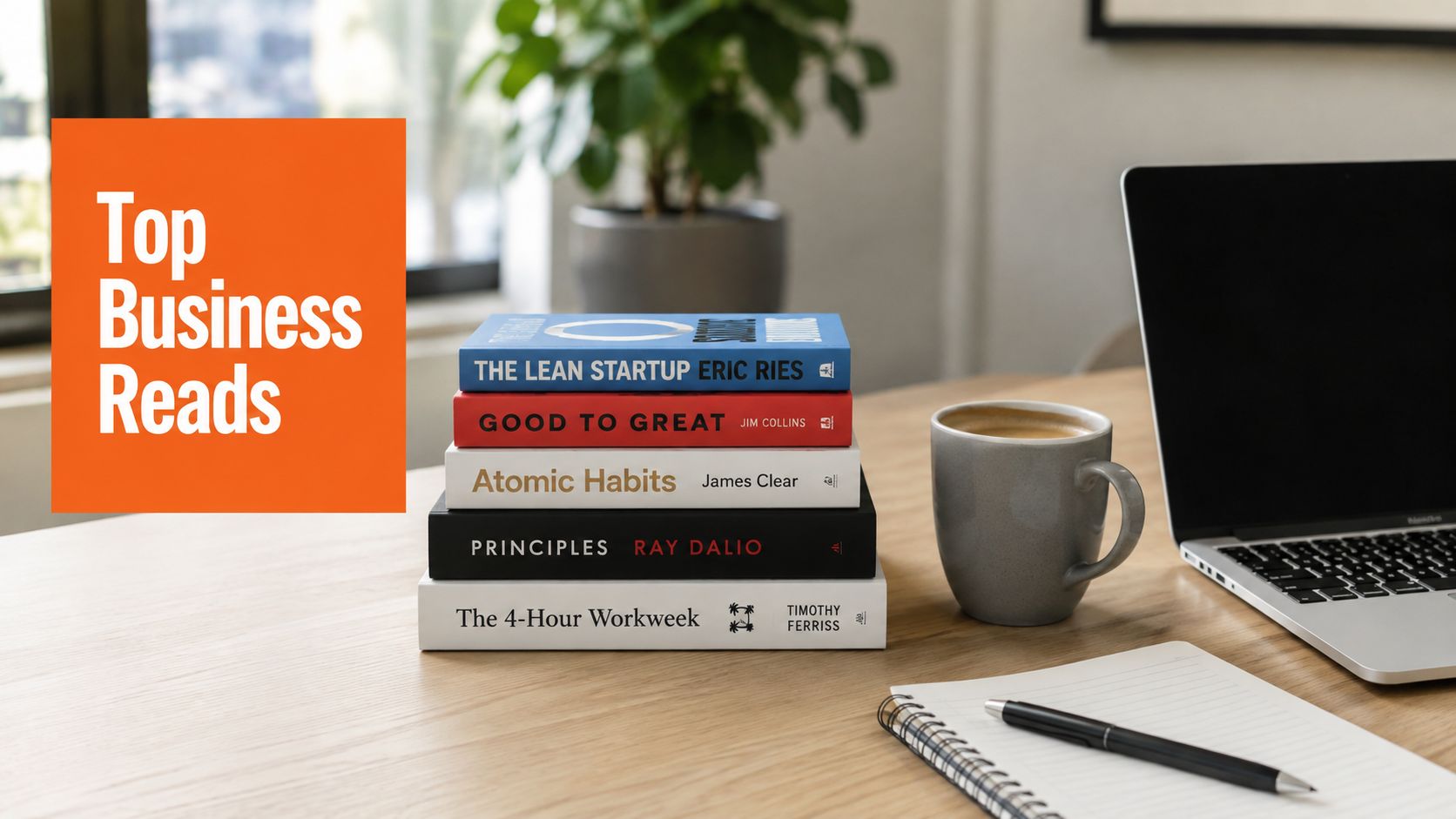
Most founders don't need a giant reading list. They need one useful book for the decision sitting in front of them.
That decision might involve testing demand, finding first customers, protecting cash, building reliable habits, managing time, or leading through a hard season. A famous title can still waste your time if it answers a problem you don't have yet. Choose the book that gives you a better next move.
The list below follows the founder's path from idea validation to growth toward seven figures. Each recommendation includes a practical action, a suggested reading order, and a prompt for a small founder group such as Chicago Brandstarters. You can work through the books alone, or use each one to start a candid conversation with peers who understand the pressure of building a company.
Business books remain a large reading and purchasing category. In 2021, readers bought approximately 80.64 million print books in business and economics, about 25% of all adult nonfiction print sales, up from 73.31 million units in the prior fiscal year, a 10% increase according to business book sales data. The point isn't to read everything. It's to choose well, apply one idea, and let the result decide what you read next.
1. The Mom Test
Before you build a product, learn whether people have a real problem. The Mom Test by Rob Fitzpatrick gives you a direct way to do that without letting polite conversations trick you.
Founders often describe an idea, ask whether someone would buy it, and treat a friendly yes as proof. That approach turns customer interviews into compliments. Fitzpatrick pushes you toward questions about past behavior, current workarounds, existing spending, and painful moments. Those answers tell you more than hypothetical enthusiasm.
A founder might believe target customers need a new reporting feature. After asking, “Would you use this feature?” they hear yes. After asking, “Tell me about the last time you prepared that report,” they discover customers already solve the problem with a spreadsheet and don't care enough to switch. That answer hurts, but it saves weeks of work.
Apply the book
- Write your assumptions first: Record what you believe about the customer, problem, urgency, and current solution before each conversation.
- Ask about the past: Use “Tell me about the last time you…” instead of “Would you ever…?”
- Track behavior: Listen for what people do, pay for, delay, and repeat. Treat future promises as untested opinions.
- Share raw notes: Give your dinner group the actual language customers used, not your polished interpretation.
Practical rule: If the conversation makes you feel certain before the customer describes a recent action, you probably pitched too soon.
Reading order and peer prompt
Read this first. Then ask your group: Which customer belief would be most expensive for you to get wrong, and what question could test it without mentioning your product?
2. The Lean Startup
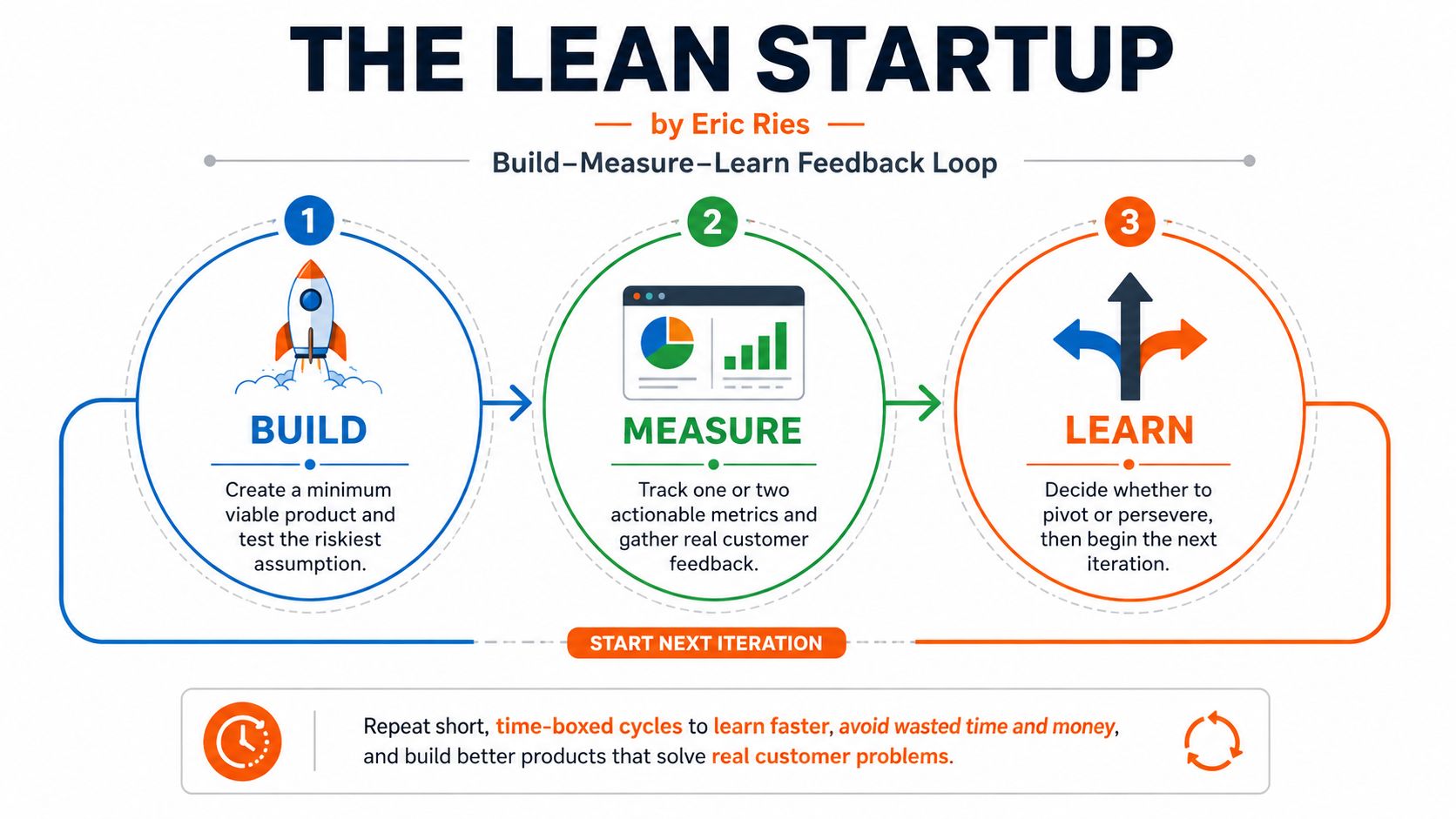
The Lean Startup by Eric Ries helps you turn uncertain ideas into small, testable experiments. It belongs directly after The Mom Test because honest conversations give you assumptions, while experiments show whether those assumptions survive contact with customers.
Ries argues for short learning cycles. Build the smallest version that can test your riskiest belief, measure what happens, and decide whether to continue or change direction. You don't need a polished product to learn. Dropbox tested interest with a simple product video before building the full service. Airbnb's founders tested their idea by posting photos of their apartment on Craigslist.
The book also gives you a useful warning about activity. A growing list of features, meetings, and sign-ups can create the appearance of progress while leaving your main question unanswered. Choose a measure connected to the decision you need to make, then run the experiment.
Use a tighter experiment loop
- Name the riskiest assumption: Write one sentence, such as “Independent retailers will pay for this inventory tool.”
- Choose the smallest test: Pick a landing page, paid pilot, manual service, interview sequence, or other test that can produce evidence.
- Set a time limit: Give the experiment a clear end point so learning doesn't become endless preparation.
- Record the result: Share what happened with your founder community and decide what you'll change.
You can find more places to study practical business strategy in this guide to business strategy books.
Reading order and peer prompt
Read this second. Ask: What would you test this week if you had to learn something useful without building the finished product?
3. Zero to One
Once you've tested that a problem exists, decide what kind of business you're trying to build. Zero to One by Peter Thiel with Blake Masters challenges you to stop copying crowded competitors and search for a specific advantage.
The book asks uncomfortable questions. Why should your company exist? Why are you the person to build it? What can you do that others can't easily reproduce? Thiel's argument favors distinctive progress over small improvements to an existing category. You don't need to accept every part of his philosophy, but you should use the questions.
PayPal's early growth gives the book a concrete business example. Thiel's team built a payment product around a problem that required a different approach from ordinary payment processing. Your own advantage might come from proprietary access, a narrow customer group, unusual distribution, specialist knowledge, or a faster way to deliver a result.
Make the strategy concrete
Write down your proposed advantage in plain language. Avoid phrases like “better service” unless you can explain exactly why your service works better and why competitors can't copy it quickly.
Then answer these questions:
- Why you: What experience, access, relationship, or insight gives you a reason to pursue this idea?
- Why this customer: Which group has a problem you understand better than a generalist competitor?
- Where can you be much better: Choose one customer outcome where you can aim for a major improvement instead of a minor feature difference.
- What conventional belief might be wrong: Write the assumption your sector repeats without testing.
Reading order and peer prompt
Read this after you've gathered early customer evidence. Ask: What advantage could we build that would still matter if a better-funded competitor copied our current product?

4. This Is Marketing
Your next decision is who you'll serve first. This Is Marketing by Seth Godin gives you a sharper alternative to vague targeting. Instead of trying to reach an average customer, define the smallest viable audience that cares enough to notice, try, and recommend your work.
A founder might sell a product to “small businesses.” That description covers too many needs, budgets, and buying habits. A better starting point might be independent Chicago retailers with a specific inventory problem, or first-time ecommerce founders who need a particular operational service. Narrowing the audience doesn't trap you. It gives you a clear group to understand and serve.
Godin's approach also changes your marketing behavior. You stop chasing attention from everyone and start making a useful promise to people who already care about the problem. A loyal community can grow from repeated service, clear language, and customer experiences worth sharing.
Define your first audience
- Name the person: Describe the buyer's role, situation, and immediate problem.
- Find the emotional stake: Ask what they fear, want, avoid, or hope to change.
- Create a specific promise: Explain the result in language your audience already uses.
- Find early believers: Use Chicago Brandstarters to meet founders and operators who may understand your customer, message, or first offer.
Your outreach may also include marketing investors in the US if you later need capital for distribution or growth. Don't confuse funding with customer understanding. Money can amplify a clear message, but it can't invent one.
Reading order and peer prompt
Read this after Zero to One. Ask: Who would miss our company if it disappeared, and what would they say they lost?
5. Traction
A good product and a clear audience still leave one hard question. How will customers find you? Traction by Gabriel Weinberg and Justin Mares gives you a practical way to test customer-acquisition channels instead of waiting for one to work by luck.
The book walks through 19 channels, including sales, public relations, partnerships, content marketing, community building, and viral loops. You don't need to pursue all of them. You need a disciplined process for comparing a few plausible options.
Dropbox used a viral loop in which users could bring others into the product. Airbnb used content and partnerships to reach people in new cities. Those examples don't give you a formula. They show why distribution deserves its own experiments, separate from product development.
Run a channel test
Choose three channels that match your audience and offer. Give each a defined test period, record the conversations or leads it creates, and compare the quality of customers rather than counting attention alone. A channel that produces interest without buying intent can consume your week while teaching you very little.
The Bullseye Framework helps you begin broadly, identify the channel with the most promise, and focus your effort where the evidence points. Keep a simple experiment log with the channel, message, audience, action, result, and next adjustment.
Reading order and peer prompt
Read this after This Is Marketing. Ask: Which channel lets us reach our smallest viable audience with the least dependence on paid attention?
6. Never Split the Difference
You'll negotiate before you hire a team or raise serious capital. Never Split the Difference by Chris Voss gives you tools for conversations with suppliers, customers, investors, partners, and contractors.
Voss draws from his experience as an FBI negotiator and focuses on listening rather than performing confidence. You label emotions, repeat important words, use calibrated questions, and allow silence to create room for the other person to think. The method doesn't mean manipulating people. It means understanding what they need before you press for a decision.
Suppose a factory gives you a price that breaks your margin. Instead of arguing immediately, ask, “How am I supposed to do that?” The question invites the supplier to solve the constraint with you. You might learn that a different order schedule, packaging choice, or payment arrangement changes the discussion.
Practice before the high-stakes call
- Label the concern: Say, “It sounds like you're worried about delivery timing,” and let the other person correct you.
- Ask calibrated questions: Use “How?” and “What?” to make the problem concrete.
- Repeat the important phrase: Echo a few words from the other person, then wait.
- Protect silence: Don't rush to fill every pause with a concession.
For a more focused application, use these ideas alongside this guide on negotiating with suppliers.
Reading order and peer prompt
Read this before your next supplier, investor, or partnership conversation. Ask: Which concern does the other side need us to understand before they can agree to our proposal?

7. Profit First
Revenue can rise while your bank balance stays frighteningly low. Profit First by Mike Michalowicz gives small-business owners a cash system that puts profit, taxes, owner pay, and operating expenses into separate accounts.
The logic is simple. If you spend whatever arrives, your business will keep finding ways to consume the money. Separate accounts create boundaries. You see what you can spend, what you must reserve, and what the business produces for you.
An ecommerce founder can separate profit, tax, owner pay, and operating accounts before placing new inventory orders. That separation makes growth decisions less emotional because the founder can see whether a purchase fits the money available for operations.
Start with account separation
- Operating account: Use this for ordinary business expenses.
- Profit account: Move your chosen profit allocation here before spending on growth.
- Owner-pay account: Treat your compensation as a planned business obligation.
- Tax account: Reserve tax money before it disappears into daily expenses.
Automate the transfers where your bank allows it. Review the allocations with an accountant who understands your structure and local tax obligations. Then use a private founder group for accountability rather than hiding weak cash control behind impressive sales conversations.
You can pair the book with this practical guide to cash flow management for small business.
Reading order and peer prompt
Read this before you add staff, inventory, or a major marketing expense. Ask: Which expense keeps growing because we never set a clear boundary around it?
8. Atomic Habits
Founders often choose goals that require daily behavior, then rely on motivation to sustain them. Atomic Habits by James Clear gives you a better operating model. Build small routines, connect them to existing behavior, and design your environment so the right action becomes easier.
A founder who writes for fifteen minutes each morning may eventually create a body of content that supports sales and trust. A founder who checks in with customers on a consistent schedule may develop stronger relationships and more referrals. The result comes from repetition, not from one heroic workday.
Clear's approach works well for companies because habits turn intentions into systems. “We should talk to customers more” remains vague. “After Monday's team meeting, I'll call one active customer and record the main problem” creates a behavior you can repeat and review.
Build one founder habit
- Stack it: Review metrics while you drink your morning coffee.
- Reduce friction: Keep the customer-notes document open and ready.
- Make it visible: Share your habit record in a group chat or dinner meeting.
- Reward consistency: Notice completed repetitions instead of waiting for a dramatic result.
Reading order and peer prompt
Read this after you've chosen your customer and channel. Ask: Which repeated action would make the business healthier if we completed it every working day?
9. The 4-Hour Workweek
The 4-Hour Workweek by Tim Ferriss is useful when your company depends too heavily on your personal availability. The book pushes you to examine what you do, remove low-value work, automate repeatable tasks, and delegate work that doesn't require your judgment.
Take a founder with a day job and a side business. If that founder answers every routine support email personally, checks every order manually, and schedules each meeting through back-and-forth messages, the business will consume the limited hours available for product and customer work. A simple response library, booking tool, or contractor can return that time.
The book's strongest use isn't permission to disappear. It's a test of applied effort. You want more output from the work that matters, not fewer responsibilities handled carelessly.
Make time visible
Track your work for a week. Mark each task as eliminate, automate, delegate, or keep. Automate repetitive steps before you delegate them, because a messy process will remain messy when you hand it to someone else.
Start with a small delegation. Give a contractor one well-defined customer-service task, provide examples of a good response, and review the result. Protect your best focus period for work only you can do, such as customer discovery, product decisions, or major negotiations.
Reading order and peer prompt
Read this after Atomic Habits, when you know which routines deserve protection. Ask: What task am I still doing because I'm used to it, even though another person or tool could handle it?
10. The Hard Thing About Hard Things
Growth creates decisions that no framework can make comfortable. The Hard Thing About Hard Things by Ben Horowitz deals with layoffs, poor performance, internal conflict, product failure, and the loneliness of leadership without pretending that a clean answer always exists.
Horowitz draws from his experience with Opsware, including the company's near-bankruptcy period and later acquisition. The practical lesson is direct. Founders still need to decide when every option carries a cost. You can gather facts, seek advice, and communicate clearly, but you can't remove the responsibility.
Read the book when you face a difficult decision, not only when everything feels stable. The chapters work better as a reference for a live problem than as another set of ideas to admire and shelve.
Lead through the hard season
- Name the decision: Write the choice in one sentence without softening the language.
- Separate facts from fear: List what you know, what you assume, and what you still need to learn.
- Speak plainly: Tell your team what changed, what you decided, and what happens next.
- Use founder relationships: Share the situation with people who understand the weight of leadership and can challenge your blind spots.
Reading order and peer prompt
Read this last in the sequence, or open it early when a serious leadership problem arrives. Ask: Which decision are we delaying because we want an option without a cost?
Top 10 Business Books Comparison
| Title | 🔄 Implementation complexity | ⚡ Resource requirements (time/cost) | ⭐ Expected effectiveness/quality | 📊 Ideal use cases | 💡 Key advantage / brief tip |
|---|---|---|---|---|---|
| The Mom Test | Medium, conversational skill & practice | ⚡ Low, quick interviews, minimal cost | ⭐⭐⭐⭐, uncovers real customer truths | Early customer discovery & idea validation | Ask about past behavior; write beliefs before calls |
| The Lean Startup | Medium, iterative process & discipline | ⚡ Low–Medium, build MVPs and run experiments | ⭐⭐⭐⭐, faster validated learning, less waste | Early-stage product development & testing | Test riskiest assumption first; measure key metrics |
| Zero to One | High, strategic, big-picture thinking | ⚡ Medium–High, may need time and capital for breakout ideas | ⭐⭐⭐, enables unique, high-impact ventures | Founders seeking radical differentiation / venture scale | Define your unfair advantage; aim for 10x improvement |
| This Is Marketing | Medium, positioning & community focus | ⚡ Low–Medium, time-intensive, low ad spend | ⭐⭐⭐⭐, durable, engaged audience growth | Niche audience building and bootstrapped marketing | Serve a smallest viable audience obsessively |
| Traction | Medium, systematic channel testing | ⚡ Medium, experiments vary by channel cost | ⭐⭐⭐⭐, identifies scalable acquisition channels | Finding first customers and growth experiments | Pick 3 channels, run time-boxed tests (Bullseye) |
| Never Split the Difference | Medium, skill-based practice | ⚡ Low, practice and role-play time | ⭐⭐⭐⭐, stronger deals and negotiations | Sales, supplier, investor and partnership talks | Use tactical empathy, labels, and calibrated questions |
| Profit First | Low, simple rules & account setup | ⚡ Low, minor setup, disciplined transfers | ⭐⭐⭐⭐, immediate cash clarity and profitability | Small businesses needing cash discipline | Pay profit first; automate transfers between accounts |
| Atomic Habits | Low, incremental habit design | ⚡ Low, small daily time investment | ⭐⭐⭐⭐, compounding personal and productivity gains | Building consistent founder routines and discipline | Stack tiny habits and design your environment |
| The 4-Hour Workweek | Medium, systems, outsourcing & delegation | ⚡ Medium, upfront setup, possible outsourcing cost | ⭐⭐⭐, more leverage and focus if applicable | Side-hustles, solo founders seeking time leverage | Automate repetitive tasks before delegating them |
| The Hard Thing About Hard Things | High, emotional & complex leadership work | ⚡ Low, reading is cheap; application requires support | ⭐⭐⭐⭐, prepares founders for brutal decisions | Leading through crisis, scaling, layoffs, tough choices | Learn from founder war stories; build resilience and networks |
Build Your Reading Plan, Then Put It to Work
Use the books in decision order rather than popularity order.
Start with The Mom Test. Write down your customer assumptions, conduct conversations about recent behavior, and record the words people use. Then read The Lean Startup and turn the riskiest assumption into a small experiment. You should leave both books with evidence, not a longer idea list.
Next, use Zero to One to decide where your business can be distinct. Use This Is Marketing to name the smallest audience you can serve well. Then read Traction and test the channels that can reach that audience. This sequence keeps strategy, audience, and distribution connected. It also prevents a common mistake, choosing channels before you know whom you want to reach.
After customer demand starts to look real, read Never Split the Difference. Apply the negotiation tools to supplier terms, customer objections, hiring discussions, and partnership proposals. Then read Profit First before growth turns into cash pressure. Separate the money, set boundaries, and make operating decisions from the cash you have.
Use Atomic Habits to create the routines that keep customer contact, metrics, content, and follow-up moving. Use The 4-Hour Workweek to remove work that blocks those routines or steals time from decisions only you can make. Finish with The Hard Thing About Hard Things, or open it sooner when leadership becomes personally difficult.
You don't need to finish every book before acting. Choose one title, one action, and one peer conversation. For example, read The Mom Test, interview five customers about their last workaround, and ask your founder group to challenge your interpretation. Then let the evidence choose your next book.
Book clubs work best when members make connections, generate ideas, and discuss their responses rather than chase a correct answer, according to University of Michigan book-club guidance. A discussion handout from Facing History also advises groups to explore a few questions through specific scenes, connections across chapters, other books, and personal experience, rather than rushing through a long question list, as described in this book-club discussion guidance. Use that approach with founders. Bring one passage, one business decision, and one action you'll take before the next meeting.
The category has a durable audience. Reported global sales estimates place Think and Grow Rich at about 70 million copies, Rich Dad Poor Dad at 44 million, The 7 Habits of Highly Effective People at 40 million, and How to Win Friends and Influence People and Who Moved My Cheese? at about 30 million each, according to this list of best-selling business books. Those figures explain why famous titles keep appearing in recommendations, but popularity shouldn't decide your next read. Your next decision should.
If you're reading in the AI era, ask whether a book gives you a durable operating principle or only current terminology. A 2026 survey of 235 domestic CEOs reported that 41% still open books because summaries can't deliver the same depth of thinking, while 31% read to borrow wisdom from proven authors, according to the CEO reading survey. Use summaries to screen books. Use full books when you need judgment, context, and a framework you can apply.
Choose your first title today. Write the action in your calendar, name the founder you'll discuss it with, and set a date to review what changed.
Chicago Brandstarters connects kind, hard-working Chicagoans and Midwesterners through free, vetted peer support, small private dinner events, and an active group chat where founders share tactics and honest business problems. Visit Chicago Brandstarters to find a founder community where you can turn business book recommendations into practical experiments and candid conversations.
Leave a Reply