
Stop guessing. Most companies already know they need market research. In fact, nearly 80% of businesses conduct it to understand customers, competitors, and performance, according to Hanover Research's overview of market research. That should tell you something simple: the winners usually aren't smarter. They just stop building on vibes alone.
Big agencies and consultants will hate me for telling you this. They charge a fortune for market research, making you think it's some dark art. It's not. You don't need a massive budget to understand your customers. You just need to know where to look and what questions to ask. I'm going to show you the exact methods I and other founders in our Chicago Brandstarters community use to go from a vague idea to a product people are lining up to buy. No fluff, just what works.
If you want the simple foundation first, start by mastering research methods. The short version is this: good research usually mixes fresh data with existing data, and it mixes numbers with conversations.
Market research methods are commonly grouped into four categories: data analytics, surveys, qualitative research, and secondary research, as explained in Hanover Research's guide to market research methods. I use that framework because it keeps founders from making the classic mistake of using one tool for every problem. Quant tells you how many. Qual tells you why. Existing data gives you context. Analytics shows what people do.
1. Customer Discovery Interviews
If I had to pick one method for an early founder, I'd pick this one.
A customer interview is just a real conversation with someone who might buy from you. You ask about their current behavior, their frustrations, what they've tried, and what they hate about the options they already have. You shut up and listen. That last part is where most founders fail.

Sara Blakely did versions of this long before Spanx became Spanx. Airbnb's founders also spent serious time talking directly with hosts and travelers before they tried to scale. That pattern matters. Before you optimize a funnel, you need to know whether the problem is real.
How I run them
I don't ask, “Would you buy this?” That question gets you polite lies.
I ask:
- Current behavior: “How are you solving this today?”
- Pain point: “What's annoying about that?”
- Workarounds: “What have you tried already?”
- Money trail: “What do you pay for now, in time, stress, or cash?”
Then I keep digging. Ask “why” again and again until you hit something emotional or expensive. That's usually where the buying decision lives.
Practical rule: Interview people from your real target market, not your friends, your cousin, or random people who like encouraging founders.
What to look for
Don't overreact to one spicy quote. Look for repeated language, repeated pain, and repeated behavior across multiple calls.
If you need a clean process for turning those conversations into a real validation step, use this guide on how to validate a business idea. It gives you a tighter way to move from “people seem interested” to “I have evidence.”
2. Surveys and Questionnaires
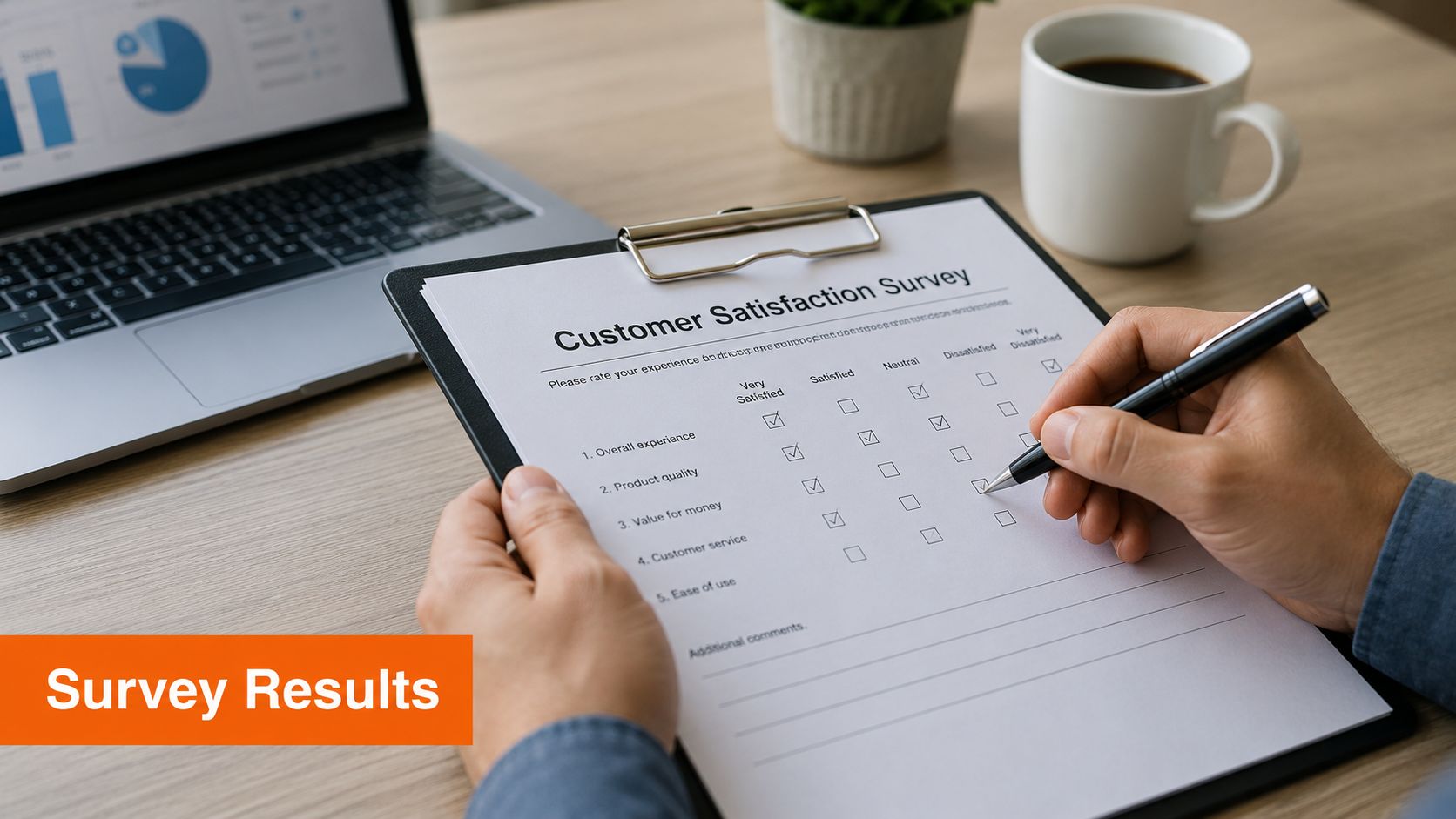
Surveys are the workhorse of quantitative research. That's the right word for them, too. They aren't glamorous, but they carry a lot of weight. Quantilope's overview of market research methods notes that surveys and questionnaires remain the “workhorse” because you can run them online, by phone, or in person to measure attitudes, preferences, and behaviors across large groups.
Here's the mistake I see all the time. Founders use surveys first, before they know what to ask. That's backwards. Interviews give you the words. Surveys test whether those words show up across a bigger group.
Keep them short and sharp
A good founder survey feels like a good sales page. Fast, clear, and focused on one thing.
Use it to test:
- Problem severity: Is this issue a minor annoyance or a real pain?
- Preference: Which option do people lean toward?
- Priority: Where does this problem rank against other problems?
- Language: Which phrasing sounds natural to the buyer?
Add one open-ended question at the end. Mine is usually, “What did I miss?” That's where people tell you the truth you forgot to ask about.
Use advanced tools only after basics work
Conjoint analysis, MaxDiff, and Implicit Association Testing can help you measure tradeoffs, rank preferences, and surface hidden associations, as described in the Quantilope piece above. Those tools are useful. They are not step one.
Start simple. If your basic survey is muddy, advanced analysis just gives you prettier confusion.
Surveys validate patterns. Interviews explain them.
3. Focus Groups
Focus groups are useful when you need to hear people react in front of other people. That social friction matters. Someone says, “I'd never pay for that,” and another person jumps in with, “I would if it saved me time.” Now you're getting somewhere.
I use focus groups when messaging is fuzzy, when product concepts feel close together, or when buyers influence each other in everyday interactions. Food brands, beauty brands, parenting products, team tools, local services. These all benefit from hearing the room push back, agree, and challenge.
When they work best
A focus group is a bad place to get clean numbers. It's a good place to hear language, tension, objections, and assumptions collide.
You'll learn things like:
- Which promise lands first
- Which feature sounds impressive but means nothing
- Which objections spread fast in a group
- Which words buyers already use without your help
Coca-Cola has long used focus groups to test flavor reactions and campaign ideas. Local consumer brands use them for the same reason. A room full of target customers will tell you fast if your idea feels obvious, confusing, overpriced, or forgettable.
How to avoid a useless session
Don't run focus groups in a stiff boardroom if your customer usually shops in a neighborhood store, scrolls TikTok in bed, or talks with friends over coffee. Context affects honesty.
Bring a discussion guide, but don't cling to it like a life raft. If the room gets animated about one pain point, stay there. That's usually more useful than your original plan.
The moderator's job isn't to impress the room. It's to keep one loud person from hijacking it.
4. Social Listening, Sentiment Analysis & Keyword Research
Modern market research gets fast.
People tell you what they want in interviews. They tell the internet what they're angry about for free. If you ignore Reddit threads, reviews, comment sections, search suggestions, and niche communities, you're leaving money on the table.
Modern research is more data-driven and omnichannel. Serpstat's guide to market research methods, tools, and best practices explains that teams now combine open-data analysis, surveys, interviews, social listening, and competitive analytics, often using tools like Google Analytics, Similarweb, and government statistics to triangulate demand, pricing, and market saturation.
What I actually check
I start with places where people talk naturally:
- Reddit: complaints, buying advice, comparisons
- Amazon reviews: what people praise, regret, and return
- G2 or Capterra: product friction and competitor gaps
- Google search suggestions: plain-English intent
- YouTube comments: reactions in the customer's own words
Then I track themes in a spreadsheet. Nothing fancy. Just recurring pains, exact phrases, repeated competitors, and common use cases.
If you're building in Chicago, local subreddits and neighborhood Facebook groups can be gold. People ask blunt questions there. They complain in public. That honesty is useful.
Where founders mess this up
They confuse noise with signal.
One angry thread doesn't prove a market. One trending phrase doesn't mean people will pay. Social listening is great for spotting patterns, weak points in the market, and sharp language you can reuse. It is weaker at explaining deep motivation by itself.
That's why mixed-method workflows win. Use social and search data to spot the smoke. Use interviews or surveys to find the fire.
5. Landing Page Testing and Conversion Optimization
A landing page is one of the cleanest market research methods because it forces honesty. People can flatter you in a call. They can praise your concept in a group. A landing page asks them to do something.
That something can be simple. Join a waitlist. Request early access. Start a preorder. Book a call. The exact conversion matters less than the fact that the visitor has to take a small risk.
Here's a simple visual of the kind of page I mean.

Dropbox is the classic example. Its early landing page and explainer video tested whether people cared before the product was fully built. Airbnb also used lightweight pages to feel out demand in new places before going deeper. That's smart founder behavior. Test the pitch before you pour concrete.
What to test first
You don't need a polished brand system. You need a clear promise.
Test:
- Headline: what pain you solve
- Subhead: who it's for
- Proof: screenshots, mockups, demo, founder story
- Call to action: waitlist, deposit, email, preorder
Keep the path short. If visitors need to think too hard, your research gets muddy. Friction hides the truth.
If you want to tighten the page after you get early traffic, study these conversion rate optimization techniques. They'll help you separate weak demand from weak execution.
Don't treat vanity traffic as validation
A bunch of clicks from curious friends means nothing. Traffic quality matters.
Send the page to people who match your target customer. Post in niche communities. Reach out to likely buyers. Share it where the pain already exists. Then watch what they do, not what they say.
If you want a quick walkthrough of simple landing-page thinking, this clip is worth a look.
6. User Testing and Usability Testing
Some founders think they have a demand problem when they really have a confusion problem.
User testing fixes that. You put your product, prototype, or website in front of a real person. Then you ask them to complete a task while you watch unobtrusively. Where they hesitate, click the wrong thing, loop back, or give up, you've found friction.
What I watch for
I care less about opinions and more about behavior.
Give someone a task like:
- Buy the product
- Book the service
- Find the pricing
- Set up the account
- Invite a teammate
Then watch where they stall. Slack learned a lot by watching onboarding behavior and finding spots where people got lost. Apple has long leaned hard on usability testing for the same reason. Design that looks clean to the team often feels confusing to the user.
Rules that make this work
Don't explain your interface while the person is using it. If you rescue them, you ruin the test.
Ask short follow-ups:
- “What are you looking for?”
- “What did you expect to happen?”
- “Why did you click that?”
People are bad at predicting behavior and pretty good at showing it. That's why usability testing is one of the few methods that can save you from building the wrong thing and from building the right thing badly.
If a user gets stuck in the same place three times, the design is the problem.
7. Competitive Analysis and Mystery Shopping
You should know your competitors well enough to order from them, use their product, email support, return something, and see what happens. Anything less is lazy.
A lot of founders do “competitive analysis” by glancing at homepages. That's like judging a restaurant from the sign out front. You need to walk through the whole experience.
What to study
Build a simple comparison sheet and fill it in like an operator, not a tourist.
Track:
- Positioning: what promise they lead with
- Pricing: how they frame cost and value
- Packaging: what the unboxing or delivery experience feels like
- Support: speed, clarity, and tone
- Reviews: repeated praise and repeated complaints
Mystery shopping makes this concrete. Buy from a competitor. Sign up for their demo. Abandon a cart and see which emails show up. Call the location if they have one. Visit in person if that's part of the business.
Don't copy. Find the gap.
This is the piece many readers skip.
Research on underserved markets points to a smarter path: use behavioral data and audience insights, break broad markets into smaller segments, and validate pain points with deeper conversations instead of relying only on obvious competitor analysis, as discussed in Luth Research's piece on underserved market aspects. In plain English, don't just ask, “What are competitors doing?” Ask, “Who are they ignoring?”
That question often leads to the best positioning and the best pricing strategy. If you need help turning those gaps into an actual offer, read this guide on pricing strategy for new products.
8. Email Newsletters and Community Building
This one is underrated.
A newsletter is not just a marketing channel. It's a long-running research lab. If people subscribe, open, click, reply, and forward, they're telling you what they care about. If they ignore an idea three weeks in a row, they're telling you that too.
Why I like this method
It creates an honest loop.
You publish something useful. People react. Some reply with questions, objections, and stories. Over time, you stop guessing what matters because your audience keeps showing you.
Writers on Substack do this all the time. Nathan Barry built audience trust by teaching what he knew. Lenny Rachitsky turned a newsletter into a business by paying attention to what product and growth people kept asking about. The lesson isn't “start a media company.” The lesson is “build direct access to your market.”
What to send
Keep it practical. One idea. One lesson. One question.
Try prompts like:
- “What's your biggest problem with this right now?”
- “Which version would you choose?”
- “What should I write about next?”
You'll learn which language gets replies, which examples pull people in, and which pain points keep resurfacing. That's research.
If you also need to understand how competitors frame price while you build your own audience, Refgrow's competitive pricing guide is a useful companion read.
9. Pre-sales and Presales Validation
If you want the truth fast, ask for money.
Pre-sales are brutal in the best way. They cut through compliments, curiosity, and fake enthusiasm. A person who prepays is telling you your promise is strong enough to beat inertia.
What this reveals
When someone buys before the product is finished, you learn three things right away:
- The problem feels real
- The promise feels credible
- The timing feels urgent enough
Crowdfunding pages, preorder forms, deposits, and direct outreach all work here. Oculus used Kickstarter to prove demand before full development. Away used early demand to pressure-test interest and get product feedback. Plenty of newer brands do softer versions with reserve-your-spot pages and founder-led sales emails.
How to do it without burning trust
Be painfully clear about what exists now and what comes later.
Tell buyers:
- What they're getting
- When they should expect it
- What could delay it
- How refunds work
That clarity is part of the research. Objections will show up fast. People will ask for missing features, better terms, proof, guarantees, or a different version of the product. That feedback is pure gold because it comes from someone close to buying.
Presales don't just validate demand. They also tell you what needs to change before a broader launch.
10. Referral Programs and Word-of-Mouth Analysis
Referrals are a research method because they reveal who loves your product enough to put their own reputation on the line.
That's a stronger signal than a like, a comment, or a polite testimonial. If someone actively shares you with a friend, coworker, or group chat, you've hit a nerve.
What referrals teach you
Look past the raw share count. Ask better questions.
Study:
- Who refers most often
- What kind of customer they bring in
- What message they use when they share
- What part of the product they mention first
Dropbox, Uber, Slack, Groupon. They all used referral mechanics in different ways. The common thread is simple. People share products that make them feel smart, helpful, connected, or early.
Build the loop, then study it
Make sharing easy. Give people a simple link, a simple reward, and a simple reason to talk.
Then ask your best referrers one question: “Why did you tell someone about us?” Their answer often gives you better positioning copy than a branding workshop ever will.
Referrals also expose your strongest segment. The people who refer well are often the people you should target more aggressively in the first place.
10-Method Market Research Comparison
| Method | 🔄 Implementation Complexity | ⚡ Resource Requirements | 📊 Expected Outcomes | 💡 Ideal Use Cases | ⭐ Key Advantages |
|---|---|---|---|---|---|
| Customer Discovery Interviews | Medium, requires skilled interviewing and scheduling | Low–Medium, time-intensive per interview, minimal cost | Deep qualitative insights into motivations and pain points (not generalizable) | Early-stage idea validation, hypothesis discovery | Direct customer voice; strong contextual insights |
| Surveys and Questionnaires | Low, structured design but easier to scale | Low–Medium, survey tools + sample acquisition | Quantifiable, comparable metrics to validate hypotheses | Hypothesis validation at scale; investor-ready data | Efficient, reproducible, measurable results |
| Focus Groups | High, needs experienced moderator and logistics | High, recruitment, facility or moderator fees ($3k+ typical) | Group dynamics, messaging feedback, emotional reactions | Messaging and brand positioning tests, concept feedback | Synergistic discussion; reveals consensus and conflicts |
| Social Listening & Keyword Research | Medium, tool setup and ongoing analysis | Low–Medium, many free/freemium tools; analyst time | Real-time trends, sentiment signals, search intent insights | Continuous market intelligence, content/SEO strategy | Scalable, passive monitoring; competitive signals |
| Landing Page Testing & CRO | Low–Medium, build pages and design tests | Low–Medium, page builder + traffic budget for significance | Quantifiable interest and messaging winners (signup/conversion rates) | Demand validation pre-product; A/B messaging experiments | Fast market proof; builds email list and conversion data |
| User & Usability Testing | Medium, task design and observation skills needed | Low–Medium, recruit 5–8 users, recording tools | Actionable UX fixes and behavioral observations | Prototype validation, onboarding and flow optimization | Reveals real user behavior; reduces product friction |
| Competitive Analysis & Mystery Shopping | Medium, systematic documentation and comparison | Low–Medium, some purchases, research time | Benchmarks on pricing, features, CX gaps | Market-entry strategy, pricing/positioning decisions | Practical, hands-on competitor benchmarks |
| Email Newsletters & Community Building | Medium, consistent content and community moderation | Low, platform costs low; time commitment ongoing | Ongoing qualitative feedback, early advocates, engagement metrics | Audience building, long-term feedback and pre-launch traction | Relationship-driven growth; sustainable engagement |
| Pre-sales & Presales Validation | Medium–High, campaign planning and fulfillment readiness | Medium, marketing, payment setup, customer communication | Real willingness-to-pay, early revenue, feature objections | Founders needing funding validation or revenue-before-build | Strongest validation (actual purchases); funds development |
| Referral Programs & Word-of-Mouth Analysis | Medium, program design, tracking and incentives | Low–Medium, platform + incentive costs | Sustainable acquisition, viral coefficient, higher LTV | Network effects, scaling growth, lowering CAC | Most cost-effective acquisition; builds advocacy |
Your Next Move Pick One and Start Today
You don't need all ten of these. You need one method, one real customer, and one honest week of work.
That's the part people try to skip. They read about market research methods, nod along, and then go back to tweaking logos, picking fonts, or arguing about brand colors. None of that tells you whether people care. Research does.
If you're at idea stage, start with customer discovery interviews. They're cheap, fast, and brutally clarifying. If you already know the problem well, run a short survey to test the pattern across a broader group. If you have a clear offer, put up a landing page and ask people to act. If you already have a product, watch users try to use it without your help. If you've got warm demand, ask for a preorder.
That's how I'd sequence it in practice. Start with conversation. Move to pattern checking. Then move to behavior. Then move to payment.
Remember the basics. Quantitative methods help you measure “how many” or “how much,” while qualitative methods help you understand “why,” as noted earlier from the Hanover framework. That split matters because founders often overuse one side. Some hide in interviews forever and never test scale. Others blast surveys before they know what question matters. Use both.
The same goes for tools. AI can speed up parts of the work, but it can't replace judgment. GWI's guide to types of market research makes the point clearly: AI-powered tools are reshaping research, but the strongest stack is still layered. Start with secondary research for context. Use qualitative methods for nuance. Validate quantitatively after that. Social listening and AI can surface trends quickly, but they can miss the motives behind behavior.
That layered approach is the grown-up version of founder research. You don't need an expensive agency deck. You need a system that keeps you close to the truth.
I'd also keep one more point in mind. Modern research works best when you combine sources instead of trusting one channel. Search data, interviews, reviews, analytics, surveys, support emails, and direct sales calls each show a different piece of the picture. Put them together and you get something much more reliable than any single method can give you on its own.
So pick the easiest one to start this week.
Call five customers.
Send one survey.
Build one landing page.
Order from two competitors.
Ask for one preorder.
Then bring what you learn to a Brandstarters dinner. We'll help you sort the signal from the noise, pressure-test your conclusions, and figure out the next move. That's how great brands get built in Chicago. Not with chest-thumping. With honest conversations, real work, and a willingness to learn faster than the next founder.
If you're building in Chicago or the Midwest and want smart founders to help you pressure-test your ideas, join Chicago Brandstarters. It's a free, vetted community for kind, bold, hard-working builders who want honest feedback, real tactics, and real relationships instead of fake networking.
Leave a Reply