You're in your kitchen at 11 p.m., staring at a sketch, a sample from Amazon, and a spreadsheet that already looks uglier than your original idea. The product still feels exciting. The sourcing part does not. Now you have to trust someone you've never met to make the thing that will represent your brand on day one.
That's the moment founders either get disciplined or get burned.
I've seen the same mistake too many times. A founder gets obsessed with finding the lowest quote, sends money too early, and treats sourcing like a price-shopping exercise. Then significant problems arise. Bad materials. Sloppy packaging. Missed deadlines. Missing paperwork. A supplier who said yes to everything and delivered a product that undermines the launch.
Your idea stops being cute and starts getting expensive.
If you're trying to make your first 1,000 units, stop chasing the absolute cheapest supplier on Alibaba. That approach can sink you before you get traction. You need the right partner. Someone who can meet your specs, communicate like a professional, produce consistent quality, and avoid the compliance mistakes that turn a simple product launch into a legal mess.
Sourcing of products is not a back-office detail. It's one of the first real tests of whether your brand is built to last.
Get this part right, and you give yourself a shot. Get it wrong, and your first batch becomes a pile of expensive lessons.
Your Product Idea Is Great Now How Do You Get It Made
A product idea feels clean in your head. Manufacturing is not clean.
The first time you source a product, everything sounds simple. You think you need a factory, a quote, and a shipment. Then you learn that one supplier can say “yes” to everything and still fail on color matching, packaging, lead times, or basic communication. Another supplier can quote low and leave out the thing that matters most, which is whether they can make your product consistently.
That's why I treat sourcing of products like dating with contracts. You're not trying to find someone who sounds exciting in the first message. You're trying to find someone stable enough to build with.
Your first job is to get specific
If you can't explain your product clearly, suppliers will fill in the blanks for you. That never ends well.
You need a working spec sheet, even if it's ugly. I'd include:
- Product basics: dimensions, materials, weight, color, finish
- Packaging: unit box, inserts, labels, barcodes
- Function: what the product must do every single time
- Non-negotiables: safety, compliance, durability, appearance
- Order intent: sample first, then small run, then repeat order if it works
A rough founder with a sharp spec sheet beats a polished founder with vague ideas.
Practical rule: If a supplier has to guess what you want, they will guess in the cheapest way possible.
Stop thinking like a shopper
You're not shopping for a product. You're building a supply chain, even if it's tiny right now.
That mindset matters because sourcing isn't only about price. It's about whether the product arrives sellable. If the zipper fails, the coating flakes, the label peels, or customs stops the shipment, your “cheap” order becomes the most expensive mistake you've made all year.
I'd rather see you launch with a smaller order from a reliable partner than chase a bargain and spend the next month apologizing to customers.
Manufacturers Wholesalers or Private Label
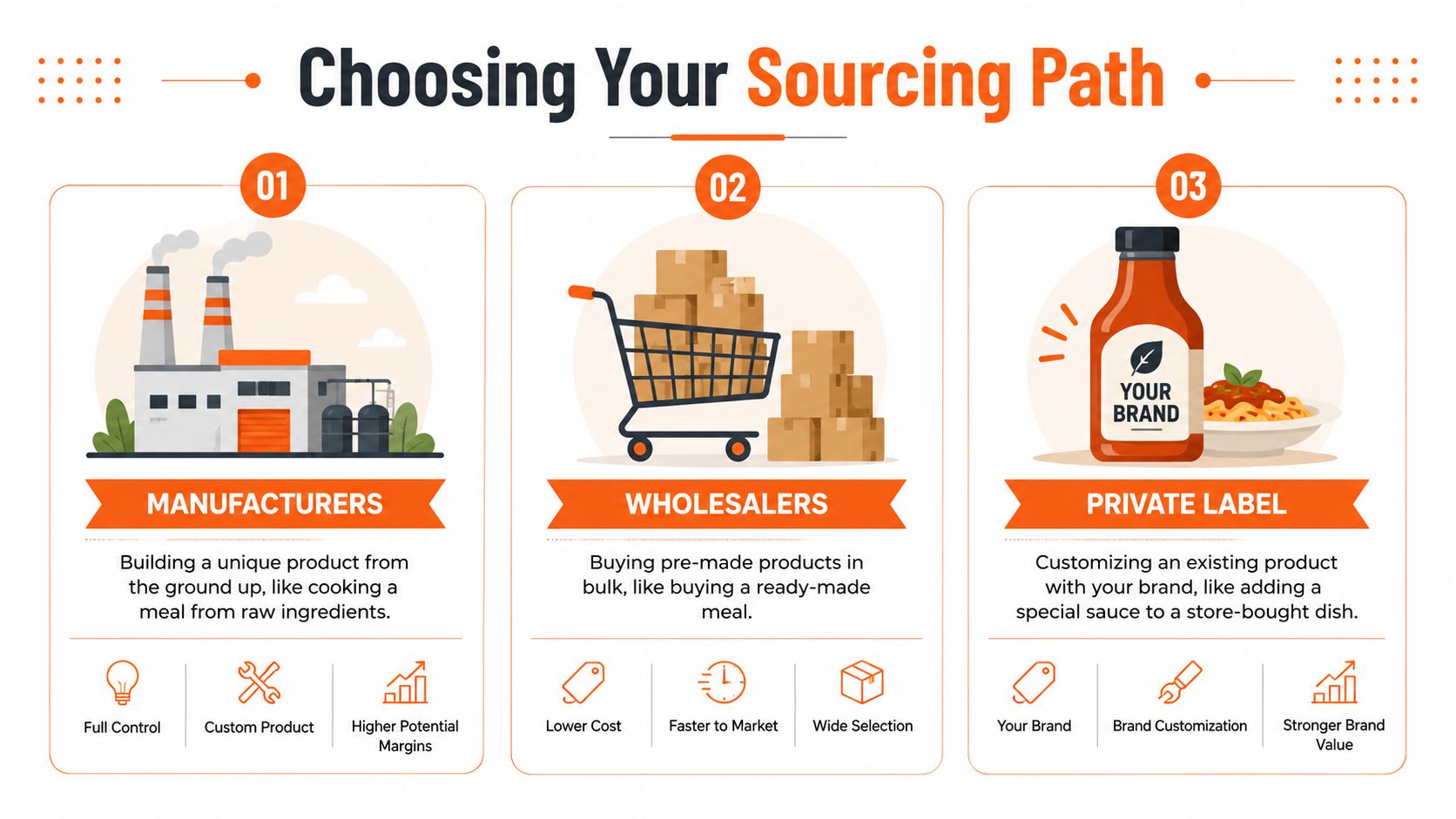
Before you contact anyone, decide what kind of game you're playing. Most founders waste time because they blur three very different paths into one messy search.
Think about dinner.
You can cook from raw ingredients. That's a manufacturer.
You can buy ready-made meals and resell them. That's a wholesaler.
Or you can take an existing dish, tweak it a bit, and put your name on it. That's private label.
Pick the path that matches your stage
A lot of advice assumes you're ready to scale. That's backwards for most new founders. The better question is how to source a minimum viable version that is small, fast, and flexible enough to learn from customers before you overcommit, as noted in this underserved market and niche testing perspective.
Here's the blunt version:
| Channel | Best For | Control | MOQ | Margin Potential |
|---|---|---|---|---|
| Manufacturer | Custom products and differentiated brands | High | Often higher | High |
| Wholesaler | Fast testing and simple resale | Low | Often lower | Lower |
| Private Label | Branded launch with limited customization | Medium | Varies | Medium to high |
Manufacturers
Go direct to a manufacturer if your product needs custom dimensions, materials, tooling, or a design that isn't sitting in a catalog already.
This path gives you the most control. It also gives you the most homework. You'll deal with specs, revisions, samples, packaging details, and production issues. If you want help thinking through that process, this guide on how to find a manufacturer for your product is a good starting point.
Best fit if you care about:
- Differentiation: your product can look and feel distinct
- Brand control: packaging and product details stay tighter
- Long-term margin: strong if volume grows and execution is good
Wholesalers
Wholesalers are fast. That's the upside.
You buy existing products in bulk and resell them. This can work for quick market tests or stores that win on curation, bundles, or audience rather than product originality. The downside is obvious. If you can buy it, so can a dozen other sellers.
This path usually makes sense when:
- You want to validate demand fast
- You don't need deep customization
- You accept thinner margins and weaker uniqueness
Wholesaling is speed over control. Sometimes that's exactly the right trade.
Private label
Private label is the middle lane. You use an existing base product and add your branding, packaging, or light customization.
For first-time founders, this is often the cleanest move. You get to launch something that feels like a brand without taking on full custom product development. Just don't confuse “middle ground” with “easy.” Bad private label products still fail for the same reasons as custom ones: poor quality, weak communication, and sloppy specs.
My take is simple. If you're testing a niche idea, private label or a light manufacturer relationship usually beats jumping straight into a complex custom build.
How to Find and Vet Suppliers Without Getting Scammed
Most founders start with a marketplace search. That's fine. It's also where lazy sourcing begins.
A supplier directory is a phone book, not a decision. You still need a process.
Build a shortlist, not a crush
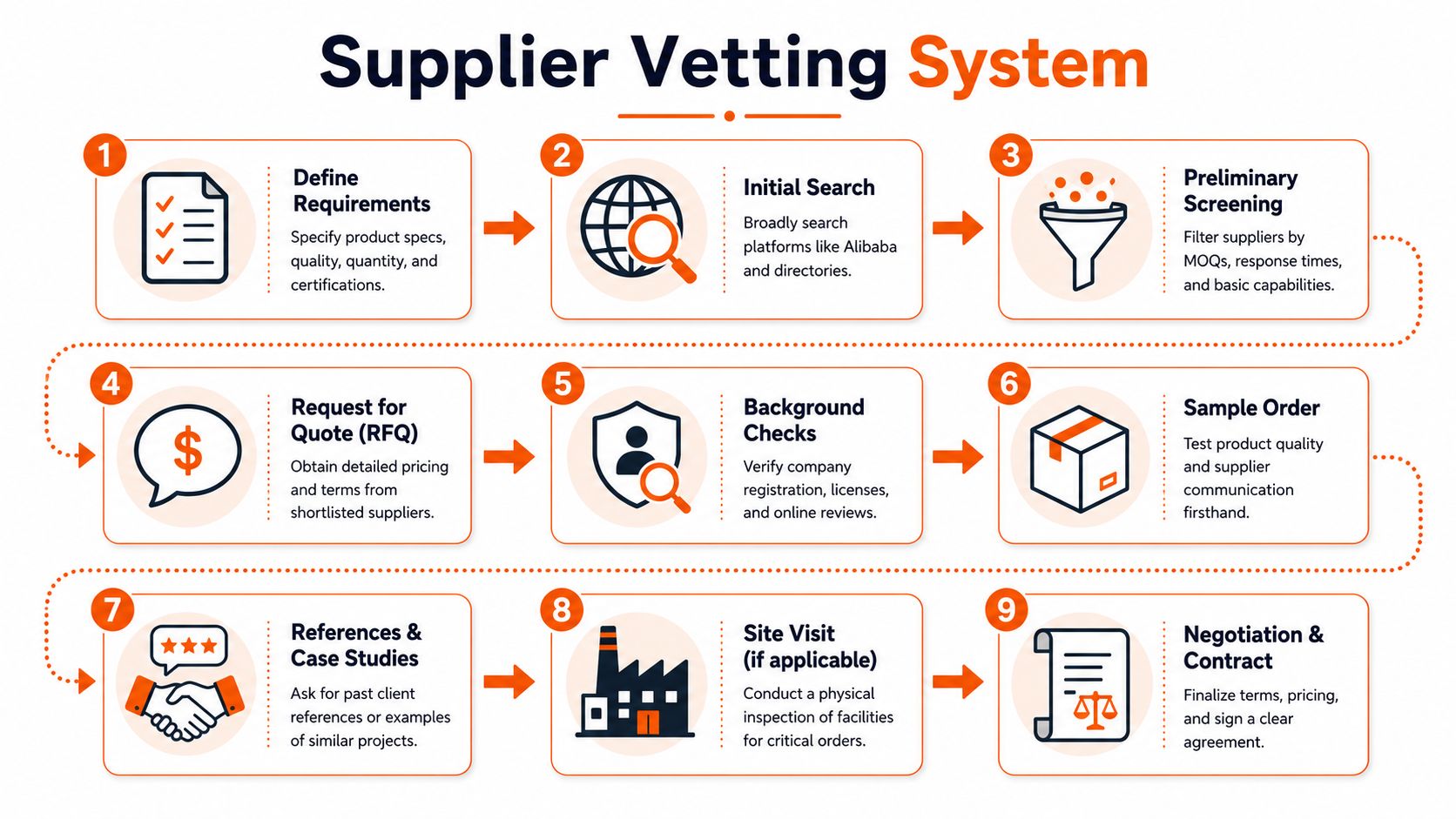
I'd start with a broad list, then cut hard. Use supplier platforms, trade show directories, referrals from founder groups, and category-specific searches. If you want another place to start meeting suppliers and buyers, this Platform for sourcing new brands is useful as one more channel in your search.
Your first target is not “the one.” Your first target is a shortlist.
I'd gather 5 to 10 possible suppliers, then narrow that list based on how they communicate and whether they make products like yours.
Look for signs they understand your category:
- Relevant experience: ask for examples of similar products
- Clear communication: do they answer your actual questions
- Basic fit: can they handle your materials, packaging, and target order size
Send a serious first message
A sloppy inquiry gets a sloppy response.
Don't send “Hi, how much for this?” with a blurry screenshot. Send a short, clean RFQ that includes product type, materials, target quantity, packaging needs, destination market, and whether you need samples first.
Good suppliers pay attention to serious buyers. Bad suppliers say yes to everything.
Here's what I want to learn from the first exchange:
- Do they answer directly
- Do they understand the product
- Do they ask smart questions
- Do they avoid weird payment requests
- Do they respond like a business, not a hustler
A useful walkthrough sits below if you want another perspective before you start outreach.
Run the vetting gauntlet
Once a few suppliers look promising, push them through real checks.
Ask for:
- Business registration: basic company documents
- Certifications if relevant: only the ones your product category needs
- Factory photos or videos: not as proof by themselves, but as one signal
- Sample policy: cost, timeline, revision process
- Production terms: packaging, lead times, inspection options, payment terms
Then watch for red flags.
Vague answers early usually turn into expensive excuses later.
Big red flags include pressure to pay fast, refusal to answer simple questions, huge confidence with no detail, and communication that gets worse as soon as you ask about quality or compliance.
Scams aren't always dramatic. Sometimes the “scam” is just a weak supplier who overpromises and ships junk.
Negotiating Samples and Minimum Order Quantities
New founders hear one ugly phrase and panic: MOQ.
Relax. MOQ is not a law of physics. It's a business preference.
Suppliers set minimums because setup takes time, labor, and machine capacity. They don't want to stop a line for a tiny run that barely pays. That's fair. But plenty of MOQs have wiggle room if you ask the right way and sound like someone worth working with.
How I'd ask for a lower MOQ
Don't beg. Don't pretend you're huge either. Suppliers can smell fake confidence.
Be direct. Tell them you're starting with a trial order and you want to prove fit before scaling. If they resist, trade something. Offer a higher per-unit price on the first run, simpler packaging, fewer variations, or a clear reorder plan if the trial succeeds.
Use language like this:
“I want to start with a smaller validation run, then move to repeat production if quality and sell-through are strong.”
That tells them you're not a tourist.
A solid sourcing process should compare suppliers during samples and trial orders using criteria like per-unit pricing, MOQs, fulfillment lead times, and quality consistency, and you can use trial-run performance to judge whether a supplier can scale with you, based on ShipBob's product sourcing guidance.
Pay for samples and learn from them
A founder who complains about sample cost usually pays for that mistake later in bulk.
Pay for samples. Pay the shipping too. Samples are not a nuisance. They're your first audit.
What I'm testing with a sample:
- Product quality: does it match the spec and feel sellable
- Attention to detail: color, finish, dimensions, packaging accuracy
- Communication quality: do they handle revisions well
- Speed: not just production speed, but response speed
Then compare suppliers side by side. Put the samples on a table. Use a scorecard. Force yourself to judge them against the same criteria.
If you need more tactical language for these conversations, read this guide on how to negotiate with suppliers.
Don't marry the first usable sample
A sample that looks “good enough” can still hide a bad production partner.
You're not only buying a prototype. You're buying the team behind it. If a supplier sends a decent sample but communicates poorly, ignores revisions, or gets slippery on order terms, that sample is bait, not proof.
I'd rather work with a supplier who gives me a slightly rough first sample and handles feedback like a pro than one who charms me early and becomes chaos later.
The Landed Cost Model Dont Forget Shipping and Taxes
You get a supplier quote for $3.80 a unit and start building your margin around it. Then the bill shows up. Freight spikes. Duties hit harder than expected. A broker invoice lands in your inbox. Your cartons need relabeling before Amazon will accept them. Now your “profitable” product is choking before the first 1,000 units even arrive.
That mistake is common. It also kills good brands early.
Your real cost starts after the quote
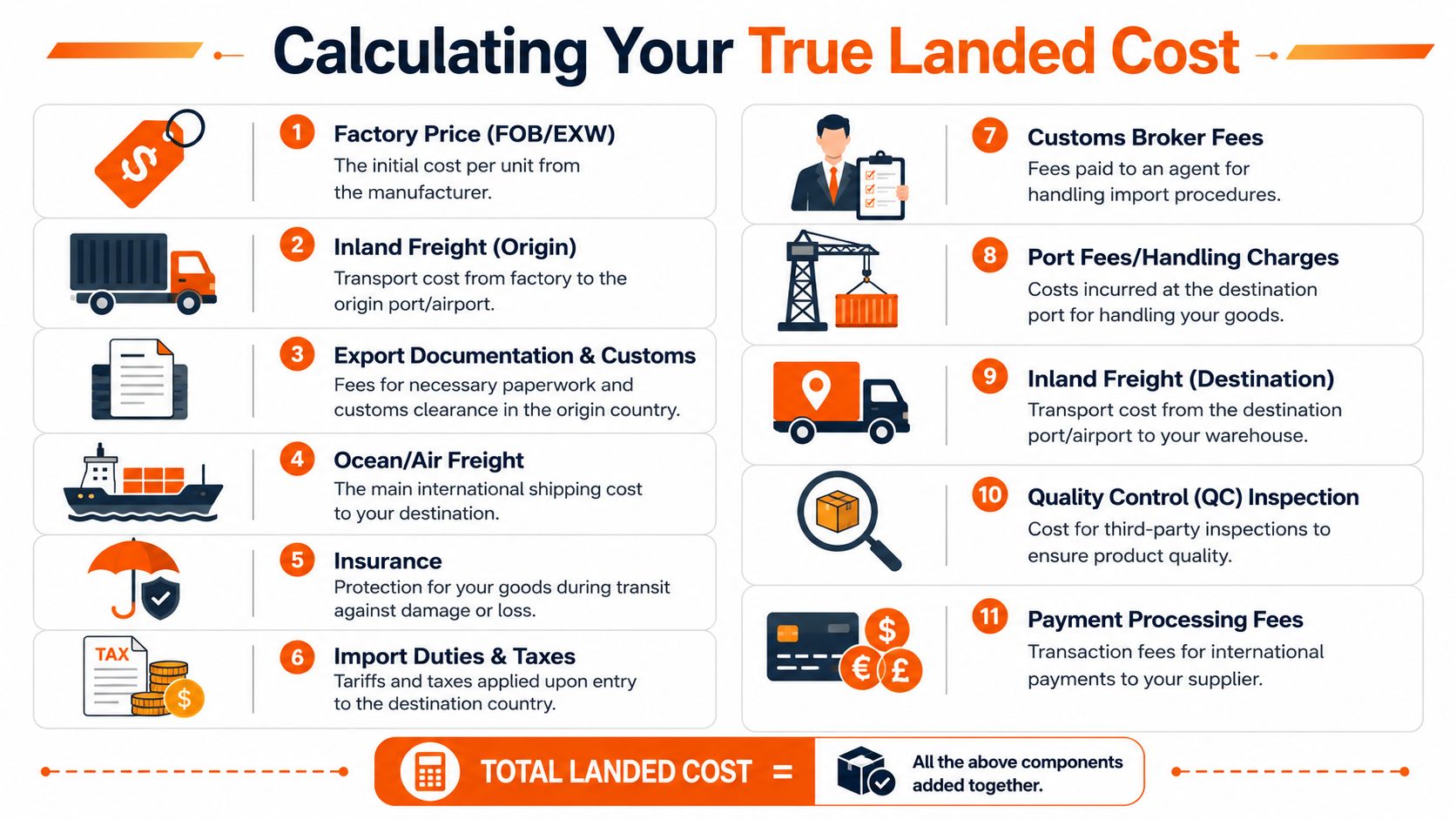
The factory price is only one line item. Your landed cost is the full amount required to get inventory from the supplier to your warehouse or fulfillment center in sellable condition.
For a first order, I want every founder to price these buckets before sending money:
- Factory price
- Packaging
- Origin transport
- Export paperwork
- International freight
- Cargo insurance
- Import duties and taxes
- Customs broker fees
- Port and terminal charges
- Destination delivery
- Inspection costs
- Payment and wire fees
- Prep or labeling fees for marketplace fulfillment
That last line catches people off guard. If your first 1,000 units need relabeling, repacking, or extra prep, your cheap supplier just became an expensive partner.
If you sell on marketplaces or use FBA, tariff exposure matters too. This overview of strategic sourcing for Amazon businesses gives useful context on sourcing choices and tariff exposure.
Ask quote questions that expose hidden costs
A sloppy RFQ produces a sloppy quote. Then you inherit the bill.
Ask suppliers to quote with clear terms. Ask what Incoterm they are using. Ask whether packaging is included. Ask who pays for factory-to-port delivery. Ask whether export documents are included. Ask carton dimensions, gross weight, and units per carton before you estimate freight. If they dodge these questions, treat that as a warning.
I care less about getting the lowest headline price and more about getting a quote I can model. That is the whole point here. You are not hunting for the cheapest Alibaba supplier. You are choosing a partner for your first 1,000 units who will not bury you in surprise costs, quality problems, or compliance messes.
A good freight partner helps you close the gaps between the quote and the shipment. If you are shipping inventory into Amazon, this guide to freight forwarders for Amazon FBA shows the handoff points founders often miss.
Build your margin on the ugly version of reality
Use a simple spreadsheet. One row per cost. Add a buffer for the stuff that always shows up late, storage, inspection rework, document corrections, and small fees nobody mentioned during the sales conversation.
Then test the product again.
If the numbers still work after freight, duties, taxes, and prep, you have something worth pursuing. If the margin disappears, good. You learned early, before inventory traps your cash.
I trust founders who know their landed cost to the dollar range. I do not trust founders who can only tell me the factory quote.
Ensuring Quality and Avoiding Legal Nightmares
Bad quality doesn't arrive like a movie villain. It arrives in cartons that look normal until you open them.
Then you find scratches, loose parts, wrong materials, bad printing, weak seams, broken closures, weird smells, or units that technically exist but can't be sold. That's how brands die early. Not from lack of hustle. From preventable sloppiness.
Build a golden sample and a written standard
You need a golden sample. That's the approved version everyone points to when there's an argument.
If it's not documented, it doesn't exist. I want the sample, the spec sheet, the packaging file, and the acceptance checklist all tied together. If the supplier changes material thickness, finish, label placement, or inner packaging without approval, that's a fail.
My basic quality checklist usually includes:
- Appearance: color, print quality, finish, defects
- Dimensions: size, weight, fit with other components
- Function: does it work the same way every time
- Packaging: labels, inserts, carton markings, barcode accuracy
- Durability: simple stress tests based on real use
Don't confuse low price with low risk
The best source is not always the lowest-cost source. For many brands, a key advantage is a supplier that can reliably meet compliance, lead-time, and quality constraints, even if the unit cost is higher, based on Global Sources guidance on supplier choice and sourcing risk.
That's exactly right.
A cheap supplier who misses requirements can cost you more through returns, refunds, missed launch dates, and customs problems than a better supplier ever would through unit price alone.
Choose your inspection method based on risk
You have three basic options.
Inspect it yourself if the order is small, local, or simple.
Trust factory QC if you already have a proven relationship and low-risk product.
Hire a third-party inspector if the order matters, the category has real compliance exposure, or you can't afford surprises.
I'm opinionated here. For first orders, I lean toward third-party inspection whenever the product is meaningfully customized or regulated. It creates one more checkpoint before goods leave the factory.
If your product touches skin, food, children, or power, treat compliance like a product feature.
You don't need to become a lawyer. You do need to know which rules apply to your category and sales market. If you skip that work because a factory says “no problem,” you're gambling with your launch.
From Handshake to Your First Shipment
Once the sample is approved, the main project starts. At this stage, founders often get casual and lose control.
A good sourcing process doesn't run on vibes. It runs on documents, checkpoints, and frequent updates.
Modern product sourcing is increasingly driven by real-time data from supplier APIs and cloud platforms. That helps buyers track production status and avoid stale quotes or stock-outs, according to Elisa Industriq's guidance on real-time sourcing data. Even if you're not using fancy integrations yet, the lesson is the same. Good communication and timeline tracking matter.
Lock the deal in writing
Start with a clean purchase order.
Your PO should spell out the product, quantity, price, packaging, quality expectations, delivery terms, and timeline. If something matters, write it down. Memory is not a control system.
I also want these items confirmed before money moves:
- Approved sample reference
- Final packaging files
- Inspection plan
- Shipping method
- Payment schedule
- Penalty or remedy language if possible
If you're preparing products for broader expansion, this guide on ensuring quality for international market entry is worth reviewing because it pushes you to think beyond the factory floor and into market readiness.
Use payment structure to keep leverage
Never hand over full payment upfront.
A deposit starts production. The balance should move only after inspection or other agreed checkpoints. This is common sense. You want the supplier committed, and they want to know you're serious too.
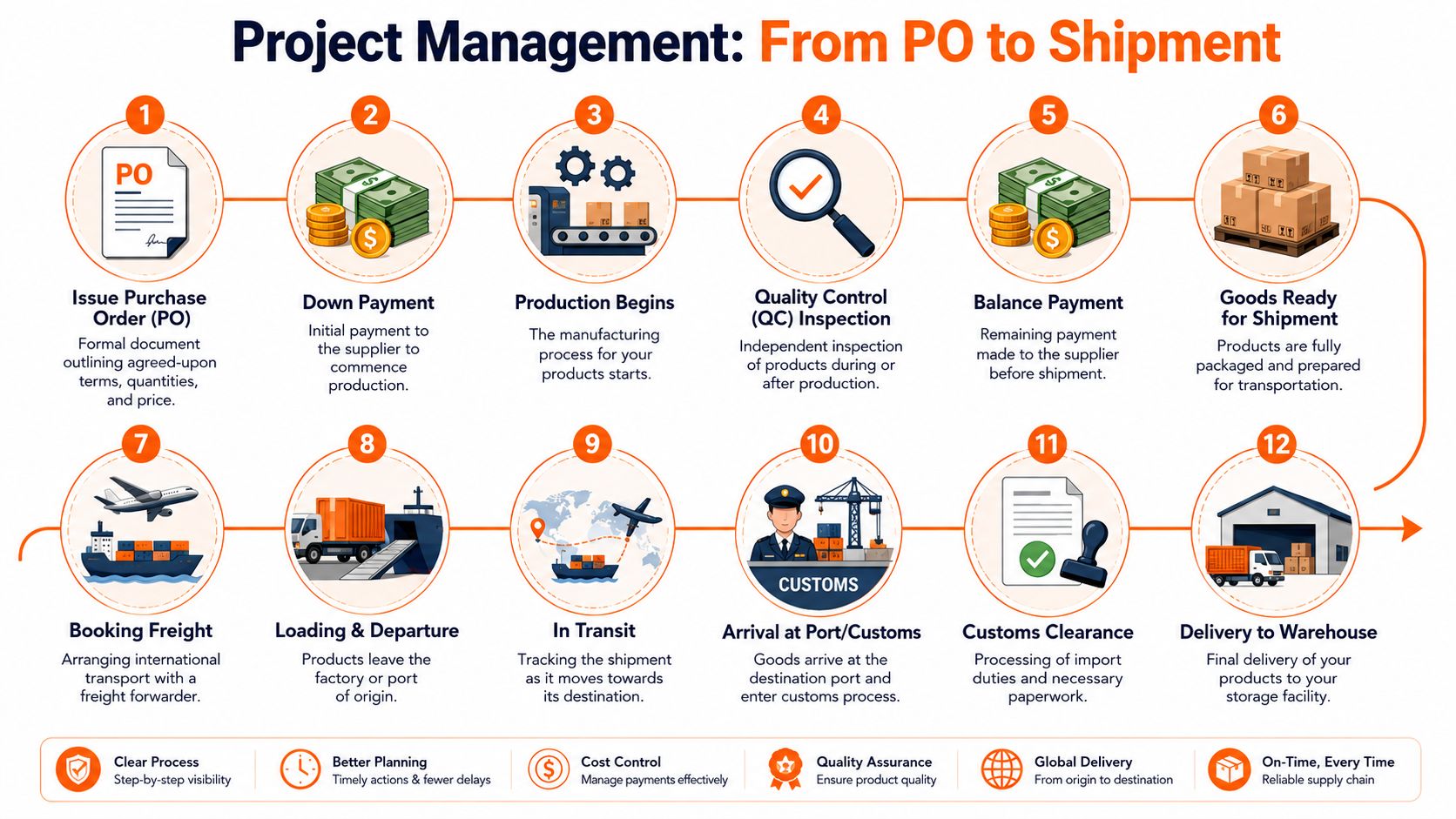
A practical timeline looks like this:
- PO issued
- Deposit paid
- Production begins
- Mid-production update
- Inspection
- Balance paid
- Shipment booked
- Goods in transit
- Customs clearance
- Delivery to warehouse
Manage the timeline like an operator
This part sounds boring until a missed date wrecks your launch plan.
I want scheduled check-ins, not random messages. I want progress photos if appropriate. I want carton counts confirmed before shipment. I want shipping documents reviewed before goods arrive.
Good founders don't disappear after the deposit. They manage the order all the way through delivery.
And that's really the heart of sourcing of products. You're not buying stuff. You're building a repeatable system for turning ideas into inventory without lighting cash on fire.
If you're building a product brand in Chicago or the Midwest and want honest help from founders who've been in the trenches, Chicago Brandstarters is worth your attention. It's a free, vetted community of kind, bold builders who share real sourcing lessons, operator advice, and hard-won mistakes in private dinners and group chat. If you're tired of fake networking and want real founder conversations, join them.
Leave a Reply