
You've spent weeks polishing a product page, testing ads, and watching sessions climb. Your analytics dashboard looks busy, yet your bank account stays flat. Then you notice the unopened cartons stacked in the garage, and the uncomfortable truth lands: you built a store, launched campaigns, and called the activity a strategy.
An effective ecommerce business strategy starts somewhere less exciting. You choose an operating model, calculate what each order leaves behind, protect cash, and select channels that support those economics. Ecommerce sales are projected to reach $6.88 trillion globally in 2026, representing 21.1% of retail spending, according to this ecommerce market size overview. That opportunity won't help you if every new order creates more work and less cash.
Why Most First-Year Strategies Fall Apart
At month one, almost any tactic can look like progress. You post on TikTok, list on Amazon, run a small Meta campaign, change your product photos, and collect a few orders. Revenue remains small, so you can mistake motion for traction because the losses hide inside shipping, returns, payment fees, discounts, and unsold stock.
By month six, the pattern gets harder to ignore. You borrowed a launch template from another founder, copied a channel mix that doesn't match your product, and changed direction whenever a campaign underperformed. TikTok ads become the answer one week, Amazon becomes the answer the next, and your inventory plan never catches up with either decision.
The founder usually discovers the problem through a simple comparison. The dashboard reports sessions and followers, while the bank account reports outgoing payments. A shipment sits in the garage because demand arrived in the wrong channel, or because the product only sells after an expensive discount.
Practical rule: Choose the economic model before you choose the marketing channel.
Activity is easy to confuse with traction
A channel gives you numbers quickly. You can count impressions, clicks, visits, followers, and add-to-carts before you know whether the customer will reorder or whether the order produced cash. That speed creates false confidence.
Average ecommerce conversion sat around 2.03% in June 2026, compared with 1.85% in June 2025, according to year-by-year ecommerce conversion benchmarks. A store that moves from 1.85% to 2.03% improves sales efficiency without adding visitors, but the improvement only matters if your contribution margin can fund fulfillment and acquisition.
Your strategy needs three decisions in order:
- Choose the model. Decide who owns the customer, who absorbs acquisition costs, and how much cash inventory requires.
- Lock the unit economics. Calculate contribution after product cost, shipping, payment fees, discounts, returns, and acquisition.
- Pick supporting channels. Use DTC, marketplaces, wholesale, or subscriptions because they fit the model.
The rest is execution. Without those decisions, every new tactic gives your cash problem another place to hide.
Business Models and the Unit Economics Behind Them
Start with the business model, because it determines where your margin comes from and where it leaks.
Own-brand DTC gives you control over pricing, customer data, merchandising, and the buying experience. You also pay for traffic, customer support, fulfillment, payment processing, and returns. Private label gives you more control than resale, but suppliers, minimum orders, packaging, and quality control tie up cash before customers buy.
Marketplace arbitrage uses existing demand. You find products, list them where shoppers already search, and trade platform fees and limited customer access for speed. Wholesale moves larger quantities through retailers, but the retailer takes margin and usually owns the relationship with the shopper. Subscription can create a predictable reorder loop when the product naturally gets consumed, yet it punishes poor product quality and weak service because customers can cancel quickly.
Unit economics in working terms
Your first calculation should be contribution margin per order:
Revenue minus product cost, shipping, payment fees, discounts, returns, and variable fulfillment costs.
Then calculate blended contribution margin across all orders, including organic, paid, marketplace, wholesale, and repeat purchases. Your paid channel may look healthy while the total business loses money through discounts or expensive returns.
Payback period tells you how long the business needs to recover customer acquisition cost from contribution profit. Break-even ROAS tells you the minimum advertising return required to avoid losing money on a first order. You can't choose a sensible ad budget until you know both.
If you need a practical refresher on the calculation itself, use this guide to calculate gross margin percentage. For paid acquisition planning, AdManage.ai performance marketing provides useful context around campaign measurement and ecommerce execution.
| Model | Typical Gross Margin | Capital to Reach $1M Revenue | Who Pays for Customer Acquisition | Customer Data Ownership |
|---|---|---|---|---|
| Own-brand DTC | Depends on product, pricing, returns, and fulfillment | Inventory and acquisition capital | Usually the brand | Mostly the brand |
| Private label | Depends on sourcing, packaging, and pricing power | Product development and purchase-order capital | Brand, marketplace, or retail partner | Depends on channel |
| Marketplace arbitrage | Usually thinner after platform costs | Inventory and marketplace cash cycle | Marketplace demand plus seller spend | Mostly the platform |
| Wholesale | Thinner per unit, larger order quantities | Production and retailer payment cycle | Retail partner | Mostly the retailer |
| Subscription | Depends on retention, discounting, and service costs | Product supply and fulfillment capacity | Brand, partner, or referral channel | Brand-owned when sold directly |
Match the model to your constraints
If you have limited capital but strong selling ability, start with a narrow assortment and validate demand before placing a large order. If you have supplier access and can manage operations, private label may give you more control, but you must fund quality and inventory decisions. If you need demand quickly and can accept lower control, a marketplace can test product-market fit.
Subscription only fits a repeatable consumption pattern. Don't force a subscription onto a durable product because recurring revenue sounds attractive. A founder with limited time should also avoid a model that requires daily marketplace repricing, complex wholesale account management, or heavy customer service unless the margin pays for that burden.
Choosing Your Go-to-Market Channel
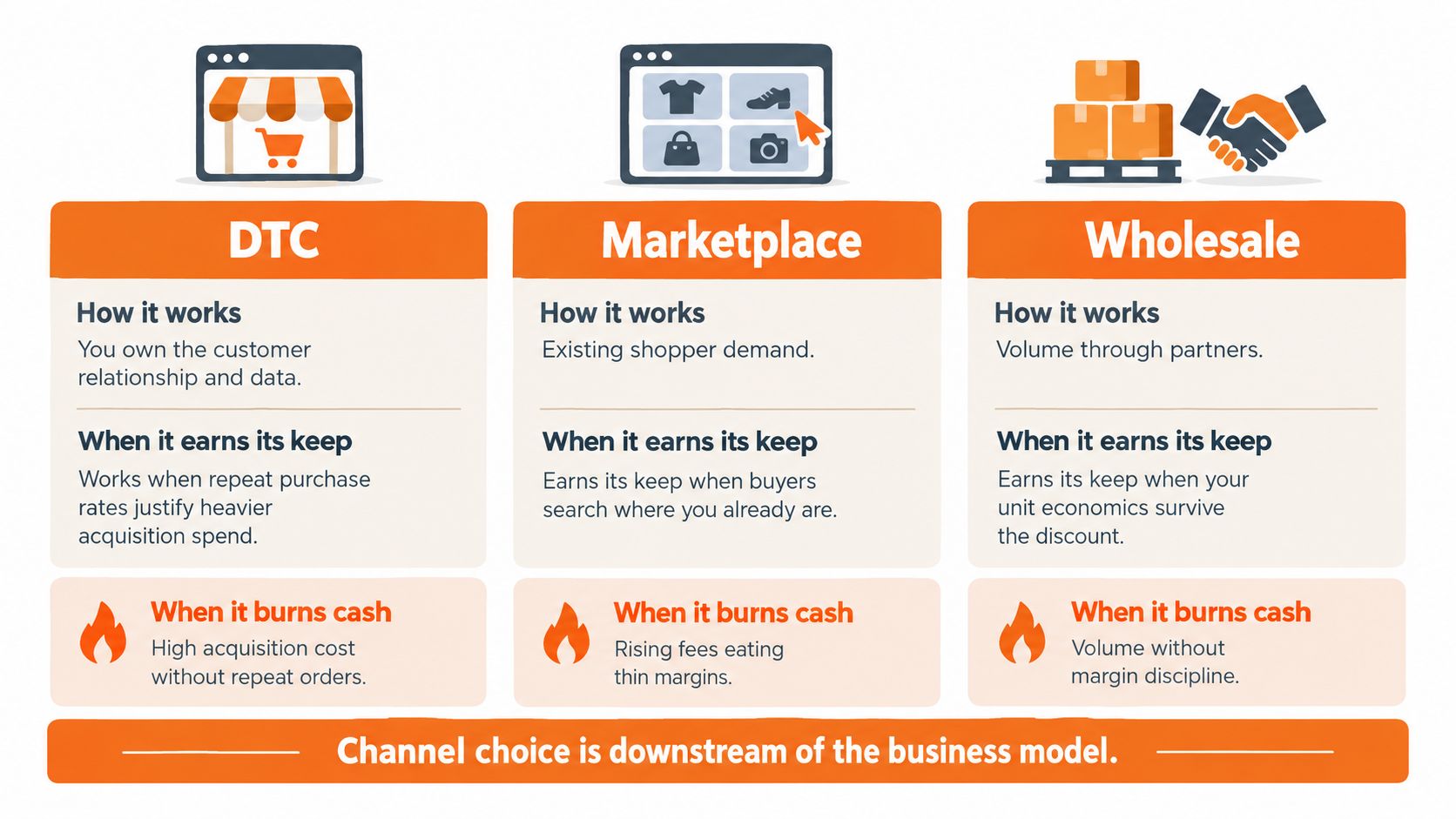
Channel choice follows the model. DTC, marketplace, and wholesale each solve a different problem, and each can burn cash when you use it for the wrong job.
DTC makes sense when you can explain the product clearly, control the customer experience, and earn enough contribution from repeat orders to justify acquisition spending. You own the email list and merchandising decisions, but you also handle abandoned carts, chargebacks, returns, delivery questions, and paid traffic.
A marketplace earns its place when shoppers already search there for your product. It can reduce the work required to create initial demand, but platform fees, advertising costs, price competition, and limited customer data can weaken an already thin margin.
Wholesale helps when you can produce consistently and a retail partner can move volume you couldn't reach alone. The trade-off is a lower unit margin, slower payment, and less control over presentation and customer information. Before accepting an account, calculate the margin after wholesale discounts, freight, samples, and retailer requirements.
Use decision rules, not channel enthusiasm
Use a marketplace to validate demand when the listing can remain profitable after every fee and the platform gives you useful purchase signals. Move more demand to DTC when your contribution margin clears your acquisition hurdle and you can give shoppers a reason to buy directly.
Layer wholesale when production capacity exceeds your own brand's pull, and when the wholesale price still leaves enough cash to replenish stock. A channel that produces revenue but consumes contribution margin isn't diversification. It's expensive reporting.
You can use the Grumspot ecommerce growth playbook to think through channel expansion, but keep the decision tied to your own margins and operational capacity. A wider distribution plan also needs the same discipline described in this distribution channel strategy guide.
Multi-channel from day one usually creates a cash drain. You duplicate inventory feeds, creative work, customer support, pricing decisions, and reconciliation before you understand which channel deserves more stock. Start with one primary route to market, make the economics legible, then add a second channel for a specific reason.
The Conversion and Retention Levers That Actually Pay You
Most founders reach for more traffic before fixing the store they already have. That sequence makes little sense when global ecommerce conversion rates commonly sit around 2.5% to 3.2%, as described in these conversion rate benchmarks. A small conversion lift increases orders from the same audience, while a traffic increase also brings acquisition cost, support work, and fulfillment demand.
Cart abandonment shows where the leak becomes expensive. Baymard's research set puts average global cart abandonment at about 70.19% to 70.22% across 50 studies, meaning roughly seven shoppers leave before payment, according to this cart abandonment statistics summary.
Audit the buying path tonight
Ask these questions before you change an ad:
- Product page: Can a shopper understand the product, price, delivery timing, use case, and return terms without hunting?
- Trust: Do real reviews answer objections, or do you rely on polished brand copy?
- Mobile: Does the page load and allow checkout comfortably on a phone? One benchmark places mobile conversion around 1.4% to 2.0%, compared with 3.2% to 4.1% on desktop (mobile ecommerce benchmark data).
- Checkout: Do you show shipping, tax, and fees before the customer commits? Unexpected costs account for about 48% of abandonments in one benchmark summary (checkout conversion benchmarks).
- Recovery: Do your abandoned-cart emails give the shopper a clear path back?
Klaviyo's benchmark reports a 3.33% placed-order conversion rate for abandoned-cart emails, with the top 10% reaching 7.69%, according to this abandoned-cart flow benchmark. Treat recovery as a revenue process, not an automated message you install and forget.
Retention pays for the first order
For non-subscription ecommerce, a 20% to 30% repeat purchase rate over a 12-month cohort is a common benchmark. Consumables can reach 35% to 50% or more, while electronics often sit around 10% to 20%, according to retention benchmarks by vertical.
| Lever | Benchmark Range | Why It Matters |
|---|---|---|
| Ecommerce conversion | 2.5% to 3.2% globally | Small lifts increase orders without equivalent traffic growth |
| Cart abandonment | 70.19% to 70.22% | Checkout contains a large recoverable revenue leak |
| Abandoned-cart email conversion | 3.33% average, 7.69% top 10% | Recovery can produce orders from existing intent |
| Repeat purchase, non-subscription | 20% to 30% over 12 months | Repeat orders reduce dependence on fresh acquisition |
| Repeat purchase, consumables | 35% to 50% or more | Replenishment supports reminders and subscriptions |
| Repeat purchase, electronics | 10% to 20% | Retention depends on upgrades, accessories, and replacements |
Build post-purchase education, replenishment reminders, review requests, and subscription prompts where the usage cycle supports them. Use these customer retention tactics as an audit list, then connect each flow to reorder timing and contribution margin.
KPIs That Predict Survival Versus Vanity Numbers
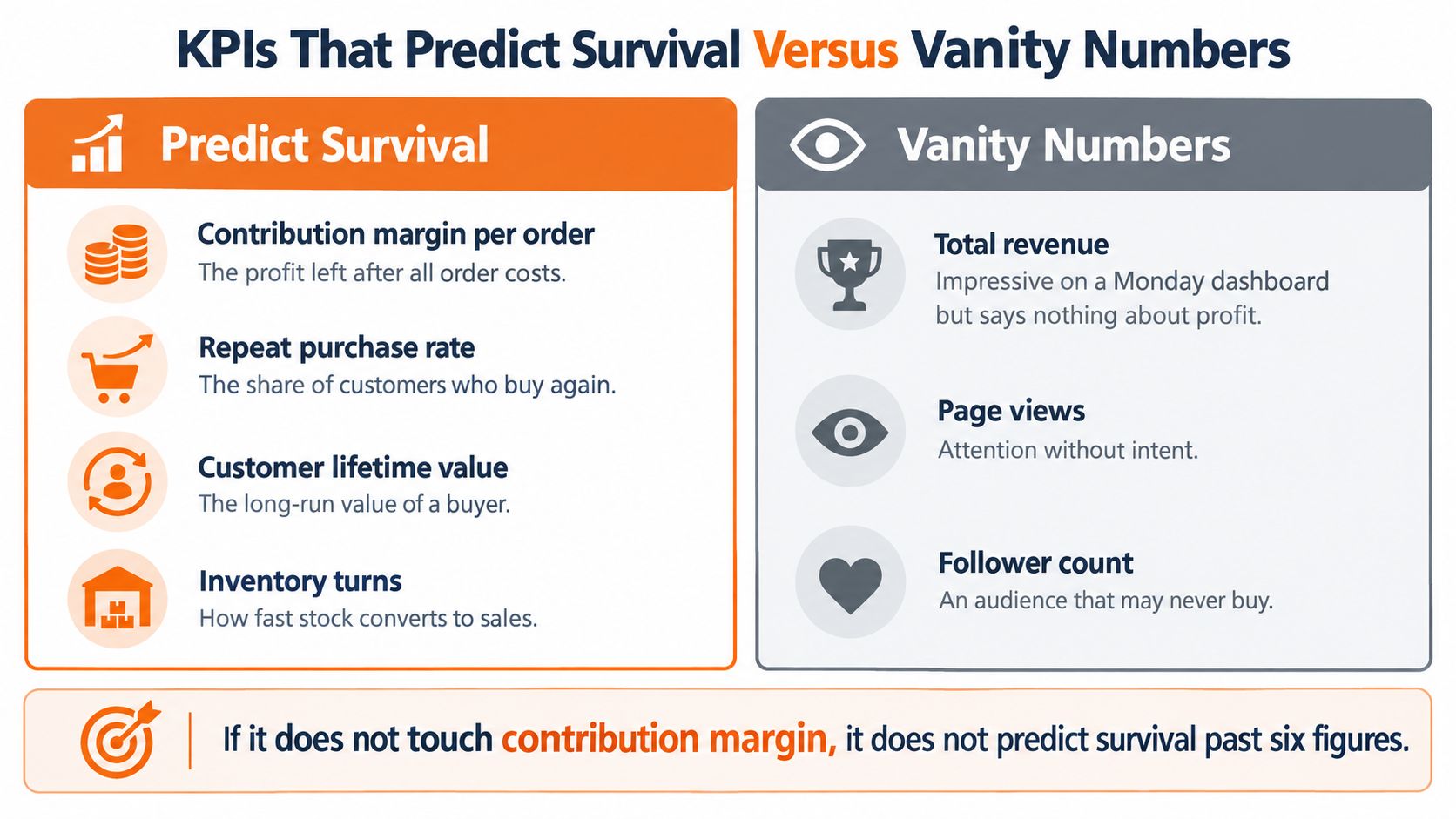
Revenue can grow while the business gets weaker. I care first about contribution margin per order, because that number tells you whether a shipment leaves enough money to fund the next shipment, pay overhead, and recover acquisition cost.
Traffic, impressions, and follower counts can help you diagnose demand, but they don't pay invoices. Total revenue can look impressive on a Monday dashboard while discounts, returns, and fulfillment costs consume the cash by Friday.
Build the scorecard around cash
Track these numbers every month:
- Contribution margin per order: Profit left after variable order costs.
- Repeat purchase rate: The share of customers who buy again.
- Customer lifetime value: The long-run contribution from a buyer, not just cumulative revenue.
- CAC payback period: The time required to recover acquisition cost from contribution.
- LTV to CAC: A comparison between customer value and acquisition cost.
- Gross margin after returns: The margin you keep after the product comes back.
- Inventory turns: How quickly stock becomes cash.
- Refund and return rate: A direct signal of product expectation, quality, and merchandising problems.
The plan notes often used by founders cite a CAC payback period under six months as a survival threshold and LTV to CAC above three as a health threshold. Treat those as internal guardrails only if your cash basis, attribution window, and return accounting match the way you calculate them. A number without consistent definitions is decoration.
Branded search volume and email open rates above 40% can look persuasive in a pitch deck, but neither proves profit. A customer can search for your brand and still buy only with a discount. An email can open without producing an order. For a deeper treatment of lifetime value, see RecurX's guide to customer value metrics for DTC brands.
Review your scorecard monthly with one question beside every metric: what decision will this number change? If the answer is none, remove it from the founder dashboard.
Designing the Operating Model for Margin, Not Just Growth
Your storefront is the visible part of the business. The operating model decides whether growth leaves cash behind.
Start with fulfillment. In-house fulfillment gives you control and can work while order volume remains manageable. A 3PL can buy back founder time and provide better systems, but its pick fees, storage, receiving charges, shipping rates, and account costs must fit your contribution margin. Don't outsource because another founder did. Outsource when the operational savings and service quality justify the cost.
Inventory creates the same trap. Founders celebrate a large purchase order because it lowers the unit cost, then spend months waiting for that inventory to turn back into cash. Track inventory turns and aging by SKU. A slow product ties up cash that could fund a proven product, a retention flow, or a better supplier.
Price for the business you actually run
Returns aren't a customer-service footnote. They create reverse shipping, inspection, repackaging, refunds, and sometimes unsellable stock. Decide whether your product price, return policy, and product content account for that cost. If your product generates frequent returns because customers misunderstand size, fit, or use, rewrite the page before you raise ad spend.
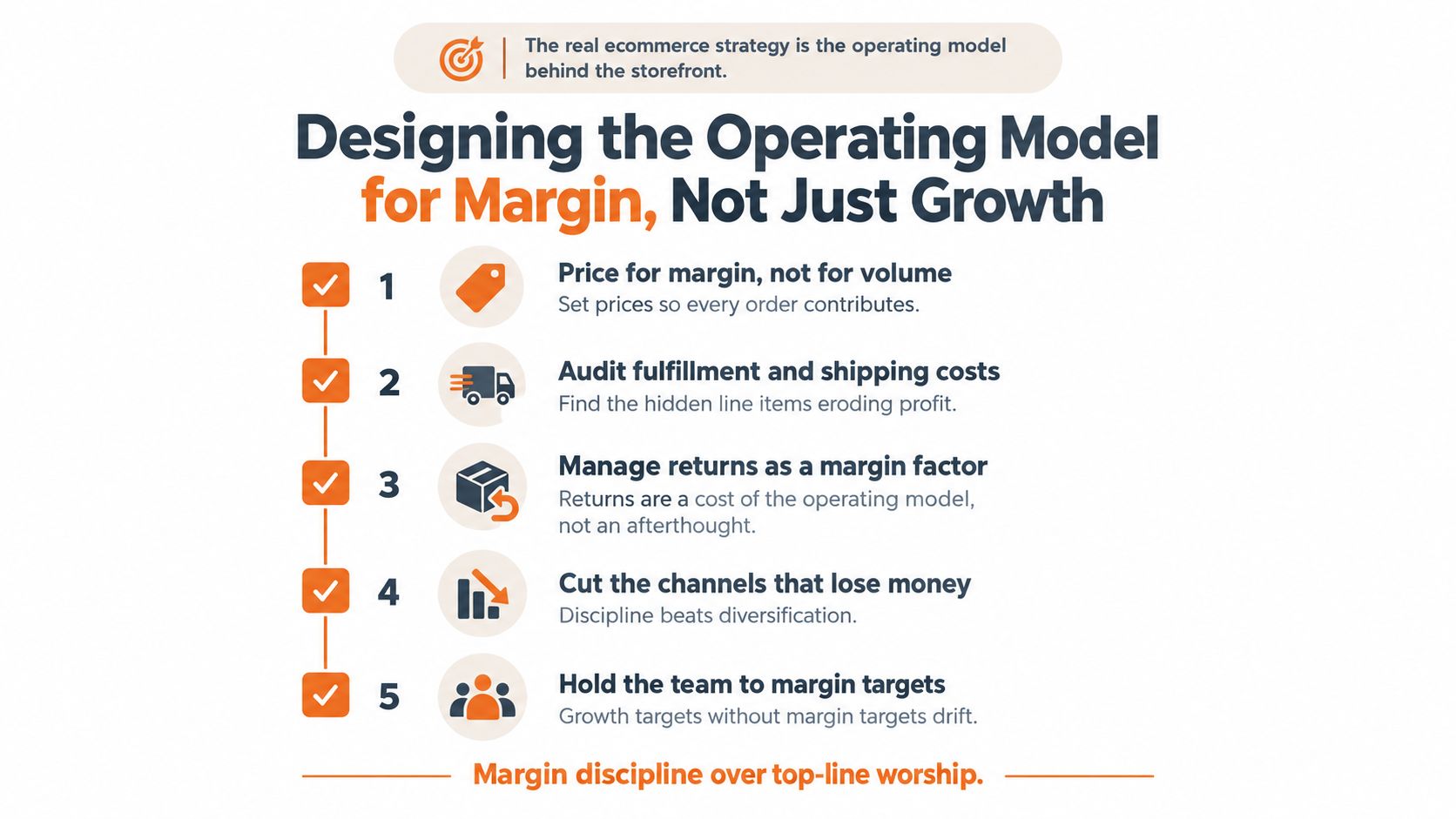
Use this order when making operating decisions:
- Price for contribution. Set a price that leaves room for fulfillment, returns, acquisition, and overhead.
- Audit fulfillment. Find every shipping, storage, packaging, and handling charge.
- Manage returns. Fix expectation gaps and include the true cost in your model.
- Cut losing channels. Don't keep a channel alive because its revenue looks good.
- Set margin targets. Give the team profit goals beside revenue goals.
Paid acquisition can produce growth quickly, but repeat purchase, organic content, referrals, and wholesale can reduce dependence on auction prices. Test each route against contribution margin rather than giving every channel equal status.
A healthier P&L beats a prettier graph every time.
Scaling Milestones and When a Mentor Program Pays Off
Scaling is a sequence of operating-model changes. Add planning before stockouts become emergencies, finance before cash decisions become guesses, and management systems before every decision waits for you.
Use these revenue ranges as planning prompts, not universal laws. Product category, reorder cycle, channel mix, and working-capital terms can change the timing.
| Revenue Range | Operating Upgrade | Support to Consider |
|---|---|---|
| Around $250K | Formal inventory planning by SKU, supplier, and reorder need | An operator who understands purchasing and demand planning |
| Around $500K | Paid social diversification and channel reporting | A performance marketer or attribution specialist |
| Near $1M | Fulfillment review, with a serious 3PL comparison | A fulfillment consultant or experienced logistics operator |
| Around $2M | Fractional finance leadership, cash forecasting, and margin reporting | A fractional finance lead |
| Around $5M | Brand leadership, delegation, and a repeatable management cadence | A brand operator or senior ecommerce leader |
At the inventory stage, better planning reduces emergency purchasing and protects cash. At the channel stage, reporting shows whether one platform controls too much of your demand or margin. At larger milestones, finance and leadership systems replace founder instinct with repeatable decisions.
Buy mentorship when the problem is knowledge
A peer group or accelerator earns its place after your unit economics are clear and growth has stalled because you lack a specific capability. Know your contribution margin, acquisition cost, retention behavior, and inventory position before paying for advice. Mentorship cannot fix a product that loses money on every order.
Choose programs with CPG experience, a clear fit for your business stage, and peers facing comparable operating problems. A founder selling consumables needs different guidance from a founder selling durable equipment. A local, vetted community such as Chicago Brandstarters can provide practical peer discussion for early founders, while you remain responsible for building and checking your own numbers.
Self-funded learning makes more sense while demand remains unproven, sales are not repeatable, or your questions are too broad to guide a decision. Read, test, document the result, and pay for support when you can name the next operating change required, such as improving purchasing discipline, assigning channel ownership, or building a management cadence.
Questions That Pressure-Test Your Ecommerce Strategy
Slogans make poor operating decisions. “Scale paid social” ignores margin. “Everyone's profitable on Amazon” ignores fees, advertising, refunds, and price competition. “DTC is dead” confuses a difficult acquisition environment with a broken business model.
Ask sharper questions.
Can your contribution margin survive a 20% CPM increase? Treat this as a stress test, not a forecast. If a modest rise in advertising cost destroys your order economics, you don't have a scaling plan. You have a fragile acquisition dependency.
What three levers would you pull next week if revenue dropped 15%? Your answer should name a price change, a spend decision, a conversion fix, a retention action, or an inventory move. If you need a long meeting to find the answer, your scorecard isn't connected to decisions.
Run the founder scorecard
- Paid acquisition: Does each new customer leave contribution after ad spend?
- Marketplace: Is Amazon profitable for you, or are fees and ads capturing the margin?
- DTC: Can your site convert and retain customers without permanent discounting?
- Retention: Is the reorder curve improving, flattening, or moving in the wrong direction?
- Cash basis: Do you measure payback after returns, refunds, and inventory timing?
- Positioning: Why does a customer choose you over the next ten tabs?
- Focus: What would you stop doing tomorrow if it produced no margin?
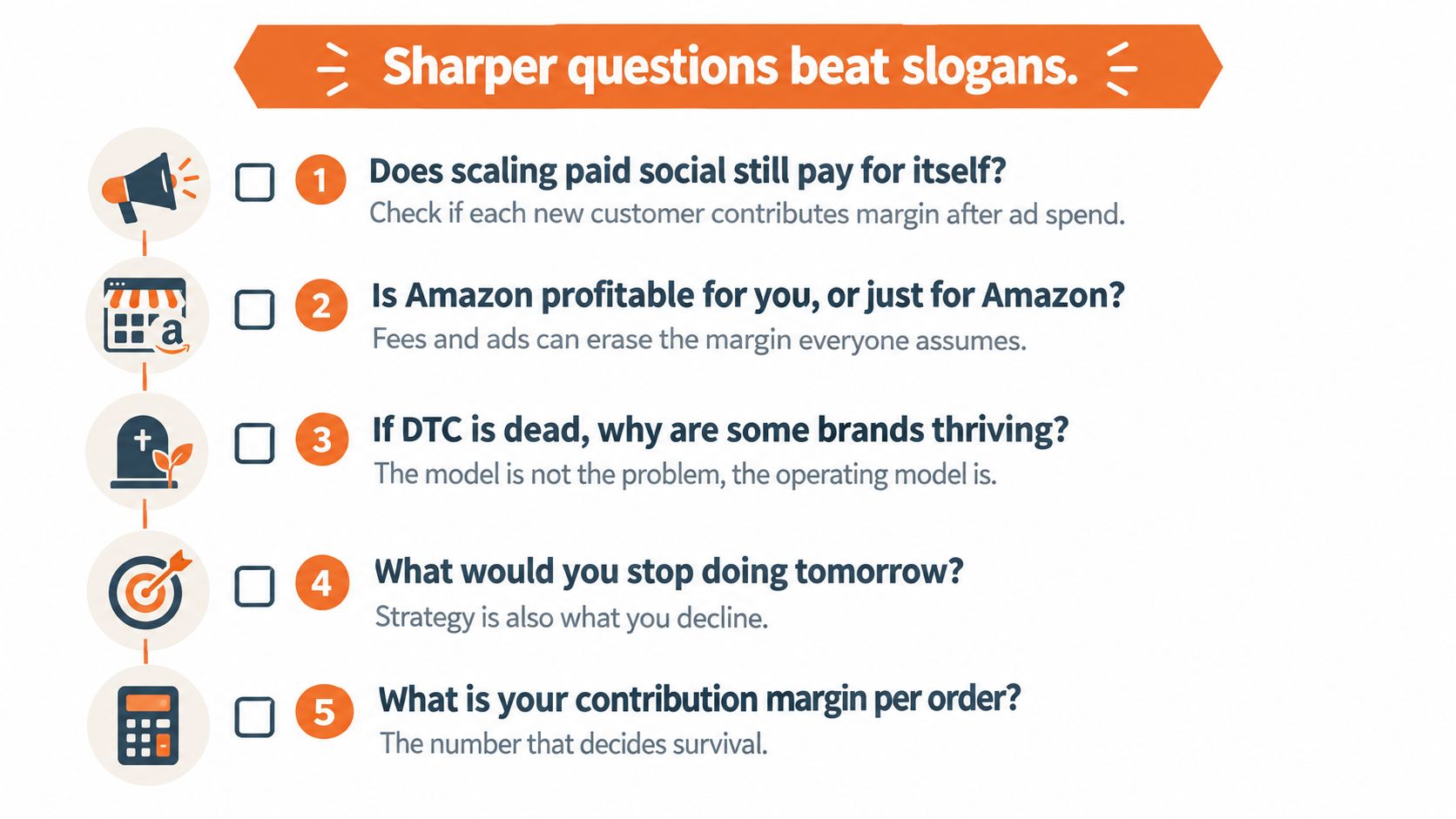
Your answers should fit on one page. Write the current number, the target, the owner, and the next action beside each question. Review it weekly while the business remains small, then review it monthly once the operating cadence becomes reliable.
Strategy is what you fund, measure, and refuse to do. A busy dashboard can show motion. Contribution margin, repeat orders, inventory discipline, and reliable fulfillment show progress.
Chicago Brandstarters gives Midwest founders a free, vetted community for honest operator conversations, private small-group dinners, and practical support from idea stage through growth toward seven figures. Visit Chicago Brandstarters to meet founders who can pressure-test your ecommerce business strategy and help you make the next operating-model decision with fewer expensive mistakes.
Leave a Reply