
Most Amazon sellers chase one number: ACOS. They cut campaigns until the percentage looks tidy, then congratulate themselves while sales stall. That's backwards. If you spend nothing, your ACOS is zero, but your ad-driven revenue is zero too.
A useful Amazon advertising strategy treats ACOS as one instrument on the dashboard, not the steering wheel. You need immediate conversion, new-to-brand customers, organic sales, inventory health, and actual profit to work together. Amazon's advertising business grew from $14.09 billion in 2019 to $56.22 billion in 2024, according to SalesDuo's summary of Amazon advertising revenue. The platform has become too competitive for lazy, single-metric management.
Rethinking Your Amazon Advertising Strategy
Low ACOS can hide weak business performance. A campaign may show an attractive percentage while capturing shoppers who already planned to buy, taking credit for organic demand, or promoting a product with too little margin to support advertising.
Judge the account by profitable incremental growth. Ask three questions at the same time:
- Did the ad create demand? Track new-to-brand customers and assess whether the audience can produce future sales.
- Did the sale make money? Include product costs, marketplace fees, fulfillment, discounts, and advertising spend before calling a campaign profitable.
- Did the campaign strengthen the account? Monitor organic sales, branded search behavior, repeat purchases, and product-level contribution.
A high-ACOS campaign can still earn its place if it brings in new buyers. A low-ACOS campaign deserves scrutiny if it only converts existing demand or leaves little contribution after costs.
Amazon's benchmark reporting includes percent of purchases new to brand, purchase rate new to brand, cost per purchase new to brand, CTR, CPC, video completion rate, cost per completed view, and CPM. Amazon calculates these benchmarks with ad-spend-weighted figures at brand level, allowing comparisons with category peers in supported products and marketplaces through Campaign Manager, Report Center, or the API. Use Amazon's benchmark reporting documentation to identify weak areas instead of reacting to one blended campaign average.
Stop buying cheap clicks
A cheap click from an irrelevant query is expensive. A costly click from a high-intent shopper can be profitable when the listing converts and the contribution margin covers the spend.
Separate campaigns into harvesting and discovery. Harvesting captures existing demand through proven search terms, branded queries, and strong product targets. Discovery uses broader targeting, category audiences, and upper-funnel placements to find future buyers. Set a specific job for each group, then judge the full account by profit and new-to-brand growth.
Amazon's advertising business has expanded beyond basic sponsored placements. Marketplace launched in 2000, while third-party histories place Sponsored Product Ads around 2002. Marketing Services followed in 2009, and Amazon DSP expanded beyond Amazon properties in 2018, according to this Amazon advertising history and statistics overview. The practical lesson is clear: capture demand today while building a larger pool of demand for later.
Understanding Campaign Structure Basics
A messy account hides useful answers. If one campaign mixes every product, match type, and goal, you won't know whether poor performance comes from the listing, the keyword, the bid, or the product margin.
Start with a simple hierarchy:
- Portfolio: Group campaigns by brand, product line, or business objective.
- Campaign: Give each campaign one clear targeting and budget purpose.
- Ad group: Keep related products and targets together.
- Target: Use keywords, product targets, categories, or audiences that fit the campaign job.
- Search term: Review the actual shopper language and move proven terms into controlled campaigns.
Build around product and intent
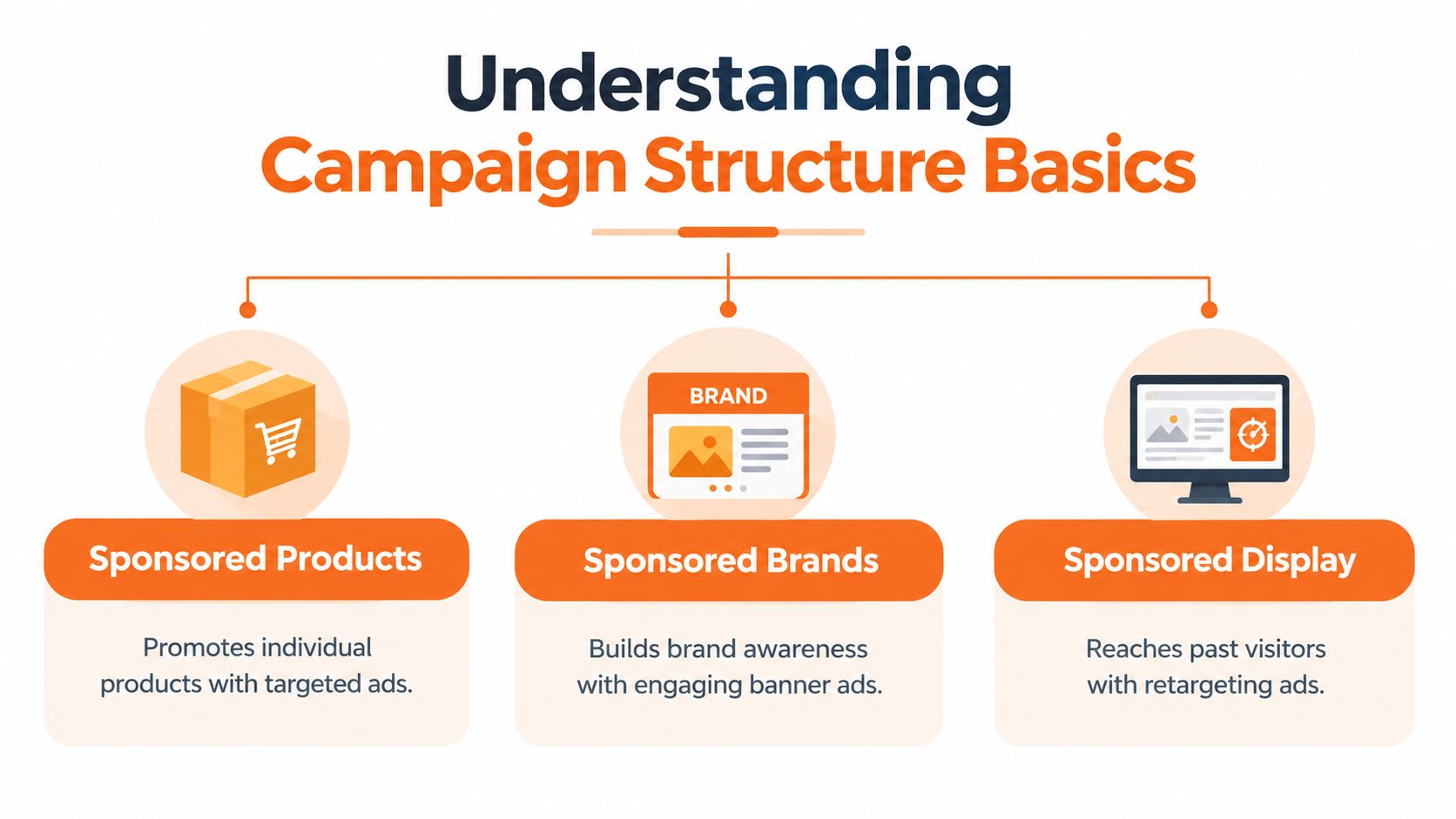
Use Sponsored Products as the foundation for individual listings. Create separate campaigns for automatic discovery, manual broad or phrase research, and manual exact harvesting. Add product targeting when you want to appear on competitor detail pages or defend your own catalog.
Keep products together only when they share economics and intent. If a premium variation and a low-margin variation sit in the same campaign, the stronger seller can consume the budget and hide the weaker one. Give hero products their own campaigns when they need distinct bids, inventory limits, or profit targets.
Sponsored Brands need a different job. Use them to present your brand name, logo, headline, and selected products to shoppers searching category or branded terms. Send traffic to a focused Store page or a relevant product collection, rather than dropping every shopper onto a generic destination.
Sponsored Display works well for audience and product-context tactics. Separate remarketing from prospecting so you can see whether you're bringing back product viewers or finding fresh shoppers. That distinction matters because the two groups require different expectations and different bids.
Practical rule: If you can't explain a campaign's purpose in one sentence, split it before you optimize it.
Name campaigns for decisions
A useful name tells you what to do next. Include the product family, ad type, targeting method, match type, and funnel purpose. A name such as HeroProduct_SP_Exact_Harvest gives you more information than Campaign 17.
Use negative keywords and negative product targets to block waste after you confirm the pattern. Don't add negatives because one click failed. Add them when the query repeatedly attracts irrelevant traffic, poor conversion, or sales you can't profitably support.
Mastering Key Metrics for Better ROI
ACOS answers one narrow question: how much ad spend did you use to generate attributed sales? Calculate it as ad spend divided by attributed ad sales. It helps you manage a campaign, but it doesn't tell you whether Amazon advertising improved the whole business.
TACoS, or Total Advertising Cost of Sales, puts ad spend against total revenue. That makes it useful for judging whether paid media supports organic growth or merely replaces sales you might have captured anyway. You can use this guide to the cost of selling on Amazon to keep marketplace fees and operating costs in the same financial conversation as media spend.
Read the metrics as a system
Use each metric to diagnose a different problem:
- ACOS: Shows campaign-level advertising efficiency. Compare it with contribution margin, not with a random account target.
- TACoS: Shows how advertising relates to total sales. A rising TACoS deserves investigation, especially if organic revenue stays flat.
- ROAS: Shows revenue generated for each advertising dollar. It's useful for budget comparisons, but it ignores margin.
- CTR: Tells you whether the targeting and creative earn attention. Low CTR can point to weak relevance, poor placement, or an unconvincing message.
- Conversion rate: Tells you whether the detail page turns traffic into orders. Strong CTR with weak conversion usually sends you to the listing, price, reviews, offer, or product fit.
- New-to-brand metrics: Show whether you're acquiring customers who haven't bought from your brand within Amazon's measurement window.
Independent 2026 benchmark data places blended Amazon ad conversion around 8.3% in one managed-account sample, with platform averages commonly reported around 10% to 12%. The same source reports healthy ACOS often around 30% to 32%, CPC around $1.18 to $1.22, CTR around 0.4% to 0.6%, and TACoS around 10% to 15%. Treat those figures as reference points, not promises, and review the Amazon advertising benchmark analysis before setting targets for your category.
Adjust bids by diagnosis
Use this sequence:
- Low CTR: Check relevance, main image, title, price position, and placement. Lowering the bid won't fix an ad nobody wants to click.
- Good CTR, weak conversion: Review the product page and offer. Search-term relevance may look fine while the listing fails to close.
- Good conversion, poor profit: Reduce the bid, tighten targeting, or move the term into a controlled campaign. Revenue doesn't excuse a loss.
- Strong profit and inventory: Increase budget carefully, then watch TACoS and organic sales.
- High new-to-brand cost with strategic value: Keep the campaign only if your margin, repeat purchase pattern, or broader business plan supports the acquisition cost.
The same period can produce a 38% median ACOS and 15% median TACoS, even while conversion looks healthy, according to Sequence Commerce. That's why I never optimize ACOS in isolation. I want profitable sales, affordable customer acquisition, and a TACoS trend that makes sense for the growth stage.
Choosing the Right Ad Products
Amazon offers several ad products, but buying access to all of them is not a strategy. Assign each format a specific job, then judge it against the role it is meant to perform. A low ACOS is not enough if the campaign only captures existing demand and adds no profitable new customers.
| Ad Product | Best Use Case | Primary Goal |
|---|---|---|
| Sponsored Products | Individual product discovery, search capture, and product targeting | Drive conversions |
| Sponsored Brands | Branded search, category visibility, and Store traffic | Build brand consideration |
| Sponsored Display | Product-context targeting, audience prospecting, and remarketing | Re-engage or find shoppers |
| Amazon DSP | Programmatic audiences, off-Amazon reach, display, and video | Expand full-funnel reach |
Sponsored Products
Use Sponsored Products for the shortest route from a search query or product page to a sale. Start with products that have a credible offer, strong listing content, healthy inventory, and enough contribution margin to support testing. Keep automatic discovery separate from manual exact campaigns. Otherwise, search-term research competes with controlled bidding.
Move proven exact-match terms into campaigns with tighter bids and budgets. Broad and phrase targeting uncover language you would not have chosen manually. Product targeting reaches shoppers comparing similar items and can expose weaknesses in your price, offer, or detail page.
For a plain-language explanation of placements, targeting, and campaign mechanics, read sponsored Amazon ads explained.
Sponsored Brands
Sponsored Brands earn their budget when your brand needs stronger visibility around a relevant search. Use a direct headline, a small set of related products, and a landing page that continues the ad's promise. Sending shoppers to a Store filled with unrelated products creates friction and wastes paid attention.
Judge Sponsored Brands by more than immediate attributed sales. Review new-to-brand purchases, branded search behavior, Store engagement, and assisted demand where your reporting supports those measures. Separate brand defense from category conquesting. Your own brand terms protect existing demand, while competitive terms attempt to create new demand. They should not share the same target or success standard.
Sponsored Display and DSP
Sponsored Display suits focused tests involving product context and audiences. Use it for product viewers, complementary products, competitor detail pages, or relevant shopper groups when the purchase path may take longer than a search click.
DSP demands tighter control over audiences, creative, frequency, and attribution. Use it only when you need reach beyond Sponsored Products and can evaluate new-to-brand growth, assisted sales, and profit. Forcing every impression to meet an exact-match search standard will make the channel look worse than it is, while ignoring profit will hide waste.
Amazon's advertising business now extends well beyond search. Its advertising revenue passed $68.63 billion in 2025, while Amazon reported more than $12 billion in incremental revenue from its full-funnel approach. Do not copy Amazon's scale. Copy the discipline: give every format a defined role, measure new-customer growth and profit, and stop campaigns that cannot justify their cost.
Scaling Your Campaigns for Growth
Scaling means finding more profitable demand, not pressing the budget button until the account catches fire. Before you raise spend, check inventory, contribution margin, Buy Box status, delivery promise, listing quality, and operational capacity. Advertising a product you can't keep in stock turns paid demand into disappointed shoppers and lost momentum.

Use a controlled expansion loop
I scale in this order:
- Protect winners: Give profitable exact terms and strong product targets enough budget to run through the day.
- Harvest evidence: Pull search terms from automatic, broad, phrase, and category campaigns. Move qualified winners into exact campaigns.
- Expand sideways: Test close variants, complementary products, competitor ASINs, and relevant categories.
- Add reach: Introduce Sponsored Brands, Sponsored Display, or DSP only when you can state the audience and measurement plan.
- Review economics: Watch TACoS, new-to-brand acquisition, inventory, and margin after each budget change.
Don't make several major changes at once. If you change bids, budgets, match types, creative, and listing content on the same day, you won't know what caused the result. Keep a change log with the date, adjustment, reason, and expected outcome.
For a separate perspective on product content and improving Amazon discoverability, focus on the parts of the catalog that help both shoppers and Amazon's automated systems understand the product. Strong titles, useful bullets, accurate attributes, clear images, and credible reviews improve the quality of every paid visit.
Prepare for AI-led discovery
Amazon Ads' 2026 trend coverage points toward assistant-native placements, conversational shopping, and AI-driven campaign tools. The practical response is simple: write product data that answers real shopper questions, make variants and use cases clear, and keep reviews aligned with the problems your product solves. Your brand may need to earn a recommendation before a shopper reaches a traditional search-results click.
Your campaign data still matters. Search terms reveal language, objections, and use cases. Feed those findings into your title, bullets, Store content, video scripts, and product education. That creates a tighter loop between paid media and catalog quality.
A useful reference for ongoing Amazon advertising optimization can help you keep the operating routine consistent as the account grows.
The video below gives you another visual break before you make larger campaign changes.
Creating a Sustainable Amazon Advertising Strategy
A durable account runs on a repeatable decision cycle. You set a business target, build campaigns around distinct jobs, collect evidence, and move money toward profitable incremental demand. You don't need a complicated dashboard. You need definitions that your team uses consistently.
Amazon's advertising revenue reached $21.3 billion in Q4 2025, up 22% year over year, while Prime Video reached 315 million global viewers, according to Skai's 2026 state of Amazon Ads. Those figures explain why Sponsored Products, streaming, display, and DSP now compete for the same budget. Your allocation should follow profit and customer acquisition goals, not platform excitement.
Use this operating checklist
Before launch
- Confirm product margin after fees, fulfillment, discounts, and expected ad cost.
- Check inventory and delivery promise.
- Improve the product detail page before buying serious traffic.
- Assign each campaign one job, one product group, and one measurement standard.
- Separate discovery, harvesting, brand defense, competitor targeting, and remarketing.
During the test
- Review spend, sales, ACOS, TACoS, ROAS, CTR, conversion rate, and new-to-brand results.
- Search the actual queries and add negatives only when the evidence supports them.
- Fix listing or offer problems before trying to solve conversion problems with bids.
- Keep a record of bid, budget, targeting, creative, and catalog changes.
During budget reviews
- Protect profitable demand that runs out of budget.
- Cut terms that consume spend without a plausible profit path.
- Fund discovery when it produces useful new-to-brand or category evidence.
- Compare performance with Amazon's available category benchmarks.
- Hold back spend when stock, margin, or fulfillment cannot support more orders.
For brands that need outside help with planning and execution, you can consult Online Brand Growth for Amazon ads. If you're deciding how much to put into harvesting, discovery, creative, and broader reach, document the assumptions in your marketing budget allocation workflow.
Judge the account like an owner
Your weekly question shouldn't be, “What campaign has the lowest ACOS?” Ask, “Where did the last dollar create the most profitable, incremental growth, and what evidence supports the next dollar?”
That question forces better choices. You may cut a high-ROAS branded campaign that only captures existing demand, then fund a new-to-brand campaign with a slower payback. You may also stop a supposedly promising DSP effort because it can't prove enough profit or customer value. Good Amazon advertising strategy makes those tradeoffs visible.
Chicago Brandstarters is a free, vetted community where founders discuss practical brand-building problems through private dinner groups and an active chat. If you're weighing Amazon ad spend alongside product, inventory, and growth decisions, visit Chicago Brandstarters to connect with other operators and compare notes in a confidential setting.
Leave a Reply