
You've probably got a note on your phone, a half-baked Figma file, or a sketch on a diner napkin. You keep coming back to it. Part of you thinks, “This could work.” The other part thinks, “If I tell people, they'll steal it. If I build it first, I might waste a year.”
I get it.
I've met plenty of founders around Chicago and the Midwest who sit in that exact tension. They're not lazy. They're scared of two things at once. Looking foolish and getting ripped off. Bad advice makes that worse because it tells you to either “just ship” or go run some bloated corporate research project. Both are dumb if you're early.
You need evidence. Not theater. Not fake validation from friends. Not your cousin saying, “Yeah, I'd totally use that.”
Stop Guessing and Start Knowing
Most founders treat market research for new products like it's some Fortune 500 ritual with one-way mirrors and stale bagels. That's nonsense. At your stage, market research is just risk reduction. It's how you stop driving at night with your headlights off.
Nearly 80% of businesses conduct market research before launching new products to gather targeted insights, and that practice reduces failure risk and improves the odds of success, according to Hanover Research on what market research is. I don't read that as a fun fact. I read it as a warning. If you skip research, you're not being scrappy. You're being careless.
What founders get wrong
A lot of first-time builders confuse secrecy with discipline. They think saying less is smart, but then they learn nothing. Or they overshare the full idea to anyone with a pulse and collect useless praise.
The middle path is better. You can protect the recipe and still test whether anyone wants the meal.
Here's the blunt version:
- Your opinion isn't market proof. You liking the idea means almost nothing.
- Your friends are bad judges. They want to encourage you, not wound your ego.
- A prototype is expensive truth. You should earn the right to build one.
If you need a simple primer on collecting customer feedback, start there. Then compare those basics against practical market research methods for founders so you don't end up doing random activity that feels productive but teaches you nothing.
Practical rule: If your research doesn't change what you build, what you charge, or who you target, it wasn't research. It was procrastination with a clipboard.
What this looks like in real life
You don't need a giant budget. You need a tight process:
- Name your biggest guess
- Find people who already feel the pain
- Ask about their behavior, not your idea
- Look for patterns
- Make a hard call
That's it. Clean. Cheap. Useful.
Define Your Riskiest Assumptions
Before you talk to anybody, sit down and admit what you're guessing. I mean really guessing. Most founders hide from this part because it forces honesty.
Your product idea is a stack of assumptions wearing a trench coat.
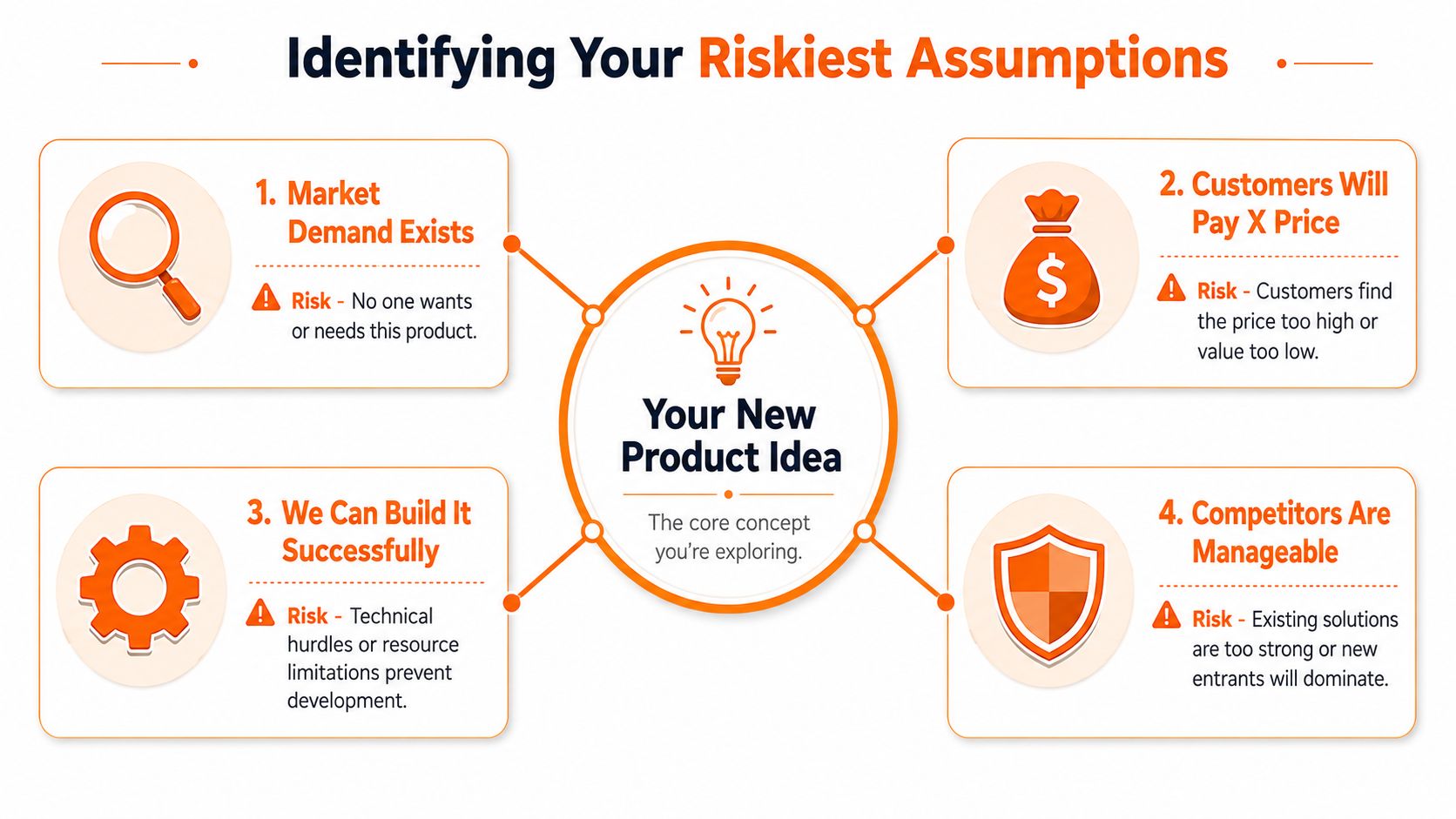
You must establish clear, specific objectives before starting market research, because if you don't, your findings lose focus and fail to give you a full read on customer needs, as noted by Sprout on market research in product development.
The four assumptions I want you to write down
Don't write a business plan. Write a hit list.
Demand assumption
Do these people have this problem, or do you just think they should?Willingness-to-pay assumption
Will they pay enough for this to become a business, not a hobby?Build assumption
Can you make this thing with your current money, talent, and time?Competitive assumption
Are buyers unhappy with what they use now, or are you walking into a knife fight with a butter knife?
If you can't name the top assumption in each bucket, you're not ready to interview anyone.
Turn vague beliefs into testable questions
Bad founders ask mushy questions. Good founders force their assumptions into plain English.
Here's a simple conversion table:
| Vague belief | Better research question |
|---|---|
| People need this | When did they last deal with this problem? |
| They'll pay for convenience | What do they pay for today, in money or time? |
| We can beat current options | What do they hate about current options? |
| Small businesses are the audience | Which exact type of small business feels this pain first? |
That last one matters more than people think. “Small business owners” is not a target market. It's a shrug.
A lot of founders get sharper by prioritizing high-value use cases before they do outreach. That's smart because it forces you to narrow the problem into something a real human recognizes in five seconds.
If your assumption sounds broad enough to fit on a conference keynote slide, it's too broad to research.
Pick the one assumption that can kill the idea
You don't need to test everything at once. You need to test the assumption that, if false, wrecks the idea.
For one founder, that's price. For another, it's whether the pain is urgent enough to change behavior. For a third, it's whether the problem even exists outside their own head.
Circle one. Start there.
Because if you try to answer twenty questions at once, you'll get a pile of notes and zero truth.
Find Your First Ten Customers to Interview
Forget the fantasy of surveying masses of strangers. Early market research for new products works better when you talk to a small number of the right people. I'd rather have eight honest conversations than a hundred lazy clicks.
And yes, you can do this without revealing the whole idea.
Many guides miss how to validate confidential, pre-prototype ideas without revealing them. Successful founders combine active concept testing with passive behavioral data like keyword traffic or ad engagement to validate ideas while keeping things quiet, as discussed in this Reddit thread on underserved niches and stealth validation.
Start where trust already exists
Midwestern founders have an advantage here. People will talk if you approach them like a person, not a growth hacker.
Places I'd look first:
Alumni circles
Big Ten alumni groups, department newsletters, Slack groups, and LinkedIn searches by school are full of people willing to help if you ask like an adult.Local interest groups
Facebook groups, Meetup circles, hobby clubs, trade associations, and neighborhood communities are gold when the problem is tied to a real behavior.In-person spots
Farmers' markets, trade shows, library events, coworking spaces, chambers of commerce, and local business meetups work if you keep the ask light.Digital complaint trails
Reddit threads, YouTube comments, Amazon reviews, G2, Capterra, and niche forums tell you where frustration already leaks out in public.
If you need help sharpening who counts as the right person, use this guide to define your target audience before you do outreach. Otherwise, you'll talk to anyone available instead of anyone relevant.
Use a soft ask, not a pitch
Here's an outreach message that doesn't sound desperate:
I'm researching how people currently handle [problem area]. I'm not selling anything. I'm trying to understand what's annoying, what you've tried, and what still doesn't work. Would you be open to a short chat this week?
That works because it lowers the temperature. You're not asking them to bless your startup baby. You're asking them to talk about themselves. People like that.
How to stay stealthy
You do not need to reveal your full concept to learn whether a pain point is real.
Try this split approach:
| Passive research | Active research |
|---|---|
| Search suggestions | Short interviews |
| Forum complaints | Problem-focused questions |
| Ad engagement on problem language | Follow-up calls |
| Email signups on a vague landing page | Controlled concept reactions |
Passive research tells you where smoke is. Active research tells you what's on fire.
I've seen founders protect confidential ideas by talking around the pain, not through the solution. If your idea is a better tool for inventory forecasting, don't lead with the product. Ask how they currently forecast, where it breaks, and what happens when they're wrong.
That gives you most of the truth without giving away the farm.
Your first ten matter more than your hundredth
Don't chase representativeness too early. Chase intensity.
You want people who have felt the problem recently, tried to fix it, and still feel annoyed. Those are your first ten. They'll save you from building for spectators.
Learn How to Ask Questions That Get Real Answers
Most founder interviews are terrible. I say that with love. The founder asks leading questions, leaks the solution too early, and mistakes politeness for demand.
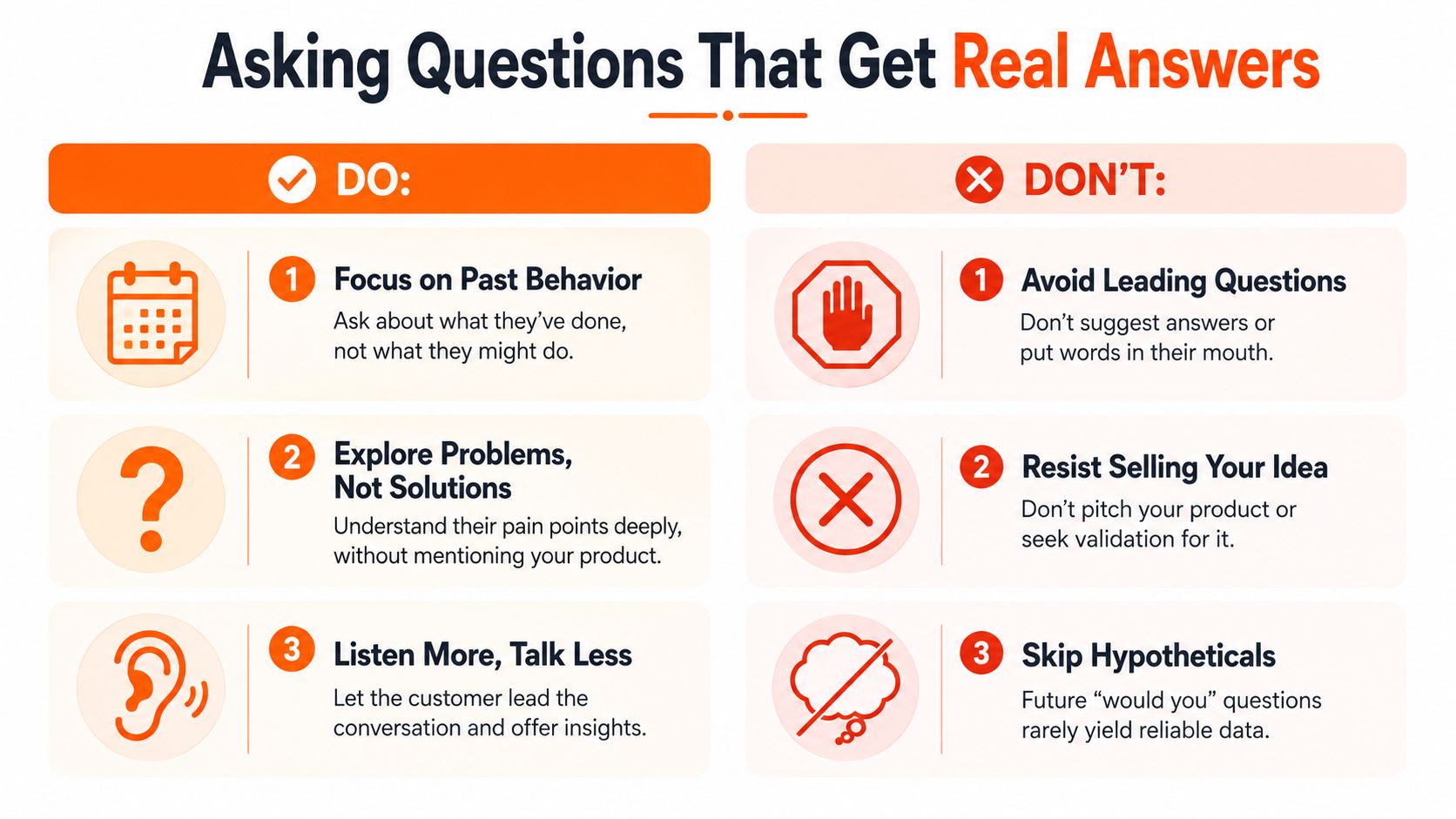
If you ask, “Would you use an app that does X?” people will smile and lie to your face. Not because they're bad people. Because hypothetical questions invite fake certainty.
To find new product opportunities, you must identify emerging jobs created by recent technological disruptions, not just persistent ones. Few resources teach a step-by-step protocol for interviewing users to uncover these new, emergent jobs, according to Harvard Business School Online on finding a need in the market.
Ask about the last time, not the next time
I use a stripped-down Jobs to Be Done approach. Fancy name, simple point. People “hire” products to make progress in their lives. Your job is to learn what progress they're trying to make.
Good questions live in the past.
Bad questions live in fantasy.
Bad questions
- Would you use a tool that does this?
- Do you think this idea is cool?
- How much would you pay for something like this?
- Would AI make this easier for you?
These are junk. They produce compliments, guesses, and social politeness.
Better questions
- Tell me about the last time you dealt with this
- What triggered that situation
- What did you try first
- What was annoying about that
- What happened when the workaround failed
- How are you handling it today
These questions uncover behavior. Behavior is harder to fake.
Ask for stories, not opinions.
Go hunting for fresh jobs
A lot of founders use JTBD like archaeologists. They dig up old needs everyone already knows. That's lazy.
The better move is to look for new jobs that showed up because tools changed. AI is the obvious example, but it's not the only one. New workflows create new frustrations. New expectations create new messes.
Ask questions like these:
- What are you doing now that you weren't doing a year ago?
- What new task showed up after your team adopted a new tool?
- What are you trying to do faster now that still feels clunky?
- Where do you still have to clean up machine output by hand?
That's where white space usually hides. Not in timeless complaints everybody has heard already, but in fresh friction no one has packaged into a product yet.
Shut up faster
Founders lose the plot. They hear a pain point and jump in with the pitch. Don't.
Use this rhythm instead:
- Ask one open question
- Let the silence sit
- Repeat back what you heard
- Ask for an example
- Dig into the consequence
If they say, “Yeah, reporting takes forever,” don't answer with your idea. Say, “Walk me through the last report you had to make.” Then keep going until you know what “forever” means in their real life.
Watch for heat, not just words
Some answers carry emotional charge. You'll hear frustration, embarrassment, dread, urgency, or resignation. That's useful. It means the problem has teeth.
Listen for phrases like:
- “I hate doing this”
- “We always end up doing it manually”
- “It breaks at the worst time”
- “I've tried three different tools”
Those are better than compliments. Compliments don't buy products. Pain does.
Turn Messy Conversations into Clear Signals
After a handful of interviews, your notes will look like a junk drawer. Half quotes. Random patterns. Contradictions. One person says price matters. Another says speed matters. A third says they'd never switch.
Good. That's normal.
Your job now is to turn noise into signal without lying to yourself.
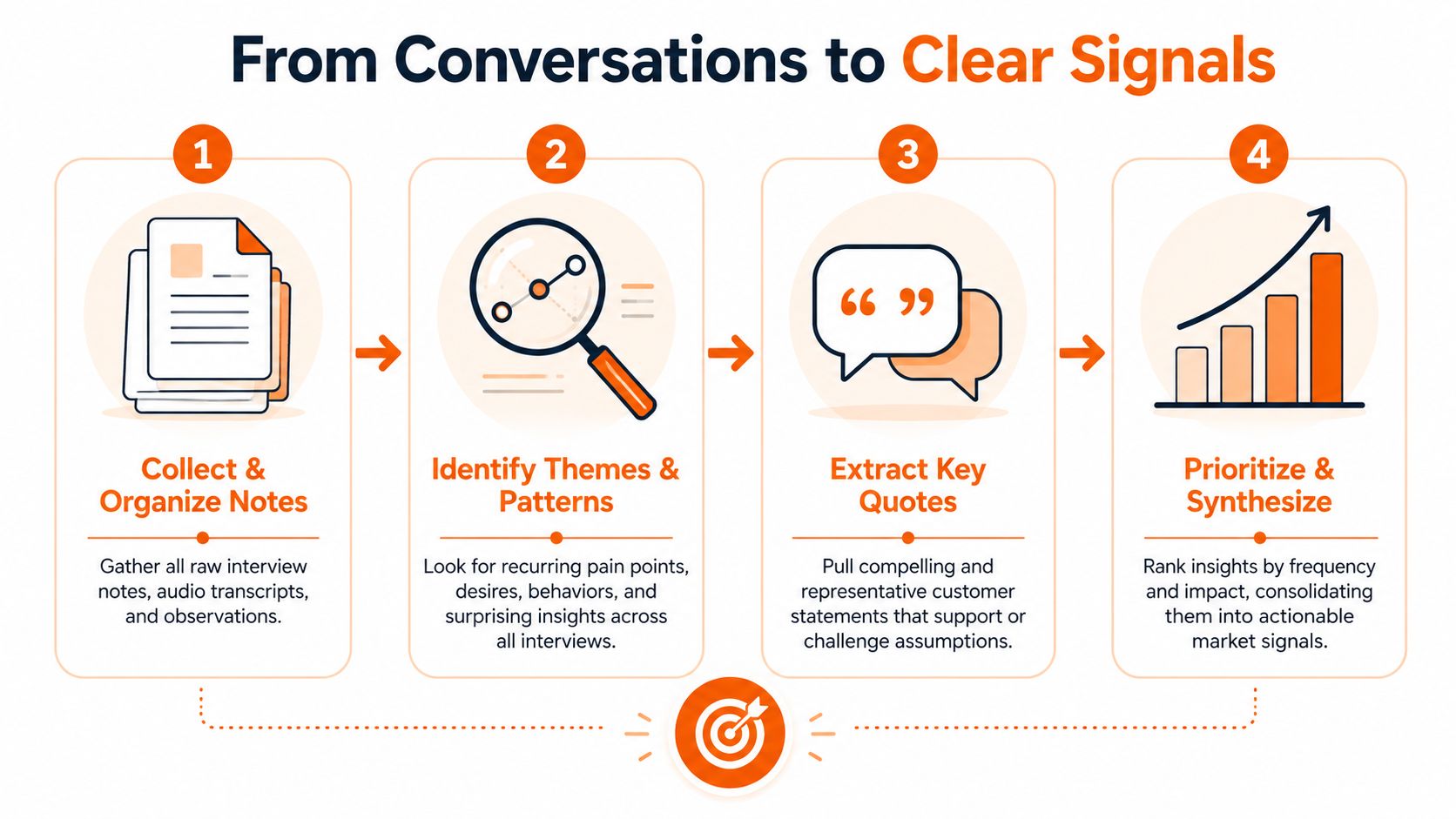
A failure to define clear research objectives leads to 40% of projects collecting irrelevant data, and success rates improve by 30% when teams combine qualitative insight with quantitative metrics, according to Design2Market on common mistakes in product market research.
First, clean the notes
Don't romanticize raw interview transcripts. Clean them.
I like a simple spreadsheet with columns for:
| Interviewee | Problem mentioned | Current workaround | Trigger event | Emotional intensity | Exact phrase worth saving |
|---|
That structure forces discipline. You stop drowning in transcript soup and start seeing repeated patterns.
If you want a stronger system for coding themes, this practical guide on qualitative data analysis methods is worth a look. Use it to sort repeated language, friction points, and failed workarounds.
Then rank patterns by frequency and pain
Don't count every comment equally. One loud opinion from a random person shouldn't steer your roadmap.
I sort what I hear into three buckets:
Frequent and painful
These are the gold nuggets. People bring them up without prompting, and the consequences are annoying enough to matter.Frequent but mild
These can shape copy, onboarding, or feature polish, but they rarely justify the whole product.Rare but intense
These are tricky. Sometimes they point to a niche. Sometimes they're just one person's weird day.
The right pattern is repeated by the right people, with enough pain that they already tried to solve it.
Build a short survey to check your read
Many founders either stop too soon or overbuild. Don't create a sixty-question monstrosity. Use a short survey to pressure-test what you think you learned.
Ask only what helps you rank priorities. Keep it tight.
A good follow-up survey usually has:
- One question about the main problem
- One about current workaround
- One about what's most frustrating
- One about how often the issue happens
- One about what would make them switch
- A screener so you know who answered
Google Forms is fine. Typeform is fine. A clean email reply asking people to rank pain points can also work if your audience is small.
Run a smoke test before you build too much
This is my favorite move for stealthy market research for new products. Put up a simple landing page that talks about the problem and the promised outcome. Keep the details light. Then ask for a concrete action.
That action might be:
- Join the waitlist
- Request early access
- Reply for a private demo
- Click through to learn more
Remember the earlier idea from stealth validation. Passive signals often tell the truth faster than compliments do. A person taking a small step beats a person saying, “Cool idea.”
One more practical option belongs here. Chicago Brandstarters has founder discussions and customer discovery support built around real behavior, frustrations, and patterns from places like Reddit reviews and product comments. That kind of structured outside read helps when you're too close to your own idea.
Making the Go or No-Go Decision
You are not trying to reach certainty. You are trying to make a better bet.
Founders get in trouble when they treat research like a hunt for permission. That's backward. Research is for judgment. Sometimes it tells you to go. Sometimes it tells you to adjust. Sometimes it tells you to kill the thing before it eats a year of your life.
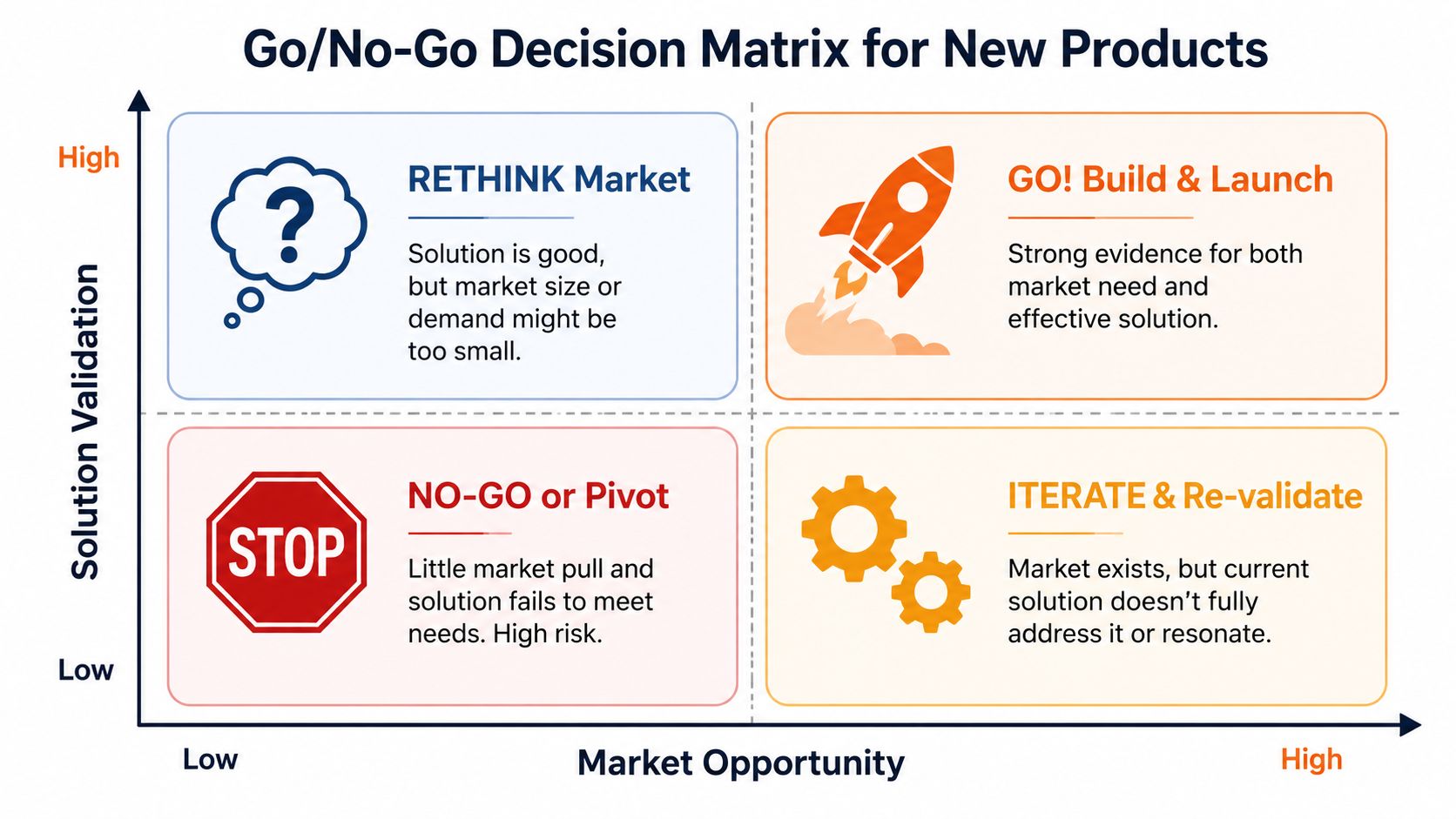
Use a simple decision grid
You don't need a fancy dashboard. I like a two-axis gut check.
| Market opportunity | Solution validation | Decision |
|---|---|---|
| High | High | Go build a small prototype |
| High | Low | Rework the solution and test again |
| Low | High | Consider a narrower or different market |
| Low | Low | Kill it or pivot hard |
That's basically the same logic behind a founder-grade business idea validation process. Keep the framework plain enough that you'll use it.
Do a back-of-the-napkin market check
I'm not talking about investor cosplay. I'm talking about common sense.
Ask yourself:
- How many people clearly have this problem
- How often does it happen
- How much do they spend now, in money or labor
- Can I reach them without lighting cash on fire
If your answer is fuzzy, that's fine. Early estimates should be rough. You're checking whether there's enough room to matter.
As one example of how market data gets used for projections, the Ready-mix Concrete Market was valued at USD 989.25 Billion in 2025 and is projected to reach USD 2,130.56 Billion by 2035, growing at a CAGR of 8.06% from 2026 to 2035, according to SNS Insider's ready-mix concrete market report. I'm not citing that because you're starting a concrete company. I'm making a point. Markets leave clues. You can study patterns without pretending your guesses are facts.
Pick one of three paths
Your next move is usually one of these:
Go
The pain is real, the buyer is clear, and your early evidence says the concept has traction. Build the smallest thing that tests the promise.Pivot
The problem is real, but your current angle is off. Change audience, workflow, price point, or positioning.No-go
The market shrugs, the pain is weak, or people already have a good enough fix. Shelve it and move on.
A no-go decision made early is a win. It means your research did its job.
A founder who kills the wrong idea quickly is ahead of the founder who spends two years defending a fantasy.
If you want a place to pressure-test your assumptions with other serious Midwestern builders, Chicago Brandstarters is a practical option. It's a free, vetted community where founders talk openly, keep things confidential, and help each other sort out whether an idea is worth building before more time and money disappear.
Leave a Reply