You've probably had this thought already.
You have a product idea, or maybe a side hustle that people keep telling you should be “online.” You open a dozen tabs. Shopify. Etsy. Amazon. WooCommerce. Payment processors. Shipping apps. Tax apps. Then your brain locks up and you close the laptop.
That reaction is normal. E commerce for small business looks simple from the outside because people love posting the polished part. They don't post the lonely Tuesday night when they're staring at shipping settings, wondering if they're building a real company or just buying themselves a new form of stress.
Here's the truth. You do not need more inspiration. You need a clear path and a few hard rules. If you're a solo founder in Chicago or anywhere in the Midwest, you can build something real online. But you need to pick the right model, use boring tools that work, and stop pretending perfection is part of the job.
What Kind of Online Business Are You Building
A lot of founders make the same mistake first. They ask, “Which platform should I use?” too early.
That's backwards. First ask: what kind of business are you building? A platform is just the building. Your model is the business.
Say you make small-batch candles in your apartment. You could sell them on your own site. You could put them on Etsy. You could sell cases to local gift shops. You could even turn the scent-of-the-month idea into a subscription. Same product. Four different businesses.
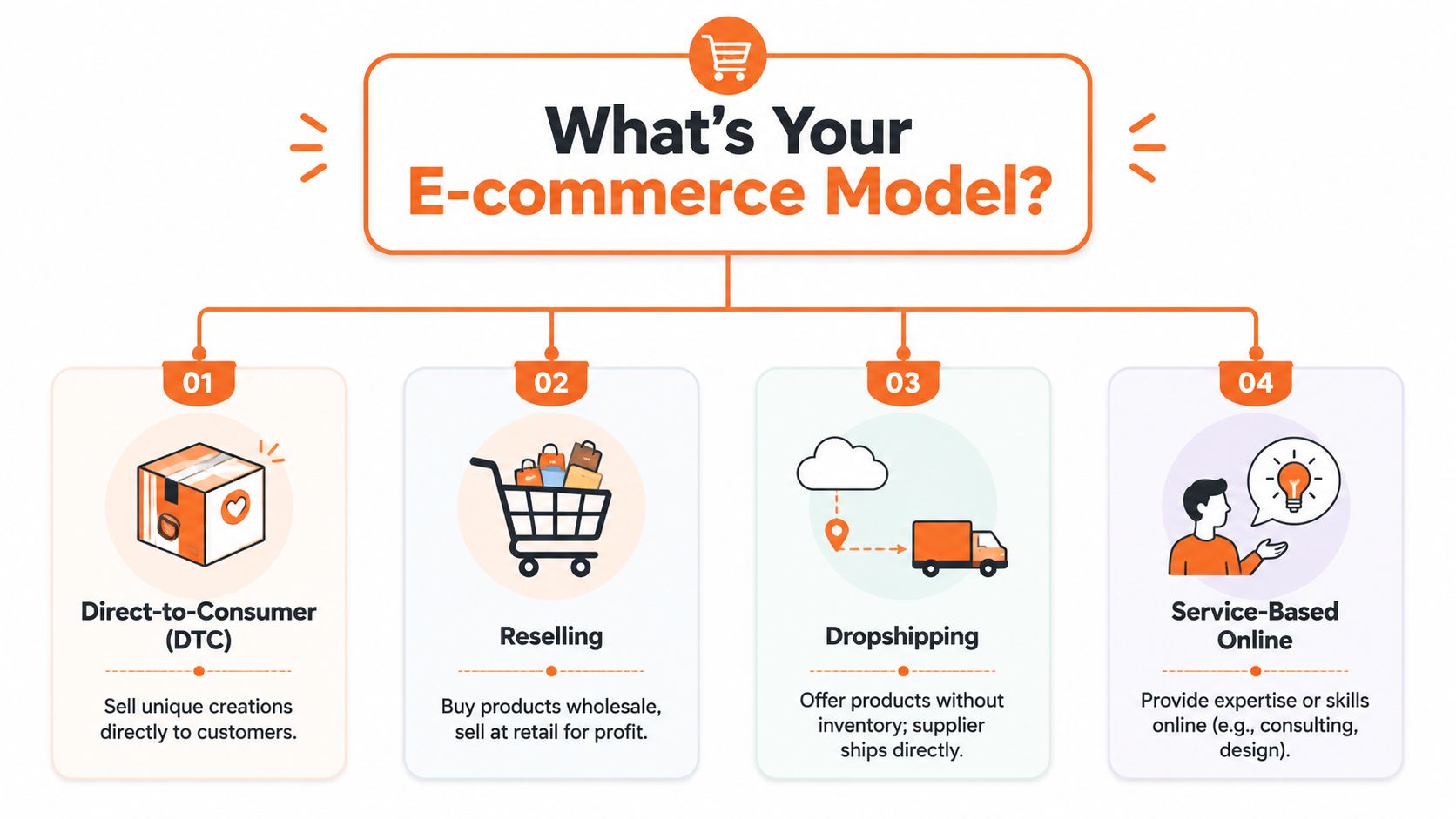
Your four real options
Think of this like selling food.
If you open your own restaurant, you control the menu, the vibe, and the customer list. If you rent a stall in a giant food hall, you get foot traffic fast, but you play by house rules. If you supply your sauce to grocery stores, you sell in volume but lose the direct relationship. If you run a meal club, you trade one-off orders for repeat buying.
Online business works the same way.
Direct-to-consumer
You sell through your own website. You control your branding, customer emails, offers, and repeat purchase flow. This is the cleanest long-term model if you want to build a brand, not just move units.
Reselling
You buy products wholesale and sell them at retail. This works if you're good at merchandising and curation. Your edge is taste, selection, or access.
Dropshipping
You sell products you don't physically stock. Your supplier ships them. This sounds easy, which is why beginners rush into it. I'm skeptical. You usually get thin control over quality, packaging, and delivery. That's a bad place to build trust.
Service-based online
You sell expertise instead of products. Design, consulting, coaching, photography, copywriting. This is still e commerce if people can buy, book, or pay online.
Practical rule: pick the model that fits your actual energy. If you hate logistics, don't build a business that lives or dies on boxes and labels.
Why marketplaces are the default
For many small businesses, starting on a third-party marketplace is the default strategy. It simplifies the technical and logistical hurdles, which is why platforms like Etsy are home to over eight million entrepreneurs and small businesses according to Statista's SME e-commerce overview.
That doesn't mean marketplaces are best. It means they're easier to start with.
If you sell handmade goods, vintage items, simple giftable products, or low-SKU products, a marketplace can get you moving fast. If you're deciding between Amazon fulfillment approaches, this breakdown of Amazon FBA vs FBM is worth reading before you commit to a shipping model you'll hate.
My blunt advice
If you're one person, don't pick the fanciest model. Pick the one you can run without needing a therapist, a warehouse, and a developer by month two.
Start with one lane:
- Handmade or niche product. Marketplace first.
- Strong brand vision and repeatable product. Own site first, maybe with marketplace support.
- B2B-friendly product. Test wholesale early.
- Consumable or collectible product. Explore subscription after people already want it.
Most founders don't fail because the idea is terrible. They fail because they chose a business model that fights their budget, skills, and patience every day.
Choosing Your E-Commerce Platform
Platform choice causes way too much drama. People treat it like marriage. It's more like renting your first apartment. Pick something decent, move in, and get on with your life.
I group platforms into three buckets. All-in-one store builders, marketplaces, and self-hosted setups. Each one has trade-offs. None is perfect.
The only question that matters
Don't ask which platform has the most features. Ask which one lets you sell this month without creating a part-time IT job.
Also, your store has to work on a phone. This is not optional. Mobile commerce accounts for nearly 60% of total online retail sales, and it is projected to hit $4.01 trillion in 2026 according to Flowlu's e-commerce statistics roundup. If your site isn't easy to browse, trust, and check out on a smartphone, you're ignoring most of the room.
Platform Trade-Offs for Small Business
| Platform Type | Best For | True Cost | Control Level |
|---|---|---|---|
| All-in-one platform like Shopify | Founders who want speed and low technical stress | Monthly subscription, app add-ons, theme costs, transaction friction if you pile on tools | Medium to high |
| Marketplace like Etsy or Amazon | Founders who need traffic and simple setup fast | Listing fees, marketplace fees, less customer ownership, pressure to compete on platform terms | Low |
| Self-hosted platform like WooCommerce | Founders who want control and already have WordPress comfort | Hosting, plugin sprawl, maintenance time, security headaches, developer help if things break | High |
| Hybrid setup | Founders who want marketplace discovery plus their own brand site | You pay in complexity because you manage more than one channel | Medium |
My opinion on each path
All-in-one platforms
If you're serious, busy, and not technical, start here.
Shopify is the classic example. You can launch quickly, process payments, and avoid a bunch of server nonsense. The downside is that your “simple” store can get expensive once you add apps for reviews, bundles, subscriptions, upsells, and email.
Still, I'd rather see you on a simple all-in-one setup making sales than on a customizable masterpiece that never launches.
Marketplaces
Marketplaces are great training wheels. I mean that as a compliment.
They help you validate demand and learn what customers click, ask, and buy. But they also put a landlord between you and your customer. You don't own the traffic. You don't fully own the relationship. That matters later.
Self-hosted setups
WooCommerce on WordPress gives you control. It also gives you responsibility.
If you enjoy tinkering, already use WordPress, or need weird custom behavior, fine. If you're a solo founder who still has a day job, be careful. You can lose whole weekends to plugin conflicts and checkout bugs.
Don't confuse flexibility with progress. Some founders spend months customizing a store when they should've been talking to buyers.
A short checklist that saves time
Use this before you commit:
- Phone test: Open the demo store on your own phone. Can you browse, add to cart, and check out without pinching and zooming?
- Payment sanity: Does it support Stripe, PayPal, or whatever payment method you trust?
- Shipping reality: Can you print labels, set simple rates, and manage orders without ten extra tools?
- Catalog fit: Does it handle your actual products well? Variants, bundles, digital goods, appointments, whatever you sell.
- Your skill level: Can you run it yourself when something small breaks?
If you want a broader outside view on choosing the right ecommerce platform, ECORN has a useful comparison that helps sort through the noise without turning it into a feature spreadsheet contest.
My simple recommendation is this. Start with the least technical platform that still gives you room to grow. You are not building a software company. You are building a business.
Setting Up the Nuts and Bolts
This is the part people avoid because it feels dull. It's also the part that decides whether your business works.
You need four things in place. Payments, inventory, shipping, and taxes. Miss one, and your “launch” is just a pretty website with failure baked in.

Payments first
Use boring payment tools. Stripe and PayPal are common choices because customers trust them and setup is straightforward on most platforms.
Your job is not to invent checkout. Your job is to remove doubt. If a buyer hesitates at the payment step, you lose the sale after doing all the hard work to earn attention.
Start with:
- One primary processor: Don't create a maze.
- Clear policies: Put shipping, returns, and contact details where people can see them.
- Test orders: Run your own card through checkout before launch.
Inventory is where solo founders get punished
Inventory is a quiet killer because the pain shows up late. You order too much, and your cash sits on a shelf. You order too little, and your best customer hits a dead end.
For solo e-commerce brands, inventory is a “delicate art.” Data shows 52% of small businesses get 25% to 75% of their revenue from online channels according to Small Business Majority's report on online growth obstacles and opportunities. That's why inventory precision matters so much. If you guess wrong, you either trap cash in unsold stock or miss sales you can't afford to miss.
My rule for early inventory
Buy narrow, not deep.
That means more caution on total units and more attention on which products deserve a reorder. Don't launch with twenty weak options. Launch with a few products you can track and understand.
Inventory is not a vanity project. Every extra unit is cash you can't spend on learning what customers want.
Shipping should be simple enough to explain in one breath
Founders love to overcomplicate shipping. Don't.
If you're starting small, flat-rate or simple tiered shipping is usually easier to manage than trying to simulate every possible postage scenario. You want the customer to understand it and you to survive it.
Use your platform's built-in label tools if possible. Printing from home beats standing in line at the post office pretending that's a growth strategy.
If support requests start piling up, get organized fast. A good help desk stops order questions from eating your whole day. If you need a practical starting point, Helmsly recommends help desk software with a useful roundup for small teams.
Here's a walkthrough that helps many founders see the moving parts in action:
Taxes and protection
Sales tax sounds scarier than it is. Modern platforms do a lot of the heavy lifting. You still need to set things up properly and know when to ask an accountant for help, but you do not need to become a tax scholar before launch.
And don't skip business protection because you're “small.” Small businesses get hit too. If you're selling physical products, this guide to business insurance for an online store will help you think through the risk before a problem teaches you the lesson the expensive way.
Your setup stack doesn't need to be sexy. It needs to let you get paid, ship fast, and sleep at night.
How You Get Your First Customers
You launch. A few friends like your post. Then nothing.
That silence messes with people. They assume the product is bad, the market is dead, or they missed some secret tactic. Usually, none of that is true. You just haven't earned enough attention yet.
I think about customer acquisition in two buckets. Rented attention and owned attention.
Rented attention gets you speed
Paid ads on Meta, Google, or TikTok can get eyeballs fast. That's useful when you need data. You can test hooks, landing pages, offers, and product demand quickly.
The problem is obvious. The second you stop paying, the traffic dries up.
That's why I don't like watching tiny brands dump all their money into ads right away, especially when their product page still stinks and their email capture is weak.
Owned attention takes longer but ages better
Email lists, search traffic, repeat customers, useful social content, direct outreach, and word of mouth are slower. They also build something you keep.
A major technical challenge for small businesses in 2026 is fragmented customer data, which leads to weak personalization. That pushes many brands into expensive paid acquisition because generic campaigns don't create strong buying journeys, as noted by Voyado's review of e-commerce industry challenges.
For a solo founder, the answer is not some giant enterprise data stack. The answer is cleaner basics.
What I'd do on day one
If I were starting from scratch with a small budget, I'd do this:
Build one tight product page
One clear promise. Better photos. Fewer words. Strong FAQs. A real reason to trust you.Start an email list immediately
Even a simple welcome flow beats hoping people remember you.Post useful content tied to buyer questions
Show the product, the use case, the objections, and the making of it.Run small paid tests
Use ads to learn, not to cosplay as a scaled brand.Talk to early buyers directly
Ask what almost stopped them. Ask what they compared you to. Ask what confused them.
Most first-customer problems are message problems, not traffic problems.
Personalization for normal humans
You do not need to act like Nike. You need to remember what your customers care about.
If someone buys a gift item, follow up with gift-focused messaging later. If someone browses one category repeatedly, send them the next useful thing about that category. Keep it human. Keep it direct.
For practical ideas, I like Next Point Digital's sales strategies because they focus on actions that can fit a small operator's week. And if you want a fuller map for traction beyond the first few orders, this ecommerce growth strategy guide is a good next read.
Your first customers usually come from focus, not reach. You don't need to be everywhere. You need to be clear in the places that matter.
Common Mistakes and How to Sidestep Them
Let me save you some pain. The biggest mistakes in e commerce for small business are usually human, not technical.
People tell themselves they're “working on the business” while hiding from the hard parts. They tweak logos. They compare themes. They build packaging inserts for orders that do not exist yet.
The myth that the store itself is the business
A website is a tool. It is not proof that demand exists.
I've seen founders spend months on branding before they've had ten honest conversations with potential buyers. That's fear dressed up as productivity. The prettier your excuse, the easier it is to believe it.
The primary barrier for small businesses adopting e-commerce is often a lack of technological knowledge, which lowers perceived ease of use and makes founders back away from digital marketing before they even start, according to the study on e-commerce adoption challenges.
So if you feel behind technically, you're not broken. But you do need a plan that avoids drowning in tools.
Mistakes I see over and over
Trying to sell everywhere at once
Etsy, Amazon, Shopify, TikTok Shop, wholesale, pop-ups. Pick one main channel first. Multichannel sounds smart until you're buried in operational crumbs.Buying too much inventory too early
Founders get emotionally attached to the idea of being “stocked.” Cash doesn't care about your optimism.Writing like a catalog instead of a person
Customers don't need fluff. They need to know what the product is, why it helps, and whether they can trust you.Ignoring customer questions
Every repeated question is a problem in your page, your photos, or your offer.
A better way to work
Use this filter every week:
- What brought people closer to buying
- What confused them
- What took my time without creating learning or sales
Then cut the third bucket hard.
“If you build it, they will come” is movie logic. Real customers come when you solve a clear problem and make the buying process easy.
The founders who last aren't always the smartest. They're the ones who can tolerate imperfect action without turning every small decision into a crisis.
Your Budget Timelines and a Dose of Reality
People either romanticize startup budgets or catastrophize them. Both are dumb.
The good news is that you can start an e-commerce business with costs that are two orders of magnitude lower than opening a physical store, which means you avoid rent and other heavy overhead and can put more money into product and marketing, based on this YouTube breakdown on ecommerce startup cost differences.
That's the good news. Here's the harder part. “Cheaper than retail” does not mean “free,” and it definitely does not mean “easy.”
Three budget mindsets
I don't love fake precision in early budgets, so think in ranges and priorities.
Shoestring
This is for the founder testing demand with extreme discipline.
You keep the product line tight. You use a simple theme. You avoid fancy apps. You take your own product photos if you can do them well enough. You spend carefully on samples, packaging, and small marketing tests.
This path is slower, but it teaches you a lot.
Standard
This is the healthiest starting point for many solo founders.
You have room for decent branding, a cleaner site, better photos, some paid traffic experiments, and a modest inventory buffer. You're still careful, but you're not trying to win a business-building contest with duct tape.
Growth-focused
This is for founders who already have proof of demand, an audience, or real conviction backed by actual customer conversations.
You can move faster here, but speed cuts both ways. More money magnifies good decisions and bad ones.
What your budget should actually cover
Don't think only in software subscriptions. Think in operating reality.
- Product and samples
- Packaging
- Platform fees
- Payment processing friction
- Basic legal and accounting help
- Photo or creative work
- Shipping supplies
- Small marketing tests
- A little breathing room for mistakes
A realistic 90-day pace
You can launch faster. I just don't think most solo founders should.
| Time period | What you should be doing |
|---|---|
| First month | Pick the model, validate the offer, choose the platform, sort out supplier or production basics |
| Second month | Build the store, write product pages, set up payments, shipping, and policies, create launch content |
| Third month | Launch, collect feedback, tighten your message, and get your first real customer conversations |
That timeline won't impress anyone on social media. Good. Social media doesn't ship your orders or fix your margin problems.
I'd rather see you launch in a sane way than race into public with a broken store, no plan, and panic in your chest.
You Are Not Alone Finding Your People
Solo founders talk a lot about freedom. They don't talk enough about the silence.
You make decisions alone. You second-guess yourself alone. You get weirdly emotional about packaging tape alone. Even wins can feel flat when nobody around you understands what it took to get there.
That's why I care so much about founder community. Not fake networking. Not people speed-running elevator pitches at each other. I mean a group where you can say, “I think I'm stuck,” and someone gives you a real answer instead of a podcast quote.
Why community changes the game
Good founder circles do three things.
They shorten your mistakes
Someone else has already made the error you're about to make.They steady your emotions
A bad week feels less catastrophic when other builders can tell you it's normal.They make you braver
Boldness is easier when you're around people who tell the truth and still want you to win.
I'm biased toward kindness and boldness as founder values. Midwest founders often have a useful edge here. They're willing to work, willing to help, and less interested in peacocking. That's a better foundation for a real business than performative hype.
Find the room where people tell the truth
If you're building an online business, your next smart move isn't another app. It's people.
Find the room where founders talk plainly about returns, inventory mistakes, ad losses, bad hires, supplier drama, and the weird self-doubt that shows up after launch. Those conversations save more businesses than motivational content ever will.
The right community won't build your store for you. It will keep you from quitting on a day when your brain lies to you.
You can build alone for a while. I don't recommend staying there.
If you want that kind of honest, generous founder room, take a look at Chicago Brandstarters. It's a free community for kind, bold, hard-working founders in Chicago and the Midwest who want real conversations, small private dinners, and practical help from people who are building.
Leave a Reply