You can have a product people like and still feel stuck. The box is packed, the samples look good, and the first buyers are asking for it, but you still need a real path from your hands to theirs. That path is your model of distribution, and if you're building in Chicago or anywhere in the Midwest, it usually decides whether your brand stays local, gets repeat orders, or burns time chasing the wrong channel.
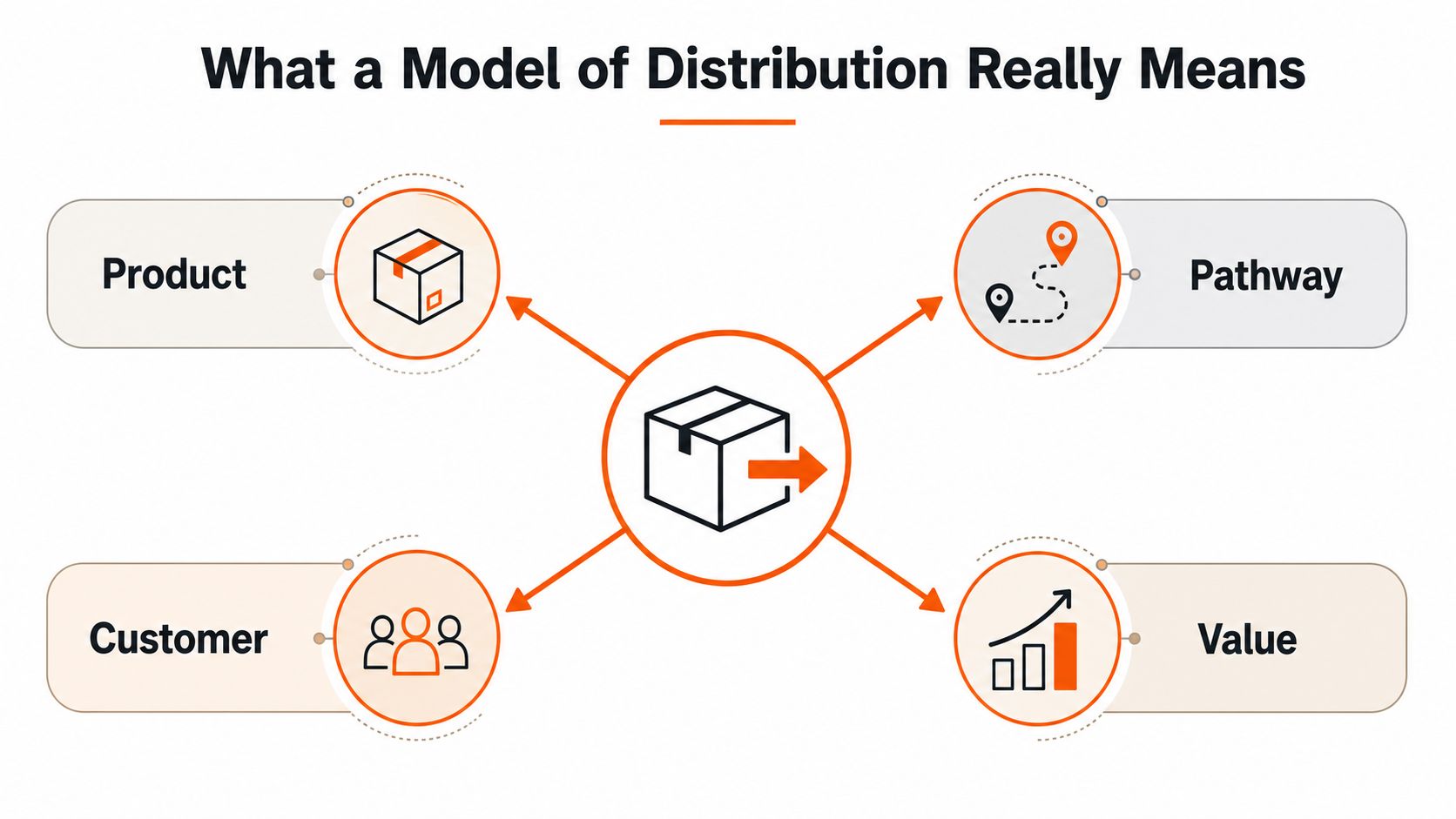
What a Model of Distribution Really Means
I've seen founders mix this up with marketing all the time. They post on social media, run a few ads, talk to a few stores, and call that distribution. It isn't. A model of distribution is the system you use to move your product from where it sits now to the buyer who pays for it.
Think of a coffee roaster in Chicago. Marketing gets someone curious. Sales gets the order. Logistics moves the bag. Distribution is the whole route, from roast to shelf, porch, or cart checkout. If that route is messy, every other part of the business feels harder.
The cleanest way to say it is this. A model of distribution is how your product reaches a customer and how value moves back to you. That's why people in health care and public policy warn against sloppy labels when they talk about underserved markets, because the issue is often specific barriers, not a vague lack of competition evidence-based work on underservedness. I think founders should use the same discipline. Don't ask, “Where can I sell?” Ask, “What path can I run well?”
A helpful shortcut is to separate distribution from demand generation. If you want a clean way to compare the channels that create demand versus the channels that move product, I'd keep compare lead generation channels open while you map your options. For a Chicago founder, that difference matters because a good promo plan can still fail if the delivery path is wrong. If you want a deeper local lens on channel planning, I'd also look at the internal guide on distribution channel strategy.
Practical rule: if the customer can't get the product easily, you don't have a distribution model yet. You have intent.
The Four Core Models Every Founder Should Know

The four models I'd put on a founder's napkin first are direct to consumer, retail, wholesale, and marketplace. They all move product, but they do it in very different ways, and the cash shows up on very different timelines.
Direct to consumer
You sell straight to the buyer through your own site, a pop-up, a text thread, or social commerce. This is direct sales, where you control the conversation, the price, the story, and the customer list.
Retail
You place your product on a physical shelf through a store buyer. That shelf can be a neighborhood boutique in Wicker Park, a grocery chain in the Midwest, or a specialty shop in Milwaukee. You give up some control, but you get a cleaner path to in-person discovery.
Wholesale
You sell in bulk to a distributor or reseller who handles the rest. This feels like loading cases onto a truck instead of carrying one bag at a time. The tradeoff is simple, you move more product at once, but you usually see the customer less.
Marketplace
You list on Amazon, Faire, Tundra, or a similar platform where shoppers already browse. That feels like opening a stall in a crowded market hall. People are already walking by, but you're sharing space with everyone else on the aisle.
If you're trying to build a distribution system from scratch, a practical primer like build a distribution system can help you think through the moving parts before you scale too fast. I like that framing because founders often pick a channel before they understand the work behind it.
Pros and Cons of Each Model
The honest version is that each model gives you something and takes something else away. I tell founders to think about what hurts first, time, margin, control, or cash flow. That answer usually points to the right path.
Direct to consumer and retail
Direct to consumer usually gives you the most control over margin and customer data. You can test copy, pricing, bundles, and repeat purchases fast. The pain is that you do more work yourself, from fulfillment to support to returns.
Retail can help when a buyer trusts the shelf and the shopper likes to touch the product. You get outside validation and real-world visibility, but you also deal with buyer meetings, shelf standards, and slower movement if the store doesn't restock well.
Wholesale and marketplace
Wholesale can simplify scale because one order can move a lot of units. The downside is that you often lose direct contact with the buyer, and your margin can feel thinner because you're pricing for a middle layer.
Marketplace can get you in front of existing traffic fast. The catch is that you're often competing on price, search placement, and reviews, so the channel can feel crowded even when sales are coming in.
Keep your eye on the channel that gives you the clearest signal, not the flashiest logo on the door.
| Distribution Model | Upfront Cost | Payback Speed | Margin You Keep | Typical Stage |
|---|---|---|---|---|
| Direct to consumer | Lower to start, but you spend time on setup and fulfillment | Faster when traffic converts | Higher, because you own the sale | Idea and launch |
| Retail | Moderate, because packaging and buyer prep take work | Slower, since stores move at their own pace | Medium, because you share the stack | Launch and growth |
| Wholesale | Higher working capital need, because you ship in bulk | Slower at first, then steadier | Lower per unit, but volume can help | Growth and scale |
| Marketplace | Lower setup cost, but you compete inside the platform | Fast when listing quality is strong | Medium to lower, depending on fees and pricing | Launch and scale |
If you want a Midwest-friendly way to think about this, a Pilsen apparel maker might start DTC, then try marketplace listings, then add wholesale once the numbers and packaging work. A Fulton Market food brand might do the same, but the shelf life and case pack math will change the route.
Matching a Model to Your Founder Stage
The right model changes with your stage. I wouldn't ask a first-time founder to build every channel at once. That's how you end up with too many promises and not enough inventory.
Idea stage to launch stage
At the idea stage, direct to consumer is often the cleanest first move because you can control the story and learn fast without begging a buyer for shelf space. If a few people in your circle buy it, you already have the beginning of a signal. If you need a simple local test plan, the internal guide on go to market strategy for startups is a useful companion.
At launch, I'd look at a hybrid model. That usually means DTC plus one additional lane, maybe a pop-up, a small marketplace test, or a single boutique. For a Chicago operator, that could mean selling online during the week and taking orders at a West Loop market on weekends.
Growth stage to scale stage
Once you've got traction, retail starts to make more sense because you can walk into buyer conversations with proof. A store buyer wants evidence that people will pick the product up again, not just curiosity on launch week. That's where your packaging, case packs, and replenishment habits matter.
When you're moving toward scale, wholesale can fit if you need volume and a cleaner shipping rhythm. That route works better when you can manage inventory without guessing. Recent global development research still finds that the most successful ways to reach rural and last-mile customers are hub-and-spoke, piggybacking on existing networks, local entrepreneurs, market linkage, and local centers last-mile distribution challenge. I think of that as a reminder that the best route often uses local structure instead of trying to invent a new one from scratch.
A Chicago founder should ask one simple question at every stage, “What route fits my current reality?” Not my dream channel, my current one. That question keeps you from signing up for a model your team can't support yet.
The Metrics That Tell You If Your Model Is Working
A distribution model is a theory until the numbers answer back. I'd watch a few plain metrics and ignore the vanity stuff that makes you feel busy. If the numbers don't move the way you expect, the model is the thing to question.
What to watch first
Customer acquisition cost, or CAC, tells you how much you spend to win one customer. If you're using paid ads, sampling, events, or retail support, this is the first number I'd keep on a short leash. If CAC climbs and repeat orders don't follow, the channel is probably leaking.
Sell-through rate tells you whether inventory is moving off shelves or listings. If products sit too long, the channel might not match the audience, the price, or the package format. That's a signal to adjust the route, not just the ad copy.
Average order value tells you whether people buy one item or build a bigger basket. If buyers only pick the cheapest option, you may have a pricing or bundling issue. If they add extras, the channel may support more margin than you thought.
Cash conversion cycle tells you how long your money stays tied up before it comes back. In plain English, it's the wait between paying for product and getting paid for it. That matters a lot in wholesale and retail, where cash can get stuck if you don't plan for it.
Watch for the channel that sells once and starves your cash. That's a bad trade, even if the topline looks fine.
I'd review those four numbers every month, then compare them across channels. A founder in Chicago can learn a lot by comparing a DTC weekend test to a small boutique placement or a marketplace listing. The best channel isn't the one that looks easiest, it's the one that gives you a repeatable pattern you can fund.
How to Test a New Channel Without Burning Cash
You don't need a giant bet to learn if a channel works. I prefer small tests because they force honesty. If a channel can't work at a small scale, it usually won't magically work at a bigger one.
Run the test like a grown-up
Pick one channel and one product. Don't mix ten SKUs into the test or you won't know what moved. A Lincoln Park boutique trial tells you something different from a Faire listing, so keep the test clean.
Set a short time window and a tight budget. Two to four weeks is usually enough to learn whether people pay attention, ask questions, and buy. Then choose one number that decides the outcome, maybe sell-through, maybe repeat interest, maybe order size.
After that, make a hard call. Scale, tweak, or kill the test. I'd rather see a founder stop a weak channel early than sink three more months into it because it felt busy.
If you want a quick way to pressure-test the idea before you spend real money, the internal guide on how to validate business idea is a solid place to sanity-check the offer before you open another channel.
Your Distribution Checklist and Next Move
Pick the model that fits your stage today. Track CAC, sell-through, average order value, and cash conversion cycle. Test one channel in the next 30 days, then decide what number says it passed.
The trap I see most is treating distribution like a one-time choice. It isn't. You tune it as your product, cash, and customer base change, and Chicago gives you fast feedback if you're paying attention.
If you want a steady place to think through your next channel choice with other operators, Chicago Brandstarters is built for Chicago and Midwest founders who are figuring out these decisions in real time. I'd use it if you want practical conversation, honest feedback, and a room of people who care about the same stage of growth you're in.
Leave a Reply