
You know the feeling. You've got a product, a logo, maybe a few sales, and a content calendar that's either a ghost town or a pile of posts no one read. You keep thinking you should publish more, but more what, and for whom? That's where most brands get stuck, because they treat content like decoration instead of a working system.
Content Marketing for Brands gets easier when you stop asking, “What should I post?” and start asking, “What job should this piece do for the business?” The market is already crowded, with content marketing now treated like a real global market, not a side tactic, and most serious teams already use it in some form (Neil Patel on content marketing statistics). So the bar isn't whether you publish. The bar is whether you can publish with a point.
I've shipped content for early-stage brands, and the pattern is always the same. Small teams win when they pick fewer angles, stay close to customer questions, and tie each post to an outcome they can defend in a planning meeting. That's the operating system this playbook uses, positioning, audience, pillars, channels, workflow, and measurement. If you do the work, you stop staring at a blank calendar and start building momentum you can repeat.
The Founder's Content Marketing Reality Check
A founder usually hits this wall the same way. You launch, get a few people interested, then realize the internet is not waiting around to understand your brand. Your content calendar either sits empty or fills up with polite posts that earn a few likes and no action.
That is the trap. You can publish for months and still have no system, no memory in the market, and no clear business lift. A documented content strategy matters because teams that write one tend to perform better than teams winging it, and a peer-reviewed study linked strategy clarity, commitment, and production matched to audience needs with stronger content marketing effectiveness (peer-reviewed study).
The founder problem is not volume
Most brands do not need a bigger content pile. They need a tighter point of view. If a piece does not help a buyer understand, trust, compare, or buy, it is probably noise.
That is why this playbook treats content like a founder operating system. Positioning tells you what you stand for. Audience tells you who you are talking to. Pillars tell you what you can own. Channels tell you where to publish. Workflow tells you how to ship. Measurement tells you what to keep.
A small team that knows the buyer better, writes with more conviction, and repeats fewer ideas with more precision can beat a louder team that never made a choice. The payoff is not just more content. It is content that has a job.
One reason this matters is simple. Brands that want content to support revenue need a clear strategy, not a stack of random posts. If you need a starting point for that kind of clarity, a marketing positioning statement template can help you turn vague ideas into a sentence you can defend in real conversation.
Lock Down Your Positioning and Audience in One Afternoon
Start with positioning before you touch a content idea. If you skip this, every post turns into a guess. Good content feels obvious after the fact because the brand already knew what it believed.
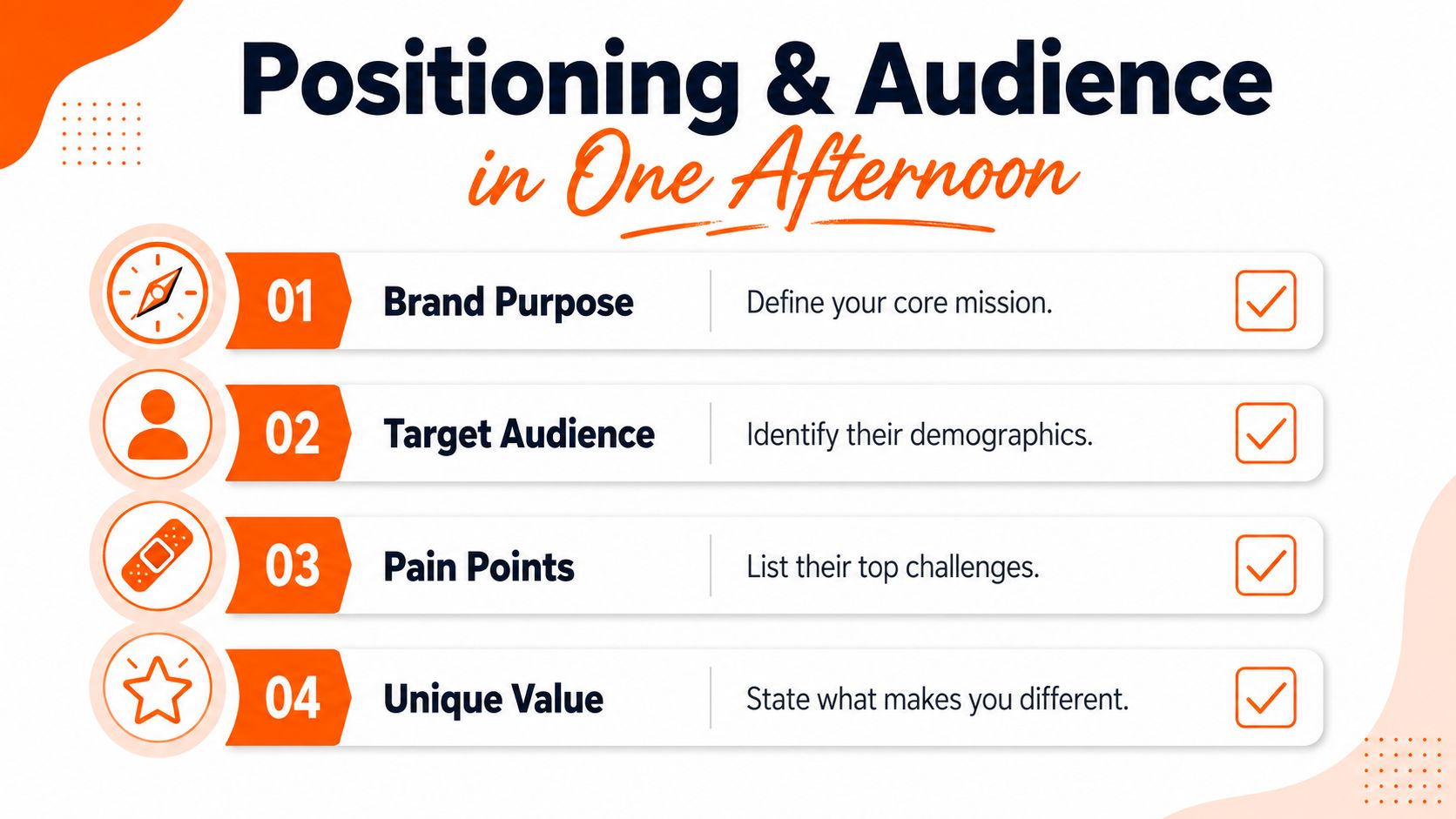
Four prompts that force clarity
Answer these in plain language.
- Who you serve: name the actual buyer, not a vague crowd.
- What you replace in their life: the old process, bad tool, or clumsy habit.
- The promise you make: what changes after they work with you.
- The proof you can show: a result, a method, a demo, a before and after, a case example.
Write one sentence from those answers. Keep it sharp enough that a stranger can repeat it back without translating your jargon. If you need a template, use a simple marketing positioning statement template and strip out anything you can't defend in real conversation.
Then talk to actual people. Read the questions customers ask in inboxes, comments, forums, and Reddit threads. Run five customer calls if you can. You're looking for language, friction, and the words people use when they're annoyed, confused, or halfway to buying.
Turn that into an audience card
Make one card with three lines.
- Who they are: role, situation, and context.
- What they fear: wasted money, lost time, bad advice, looking foolish.
- What they want: speed, clarity, confidence, less risk.
That's enough for a first pass. You don't need a polished persona deck with eight slides and a fake name. You need a note you can tape above your desk and check before every draft. If you write for “small business owners,” you'll get mush. If you write for one specific person with one specific problem, your copy starts to breathe.
Pick Three Content Pillars That Match the Buyer Journey
A founder with a clear offer can still waste months posting random ideas. The fix is to pick three content pillars and make each one do a different job for the buyer. Three, not seven. More than that, your team starts splitting attention. Fewer than that, and you risk repeating the same angle until people tune out.
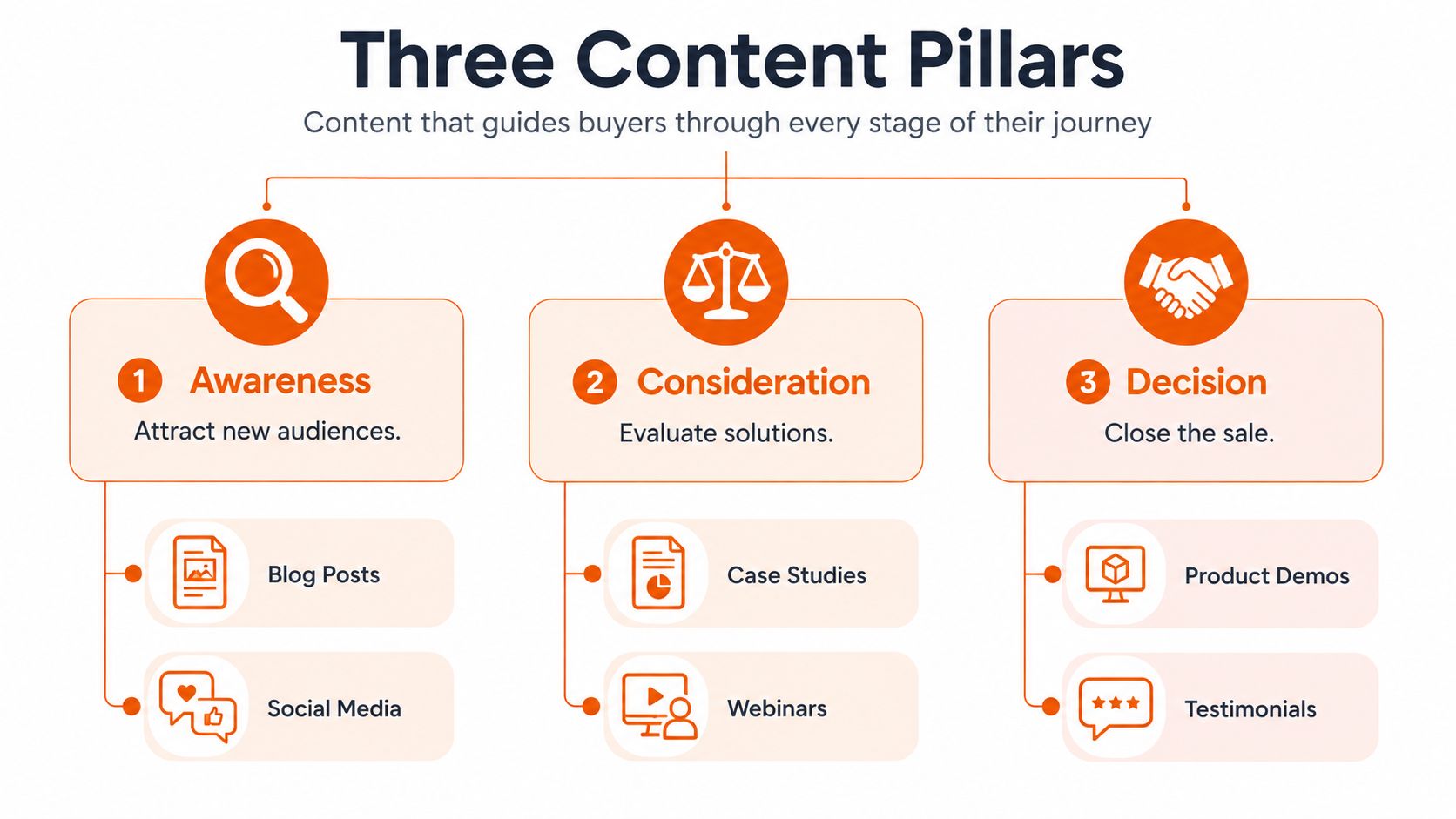
Adobe's awareness, consideration, and decision framework is a clean way to map those jobs, and it lines up with content planning definitions that separate planning from strategy. Planning decides what goes into the queue. Strategy decides which work deserves your time in the first place. One pillar attracts attention. One helps a buyer compare. One helps them say yes.
Build the pillars from buyer questions
Start with the questions your buyer asks at each stage.
- Awareness: what is wrong, what should I call this problem, what should I learn first?
- Consideration: what are my options, what trade-offs matter, what should I compare?
- Decision: why you, why now, why this version of the solution?
Then narrow the list to three topics you can speak about for years without sounding like you are bluffing. Ask whether the founder can still defend the position after the launch buzz fades. If the answer is no, cut it. A small brand wins by staying close to what it knows, not by pretending to cover everything.
A Midwest food brand might choose “how to stock a small kitchen,” “recipes for real weeknights,” and “the story behind our sourcing.” That mix works because each pillar handles a different part of the buyer journey. The first pulls in attention. The second keeps people reading. The third gives them a reason to trust the brand enough to buy.
Use the pillar as a filter
Use content planning definitions to keep the line between strategy and random posting clear. If a topic does not fit one of your three pillars, it probably belongs in a note, not in the production queue. That discipline matters more than having a long list of ideas.
An omnichannel plan should still start with a small set of repeatable themes, which is why an omnichannel marketing strategy guide belongs in the same conversation as pillar planning. You are not chasing channels first. You are deciding which themes can travel across channels without losing their shape.
If a topic does not fit one of your three pillars, it probably belongs in a note, not in the queue.
The funnel mapping matters too. Adobe's structure gives you the basic content types for each stage, blog posts and thought leadership for awareness, how-to content and webinars for consideration, testimonials and comparisons for decision (Adobe content marketing basics). That means each piece has a job, not just a headline. It also keeps the brand from posting “useful” content that never helps a buyer move forward.
Use the pillars to sort every idea. If it does not match a stage, it does not belong on the board.
Choose Two Channels and Earn Them Before Adding More
Founders get pulled into channel hopping because it feels like momentum. One week it is LinkedIn, the next it is a podcast, then email goes quiet, the blog slows down, and nothing has time to compound. I have made that mistake too. It usually ends the same way, spread thin, underpowered, and too tired to keep the promises you made to your audience.
The stronger move is to choose two channels based on where your audience already pays attention and where you can show up every week. For early-stage brands, owned channels usually deserve the first seat at the table because you control the list, the archive, and the follow-up.
Match the channel to how people discover you
If people find you through search or referrals, start with a blog or YouTube, plus email capture. If people discover brands through creators or peers, use one social platform and one private channel. That private channel might be email, a newsletter, or a blog you own.
Here is a clean way to weigh the trade-offs:
| Audience habit | Founder strength | Best two-channel combo |
|---|---|---|
| Search first | Writing and teaching | Blog plus email |
| Search first | Speaking on camera | YouTube plus email |
| Social first | Fast opinions and short posts | Instagram plus newsletter |
| Professional peer network | Strong point of view in public | LinkedIn plus email |
Owned channels win for a reason. They do not disappear when an algorithm changes, and they let you keep the relationship. Social channels still matter, but they work better as discovery layers than as the whole system.
Pick the channel you can feed without resentment
Be honest about your own energy. A podcast sounds great until you hate recording. A blog feels safe until your draft process gets slow and awkward. A newsletter looks simple until you realize you have no habit around writing.
That is why the same channel can be easy for one founder and draining for another. The channel has to fit the way you work, not the way it looks in someone else's growth thread. If you want a wider distribution plan after you have chosen your core channels, this guide to multi channel distribution is useful because it treats republishing as a system, not a scramble. That matters once you have already earned your first two channels and need to stretch each piece further.
Chicago Brandstarters is one place where founders talk through channel choices in a practical way, but the bigger point is the same everywhere, choose what you can sustain. Vanity metrics on rented channels will tempt you to keep posting for applause. Attention is not traction.
Run a Weekly Production Workflow That Ships
A content system falls apart when the process feels ceremonial. You do not need a polished studio or a perfect calendar. You need a rhythm you can keep during a messy week, without renegotiating the work every morning.
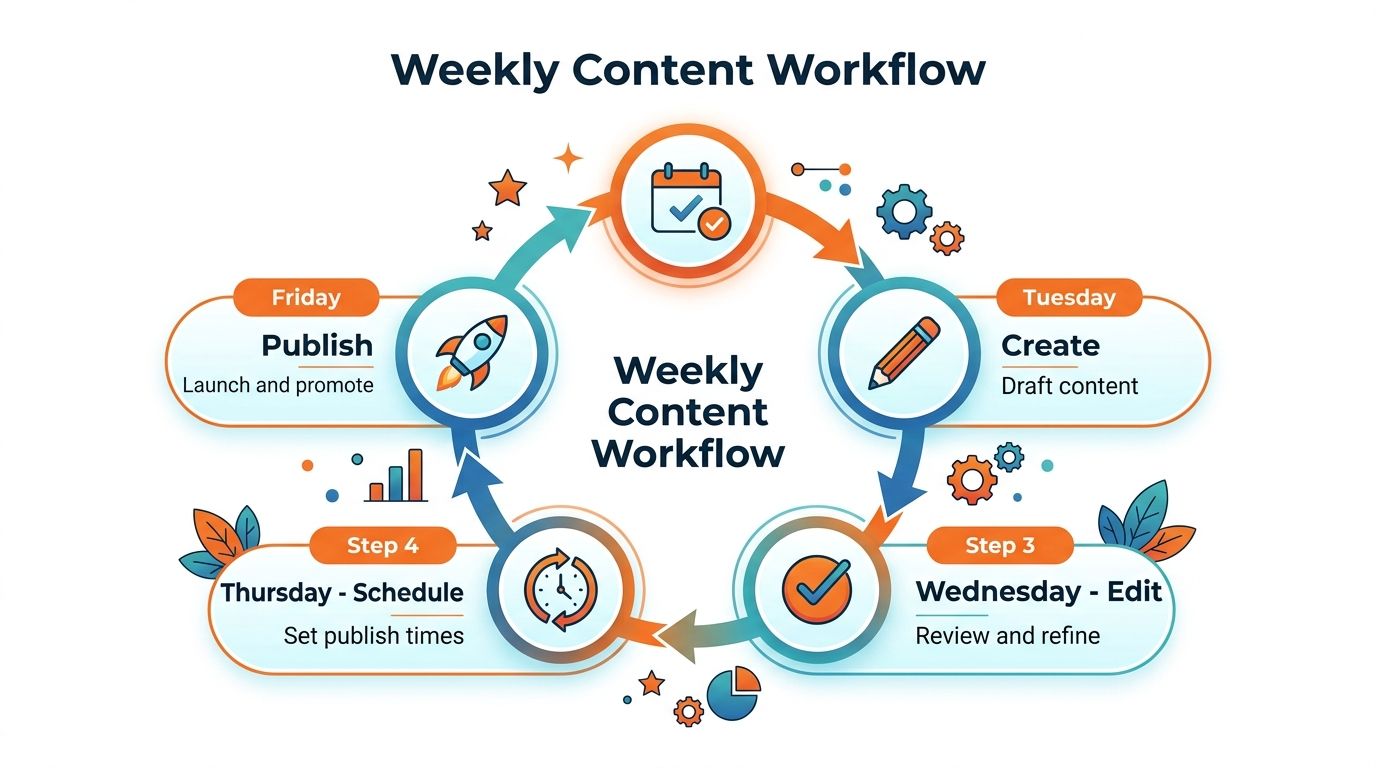
I use a simple weekly loop. Monday, decide the anchor piece. Tuesday and Wednesday, draft or record. Thursday, edit. Friday, publish, then turn one asset into several posts and touchpoints.
Use one anchor piece to feed the week
Start with one deep piece, a blog post, a video, or a podcast episode. Then break it into smaller pieces that fit the channels you already chose.
- Newsletter issue: the strongest angle plus one useful lesson.
- Three social posts: one quote, one tip, one opinion.
- Short clip or excerpt: a sharp cut from the main asset.
Small teams can win here. One founder with a steady repurposing habit can get more mileage from a single strong idea than a larger team that keeps starting from zero. A long piece should do more than fill a page. It should feed the rest of the week and make the next publish easier. For a practical way to stretch each asset without turning the work into busywork, this content repurposing strategy is a useful reference.
Keep a brief, not a mood
Every piece needs the same basic brief.
- The buyer question: what does the reader need answered?
- The promise: what will they know, do, or decide after reading?
- The proof: what examples, experience, or evidence can you use?
- The next step: what should they do after this piece?
That brief cuts out the blank-page spiral. It also keeps your repurposing clean, because you can pull the same core thought into different formats without sounding like you are padding word count. It gives a small team a way to move fast without drifting off message.
Write the answer first, then shape the format around it.
If you want another lens on distribution, the guide to multi channel distribution helps you think about where each version belongs once the anchor is done. The point is to make each piece travel farther without turning the week into chaos. Use the same core idea across channels, then adjust the format to match how people consume it in each place.
Measure What Moves the Business, Not What Looks Good
Founders get tempted by metrics that feel busy. Views, likes, impressions, follower counts. Those numbers can tell you something, but they rarely tell you enough to make a decision. If a content pillar cannot connect to a business result, you are building a dashboard for comfort, not for action.
Use three layers. Inputs are what you ship. Outputs are what people do with it. Outcomes are what the business gets from it. Many teams stop at outputs because they are easier to see and easier to brag about.
Track the few numbers that matter
Here is the simple stack I would defend in a meeting.
- Inputs: pieces shipped, channels active, cadence kept.
- Outputs: traffic, subscribers, watch time, clicks.
- Outcomes: qualified leads, sales, retention.
Set one OKR per pillar. Use a plain formula, we will move X from Y to Z by date. That keeps the metric tied to a decision, not a mood. Monthly review works better than daily checking because content needs time to move through the buyer journey.
You also need to watch the cost of one piece from start to finish. If a format takes too much time and does not move outcomes, cut it. If a format keeps producing qualified leads, keep it even if it does not feel glamorous.
Don't confuse output with proof
A blog post that gets traffic but no qualified leads may be teaching the wrong people. A social account with steady engagement but no email growth may be building borrowed attention. A newsletter with a small list but strong replies may be more useful than a bigger audience that never answers.
The buyer journey numbers from earlier help here. As noted earlier, buyers usually need several pieces of content before they are ready to talk. That means one post rarely carries the whole burden. The job is to measure the chain, not just the first click.
If a metric does not change what you publish next month, cut it from the dashboard.
Build a Brand That Teaches and Lasts
The strongest brands I've seen use content the way a good neighbor uses a front porch. They are visible, useful, and easy to talk to. They do not shout every time they open the door. They teach, and they stay close enough to hear what people need next.
That matters because buyers do their homework before they buy. The old model was to interrupt and persuade. The better model is to teach, earn trust, and then ask for the sale with a clear next step. Teams that keep a documented strategy, a tight audience focus, and a simple workflow tend to stay disciplined longer than teams chasing whatever feels hot that week.
Boldness and kindness fit together here. Boldness means taking a real position and not hiding behind generic advice. Kindness means explaining the thing clearly, without talking down to people or making them work too hard for the answer.
Ship weekly. Teach first. Stay close to customers. Measure outcomes. Keep the team small enough to stay honest and the content sharp enough to matter. That is how content stops being decoration and starts acting like a founder operating system.
If you want help turning your brand into a content system that pulls its weight, Chicago Brandstarters can help you think through positioning, audience, and the founder habits behind durable marketing. Visit Chicago Brandstarters and see how a room of kind, hard-working founders builds brands with more clarity and less noise.
Leave a Reply