
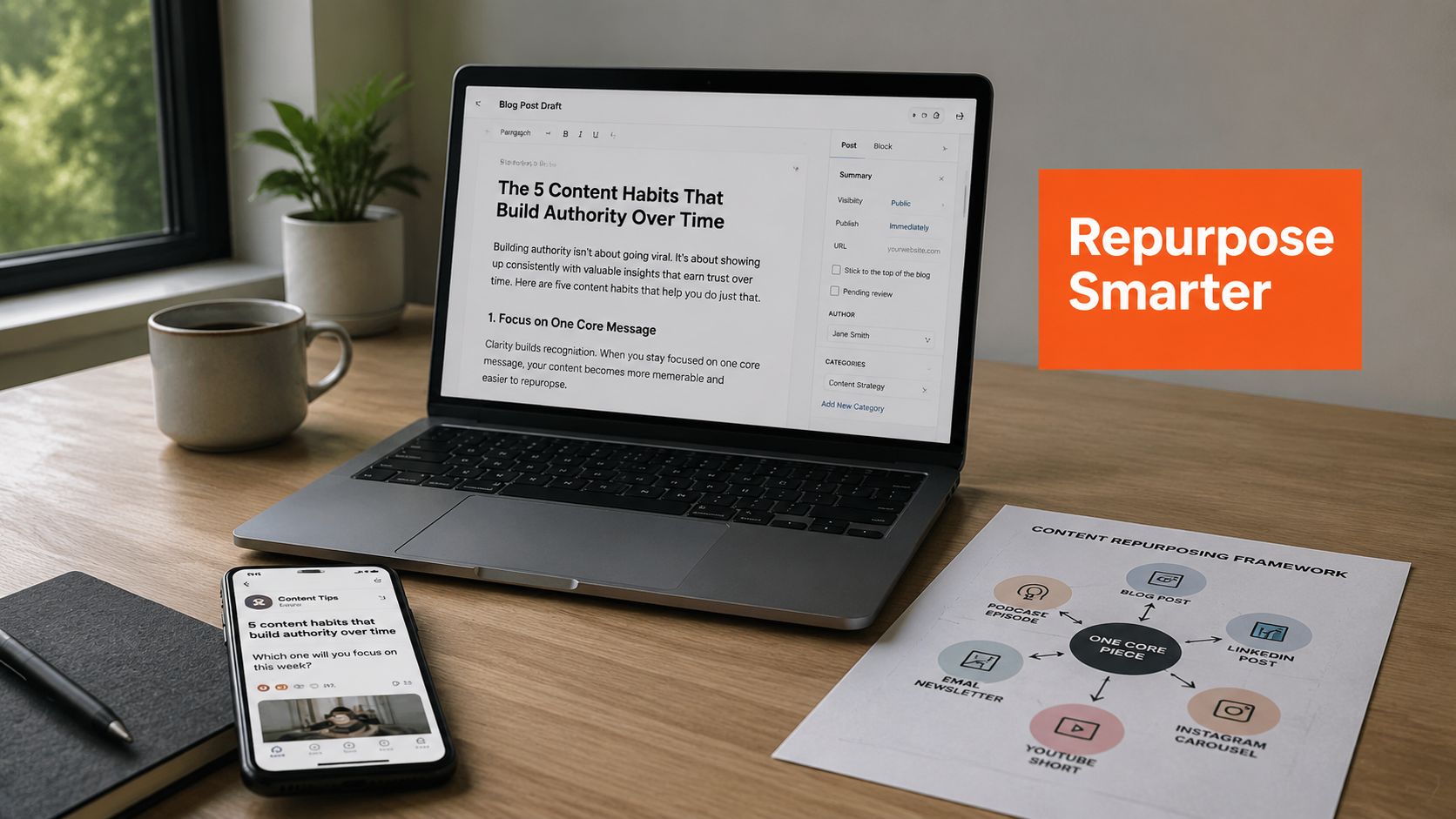
You're probably doing this right now. A product launch is coming, your store needs traffic, and you're staring at a blank doc trying to invent something smart to post before bed. You already wrote the email. You already made the product page. You already answered the same customer questions in DMs, on sales calls, and in comments. Yet somehow you still feel behind.
That's the trap. Most founders act like every post has to be born from scratch. That's a bad content repurposing strategy. It burns time, kills consistency, and makes content feel heavier than it is.
I learned this the hard way. I once spent days writing one strong article, then almost ignored it after publishing. Later I pulled the best line for LinkedIn, turned the main lesson into an email, used the objections section for short videos, and lifted the FAQ into product-page copy. One piece fed a month of useful marketing. Same idea. Different wrappers. Way less stress.
Stop Feeding the Content Monster
Founders love effort. That's usually a strength. In content, it can become a stupid habit.
If you keep feeding the content monster with brand-new ideas every week, it will eat your calendar and still ask for more. Blog post. Instagram caption. Email. Reel. Product education. Founder story. Customer objection post. You can do that for a while. Then the wheels come off.
Creating from zero is the expensive way
Starting from a blank page is like cooking every meal from raw ingredients when your fridge is already full of leftovers. It feels noble. It's also wasteful.
Most of your best marketing ideas already exist inside things you've made:
- Sales emails with objections customers care about
- Product pages with language buyers already understand
- Customer support replies that explain the same problem clearly
- Old blog posts or videos that had real traction
- Founder rants that got strong replies in a comment thread
The smart move is simple. Stop asking, “What should I create next?” Start asking, “What can I reuse, reshape, and redistribute?”
Practical rule: If a piece of content took real thought to make, it deserves more than one outing.
That's not a fringe tactic. According to Hannon Hill's writeup of a 48-marketer survey, 94% of marketers already actively repurpose their content. That tells me this isn't a clever little hack. It's the default play for anyone who wants output without chaos.
Lean brands win by squeezing more from less
Small teams don't have a volume problem. They have a problem with maximizing their impact.
You don't need more ideas. You need a better system for extracting more value from the ideas you already proved in the market. That's why I like simple planning tools that force clarity, like a tight one-page marketing plan framework. If your core message is fuzzy there, repurposing just spreads the fuzz faster.
If video is part of your mix, this Guide to repurposing video for brands is worth a look because video clips are usually the easiest raw material to slice into platform-specific posts.
My opinion
This is not optional.
If nearly everyone in the field already repurposes, and you're still creating every asset from scratch, you're choosing the slow lane. You're spending founder energy on reinvention when you should spend it on distribution, testing, and sales.
A good content repurposing strategy is not laziness. It's operational discipline.
Find Your Goldmines Before You Dig
Most content libraries are junk drawers. Random blog posts. Half-decent captions. One webinar nobody promoted well. A product explainer with promise but no follow-up. Don't repurpose all of it. That's how you waste another month.
You need to find the gold first.
Use a simple founder scorecard
I don't run a bloated audit for this. I use a spreadsheet and score every candidate on three things:
| Signal | What to check | Why it matters |
|---|---|---|
| Traffic | Page views, clicks, opens, or visits from a post | People already voted with attention |
| Engagement | Replies, comments, saves, shares, or strong watch time | The message had some spark |
| Conversions | Sales inquiries, email signups, purchases, or assisted sales | The piece moved someone closer to buying |
Give each piece a rough score like low, medium, or high. You do not need some enterprise dashboard to know what's working. Google Analytics, Shopify, Klaviyo, YouTube Studio, and your own eyeballs are enough.
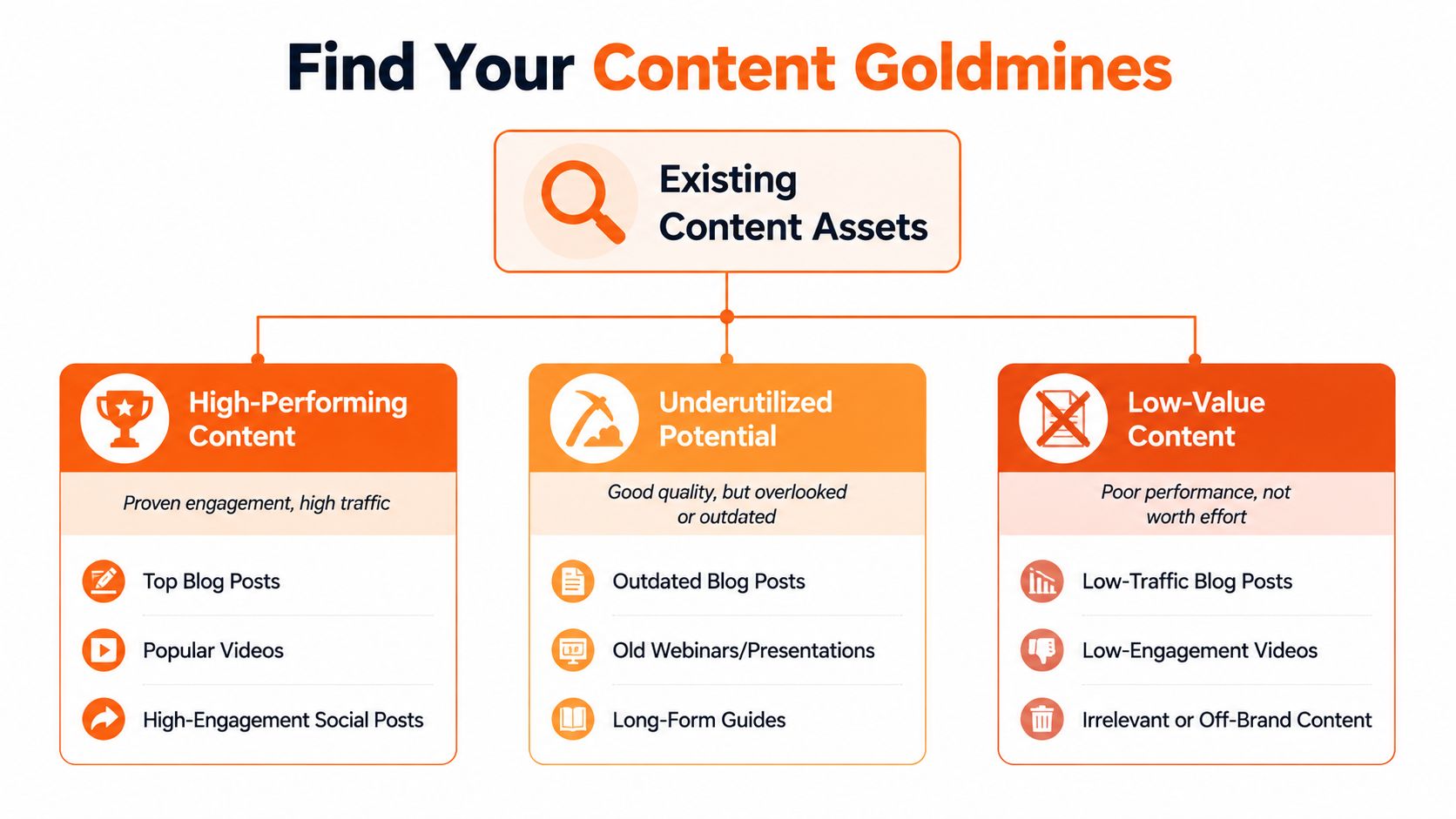
Here's the sorting visual I'd use with any founder team:
Pick winners, not sentimental favorites
Founders often make peculiar choices. They want to repurpose the piece they loved writing, not the one buyers cared about. Bad move.
HubSpot research, cited in Docswrite's roundup on repurposing statistics, says 60% of marketers find repurposed content generates more leads than original content created from scratch. The implication is obvious. Put your effort behind content that already has evidence. Don't gamble on your personal favorite if the market shrugged.
The market usually tells you which ideas deserve a second life. Your ego tells you otherwise.
Sort your library into three piles
I like this triage because it keeps the decision fast.
High-performing content
These are your obvious winners. Top blog posts, top product education emails, strongest founder posts, best-performing videos. Repurpose these first.Underused content with potential
Good idea, weak packaging. Maybe the hook was bad. Maybe it lived on the wrong platform. Maybe the examples are dated. Salvage these next.Low-value content
If a piece got no traction, no engagement, and no business result, let it die. Don't turn bad content into more bad content.
A fast filter for ecommerce founders
If you run an ecommerce brand, your best source material often isn't your blog. It's your customer conversation trail.
Look at:
- Product reviews for language customers use naturally
- Support tickets for recurring confusion
- Return reasons for objections you need to answer better
- Pre-purchase questions for content topics with direct revenue impact
That pile is often more useful than your polished “brand content.” Why? Because buyers already wrote the script for you.
What to do this week
Open a sheet. List your last twenty meaningful assets. Score them on traffic, engagement, and conversions. Circle the top few. Ignore the rest for now.
That's your repurposing backlog. Everything else can wait.
Map Your Content Once Create It Everywhere
A strong piece of content is a Lego set. Many individuals admire the finished castle, post it once, and move on. I'd rather dump the pieces on the table and build ten more things from the same bricks.
That's how I think about atomizing content. You break one pillar asset into smaller parts, then fit each part to the channel where it makes sense.
Here's the map:
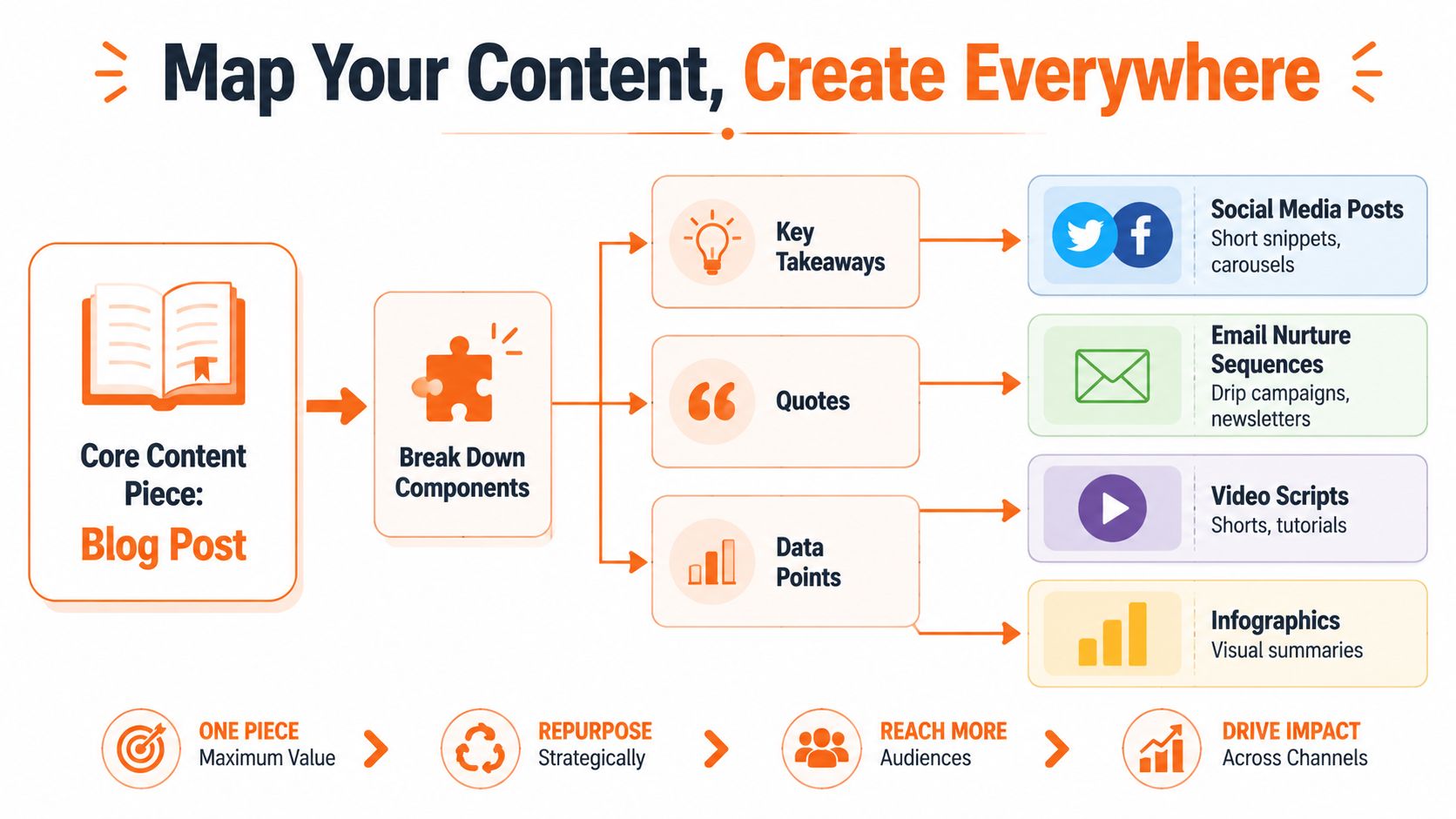
Pull the atoms out of the original piece
Take one solid blog post, product education guide, webinar, or podcast. Then strip it for parts.
Look for:
- Strong claims that can open a social post
- One clean lesson that can become an email
- A simple framework that can turn into a carousel
- A customer objection that can become a short video
- A checklist that can become a downloadable asset
- A story or example that can become a founder post
If you need help thinking across channels, I'd also look at this piece on effective multi-platform social media publishing. It's useful when you're trying to adapt one idea for several destinations without copy-pasting it like a robot.
Match each atom to the right format
Here's the part people skip. Different atoms belong in different containers.
| Content atom | Best format | Why it works |
|---|---|---|
| Sharp opinion | LinkedIn post or X thread | Fast to consume and easy to react to |
| Step-by-step process | Carousel or short tutorial video | Structure matters more than prose |
| Customer question | FAQ email or short-form video | Feels direct and useful |
| Founder story | Email newsletter or LinkedIn post | Context and voice matter |
| Product demo moment | Reel, Short, or product page clip | Buyers need to see the thing |
Don't paste the same paragraph into five places. Translate it. TikTok wants pace. LinkedIn wants a point of view. Email wants clarity. Your site wants depth.
Build around your omnichannel reality
If you sell online, your channels already influence each other. Someone sees a clip, joins your email list, reads a product education page, then buys two weeks later. That's why I like thinking in terms of an omnichannel marketing approach instead of treating every platform like a silo.
A useful video can feed a product page. A product page FAQ can feed email. An email can feed a founder post. One asset should travel.
Here's a quick walkthrough that shows the spirit of this approach in action:
A founder-friendly example
Say you wrote a blog post called “Why customers hesitate before buying our premium bundle.”
You can turn it into:
- A short reel answering the biggest objection
- An email on what buyers get wrong before first purchase
- A carousel breaking down the decision checklist
- A product page section using the cleanest explanation
- A founder post on what you learned from customer calls
That's not extra work. That's one idea finishing the job.
Build a Low-Friction Repurposing Machine
Monday hits. You finally have one solid piece of content. By Friday, it should be working in five places without eating your whole week. If that is not happening, your process is too loose.
A repurposing system should reduce decisions. That is the job. You are not building a content department. You are building a repeatable way to squeeze more sales value out of ideas you already paid for with time, customer research, and attention.

Build one operating system, not a pile of tasks
The cleanest workflow I've seen follows five simple phases, based on the framework described in Libril's guide to content repurposing: audit, format mapping, quality control, distribution, and review.
For a small brand, that turns into this:
Pick one source asset
Choose the piece already getting replies, clicks, saves, or sales questions. Do not start from scratch because you are bored.Strip it for parts
Pull out hooks, objections, examples, screenshots, quotes, and customer questions. That is the raw material.Clean it up fast
Tighten wording, swap weak openings, and cut anything that sounds generic.Queue it once
Load the assets into the tools you already use and schedule them in one sitting.Review the response
Keep the formats that triggered action. Cut the ones that looked busy but did nothing.
That is enough. You do not need a ten-step content pipeline with status labels and color coding.
Templates beat creativity on busy weeks
Founders waste time on tiny decisions. Which font. Which hook style. Which CTA. Make those choices once and stop revisiting them.
I keep:
- Canva templates for carousels, quote cards, and product education graphics
- Saved prompts for turning rough notes into email drafts, short scripts, or captions
- Three fixed post structures for LinkedIn, email, and short-form video
- A naming rule so every file is easy to find later
If you want a practical setup for automating the repetitive parts, this guide for content marketers is worth reading.
My rule: if a task repeats twice, template it on the second pass.
Keep the stack cheap and boring
Use tools your team can stick with. That usually means Google Docs, Notion, Canva, CapCut, your scheduler, and your email platform. Fancy software does not save a weak workflow.
If your team needs help turning this into a repeatable routine, a hands-on marketing workshop for small teams will get you further than another pile of bookmarked articles.
The goal is speed with control. One person should be able to run this without asking permission, hunting for files, or rewriting the same caption three times.
A weekly rhythm that does not fall apart
I like a simple cadence because it survives real life:
| Day | Task | Tool |
|---|---|---|
| Monday | Choose one proven source asset and pull the best parts | Google Docs or Notion |
| Tuesday | Draft posts, emails, and short video scripts | ChatGPT, Claude, or plain docs |
| Wednesday | Design graphics and record clips | Canva, CapCut, Loom |
| Thursday | Schedule everything | Buffer, Klaviyo, Meta scheduler |
| Friday | Check replies, clicks, and conversions | GA4, Shopify, email analytics |
One good asset can cover the week. That is the point.
Small brands do not win by publishing more. They win by making each useful idea travel further, faster, with less effort.
Pro-Level Plays Most Guides Miss
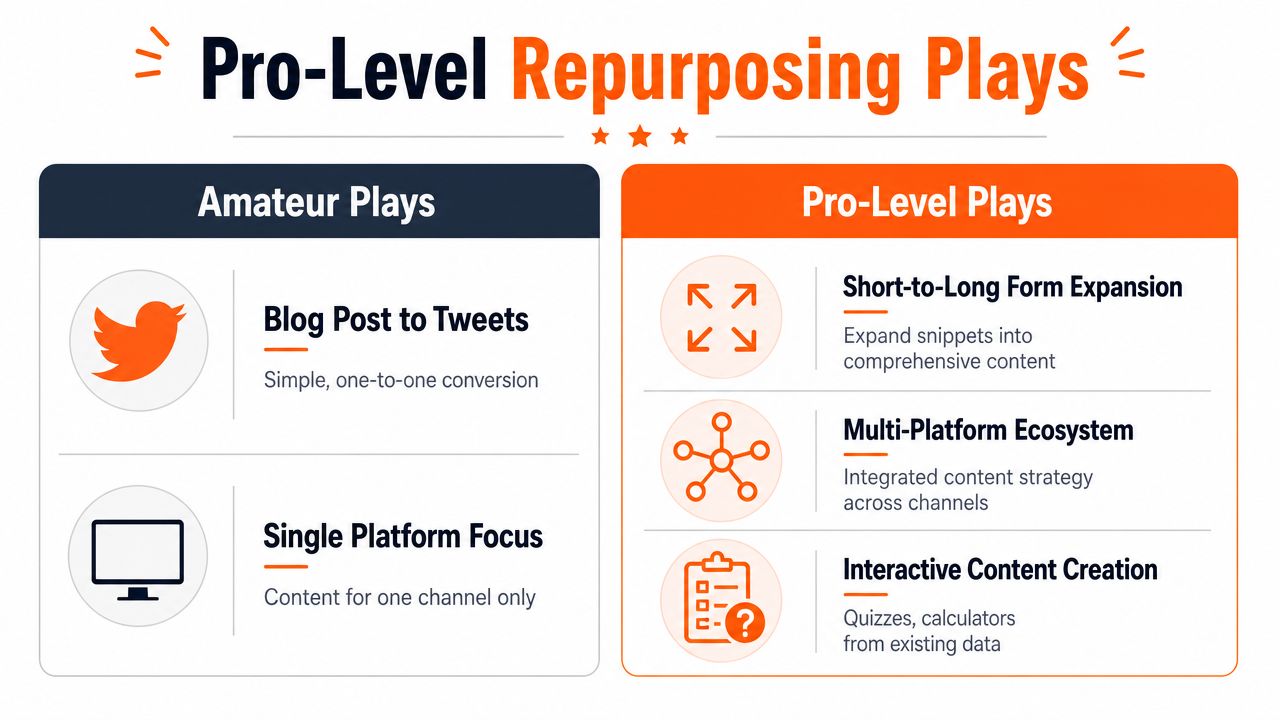
Most repurposing advice is beginner stuff. Turn a blog post into tweets. Turn a webinar into clips. Fine. Useful. Also obvious.
The move I like more is the reverse.
Go from short to long
The internet is full of fast takes. A customer comment, a spicy LinkedIn post, a strong Reddit thread, a half-baked tweet storm. Audiences generally react, nod, and scroll. You can do more with it.
Take the short-form idea. Add your own hard opinion. Then expand it into something deeper and more useful.
That's the play:
A lot of ecommerce founders are sitting on this opportunity because they think authority starts with long-form research. Sometimes it starts with a sharp disagreement.
Why this works
The usual long-to-short flow is easy. You cut a blog into smaller pieces. Good. Keep doing that.
But short-to-long has more bite. You spot a hot take. You ask, “Do I agree with this?” Then you build a stronger argument from your own customer experience, product data, sales calls, or support patterns.
According to this discussion on overlooked repurposing tactics, 68% of audiences prefer content that offers a unique perspective, yet only 12% of repurposing guides address the short-to-long reversal strategy. That gap is where a small brand can punch above its weight.
Don't just summarize what everyone already said. Push back. Add texture. Give the reader a reason to care what you think.
A practical way to do it
Say you see a short post that says, “Discounts are the fastest way to grow an ecommerce brand.”
You could turn that into a long-form piece like:
- Why discounts train bad customers
- When bundles beat discounts
- What buyers need before first purchase
- How education content lowers hesitation without cutting margin
Now you have:
- one long article
- several email angles
- a founder video rant
- short clips from your strongest points
- FAQ copy for product pages
That's a serious content repurposing strategy because it starts with tension, not just formatting.
Workshop your point of view
If your opinion still feels mushy, test it in conversation before you publish. Say it out loud. Use it in sales calls. Drop it in a small founder discussion. See where people push back. That friction sharpens the final draft.
That's one reason a live marketing workshop setting can be useful. A weak idea collapses fast when real people challenge it. Better to find that out early.
Pro move for product brands
Use short-to-long on customer language, too.
A single customer review like “I liked the product, but I wasn't sure which version to buy” can become:
- a buying guide
- a comparison page
- an email flow for indecisive shoppers
- a short video on choosing the right fit
That's the kind of repurposing that effectively helps sales.
Measure What Matters and Ignore the Rest
Most founders drown in fake metrics. Likes. Impressions. Reach screenshots. Tiny spikes that don't change the business.
I care about three things.
Track the few signals tied to action
Use a tiny scorecard every month:
Leads or sales from repurposed content
Which assets brought email signups, inquiries, or purchases?Time saved in production
Did your team ship more without adding stress?One platform metric that reflects real interest
Replies on LinkedIn. Click-throughs in email. Watch completion on short videos. Pick one per platform and move on.
If a post got applause but no action, I don't give it much weight. If a plain-looking FAQ email drove clicks to a product page, I want more of that.
Use a keep cut test
At the end of each month, review every repurposed format and sort it into one of two buckets.
| Decision | Meaning |
|---|---|
| Keep | The format got response, drove traffic, or helped sales conversations |
| Cut | The format ate time and gave you little back |
That's it. No long retrospective. No slide deck.
The best repurposing system gets smaller as it gets smarter.
Look for patterns, not noise
You might learn that:
- founder opinion posts drive replies
- product education emails drive clicks
- short clips help retargeting
- fancy graphics do almost nothing
Good. That's useful. Lean into the winners and stop doing the decorative stuff.
A content repurposing strategy should make your marketing lighter over time. If your process keeps growing and your results stay fuzzy, you built a content hobby, not a growth system.
If you're building in Chicago or the Midwest and want honest feedback from founders who ship, Chicago Brandstarters is worth checking out. It's a free, vetted community of kind, bold builders who swap real tactics, hard lessons, and support without the fake networking energy. If you want sharper ideas, better operator conversations, and a room full of people who care about building durable brands, that's a good place to be.
Leave a Reply