You're probably in the ugliest part of building right now.
It's late. You've got a notes app full of half-baked ideas, a Figma file, maybe a Shopify draft, maybe a no-code prototype, maybe just a weird conviction that this thing should exist. You can feel the pull to start building because building feels productive. It scratches the itch.
Then the honest question shows up. What if nobody wants this?
That question is healthy. I'd worry more if you never asked it.
What is product validation? It's the work you do before you go all in. It's how you stop guessing and start learning from real people. It's less like filling out a corporate worksheet and more like pulling over before a long drive to make sure you're headed the right way.
So You Have an Idea Now What
I've watched founders do the same thing over and over. They get excited, disappear into their laptop for a few weeks, then come back with a logo, a landing page, and a product nobody asked for. It isn't because they're lazy. It's because building alone feels safer than hearing the truth early.
That's where product validation comes in.
Product validation is the process of ensuring that the "right product was done" rather than just verifying the product was done right. It's the stage where you test solutions to find the one that works, according to ProdPad's definition of product validation. I like that wording because it kills a common founder mistake. You can build something beautifully and still build the wrong thing.
Start with the napkin, not the factory
If you're still shaping the idea, I'd sketch the business on one page before I touch a serious build. A simple guide to lean canvas can help you pressure-test the problem, customer, and value prop without getting lost in a giant business plan.
Then I'd do one more thing before I spend real money. I'd turn the idea into something people can react to. If you need help getting from vague concept to something testable, this breakdown on how to turn an idea into a product is a practical starting point.
Practical rule: If people can't react to it, you can't validate it.
Validation is a gut check with evidence
I don't mean “gut check” as in vibes. I mean you're checking whether your instincts survive contact with reality.
Imagine asking for directions before you leave Chicago for a cross-country drive. You can trust your confidence all you want. If you're pointed the wrong way, confidence just gets you lost faster.
That's why I don't treat validation like a checklist. I treat it like a series of honest conversations. Some happen with your customer. Some happen with your own ego. Both matter.
Why Validation Is Your Best Friend
Let's be blunt. An estimated 95% of new products fail due to a lack of market demand, based on this UserVoice write-up on product development and validation. That same piece makes the point I wish more founders took seriously: validation lets you test assumptions early, before you dump time and money into features that don't matter.
Passion doesn't rescue bad demand.
Hard work doesn't rescue bad demand either.
The map before the road trip
When I say validation is your best friend, I mean it's the friend who tells you the truth before you drive six hours in the wrong direction. If you were heading from Chicago to Los Angeles, you'd check the route. You'd look for construction, weather, and whether you're even on the right highway.
A product idea works the same way. Validation is your map.
Without it, founders do weird stuff:
- They build for themselves when they aren't the customer.
- They confuse compliments with demand because people say “cool idea.”
- They keep adding features to fix a problem that was never worth solving.
Validation doesn't judge you
A lot of people avoid validation because they think it's a verdict. It isn't. It's feedback. There's a huge difference.
If your first concept doesn't land, good. You learned while the cost of change was still low. That's a lot better than learning after you hired developers, printed packaging, or spent months polishing an app nobody sticks with.
Validation is how you buy clarity with small tests instead of buying regret with big launches.
Here's my opinion. If you skip validation because you're afraid of bad news, you're choosing expensive bad news later. That's not courage. That's delay.
What good validation gives you
A solid validation process helps you answer a few painful questions fast:
| Question | Why it matters |
|---|---|
| Do people actually have this problem? | If the pain isn't real, the solution doesn't matter. |
| Do they care enough to change behavior? | Interest alone won't move a business forward. |
| Will they pay, commit, or act? | Action beats praise every time. |
I'd rather learn that my idea needs a pivot after a few interviews and a rough test than after a full launch. You should too.
The Two Flavors of Validation Qualitative and Quantitative
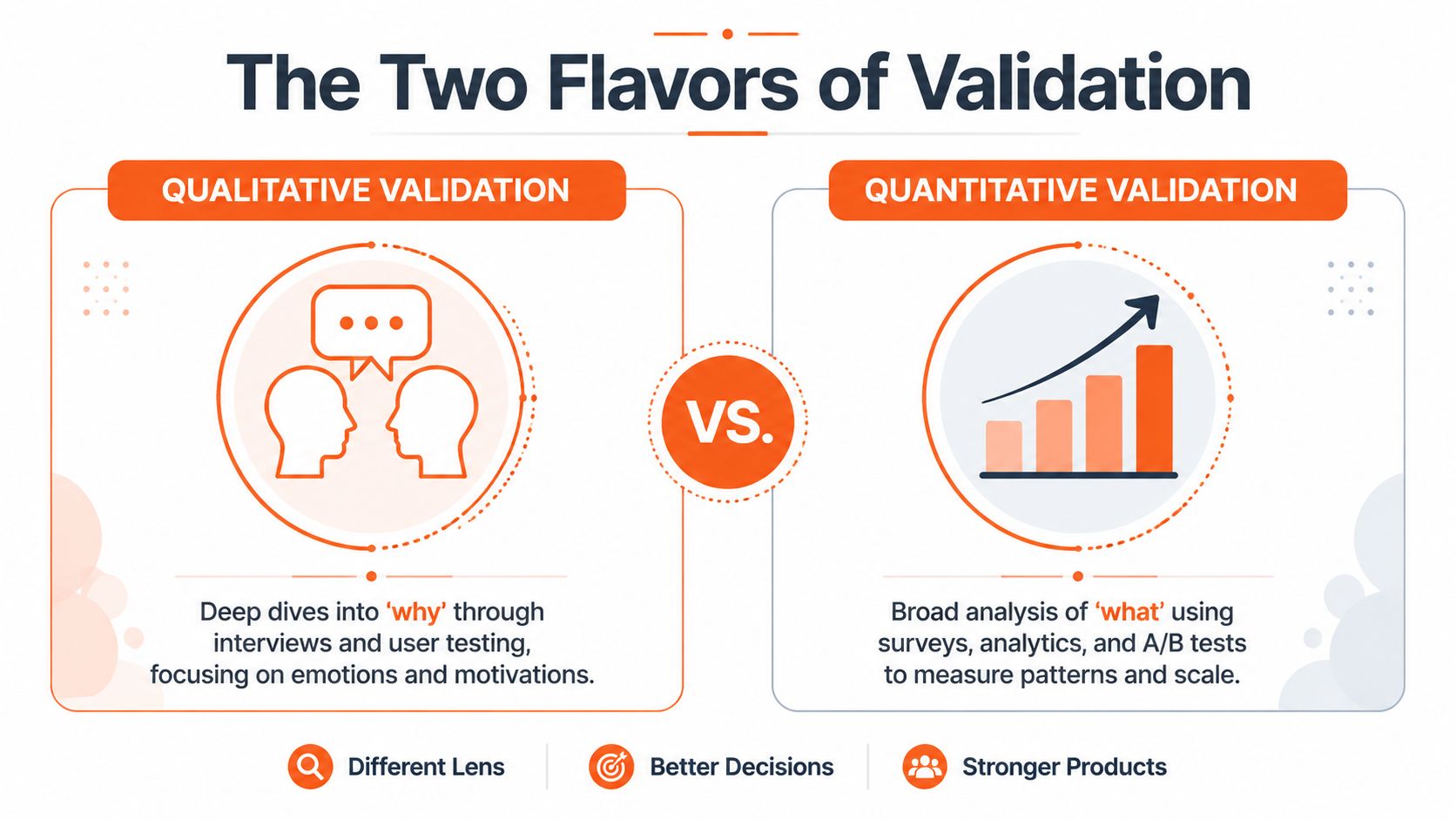
You do not need a giant research program. You need two kinds of evidence, and they do two different jobs.
Qualitative validation shows you the human mess behind the problem. Quantitative validation shows you whether that problem shows up often enough, and strongly enough, to build a business around. Productboard's overview of product validation makes the same point. Good teams use both because opinions alone are flimsy, and raw numbers without context can fool you fast.
Qualitative is where you hear the truth people do not put in surveys
This work is personal. You get on a call, sit across from someone, or watch them fumble through a prototype. You pay attention to the parts they skip, the hacks they invented, and the moment their voice changes because the problem costs them something.
That is the gut-check part of product validation. You are not collecting praise. You are checking whether your idea is kind enough to solve a real frustration and bold enough to change behavior.
Good qualitative work usually includes:
- User interviews about what people already did, bought, tried, or ignored
- Prototype walkthroughs that show where the idea clicks and where it falls apart
- Usability sessions that expose friction before you waste months polishing the wrong thing
If you need better ways to ask questions and structure early research, these market research methods for early-stage founders will help you get past polite chatter and into real evidence.
Quantitative is where you check whether the pattern holds
After a few strong conversations, stop guessing and test behavior. Put up a landing page. Run two versions of a headline. Offer a waitlist. Try a pre-order. Track whether people click, sign up, return, or drop.
A/B testing is useful here because it forces a choice. Optimizely's guide to A/B testing explains the method well. You show different versions to different users and compare what they do. That beats asking which version they “like.”
Use quantitative validation to measure actions such as:
- Landing page signups
- Waitlist joins
- Pre-order clicks
- A/B tests on pricing, offers, or messaging
- Basic usage data from a scrappy MVP
Use both, or you build alone
Founders who only do interviews can talk themselves into a story. Founders who only stare at metrics can miss the reason nobody cares.
The better approach is simple. Start with conversations that reveal pain, language, and current behavior. Then run a small test to see whether that behavior repeats beyond a handful of people. That is how you avoid building in a vacuum. You validate what people do, not what they say in a nice tone on a Zoom call.
This ecommerce guide on quality vs quantity is about inventory and selling strategy, but the same lesson fits here. A small number of strong conversations gives you depth. A wider behavior test gives you range. You need both if you want a clear read on demand.
| Type | Best question | What you get |
|---|---|---|
| Qualitative | Why does this problem bother people enough to act? | Context, emotion, language, workarounds |
| Quantitative | Are enough people taking the action I hoped for? | Patterns, conversion signals, comparison |
A handful of honest conversations can save you from building the wrong product. A small behavior test can save you from building the right product for too few people.
Practical Plays to Validate Your Idea Today
Most founders don't need another philosophy lesson. They need something they can do by Friday.
Before the tactics, here's the rule I want burned into your brain. True validation is observing your target user interacting in the way you expected. Everything else is research, from UXtweak's take on product validation. I agree with that completely. If all you have is polite opinions, you don't have validation yet.
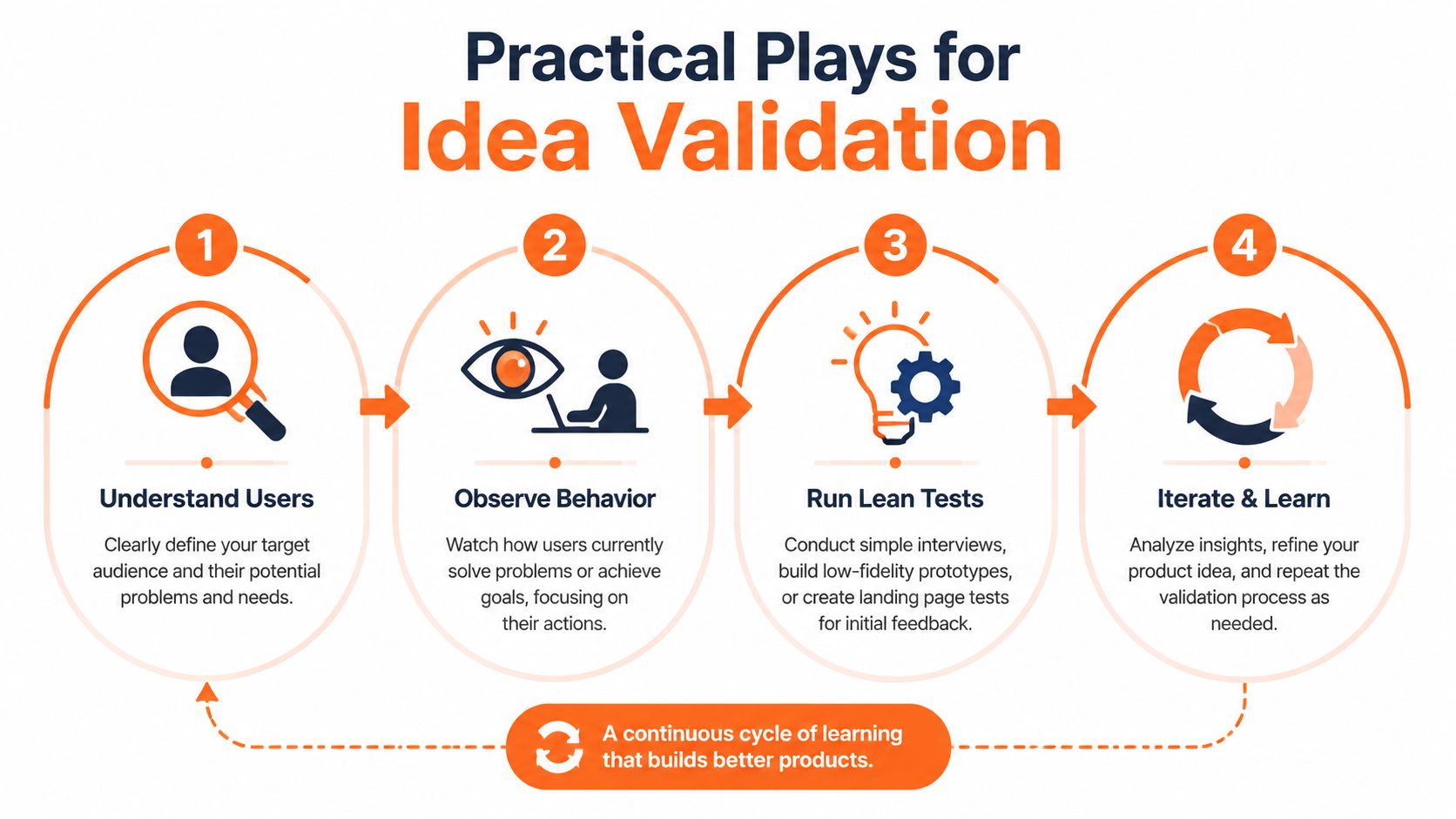
Here's a simple visual for the process.
Run interviews that dig up real behavior
Bad founder question: “Would you buy this?”
Good founder question: “Tell me about the last time you tried to solve this.”
That one shift changes everything. People are bad at predicting what they'll do in the future. They're much better at describing what they already did, what annoyed them, and what they paid for.
Use a script like this:
- Start with the problem. “Tell me about the last time this came up.”
- Ask about current behavior. “What did you use?”
- Find the pain. “What was frustrating?”
- Ask about money or effort. “What did it cost you, in cash or time?”
- Look for workarounds. “What did you do when the tool or service fell short?”
Don't pitch too early. If you start selling in minute two, you'll contaminate the whole conversation.
Build a smoke test landing page
This is one of my favorite cheap tests. Use Webflow, Carrd, Shopify, Framer, or even a rough page builder. Explain the product clearly. Add one call to action, like “Get Early Access” or “Pre-Order Now.”
Then send traffic to it from your network, direct outreach, niche communities, or a small ad budget if you know what you're doing. Don't obsess over making it pretty. Obsess over whether people take the next step.
If you want to see how a stripped-down first version can work in practice, this article on a product MVP example is worth reading.
Try a concierge MVP
If your idea is a service, workflow, or software-enabled process, don't build the full machine first. Do the job manually for a few customers.
Say you want to build software that automates wholesale order tracking. Before you hire developers, do the tracking yourself with Airtable, email, and a spreadsheet. It's not glamorous. It is useful. You get paid to learn what matters.
That's the same reason people test crowdfunding and audience demand before going all in on hardware or tooling. If you're thinking in that direction, this guide on how to fund a 3D printer idea is a smart example of using early market response to shape what gets built.
Here's a founder talk that fits this mindset well.
My advice: Make the test cheap, fast, and a little uncomfortable. If it feels too safe, you probably designed it to protect your ego.
Reading the Signals and Dodging the Pitfalls
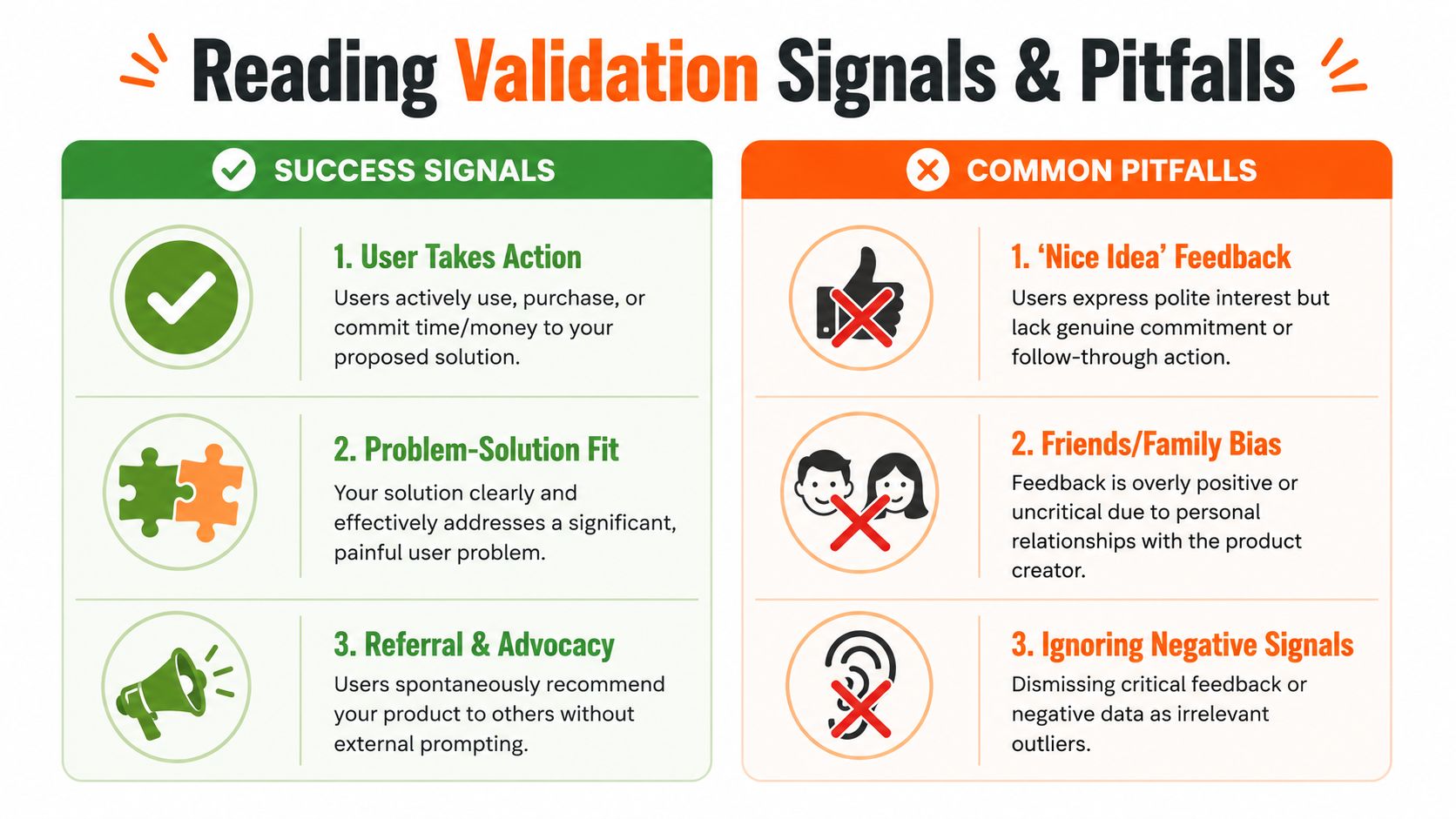
You run a test, send the page to ten people, and a few come back with “that's cool,” “I'd use that,” or “keep me posted.” That feels encouraging for about five minutes. Then you need to ask the only question that matters. Did anyone do something that cost them time, effort, reputation, or money?
Polite feedback is common. Behavior is rare. Product validation lives in that gap.
What counts as a real signal
Technical validation must measure four critical data dimensions: user interest, willingness to pay, technical fit, and usability. The strongest proof includes things like pre-orders and letters of intent, based on Techfinders' explanation of technology market validation.
That matches real founder life. Good signals usually require some sacrifice from the other person.
Look for people who give you:
- Time by joining a serious interview or walking through a live test
- Effort by trying the workaround, onboarding flow, or prototype
- Reputation by introducing you to a colleague, boss, or buyer
- Money through a deposit, paid pilot, pre-order, or signed commitment
Money is the clearest signal because it strips away politeness.
A strong validation conversation does not end with “nice idea.” It ends with action. They book the next call. They ask about rollout timing. They want pricing. They forward you to the person who owns the budget. Those are buying signals. “That's interesting” is not.
The traps that waste months
Founders get lonely fast. That loneliness makes weak signals feel bigger than they are, especially when you have been building in your own head for too long.
Here are the mistakes that drag this out:
- Friends and family feedback. They want to protect your feelings, not sharpen your offer.
- Leading questions. If you ask for validation, people will hand you compliments.
- Cherry-picking good news. One excited response does not erase nine shrugging ones.
- Confusing interest with intent. Curiosity is cheap. Change in behavior is expensive.
- Quitting after one bad test. A weak result may point to the audience, message, timing, or offer, not the whole idea.
These phrases are often polite noise, not genuine buying signals.
What to verify before you trust the idea
Demand is only half the job. If the product falls apart the moment someone tries it, your test result is dirty and your confidence is fake.
Jama Software's guidance on verification and validation recommends a mixed approach that includes unit testing, integration testing, system testing, and user acceptance testing. That matters because interest alone does not prove readiness. You need evidence that the core function works, the parts work together, the whole experience holds up, and a real user can complete the job without getting stuck.
Do not hide behind compliments. Look for behavior. Validation is how you stop building alone in a vacuum and start learning from what people will do.
Your Next Move in Chicago
Founders romanticize solitude way too much.
Yes, you need quiet time to think. No, you should not build in a cave. Product validation is human work. You get better answers when you're around honest people who ask better questions and call out your blind spots before they become expensive.
That's why I like in-person founder circles more than performative networking events. A good dinner table beats a hundred polished LinkedIn posts. You can say the messy version out loud. You can explain the half-formed offer. You can hear someone say, “I had that same problem,” or “I tried that and here's where it broke.”
Validation gets easier when you stop treating it like a lonely homework assignment.
Here's the part I want you to keep. What is product validation? It's your way out of the vacuum. It's the practice of putting your idea in front of real humans early enough to learn something useful. It's asking whether your idea is kind and bold enough to solve a real problem for someone who will take action.
You do not need perfect certainty.
You do need honest signals.
If you're in Chicago or the Midwest, go find rooms where people tell the truth. Your next step is not more secret polishing. It's conversation, observation, and a small test you can run this week.
If you want that kind of honest room, join Chicago Brandstarters. It's a free community for kind, bold, hard-working founders and operators in Chicago and the Midwest. The small private dinners and active group chat are built for real conversations, not fake networking. Bring the rough idea, the awkward test result, or the thing you're stuck on. You'll get straight feedback from people who are building.
Leave a Reply