
You get your first factory quote back, and the lead time looks absurd. Twelve weeks. Sixteen weeks. Maybe longer. You stare at the PDF and think, “Are they building my product or a bridge?”
I've watched a lot of founders make the same mistake right here. They treat that number like weather. Unpleasant, but out of their hands. That's wrong. Manufacturing lead times are not one mysterious blob of time. They are a stack of delays, handoffs, approvals, shortages, queues, and shipping moves. Once you break that stack apart, you can start cutting it.
I learned this the hard way. If you're launching a physical product, lead time is one of the few dates that can wreck your cash flow, your preorder plan, and your sanity all at once. The good news is that most of the delay usually has nothing to do with the machine making your product.
Your First Brush with Manufacturing Lead Times
The first time you hear “12-week lead time,” it feels like nonsense. If your product only takes a day or two to make, why are you waiting months?
Use a restaurant analogy. You order a complicated tasting menu on a packed Friday night. The chef doesn't spend the whole evening cooking your plate. Your order waits for the server to enter it, the kitchen to prep ingredients, another station to finish a component, the pass to clear, and the runner to bring it out. Manufacturing works the same way.
Lead time is the total time from when the order gets accepted to when the finished goods are ready to reach you. It includes the boring stuff founders skip over at first. Confirming specs. Ordering materials. Waiting for capacity. Quality checks. Packing. Freight booking. Transit. Customs if you're importing.
That's why I tell founders to stop asking one lazy question.
“How long is lead time?”
Ask better ones instead:
- When does the clock start: At deposit, purchase order approval, or final sample signoff?
- What is waiting on materials: Raw inputs, packaging, components, or tooling?
- What sits in queue: Your job before production, after production, or before shipment?
- What can I do early: Artwork approval, forecast sharing, or partial component commits?
Practical rule: If a supplier gives you one big lead time number without breaking it down, you do not have a schedule. You have a guess.
You need to see lead time as a chain, not a wall. Once you do, the whole game changes. You stop reacting and start managing.
Breaking Down the Lead Time Puzzle
Most founders think manufacturing lead times are about production. Usually they aren't. They're about everything wrapped around production.
A simple way to break it down is into pre-processing, processing, and post-processing. If you only focus on the middle part, you'll miss the biggest delays.
Pre-processing
This is the mess before anyone makes anything.
It includes purchase order review, engineering checks, material sourcing, production planning, and slotting your order into the factory calendar. If your supplier has to wait on resin, metal, a custom board, packaging, or label approval, the clock is already ticking.
If you're still trying to find a manufacturer for your product, good factories distinguish themselves from sloppy ones. Good partners can explain the order of events. Bad ones toss out a date and hope you don't ask follow-up questions.
Processing
This is the part founders obsess over because it feels tangible. Cutting, molding, assembling, soldering, sewing, printing, filling. Real work. Real machines.
But here's the surprise. In optimized environments, average manufacturing lead times are often around 15 days, while actual production cycle time can be just 2 days. That means 13 days get burned by non-value-added activity like waiting in queues, planning, and quality control, according to Atlas Fibre's breakdown of lead-time planning.
That single fact should change how you think.
Post-processing
This is the after-party that nobody budgets for properly.
Inspection. Rework. Final packing. Palletizing. Booking freight. Warehouse staging. Shipping. If your supplier finishes production on Friday but misses the carrier handoff, you might lose days before the product even moves.
Here's the breakdown I use with founders:
| Stage | What It Includes | Typical Time Sink |
|---|---|---|
| Pre-processing | PO review, engineering clarification, material sourcing, planning, scheduling | Waiting for approvals, supplier confirmations, incoming materials |
| Processing | Actual machine time, assembly, setup, in-line checks | Queue before work starts, changeovers, resource conflicts |
| Post-processing | Final QC, packaging, labeling, freight booking, warehouse handoff, shipment | Inspection holds, paperwork, missed pickup windows, transit delays |
Most delay lives in the handoff. One team waits for a file. Another waits for materials. Another waits for pickup. Nobody feels responsible for the full timeline unless you force the issue.
That's why I push founders to ask for stage-by-stage timing. If the factory says “15 days,” I want to know how many of those days happen before production starts, how many happen on the floor, and how many happen after completion.
You can't fix what you can't see.
How to Calculate and Track Your Lead Time
I don't care how early-stage you are. You need a lead-time sheet.
The formula is simple: Order Processing Time + Production Time + Shipping Time. That's the structure I want every founder to track. It's also the basic calculation described in Wrike's lead time guide, which notes that in April 2024, the average lead time for production materials reached 79 days.
That number should sober you up. If you're ordering production materials, you cannot assume they'll show up in two weeks.
Here's a visual that captures the kind of live tracking mindset you need:

Track each part separately
If you lump everything into one giant ETA, you'll never know what broke. Was the supplier late confirming the order? Did production slip? Did freight roll to the next sailing?
I like a dead-simple tracker with these columns:
- Order confirmed date
- Material ready date
- Production start date
- Production complete date
- Ship date
- Arrival date
- Reason for any slip
That's enough to spot patterns fast. If production always starts late, your issue may be materials or planning. If goods finish on time but arrive late, your problem may be freight choice or handoff discipline.
Build in a founder buffer
Factories usually quote the clean path. Real life rarely follows the clean path.
If supplier confirmation slips by a few days, your total delay grows right with it. That's why I always add buffer between the factory promise and the date I tell customers, retailers, or my own ops team. You don't need a fancy system to do this. A spreadsheet works.
If you're also trying to understand how inventory pressure ties back to scheduling, this guide on the inventory turnover formula is useful because lead time and inventory are tied at the hip. Longer lead times usually force you to carry more.
What to ask your supplier every week
Send a short update request. Keep it boring and specific.
Please confirm current status for materials, production start, production completion, and ship date. If any date changed, tell me what changed and what action is being taken.
That one habit will save you from the classic founder disaster. You assume the order is “on track” until the week before launch, then discover nothing moved because someone was waiting on a packaging file.
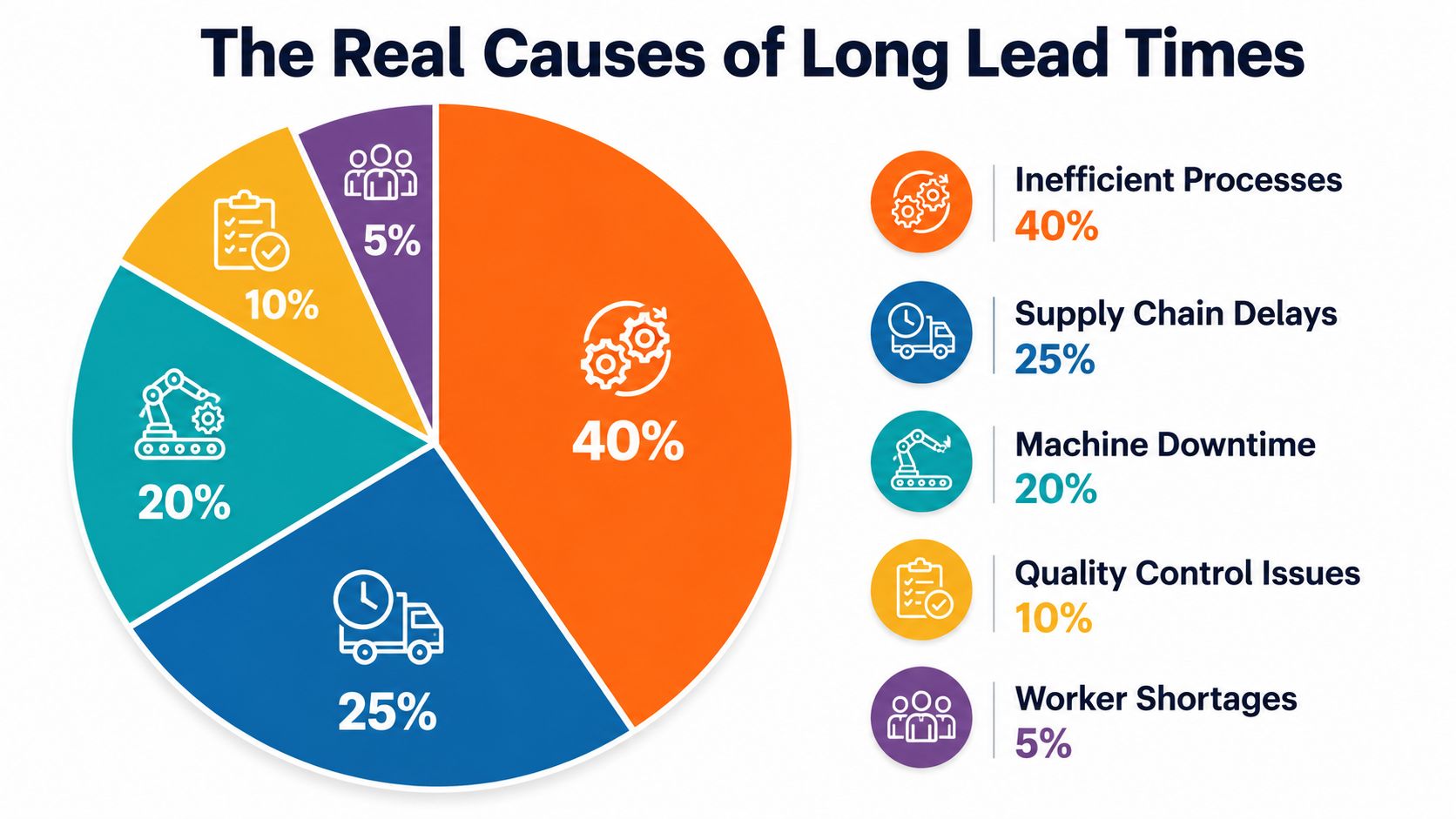
Why Your Lead Times Are So Long
You approve the order on Monday. By Friday, nothing has been made, nothing has shipped, and your supplier still says the job is "in process." I've seen this movie too many times. The order is not late because a machine runs slowly. It's late because your product spends most of its life sitting still between steps.
The hidden 80 to 90 percent problem
In many job shops, 80 to 90% of total lead time is non-value-added queue and wait time, according to User Solutions on manufacturing lead time reduction. That's the part new founders miss.
They focus on cutting minutes from assembly while losing days to silence, approvals, handoffs, and scheduling gaps. Production gets blamed because it is visible. Waiting gets ignored because nobody owns it.
Here's the hard truth. Your factory can build fast and still deliver late.
If your CAD file sat in engineering review for three days, or your packaging dieline needed one more approval, machine speed wasn't the primary issue. The same source makes the point clearly: reducing an engineering clarification from 3 days to 1 day can cut total lead time more than trying to squeeze extra speed out of production.
If your order is sitting in someone's inbox, your problem is process control, not factory capacity.
Where the waiting actually happens
I keep seeing the same delays:
- Engineering clarification: Wrong revision, missing specs, open questions on fit, finish, or packaging.
- Material confirmation: The PO went out, but nobody confirmed stock, substitute material, or receipt date.
- Queue before production: Your order is approved and ready, but it sits behind higher-priority work.
- Inspection holds: Goods are finished, but QA, test reports, or paperwork are still pending.
- Freight handoff gaps: Cartons are packed, yet pickup was never booked correctly or customs documents are incomplete.
That's why I push founders to fix information flow before they obsess over run rates. Clean files. Tight revision control. Clear approval deadlines. One person on each side who owns the timeline and answers for delays.
If you want a practical primer on the systems side, this guide to manufacturing ERP from Wistec is worth a look. I'm sending you there because scattered spreadsheets, email chains, and verbal updates create wait time fast.
What I'd do in your shoes
Stop accepting updates like “in progress.” That phrase hides the actual problem.
Ask one question instead: Where is this order waiting right now? Keep asking until you get a specific answer with a named blocker, a named owner, and a date.
Then tighten every handoff that slows the job down. Your supplier should know who approves artwork, who signs off samples, who confirms ship mode, and how long each response takes. If those steps are vague, your lead time will stay long no matter how efficient the factory floor looks.
Actionable Tactics to Cut Your Lead Times
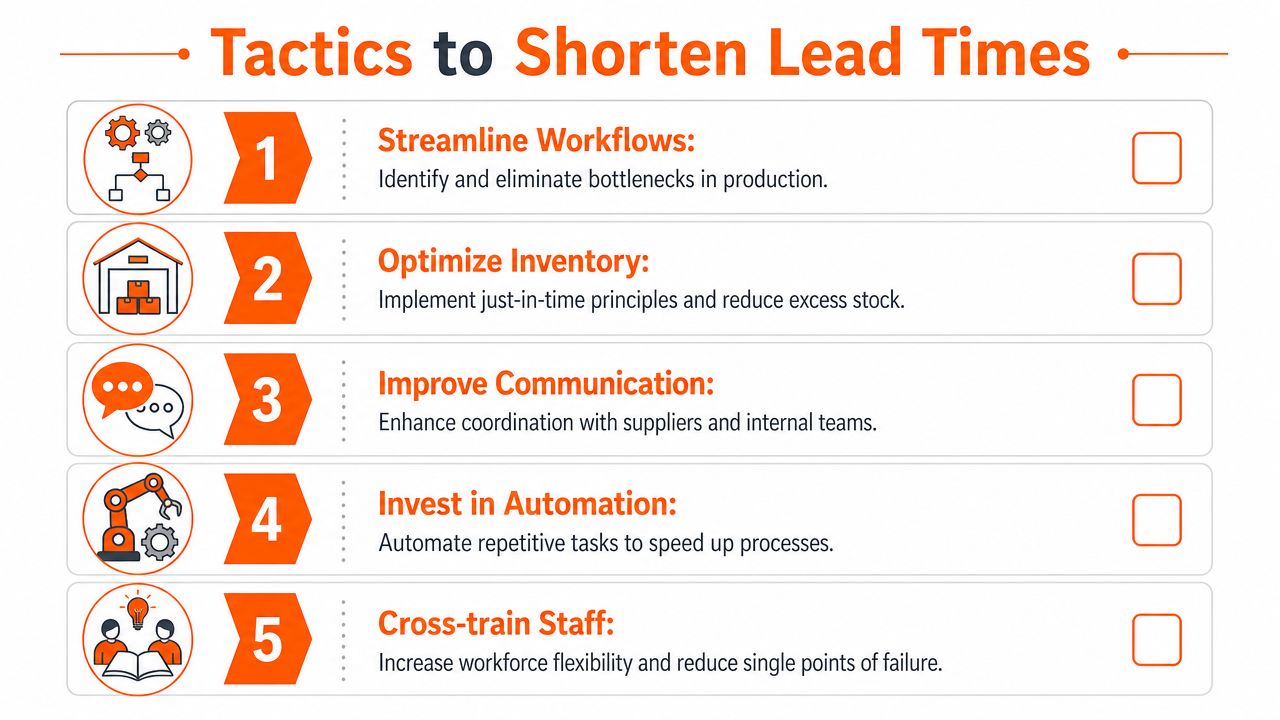
A late launch usually doesn't die on the factory floor. It dies in the gaps between decisions, materials, scheduling, inspection, and shipping. If you want shorter lead times, attack the waiting first.
Here are the tactics I trust.
Choose suppliers by calendar speed, not unit cost
Founders love comparing piece price. I care more about elapsed time from PO to dock.
A cheaper factory is often the expensive choice if it adds extra quoting lag, slower sample revisions, longer transit, and more missed handoffs. For early runs, unstable products, and launch-sensitive SKUs, I'd rather work with a partner I can reach quickly, visit easily, and pressure when something slips. If you're evaluating regional options, this list of Chicago-area factories and manufacturing partners is a practical place to start.
Momentum is worth money.
Carry buffer stock only where a single shortage can stop revenue
Do not spread inventory across every component just because “more stock feels safer.” That's lazy planning.
I stock the few items that can freeze the entire order. The custom bottle. The proprietary PCB. The printed carton with the long artwork cycle. The one imported trim that has no clean substitute. Those are the parts that deserve a buffer because they create wait time far beyond their cost.
A small targeted buffer beats a warehouse full of the wrong parts.
Split development speed from real production speed
Sample timelines lie. I've seen factories turn samples in days, then push bulk orders into a normal queue that runs weeks longer.
Force them to give you separate dates for:
- sample completion
- revision turnaround
- material ready date for bulk
- production slot date
- final ship date
That one change cleans up a lot of false optimism. You stop confusing “they moved fast for the prototype” with “they can ship production on time.”
If you're comparing alternative ways to shorten certain steps, this article on advanced manufacturing strategies is worth reading.
Use an email format that forces specific answers
Vague updates create hidden wait time. “On track” and “in progress” are useless.
Send this instead:
Email template
Subject: PO [number] weekly status and blockers
Hi [name],
Please confirm these five dates for PO [number]:
- Material availability
- Production start
- Production complete
- QC complete
- Ship date
If any date changed, tell me:
- what changed
- why it changed
- what action is being taken
- whether my approval is needed for anything today
Thanks,
[Your name]
I like this format because it exposes waiting between steps, not just the steps themselves. It also gives you a written record when someone tries to rewrite history later.
Here's a quick video worth watching if you want a broader operations lens before you tighten your own process:
Reserve capacity before everything is perfect
A lot of founders wait until every file, approval, and forecast is final before they ask for a production slot. That habit adds dead time.
Book the slot earlier. Pre-align the factory on volume ranges, packaging assumptions, inspection requirements, and ship window while a few details are still being finalized. You are buying position in the queue. That matters because most lead time is waiting, not making.
Cut approval lag like it's a defect
Your team can add a week of delay without noticing. Packaging sits in someone's inbox. Compliance questions wait for legal. A sample arrives Friday and nobody reviews it until Wednesday.
Set response deadlines for your own side. Name one owner for artwork, one for labeling, one for engineering questions, and one for shipment release. If nobody owns the decision, the order waits.
That's the whole game. Shorter lead times come from fewer idle days between handoffs, not factory speeches about working harder.
Putting It All Together A Chicago Founder's Story
A founder I know in Chicago was getting ready to launch a smart home product. Her first manufacturing quote looked brutal. The factory wasn't the whole problem. One component was.
She traced the schedule back to a capacitor. In electronics manufacturing, some capacitors now have 34-week lead times, and overall electronic component lead times can run from 12 to 40 weeks, according to MRPeasy's guide on lead time in manufacturing. That one part was driving the entire calendar.
She made the smart move. She stopped asking the factory to “go faster” and started attacking the waiting. She pre-ordered the capacitor while the last design details were still getting finalized. She built a small safety buffer around the risky component. She tightened communication so engineering questions got answered quickly instead of drifting across email threads for days.
Then she made another move that a lot of founders miss. She changed where final assembly happened. Instead of keeping everything far away and hoping freight behaved, she moved assembly closer to home with a regional partner. If you're exploring local options, this list of factories in Chicago, IL is a useful place to start.
That didn't make the capacitor faster. It did cut waste everywhere around it. Shorter shipping. Faster issue resolution. Easier schedule checks. Less dead air between steps.
You usually can't speed up the longest-lead component. You can stop wasting time around it.
That's the founder lesson. Manufacturing lead times don't improve because you complain harder. They improve when you identify the primary bottleneck, isolate the waiting, and force each handoff to move cleanly.
If you do that early, you give yourself a real shot at launching on time. If you don't, the schedule will run you.
If you're building a product brand in Chicago or the Midwest and want honest conversations with founders who've fought through supplier chaos, delays, and launch headaches, join Chicago Brandstarters. It's a free community for kind, hard-working builders who want real operator advice, not networking theater.
Leave a Reply