Most advice about brand loyalty gets the first half wrong. It treats loyalty like a synonym for repeat buying, then stops there. That's a mistake, because a customer can buy again from habit, convenience, or a discount and still leave the second a better offer shows up.
If you run an ecommerce brand, you feel the difference fast. A loyal customer keeps choosing you when it would be easier to click elsewhere. A repeat buyer just happened to come back this time.
What Brand Loyalty Actually Means
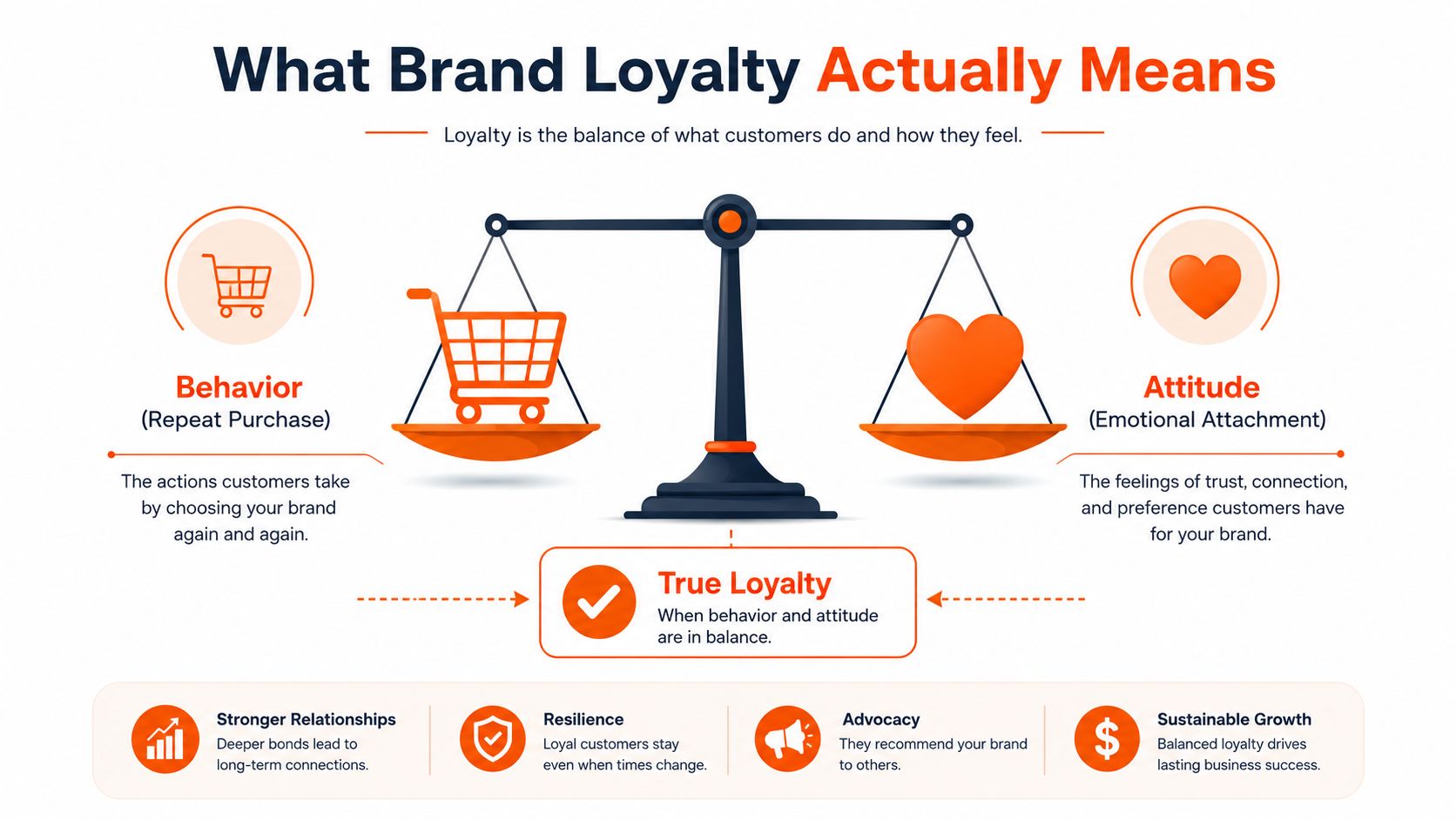
Brand loyalty is not the same thing as a customer buying twice. It is a mix of behavior and attitude. Behavior is what you can see, the repeat order. Attitude is what sits underneath it, the preference, trust, and willingness to keep choosing you even when someone else looks cheaper or easier.
A gym membership versus a training partner offers a useful comparison. A member might pay every month and never show up. A training partner shows up because they want to be there. That second person is what you want.
Repeat purchase is only the surface
A customer can buy from you again and still be fragile. If they came back because you were the cheapest option, they are loyal to the price, not the brand. If they came back because checkout was easy, they may still leave when another store makes checkout easier.
That's why I don't treat repeat orders as the whole story. I treat them as a signal, then I ask what caused the signal. Was it trust, habit, a discount, or pure convenience?
The distinction matters. Research reviews treat “true loyalty” as repeat patronage plus a favorable disposition toward the brand, not just transaction frequency, because buying again can come from inertia or promotions instead of real preference (marketing literature review on true loyalty). A practical guide on brand loyalty also frames repeat-customer rate as a retention metric that needs a sentiment check beside it (brand loyalty KPI guide).
Practical rule: if a customer only stays when you discount, you have retention. You don't yet have loyalty.
For a deeper look at the emotional side, I like this resource on emotional connection loyalty strategies. It pairs well with the trust work you need to do on your own site, like the ideas in how to build trust with customers.
The simplest test
Ask one question. Would this customer keep choosing you if a similar option appeared at the same price?
If the answer is yes, you're moving toward real loyalty. If the answer is no, you're looking at a short-term purchase pattern, not a durable relationship.
That's the whole game. Brand loyalty is preference with proof.
The Two Types of Loyalty You Need to Track
I've watched founders celebrate a rising repeat rate while their customer base got more price-sensitive. The dashboard looked healthy, but it only showed one side of the story. If you track buying behavior alone, you can miss the fact that customers do not care who you are, they only care that you are convenient right now.
Behavioral loyalty looks good until it doesn't
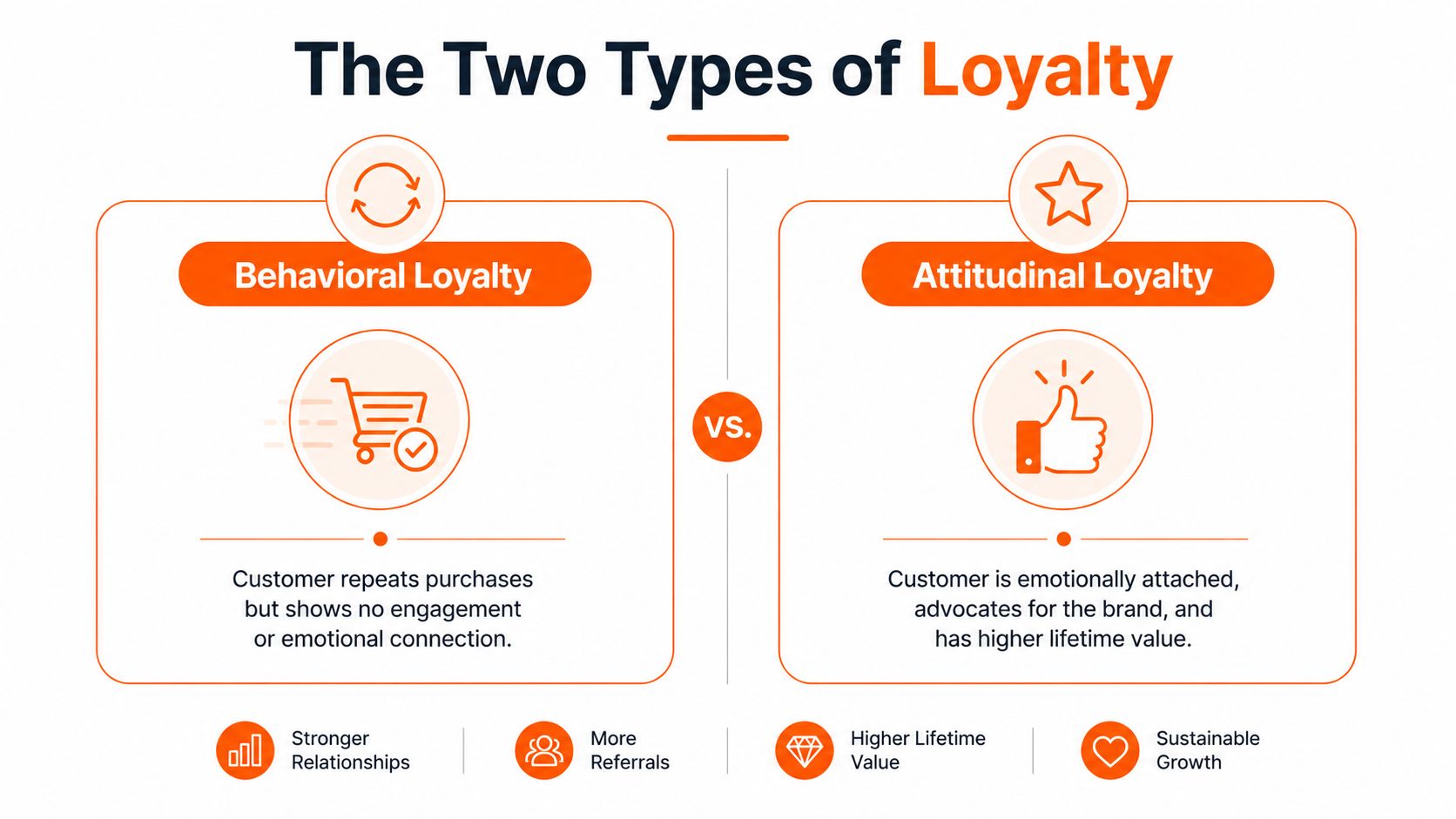
Behavioral loyalty is the repeat action. A subscription customer who keeps paying is behaviorally loyal. A buyer who reorders the same cleanser every six weeks is behaviorally loyal. A customer who comes back because your reorder reminder lands in the right inbox at the right time is also behaviorally loyal.
That can still be useful. You want repeat revenue. But the risk is straightforward. If that customer never builds attachment, they can leave when a competitor offers a lower price, a faster ship date, or a slightly cleaner interface.
I've seen this most clearly in subscription businesses. A person keeps paying because canceling feels harder than staying, or because the service is set and forget. That is not the same thing as preferring your brand.
Attitudinal loyalty is harder to fake
Attitudinal loyalty is the feeling underneath the purchase. It shows up when customers recommend you, defend you, and keep choosing you when they have real alternatives. A customer can post about you, rave about you, and still only buy once a year. That is a different problem from someone who buys often but never talks about you.
I like to separate the two in practice:
- Behavior without attitude means you have repeat orders, but you may be riding on habit.
- Attitude without behavior means you have goodwill, but you have not turned it into a buying pattern.
- Both together is the signal I trust most, because it points to durable preference.
A peer-reviewed review of brand loyalty describes it as repeated purchases, active engagement, advocacy, and co-creation of value (peer-reviewed review of brand loyalty). That matches what I've seen in real stores. The customers who stay longest are usually the ones who feel known, not just marketed to.
A useful mental model is this. Behavioral loyalty is the receipt. Attitudinal loyalty is the reason the receipt keeps happening.
If you only celebrate the receipt, you miss the reason customers stay.
Why Loyalty Matters More Than Acquisition
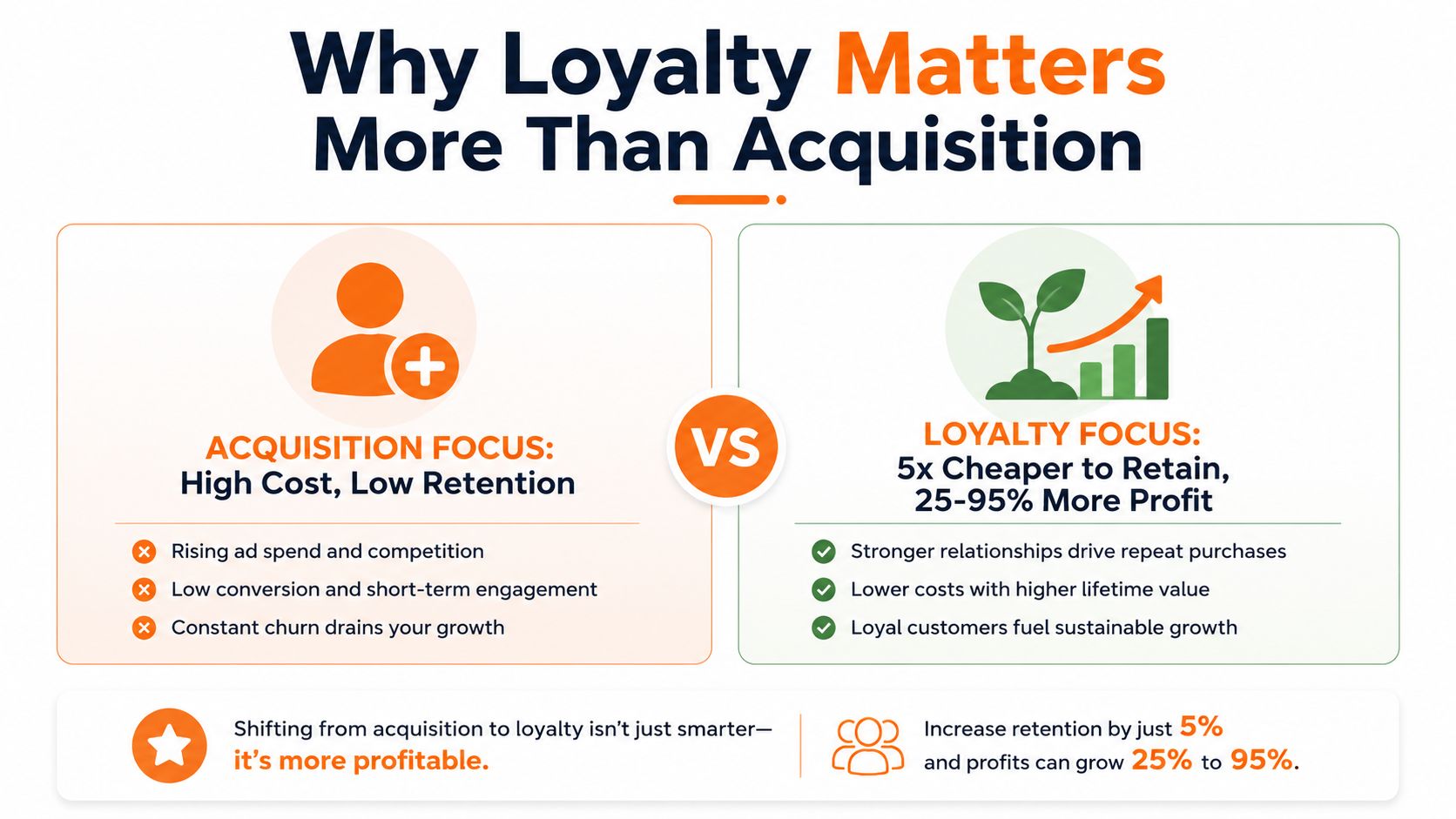
Founders love acquisition because it feels visible. Ads go out. Traffic comes in. Sales spike. Then the chargeback, refund, and reorder numbers tell a quieter story. Loyalty matters because it changes the economics behind all of that.
The math favors keeping people
A retail-focused analysis found that 65% of retail business comes from loyal customers, and those customers spend 67% more per purchase than new customers (Capital One Shopping brand loyalty statistics). The same source says loyal customers are worth 2.5 times more revenue than new or future customers. Another report says acquiring a new customer costs 5x more than retaining an existing one (brand loyalty report).
That math is hard to ignore. If you spend less to keep someone and they spend more when they return, you get better unit economics without needing a miracle ad campaign.
Here's the practical version. If two brands sell the same product and one keeps customers coming back while the other keeps buying cold traffic, the first brand usually has more room to breathe. It can tolerate a slow week, a bad CPM, or a weaker launch because the base is already warm.
Simple rule: a small lift in retention often beats a large lift in acquisition, because you're working on customers who already know you.
Loyalty changes risk
Acquisition can be rented. Loyalty is earned over time and sits inside the business itself. That matters when markets get crowded, attention gets expensive, or a channel changes overnight. You don't want to build a company that needs a constant stream of new strangers just to survive.
The bigger point is this. Brand loyalty turns your existing customer base into an engine, not a leak. You still need acquisition, of course. But if you build acquisition first and loyalty later, you often pay too much for growth that won't stick.
I've seen founders chase more ad spend when what they needed was better repeat behavior. That usually ends in a messy dashboard and thin margins. Loyalty is slower to build, but it pays back in a way paid traffic never will.
How to Measure Brand Loyalty
You can't manage brand loyalty from a gut feeling. You need a small, honest set of numbers that shows both what customers do and what they believe about the brand. One metric by itself will mislead you, especially when discounts are doing the heavy lifting.
Start with repeat customer rate
Repeat customer rate is the simplest behavioral metric to start with. The formula is straightforward, repeat customers divided by total customers, multiplied by 100, as outlined in the repeat-customer-rate KPI guide. It tells you how many people came back.
Use it, but do not worship it. A high repeat rate can come from a discount cycle, a subscription lock-in, or plain inertia. It does not prove attachment, and it does not tell you whether people would stay if the offers disappeared.
Add a sentiment metric
Pair behavior with sentiment. Net Promoter Score, customer reviews, and direct feedback can show whether people would recommend you. If repeat buying rises and sentiment stays flat, the business may be holding customers through convenience, not preference.
That matters because loyalty usually takes time. In a consumer survey, 88% of consumers said it takes three or more purchases before they consider themselves loyal, and 36.4% said they do not regard themselves as loyal until they have made five or more purchases from a brand (Yotpo brand loyalty statistics). If you expect loyalty after one order, the bar is set too early.
Build a simple dashboard
Use a small scorecard, not a giant wall of numbers. I would track repeat customer rate, retention rate, customer lifetime value, and one sentiment signal together. If you want a practical framework for setting this up, a customer retention tactics guide can help you connect the metric to day-to-day operations.
| Metric | How to Calculate | What It Tells You | What It Misses |
|---|---|---|---|
| Repeat customer rate | Repeat customers divided by total customers, times 100 | Who came back | Why they came back |
| Retention rate | Customers retained over a set period | Whether your base is holding | Whether customers prefer you |
| Customer lifetime value | Total value from a customer over time | How much a customer is worth | Whether the value comes from loyalty or discounts |
| Net Promoter Score | Survey-based recommendation score | Willingness to recommend | Actual buying behavior |
A market analysis notes that the average U.S. consumer belongs to 17 loyalty programs, with only 51% active participation (Yotpo brand loyalty statistics). That tells me a lot of “loyalty” is shallow. Membership alone does not mean engagement, and a dashboard full of members can still hide weak behavior.
Track buying and feeling together. If one rises without the other, you are measuring the wrong thing.
A final check is whether repeat orders are tied to real preference or to perks that disappear when the promotion ends. The best proof is not a busy email list or a loaded rewards balance, it is customers returning without needing a push.
If you need a different lens, compare your repeat rate against the kind of gift-driven retention a customer might get from a 2026 corporate gift guide. That contrast makes it easier to separate convenience purchases from loyalty that can survive without a nudge.
Practical Tactics to Build Real Loyalty
I've seen loyalty grow when the brand feels steady in the places that matter and sloppy everywhere else. Customers don't stay because your program is flashy. They stay because you keep proving that you know what they want and you won't waste their time.
Make the product easy to trust
Start with quality. If the product misses, everything else gets expensive fast. A customer can forgive a slow email. They won't forgive a serum that arrives leaking or a supplement that tastes different every batch.
Consistency matters more than cleverness here. If your customer has to wonder whether the next order will be the same as the last one, you've introduced friction right into the core of the brand.
Use memory like a real advantage
Personalization is where a lot of brands waste money. A first-name merge tag is not personalization. Real memory is remembering a size preference, a replenishment cycle, a past complaint, or a channel the customer prefers.
Recent shopper data says 66% are more likely to keep shopping with a brand when it remembers their preferences, 52% when it makes relevant product suggestions, and 47% when it remembers past interactions (Zeta Global loyalty shift research). That lines up with what I've seen. People stay when your brand behaves like it remembers them.
Build small rituals, not just discounts
The best loyalty programs I've seen create habits and recognition. They give customers reasons to return that are bigger than price cuts. That can mean early access, post-purchase follow-up, a clear restock reminder, or a community around a category customers care about.
If you need a practical reference for gifting and relationship-building at the B2B or partner level, this 2026 corporate gift guide has useful ideas that go beyond generic swag. The point isn't the gift itself. The point is whether the customer feels remembered.
Customer retention tactics matter because loyalty grows from repeat contact that feels useful, not repetitive. When you reach out, give people a reason to care again.
Customers don't want to feel managed. They want to feel remembered.
That is the difference between a brand that earns loyalty and a brand that buys temporary repeat business.
Common Mistakes That Kill Loyalty
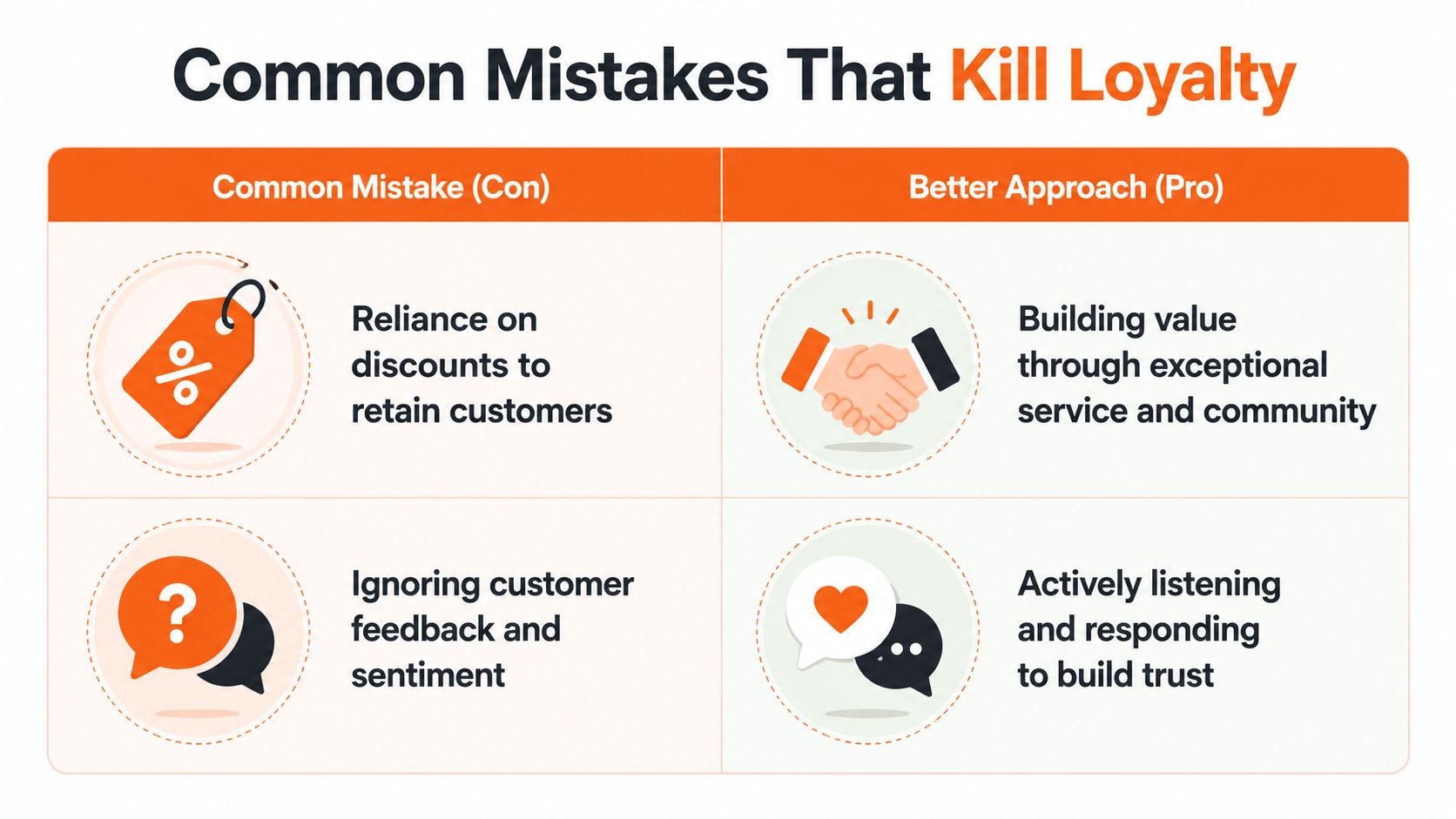
The fastest way to kill loyalty is to confuse motion with progress. A discount that brings people back once can also teach them to wait for the next discount. A loyalty program can look healthy while your customers learn that your brand is just a coupon source.
Discount dependence vs real value
If every repeat order needs a promo code, you've trained price sensitivity. The customer comes back for the deal, then leaves when another brand undercuts you. That feels like retention on paper and fragility in real life.
The better move is to make the brand worth coming back to without a coupon. Better service, better communication, better packaging, and better product consistency do more for long-term loyalty than endless markdowns.
Inconsistency vs predictability
A product that changes from batch to batch destroys trust. So does support that answers one way on email and another way on chat. Customers notice pattern breaks, even if they don't complain every time.
I'd rather have a simpler offer that works the same way every time than a fancy one that creates doubt. Predictability is boring on a sales deck and powerful in a reorder cycle.
Marketing-only thinking vs operational ownership
Loyalty dies when marketing owns it alone. You can send the right email, but if fulfillment is late, the product is off, or support ignores the complaint, the email won't save you. Customers remember the full experience, not the campaign.
The stronger approach is cross-functional. Operations, support, product, and marketing all touch loyalty. If one of them breaks the promise, the others pay for it.
The older habit of treating loyalty like a points program misses this completely. Real loyalty comes from the sum of each interaction, not from a badge in an app. That's why a customer who feels taken care of usually stays longer than a customer who only feels incentivized.
Your Brand Loyalty Implementation Checklist
You don't need to fix everything at once. Start with the parts that change what customers feel on their next order. If your base experience is shaky, don't add more complexity.
This week
- Audit repeat behavior: Look at repeat customer rate and ask which products bring people back most often. If you can't explain why they return, you're guessing.
- Read recent complaints: Pull the last ten support tickets and find the patterns. If the same issue keeps showing up, it is probably a loyalty problem already.
- Review your post-purchase flow: Check whether your emails sound helpful or generic. Customers notice the difference.
This month
- Add one sentiment check: Send a short survey or review request after delivery. You want one metric that tells you how customers feel, not just how often they buy.
- Improve one memory point: Remember a preference, a reorder window, or a product use case. One useful memory beats five empty messages.
- Test one non-discount reward: Try early access, a surprise sample, or priority support. Watch whether it changes repeat behavior without lowering your margin.
This quarter
- Map the full experience: Trace the path from ad to checkout to delivery to support. Find the weak handoff that breaks trust.
- Create a referral path: If customers already talk about you, give them a simple way to send friends your way, like the framework in how to create a referral program.
- Set one loyalty review cadence: Look at behavior and sentiment together once a month. If one goes up while the other drops, you need to adjust fast.
If you're short on time, fix product consistency first, then customer communication, then rewards. In that order. A polished incentive layer can't cover a rough core experience.
The best brands don't chase loyalty as a slogan. They build it by making each order easier to trust than the last one. If you want a stronger brand and a clearer path from first purchase to repeat purchase, visit Chicago Brandstarters and find a community of operators who care about building real businesses, not just pretty dashboards.
Leave a Reply