You've chosen a product, saved a few packaging references, and started a folder of shade names. Then the practical questions arrive. Who needs this product? Which manufacturer will accept a small order? What must appear on the label? How will you know whether customers want another shade or a completely different format?
Building a makeup brand takes more than a polished launch page. You need a focused product idea, evidence from real customers, compliant packaging, dependable supply, and a sales system that can turn first purchases into repeat orders. The founders who manage those details early give themselves room to create.
Starting Your Makeup Brand Journey
A new founder often begins with a strong personal insight. Maybe mascara always smudges under their eyes, or foundation feels too heavy by midday. They sketch a tubing mascara or a skin-tint stick, choose a name, and start imagining the launch video. Then a manufacturer asks about minimum order quantity, a designer asks for final label copy, and a customer asks whether the product suits a specific skin tone.
That gap between the idea and the operating work catches people off guard. Packaging, shade names, and social content matter, yet they can't rescue a product that solves a weak problem or arrives with unclear usage instructions. Before you spend heavily, write down the customer problem, the product promise, the proof you need, and the channel where customers will discover you.
Start with a narrow business question
The modern makeup category became a mass consumer market in the early twentieth century, when American companies began producing and selling cosmetics and fragrances at scale. The number of United States firms making perfumery and toilet goods rose from 67 in 1880 to 262 later on, and one company sold five million units in North America during World War I alone, according to this history of cosmetics from Cosmetics Info. T. L. Williams created Maybelline mascara for his sister Mabel, helping turn mascara into a repeat-purchase staple.
The lesson for a new founder is practical. Products gain traction when customers can see the problem, understand the use, and buy the solution again. A product that tries to serve every makeup routine usually creates a vague message and a difficult assortment.
Use this guide to starting a product business to turn the idea into a simple operating plan. Then speak with potential buyers before you approve a formula. Ask what they use now, where it fails, and what would make them switch. Their language should shape your product page, label, demonstrations, and customer support.
Practical rule: Treat your first product as a test of a customer problem, not as proof of your creativity.
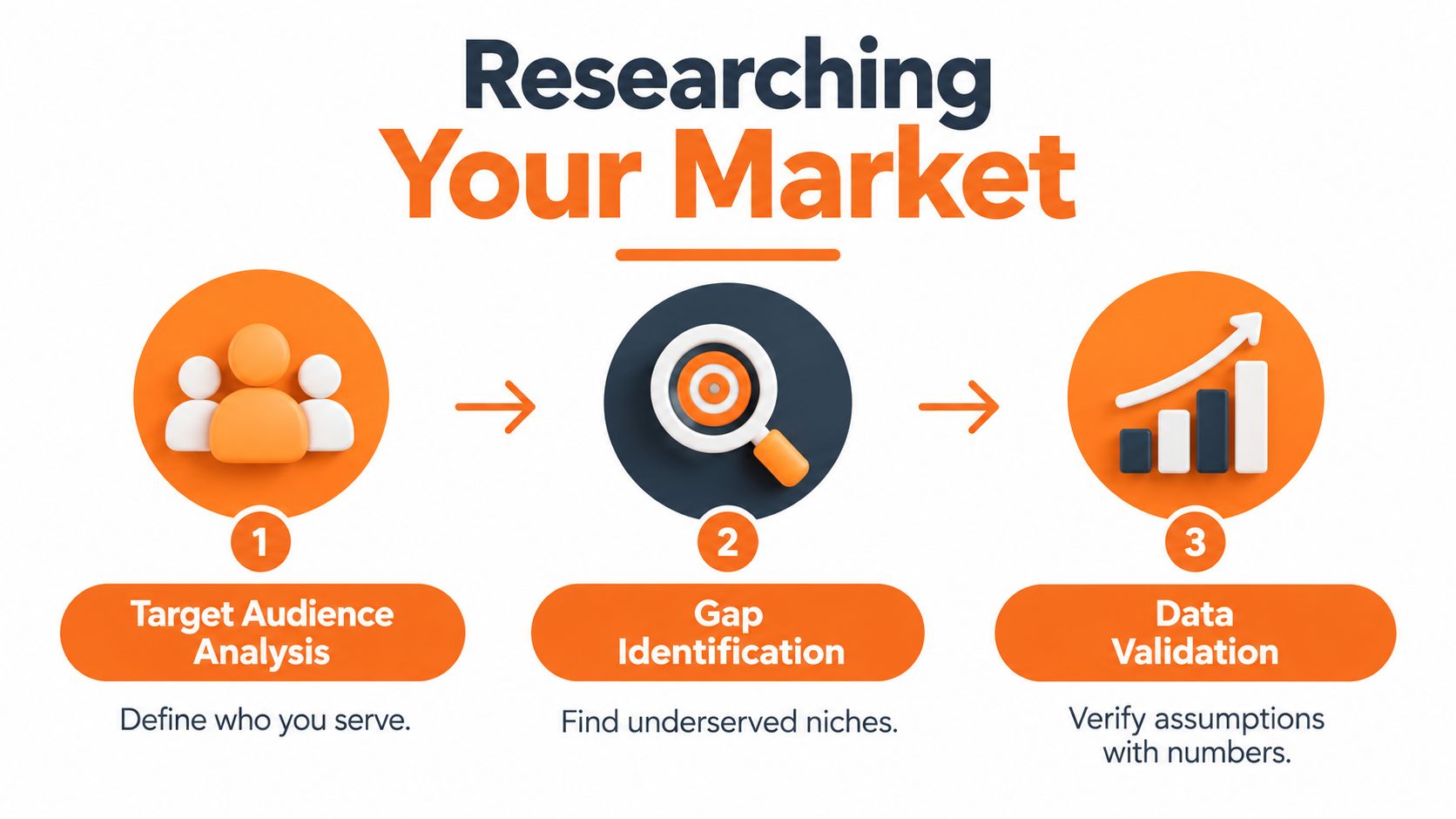
Researching Your Market and Finding Your Niche
Broad beauty data can make a niche look obvious when it isn't. McKinsey notes that entrepreneurs often lack important market data, and that beauty data for Black consumers can remain thin because some wholesale channels don't track point-of-sale information. A standard retail dashboard may show weak demand where the actual issue is missing data.
Test the customer before the category
Start with conversations, creator comments, retailer feedback, and search behavior. Ask people to show you their current product, explain what they dislike, and describe the moment when the problem appears. Don't ask whether they like your idea. Ask what they already buy and what they wish worked better.
For communities that standard retail data misses, direct research matters even more. Work with creators who already serve that audience, review comments under relevant product videos, and run a small product test before you commit to a broad line. McKinsey's analysis of Black representation in beauty explains why founders can't treat missing point-of-sale data as proof that an opportunity doesn't exist.
Follow the use case, not the buzzword
The strongest niche may come from a format or routine rather than a demographic label. Recent coverage points toward skin-first, multitasking products, including tinted moisturizers, balms, primers, and sticks, while high-coverage foundation and classic lip color have softened. The same coverage reports that searches for tubing mascara rose 100.3% in the last year, peel-off lip stains rose 117.1% year over year, and lip liner sales grew 28% in prestige and 36% in mass during the first eight months of 2025, as reported by Vogue Business on makeup formats and demand.
Those signals don't tell you to copy a trend. They tell you where to ask better questions. A tubing mascara brand might focus on removal for sensitive eyes. A lip stain brand might focus on transfer resistance during long workdays. A stick product might focus on fast application for people who get ready while travelling.
Build a short evidence file for each idea:
- Observed problem: Record the exact complaint and the routine where it occurs.
- Existing solution: Buy competing products and document their formula, shade range, price, packaging, and weaknesses.
- Community signal: Compare creator comments, customer interviews, and retailer conversations.
- Small test: Use samples, a waitlist, or a limited release before expanding the assortment.
That process gives you a defensible niche even when category data leaves gaps.
Formulating Products and Navigating Compliance
Once you choose a use case, turn the promise into a product specification. Write the texture, finish, wear expectation, application method, removal experience, shade range, packaging format, and claims you want to make. A contract manufacturer can work faster when you give them a precise brief instead of asking for something that only feels premium.
Choose the formulation route
Private label can reduce development work because a manufacturer already has a formula. Custom formulation gives you more control over texture, pigment, and performance, though it usually demands more development time and cash. Making cosmetics yourself gives you control over small batches, yet it also leaves you responsible for formulation knowledge, testing, production controls, and product safety.
Request samples before you approve anything. Test the product across the intended skin tones, application methods, wear conditions, and packaging. For color cosmetics, test every proposed shade. One shade can perform well while another applies unevenly, fades quickly, or looks different after it dries.
Keep a product file with the formula version, ingredient documentation, sample notes, testing records, supplier information, and approved claims. Use this guide to protecting intellectual property while you decide what belongs in contracts, confidentiality terms, and brand protection work.
Treat the label as a product requirement
For United States sales, the label must include the product identity, net quantity, ingredient declaration, and the name and place of business of the manufacturer, packer, or distributor. The FDA summary of cosmetic labeling requirements says required label statements must appear in English, and the ingredient list must use common or usual names rather than trade names.
FDA doesn't require pre-market approval for cosmetics or their ingredients before sale, except for color additives. That doesn't remove your responsibility. The product must not be adulterated or misbranded, and it must remain safe under labeled or customary use, as explained in the FDA fact sheet for small cosmetic businesses.
Each person who owns or operates a facility that manufactures or processes cosmetics for distribution in the United States must register each facility with FDA under the cosmetic registration and listing rule. Review the FDA guidance on cosmetic facility registration and product listing with your regulatory adviser or manufacturer.
Don't print packaging until someone checks the final artwork against the formula, claims, net quantity, business details, and required ingredient names. A late correction can affect cartons, labels, photography, and inventory at the same time.
Sourcing Manufacturers and Managing Inventory
Your manufacturer affects your cash flow, launch timing, quality, and ability to replenish. Compare partners on formula ownership, sample quality, testing support, packaging options, communication, production timing, payment terms, and defect handling. A low unit price means little if the supplier misses delivery or can't reproduce the approved shade.
Pick the route that matches your stage
Private label works when speed and a small development burden matter most. You trade some formula uniqueness for a faster path to market, so inspect samples carefully and ask whether other brands use the same base.
Custom formulation fits a brand built around a distinctive texture, finish, or performance claim. You gain control, though you take on more development decisions and a longer path before production.
Private label cosmetics often require minimum order quantities that start in the low thousands of units, and the amount varies by category. Skincare usually has lower minimums, while color cosmetics often has higher ones, according to this private label cosmetics MOQ guide. Ask whether the minimum applies per shade, product, finish, or total order. Those details change the amount of inventory you must fund.
Protect availability before adding variety
Launch with a hero-product matrix. Choose the product, the smallest sensible shade range, the packaging components, and the reorder trigger. Track sell-through by shade, returns, customer complaints, repeat purchase, and stockouts. If your best shade disappears, paid traffic keeps arriving at a page that can't convert.
For a useful ecommerce reference point, the median Shopify beauty and skincare store converts about 2.6% of sessions into orders, while the top 20% reach roughly 3.8%, according to Littledata's Shopify conversion benchmark. Treat that as a comparison point, not a promise. Your traffic source, product price, mobile experience, shade clarity, and customer trust can move the result.
A wholesale buyer also needs clean information. Include product names, pack shots, case details, wholesale pricing, retail pricing, lead times, ingredients, claims, and contact information in your line sheet. These tips for wholesale line sheets from NanoPIM can help you present the information buyers need without burying it in a long brand story.
Before you sign a production agreement, ask for defect procedures, batch records, component substitutions, shipping responsibility, and approval rights. This guide to finding a product manufacturer can help you prepare questions before supplier calls.
Building Your Brand Identity and Packaging
A makeup brand becomes easier to understand when the product, message, and visual system point in the same direction. A tubing mascara for people who want clean removal needs different language from a luxury mascara built around drama and volume. Both can look attractive, yet only one will make the product promise easy to grasp.
Turn the use case into a brand system
Write a one-sentence position that names the customer, the routine, and the product benefit. Then build the name, tone, photography, colors, and packaging around that sentence. If your brand centers on quick application, show the product in a real morning routine. If it serves a specific shade concern, show accurate swatches across the customers you want to reach.
Your packaging has two jobs. It must protect the product and help a shopper understand it before they open the box. Use a clear product name, readable shade information, useful instructions, and a front panel that communicates the use case quickly. Avoid decorative language that makes a practical product sound mysterious.
Design for the shelf and the screen
Request physical packaging samples before you approve a large order. Check cap fit, wand function, label adhesion, print color, barcode placement, carton strength, and how the product looks in ordinary light. A package can look perfect in a design file and become hard to read on a phone or after condensation reaches the label.
Product photography should show the formula, shade, applicator, and scale. If you use generated or edited images, check that the packaging text, shade appearance, and claims remain accurate. Nereo's guide to label accuracy with AI photography provides useful context for reviewing cosmetic packaging in AI-assisted visuals.
Keep the first identity system simple. One type system, a limited color set, repeatable photo rules, and a consistent voice will help you produce product pages and social content without reinventing the brand every week. Your visual identity should make the product easier to buy, not compete with it.
Launching and Scaling Your Makeup Brand
A broad line can feel safer because it gives shoppers more choice. For a new founder, it often spreads cash, attention, samples, and content across too many products. A utility-led niche gives you one problem to demonstrate repeatedly, which makes launch content easier to understand and customer feedback easier to interpret.
The online channel deserves serious planning from the first day. The United States beauty and personal care ecommerce market reached an estimated $61 billion in 2024, while the global beauty and personal care ecommerce market reached an estimated $257 billion in 2025 and is projected to reach $338 billion by 2029, according to Statista's beauty and personal care ecommerce overview. The same source reports that online penetration rose from 14% in 2015 to 26% in 2024, and one 2025 industry report placed United States beauty sales at 41% online.
Build the launch around proof
Show the product solving the problem before you ask people to buy it. Demonstrate application, wear, removal, shade comparison, and common mistakes. Give creators samples with a clear brief, then let them explain the product in their own words. Capture customer questions and turn those questions into product-page copy, email content, and short videos.
A simple launch sequence can include:
- Pre-launch education: Collect email addresses with useful demonstrations and honest product information.
- First release: Sell the narrow assortment through your own store and watch customer behavior closely.
- Early support: Answer shade, application, shipping, and ingredient questions quickly.
- Post-purchase follow-up: Ask about the result, invite reviews, and learn when customers expect to replenish.
- Paid acquisition: Put money behind content and pages that already show signs of customer interest.
Don't scale traffic before you understand conversion. Segment results by product, shade, channel, mobile, desktop, new customer, and returning customer. Track add-to-cart rate, checkout completion, refund reasons, contribution margin, repeat purchase, and inventory age. A large audience can't compensate for a confusing shade selector or an out-of-stock hero product.
Expand only after the first loop works
A new shade should answer a documented customer request or improve coverage across the intended audience. A new product should either solve the same problem in another format or create a sensible routine around the first product. If neither happens, keep the assortment narrow and spend the money on sampling, education, and replenishment.
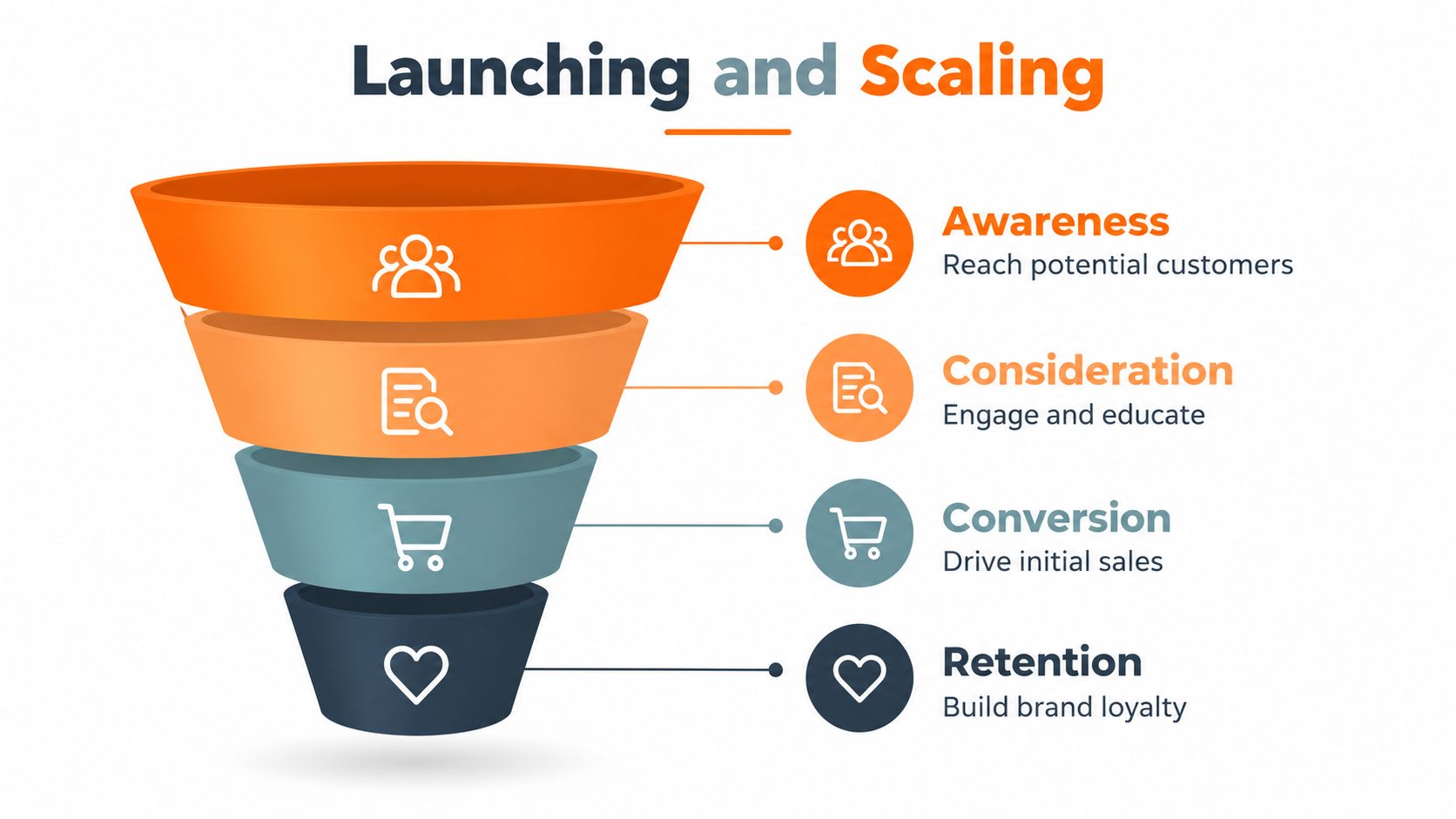
This video can help you think through the movement from discovery to retention:
The strongest early brands often behave like product laboratories. They listen, adjust, document what changed, and keep the promise clear. A utility-led mascara, stain, primer, or skin tint can earn attention through demonstrated performance instead of a long catalog.
Next Steps and Community Resources for Founders
Building a makeup brand can leave a solo founder handling supplier calls, ingredient reviews, customer messages, and compliance questions in the same day. A peer group cannot replace a chemist, lawyer, accountant, or regulatory adviser. It can expose weak assumptions before they become expensive decisions.
Choose communities that fit the work you are doing. Useful peers will discuss failed samples, supplier delays, pricing problems, and customer complaints without turning every exchange into a sales pitch. Private dinners, small peer groups, founder chats, trade associations, local retail conversations, and structured mentorship each provide different kinds of support.
Chicago Brandstarters is a free, vetted community for Chicagoans and Midwesterners building brands from the idea stage toward seven figures. Members take part in private dinners and an active group chat where founders share practical tactics, problems, and support. As companies grow, the community points members toward programs including Goldman Sachs 10KSB, EcomFuel, and Million Dollar Sellers. Visit Chicago Brandstarters to find a founder community for pressure-testing product and supplier decisions.
Use the next working session well
Bring one specific question instead of asking for general feedback. Ask whether the product promise is clear, whether the first shade range serves a documented audience, or whether a wholesale sheet answers a buyer's questions. If your audience research is thin, ask peers to challenge the evidence behind the niche rather than approve the concept. Record the feedback, then decide what to change, test, or reject.
Before placing a production order, confirm the following:
- Customer: Who experiences the problem, and what evidence verifies it?
- Product: What does the formula do, and which claims will you avoid?
- Compliance: Has someone reviewed the label, claims, ingredients, and facility responsibilities?
- Supply: What happens if a component arrives late or a hero shade sells faster than expected?
- Sales: Can a shopper understand the product and choose a shade without personal help?
- Retention: What reason will bring the customer back?
Regulatory review should happen before the order, not after a label is printed. Keep the product promise narrow enough to support with the formula and documentation. A utility-led niche, such as a mascara, stain, primer, or skin tint solving a defined problem, gives customer conversations a clearer focus than a broad product line.
Take the next step with a short working list. Speak with customers, order samples, review the label, and test the product page before expanding the assortment. Community feedback is most useful when it leads to a recorded decision and a specific follow-up test.
Leave a Reply