
You're staring at a dashboard full of orders, a growing pile of returns, and a carrier message that says one shipment has stalled. Customers want fast delivery, but every promise creates work somewhere else. The warehouse needs more labor, your cash gets tied up in stock, and a cheap fulfillment quote can turn expensive once storage, packaging, software, and returns enter the bill.
E-commerce fulfillment solutions can remove that pressure, but they can also add new constraints. The right choice depends on your order pattern, product mix, cash position, customer promise, and tolerance for operational complexity. Speed matters, yet speed alone won't tell you whether a model makes money.
Why Fulfillment Decisions Define Early Growth
Most founders first notice fulfillment when it breaks. You run out of shelf space, miss a dispatch promise, or spend an evening correcting an address that your system should have caught. At that point, switching providers feels urgent, which makes it easy to choose a model based on a sales pitch instead of your actual operating needs.
Start with a simple baseline. Pull recent order data and write down:
- Daily order volume: Separate ordinary days from launch days, promotions, and seasonal surges.
- Order shape: Record units per order, product dimensions, weight, bundles, fragile items, and custom packaging.
- Dispatch expectations: Decide whether customers expect same-day handling, next-day delivery, or a lower-cost service.
- Return behavior: Track why customers return products and how much work inspection, cleaning, repackaging, or resale requires.
- Cash limits: Note how much money you can tie up in stock, storage, packaging, deposits, and software.
This exercise gives you something better than a forecast. It shows the conditions your fulfillment partner must handle today. A model that works for small, predictable parcels may struggle with oversized products, kits, subscriptions, or products that need quality checks before resale.
Use orders and margin together
Order volume alone won't tell you when to outsource. A product with a low average order value can lose money under a fee structure that looks reasonable for a higher-value basket. A bulky product can make storage and carrier charges more important than the pick fee. A product with a high return rate can turn a smooth outbound process into a labor-heavy reverse workflow.
The e-commerce fulfillment market data from Mordor Intelligence projects growth from USD 138.25 billion in 2025 to USD 154.31 billion in 2026, then to USD 267.58 billion by 2031, with an 11.62% CAGR from 2026 to 2031. The same source says third-party logistics providers held 59.25% of revenue in 2025, while shipping fulfillment services accounted for 40.65%. Those figures describe the wider market, not your business, but they show why founders have many outsourcing options and why transportation execution deserves close review.
Practical rule: Choose a fulfillment model that fits your ordinary week, then test it against your worst realistic week.
Set a decision baseline
Write down three operating views before you compare providers:
- Current reality: What you ship, how often you ship it, and what goes wrong now.
- Near-term pressure: The next product launch, promotion, channel, or seasonal spike that could strain capacity.
- Non-negotiables: Your acceptable error rate, dispatch promise, packaging requirements, return process, and monthly budget.
Don't build a network for a forecast you haven't validated. A small brand often needs flexibility more than warehouse sophistication. A growing brand may need outside labor and better systems before it needs another warehouse. Your first decision should protect cash flow and customer trust at the same time.
E-commerce Fulfillment Solutions Compared
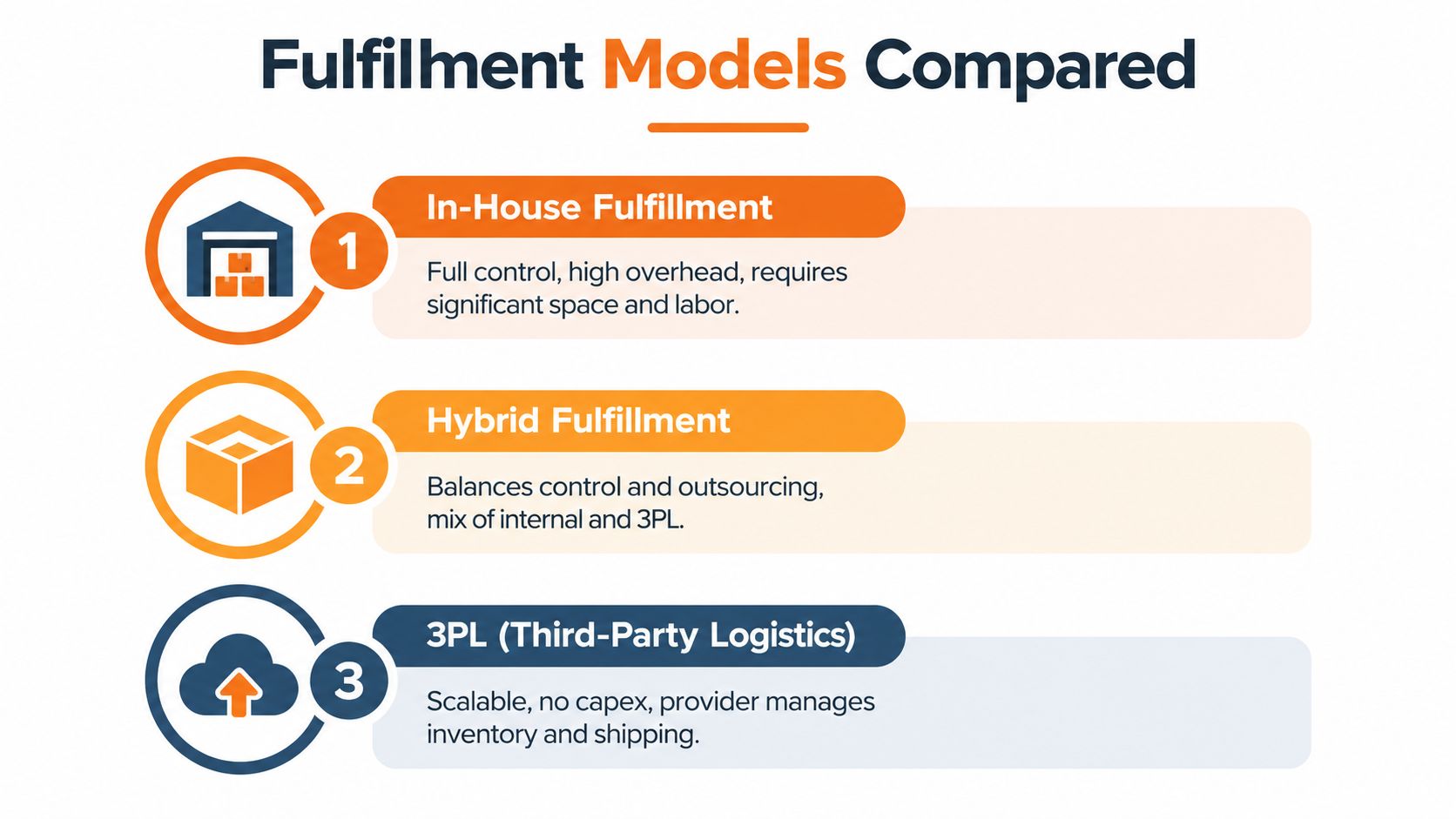
The five models below cover most choices growing brands encounter. Each one gives you a different balance of control, fixed cost, labor exposure, and operating complexity.
| Model | What you manage | What the model does well | Where it strains |
|---|---|---|---|
| In-house fulfillment | People, space, stock, packing, carrier handoff | Control and direct product handling | Labor, space, systems, and peak capacity |
| FBA | Inventory sent into Amazon's network | Amazon marketplace delivery and returns | Brand control, fee changes, and channel dependence |
| 3PL | Provider relationship, data, service levels | Scalable storage, picking, packing, and shipping | Provider quality, integrations, and minimums |
| Hybrid fulfillment | Rules across internal and external operations | Control for special orders, outside capacity for routine work | Inventory allocation and system reconciliation |
| Local or same-day fulfillment | Dense local stock and rapid dispatch | Fast delivery in a concentrated service area | Limited geography and difficult unit economics |
In-house fulfillment
Your team receives stock, stores it, picks orders, packs parcels, prints labels, handles exceptions, and processes returns. You control inserts, packaging, quality checks, and the customer experience. You also carry the full burden of recruiting, training, scheduling, equipment, software, rent, and sick-day coverage.
In-house works well when products need close inspection or unusual packing. It can fail when order volume rises faster than your space and processes. Founders often keep adding shelves and temporary labor while the issue sits in inventory accuracy, poor slotting, or a dispatch cutoff that nobody follows.
FBA and marketplace fulfillment
Amazon FBA places stock into Amazon's network and handles marketplace shipping and many returns. That convenience can help a seller who depends heavily on Amazon and wants customers to receive familiar delivery service.
You give up control over the packing experience and accept Amazon's storage, fulfillment, removal, and return rules. FBA can also create awkward inventory decisions when you sell through your own store, wholesale accounts, or another marketplace. Treat it as a channel-specific tool rather than an automatic answer for every order.
Third-party logistics
A 3PL stores your inventory and handles receiving, picking, packing, shipping, and often returns. You pay for a service instead of building the warehouse operation yourself. The arrangement can free your team to focus on product, sales, and customer retention.
A 3PL still needs management. You must check integration quality, inventory reporting, carrier options, packaging rules, escalation speed, and the provider's performance during demand spikes. The AUSFF fulfillment services overview is a useful reference when you want to see the workflow categories a provider may cover. For broader vendor research, you can also review shipping fulfillment companies and compare their operating models rather than comparing headline prices alone.
Hybrid fulfillment
Hybrid operations keep selected work in-house and send routine orders to a 3PL. You might retain wholesale kitting, influencer boxes, fragile products, or premium packaging while a partner handles standard direct-to-consumer orders.
This model gives you room to protect special experiences, but it creates two sources of truth unless both sides share clean inventory and order data. It fails when founders split stock without clear rules. Decide which channel owns each SKU, when a team moves inventory, and who handles an exception at night.
Local or same-day fulfillment
Local fulfillment can work in a dense customer area with predictable demand. A nearby warehouse or delivery partner may reduce transit time and support a same-day promise.
The model struggles when demand spreads across regions. You can pay for local capacity that sits idle, split inventory too early, and make replenishment harder. Fast delivery only helps if enough customers use it and the margin covers the extra handling.
Cost, Control, and Speed Trade-offs
A fulfillment quote rarely tells you the cost of an order. You need to add receiving, storage, pick and pack, packaging, postage, software, account fees, minimums, special handling, and returns. Some providers charge for inventory adjustments or account support. Others bury cost in packaging rules, carrier markups, or long-term storage terms.
Read the fee schedule as a workflow. Ask what happens when an order contains multiple items, when a customer changes an address, when stock arrives without the required labels, and when a return needs inspection. Those answers matter more than a low base pick fee.
| Fulfillment Model Trade-offs | Cost Structure | Control | Speed | Returns Handling | Scaling Risk |
|---|---|---|---|---|---|
| In-house | Rent, labor, equipment, software, packaging, and postage | Highest | Depends on staffing and location | Direct control, but your team does the work | Capacity can fail suddenly |
| FBA | Marketplace fulfillment and storage fees, plus channel-specific charges | Limited | Strong inside Amazon's network | Convenient within Amazon's rules | Dependence on one channel and its policies |
| 3PL | Receiving, storage, handling, shipping, software, and account charges | Shared through service rules | Depends on warehouse location and workflow | Often available, but quality varies by provider | Contract terms and provider capacity |
| Hybrid | Two operating cost structures and transfer work | High for selected orders | Fast for planned lanes | Flexible, with more coordination | Inventory and data can fragment |
| Local or same-day | Local labor, storage, delivery, and dispatch fees | Moderate | Fast inside a narrow area | Can be responsive, but geography limits scale | Low density makes each order expensive |
Calculate effective cost per order
Take the total monthly fulfillment bill and divide it by shipped orders. Include warehouse charges, packaging, software, receiving, account fees, postage, and return processing. Then separate ordinary orders from expensive exceptions, because a blended average can hide a product that loses money every time it ships.
Control has a price too. In-house teams can change packaging tonight, inspect a product personally, or rescue a VIP order. A 3PL can give you labor and space, but you need service rules and escalation contacts. FBA can simplify marketplace operations, but it changes how you manage stock and customer experience.
Speed creates another trade-off. A nearby node may shorten delivery, yet regional stock ties up cash and increases the chance that one location has the item while another location receives the order. A same-day promise also creates a hard dispatch cutoff. Many 3PLs use a cutoff around 12:00 to 2:00 PM local time, so orders before that window can ship the same day, as explained in this e-commerce order fulfillment process guide.
Returns deserve their own line in your comparison. They can involve collection, inspection, refurbishment, repackaging, and resale, rather than a simple label and refund. One industry summary of e-commerce fulfillment services says apparel return rates can reach 90% in some cases. That figure applies to some situations, not every apparel brand, but it shows why a return workflow can change the economics of a product category.
For a practical comparison of Amazon's two common operating paths, review Amazon FBA versus FBM alongside your own channel mix. The right model gives you a workable cost after exceptions, not a cheap number before the difficult orders arrive.
Real Brand Scenarios and What Fits Each Stage
A pre-revenue founder usually needs proof before infrastructure. A fast-growing operator needs capacity without losing stock control. A mature brand needs a system that protects margin across channels. Those situations can involve the same product, yet they call for different fulfillment choices.
The pre-revenue product test
A founder launches a small run of lightweight skincare products. Orders arrive unevenly, packaging includes a handwritten note, and the founder still wants to inspect every parcel. In-house fulfillment may fit because the team can learn from customer feedback without signing a warehouse contract or sending stock into a network before demand settles.
The founder should still use a basic shipping station, barcode labels, reorder points, and a daily cutoff. Manual work becomes expensive when nobody records stock movements or return reasons. A 3PL makes more sense after routine orders consume time that the founder needs for sales and product work, or when a channel requires faster and more consistent dispatch.
The fast-growing brand with a capacity problem
A supplement brand starts with one product, then adds bundles and subscriptions. A promotion creates a sudden queue, the team hires temporary packers, and inventory counts stop matching the storefront. A 3PL can take over standard orders while the brand retains special bundles or quality-sensitive work through a hybrid setup.
The wrong response is to rent a larger warehouse before fixing the workflow. The team should first map SKU locations, receiving checks, subscription dates, bundle components, and exception handling. If a provider can't show how it will manage those details, more space won't solve the problem.

The mature brand protecting margin
A home goods brand sells through its own store, marketplaces, and wholesale accounts. Products vary in size, some orders need inserts, and returns often require inspection before resale. This brand may use multiple fulfillment paths, but it needs one inventory view and clear ownership for every order type.
A regional network could shorten delivery and reduce some shipping costs, yet it also adds placement, forecasting, replenishment, integration, and carrier-selection work. Before adding nodes, the brand should compare the expected shipping benefit with the cost of fragmented stock and extra coordination. A mature operation can afford more complexity only when its data and demand support it.
A warehouse is capacity. It isn't a strategy.
Hidden Costs and Performance Benchmarks
Sales decks tend to show the pick fee first. Your invoice may also include receiving, storage, pallet or carton handling, packaging materials, branded inserts, relabeling, inventory counts, software connections, account management, address corrections, minimum monthly charges, and return inspection. Ask for an example invoice based on your actual SKU dimensions and order mix.
Returns create another billable workflow. Warehouse efficiency metrics define order-picking accuracy as accurately fulfilled orders divided by total orders, multiplied by 100. The same source defines receiving accuracy as actual items received divided by items expected, multiplied by 100, and return rate as returned orders divided by total shipped, multiplied by 100. It also notes that e-commerce return rates can reach 30% of shipments, so you need a process that records what came back and why.
Measure accuracy where mistakes happen
A provider can report high overall accuracy while one product location causes repeated errors. Warehouse performance benchmarks place inventory accuracy by location at about 98%, with a target of at least 99.8%. The same benchmark set places order-picking accuracy around 99.3%, with a target of at least 99.9%, and says e-commerce leaders generally target at least 99.5%.
Another fulfillment KPI guide puts average order accuracy around 97% to 98%, good performance at 98% to 99%, best-in-class at 99% or higher, and enterprise-level fulfillment at 99.8% or higher. It also places strong inventory accuracy at 99% or higher and expects same-day or within-24-hour order cycle time for competitive fulfillment.
A separate e-commerce fulfillment guide says strong order accuracy reaches 99% or higher, sometimes 99.9% or higher, and notes that performance below 99.5% can mean roughly one wrong item in every 200 orders. One wrong pick creates a replacement shipment, support work, refund exposure, and a customer who may not order again.
Automation needs a business case
Automation can improve repeatable work, but it won't repair unclear SKU data or poor receiving discipline. A survey cited by FM Logistic on warehouse automation found that 80% of e-commerce warehouses had partially automated activities, along with 84% of B2B warehouses. Separate market reporting in the same verified data says e-commerce and 3PLs accounted for 38.96% of warehouse automation spending in 2025.
Those figures show adoption, not a command to automate your operation. Start with barcode scanning, slot-level reconciliation, cycle counts, and clean integrations. Then price automation against labor savings, error reduction, maintenance, implementation, and the cost of changing a process that hasn't settled. E-commerce logistics guidance can help you frame fulfillment as a measurable picking, packing, shipping, and inventory workflow.
How to Choose the Right Fulfillment Strategy
Choose from your operating facts, not from a provider's biggest warehouse or most optimistic forecast. Use four questions:
- How many orders do you ship now, and how unevenly do they arrive? Stable demand may support a 3PL or in-house process. Sharp peaks require a labor and cutoff plan before you sign.
- What growth can your current setup absorb? If one promotion fills every shelf and leaves no room for replenishment, test outside capacity. If demand remains uncertain, avoid fixed commitments.
- What happens after delivery? Simple, low-return products allow a simpler workflow. Apparel, beauty, supplements, kits, and fragile goods need documented inspection and resale rules.
- How much budget can you flex? Variable pay-per-order costs can protect cash early. Fixed warehouse and software commitments may make sense once demand supports them.
Keep fulfillment in-house while you need direct product control and your process still fits your available labor and space. Test a 3PL when routine fulfillment pulls the founder away from growth work or when capacity creates repeated dispatch failures. Use hybrid fulfillment when special orders need internal handling while standard orders follow a repeatable external workflow.
Distributed fulfillment deserves a separate test. A 2026 e-commerce fulfillment trends report says 44% of brands will increase the number of fulfillment centers they use. More nodes can improve delivery speed and shipping cost when demand is dense and your team can manage placement, forecasting, replenishment, integrations, and carrier selection. If demand remains scattered, extra warehouses can fragment stock and add coordination work without improving margin.
Run a controlled transition. Compare order accuracy, inventory accuracy, cycle time, return processing, effective cost per order, and customer complaints before and after the change. Give the provider a defined pilot, clear escalation rules, and an exit plan. Then expand only after the numbers match the promise.
Chicago Brandstarters gives founders a free, vetted community with private dinner groups and an active chat for sharing practical operating problems, including fulfillment decisions and growth challenges. Visit Chicago Brandstarters to meet other kind, hard-working builders and discuss your next fulfillment move with people who understand the pressure.
Leave a Reply