

Most advice on how to build trust with customers is too clean. It sounds like it came from a conference slide. Define your values. Polish your brand voice. Post testimonials. Be transparent.
That stuff is fine. It’s also incomplete.
Trust doesn’t come from a slogan. It comes from what you do when a customer is confused, annoyed, nervous, or disappointed. It comes from whether you answer the email. Whether your pricing is plain English. Whether your onboarding feels calm or chaotic. Whether you admit a mistake without trying to sound clever.
I’ve spent enough time around founders to know this: people trust people who feel real, steady, and useful. Not performative. Not perfect. Real. If you want customers to trust you, stop treating trust like a branding exercise and start treating it like a daily operating system.
Why Most Advice on Customer Trust Is Wrong
The usual advice says trust starts with your brand story. I think that’s backwards.
Trust starts when the customer asks, “If something goes wrong, will you help me?” If your answer is buried under polished copy and vague promises, you’ve already lost ground. Customers don’t need a sermon. They need proof that you’re solid.

Trust is earned in the messy moments
A lot of founders think trust is something you create before the sale. Nice homepage. Nice packaging. Nice About page. But customers usually decide whether they trust you after friction shows up.
That’s why I don’t buy the idea that trust is mainly a marketing function. It’s an output of operations, communication, and character. If your systems are sloppy, your trust is fragile.
The part most advice misses is vulnerability. Founders hide the rough edges because they think confidence sells. Sometimes it does. But fake confidence has a smell. Customers can sense when you’re dodging, spinning, or trying to look bigger than you are.
Trust grows faster when you tell the truth early, especially when the truth is slightly uncomfortable.
Customers trust honesty more than polish
There’s another blind spot here. Most trust advice focuses on one-way communication. You broadcast. The customer listens. That’s not how real trust works.
Real trust is relational. It’s built when you let people see how you think, what you’re still improving, and where the limits are. That’s true with customers, and it’s true with founders too. A 2025 Startup Genome finding discussed here says 70% of founders cite isolation as a top challenge, and that same write-up notes peer networks in the Midwest grew 40% after economic strain, with more people looking for “kind givers” instead of transactional networking. That rings true to me. People are tired of fake certainty.
Here’s the simple version:
| Bad trust advice | Better trust practice |
|---|---|
| Lead with image | Lead with clarity |
| Try to sound bigger | Try to sound honest |
| Hide limitations | Explain tradeoffs |
| Treat complaints like threats | Treat complaints like data |
If you remember one thing, remember this. Customers don’t trust the business that looks flawless. They trust the business that feels dependable.
Set Clear Expectations Before the Sale
If you want trust, fix your promises first.
Most trust problems don’t start with a bad product. They start with a fuzzy promise. The customer thinks they’re buying one thing. You think you’re selling another. Now both sides are frustrated, and nobody feels like the bad guy.
That’s avoidable.
Write like a human, not a pitch deck
Businesses with clear onboarding see 20-30% higher client retention, and 70% of failed client relationships stem from misaligned expectations, while 40% of initial failures come from vague messaging, according to ActiveCollab’s breakdown on building trust with clients. That should hit every founder between the eyes.
Your website copy should answer basic questions fast:
- What is this really for: Say who it helps and who it doesn’t.
- What happens next: Explain the first step after purchase or inquiry.
- How long it takes: Give a realistic timeline, not the best-case fantasy.
- What it costs: Show the actual price and call out any add-ons.
- What could go wrong: Mention common limitations in plain language.
If your copy sounds too slick, it probably hides something.
Practical rule: If a customer has to ask “wait, what did I actually buy?” your copy failed.
Send a what-to-expect email right away
I like simple systems. One of the best trust builders is an immediate email after someone signs up, books, or buys. Not a pretty email. A useful one.
Include:
- What they bought
- What happens in the next few days
- What you need from them
- Who to contact if they get stuck
- Any limitation they should know now, not later
Many founders become timid. They worry honesty will hurt conversion. Sometimes it will lower the wrong conversions. Good. You don’t want confused buyers.
If you need help making trust visible before someone buys, you can build custom credibility badges for things like secure checkout, verified reviews, or satisfaction policies. I’d use them sparingly. Badges help when they support clarity. They hurt when they try to compensate for weak copy.
Your story should reduce confusion
A good brand story isn’t decoration. It should make your promises easier to understand. If your story is vague, emotional, and detached from the actual offer, it won’t help. If you want a cleaner way to do that, read this guide on how to write a brand story.
Try this quick test on your homepage and product page:
| If your page says this | Replace it with this |
|---|---|
| “Premium experience” | “Ships in 3 business days” or a qualitative timeline if timing varies |
| “Tailored support” | “Email us and you’ll hear from a real person” |
| “Results-driven solution” | “Best for customers who want X, not Y” |
Specificity builds trust because it lowers anxiety. Ambiguity creates hope for the sale and trouble after the sale.
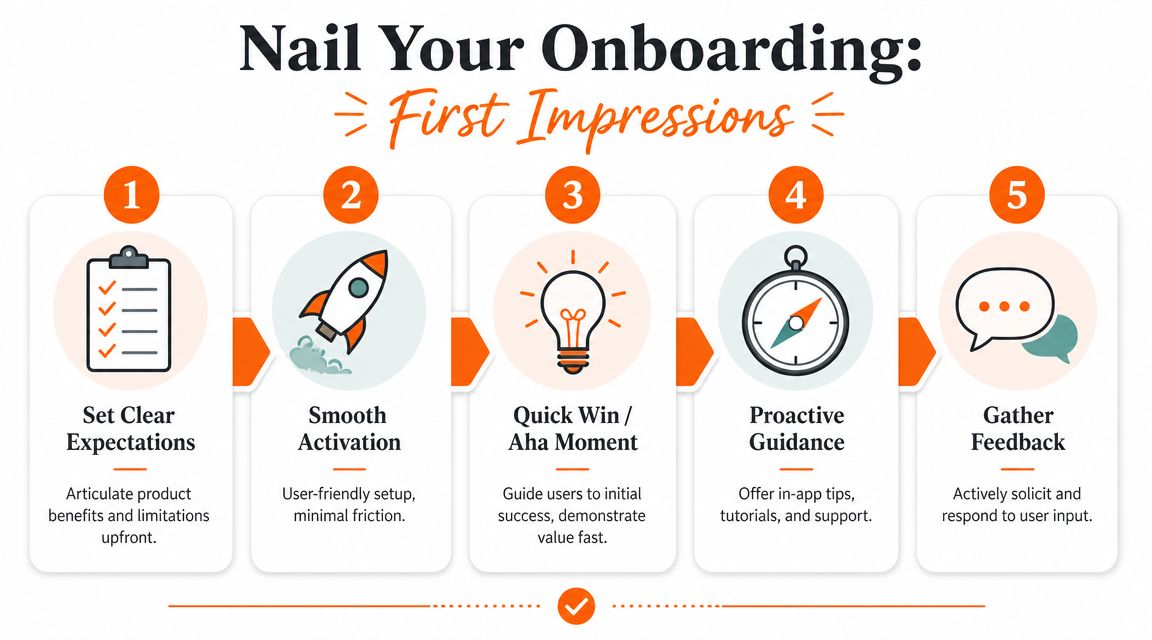
Nail Your Onboarding and First Product Experience
The sale is not the finish line. It’s the first trust test.
Customers buy with hope. Then they look for confirmation that they made the right call. Your onboarding either calms that anxiety or pours gas on it. A messy first experience feels like getting on a plane where nobody can find the pilot.
Move people to a quick win
Research shows 74% of consumers build trust when a business quickly resolves their concerns, 79% prioritize companies that protect their data, 83% become loyal when complaints are resolved well, and 75% won’t buy from a company they don’t trust with their data, based on this trust research summary.
That tells you what matters right after purchase. Speed. Calm. Security.
Your first product experience should do five things well:
- Confirm the decision: Send a clean welcome note that says what happens next.
- Reduce friction: Remove extra steps, extra clicks, and extra confusion.
- Create one early success: Give the customer a small win fast.
- Make support easy to find: Don’t bury help behind forms and menus.
- Signal data care: Tell them how you handle their information.
If you need ideas for the first note a customer sees, I’d look at examples of effective welcome messages. Don’t copy the tone blindly. Steal the structure.
Build a boring onboarding system
I mean that as a compliment. Boring is good here. Boring means repeatable. Boring means customers know what’s happening.
For a physical product, your onboarding can be as simple as:
- Order confirmation: “We got it. Here’s what happens next.”
- Shipping update: “Your package is moving. Here’s the tracking link.”
- First-use guide: One page, not a giant manual.
- Check-in message: “Did setup go smoothly?”
For a service or software product, use a short sequence:
| Moment | What you send |
|---|---|
| Right after purchase | Welcome email with login, next steps, support contact |
| First day | One task to complete, not ten |
| Early use | A short tutorial or founder video |
| First question | Fast human reply |
| First week | Check-in plus one feedback question |
Treat data protection like part of the product
A lot of small founders act like security is for bigger companies. Wrong. A customer doesn’t care how early you are. They care whether you handle their information responsibly.
Use secure payment tools. Keep customer access limited to what’s necessary. Don’t ask for extra data you don’t need. Write a plain-English privacy policy. If you store anything sensitive, tell people why.
Your onboarding doesn’t need to feel expensive. It needs to feel intentional.
You don’t need enterprise software to do this. You need a checklist, a support inbox you actively watch, and the discipline to think from the customer’s side of the screen.
Communicate Consistently and Proactively
Silence makes customers nervous.
You don’t need to email people every day. You do need a rhythm. If customers only hear from you when you want money or when there’s a problem, trust stays shallow. If they hear from you with useful updates, practical tips, and honest check-ins, trust deepens.

Keep a simple communication cadence
According to Moxo’s guide on building trust with customers and clients, 80% of clients cite communication as their top trust factor. The same source says acting on feedback can boost retention by 30%, and consistent value-add communication can increase loyalty by 25-40%.
That’s a giant clue. Most founders under-communicate because they’re busy. I get it. Busy still costs you.
My favorite cadence is simple:
- Weekly or every other week: Send one useful update.
- Monthly: Ask one sharp feedback question.
- When something changes: Tell customers before they have to ask.
- When nothing changes: Say that too, if they’re waiting on something.
Useful updates beat promotional fluff every time.
Share something that helps, not something that performs
A good customer update can include:
- One lesson: A better way to use the product.
- One behind-the-scenes note: What you improved.
- One honest heads-up: A delay, a change, a known issue.
- One ask: A question that helps you improve.
That last part matters. Feedback should not disappear into a black hole. If a customer suggests something smart and you act on it, tell them. People trust businesses that listen in public and fix things in plain sight.
If you ask for feedback and never mention it again, customers learn that your questions are decoration.
Here’s a useful reminder on communication habits:
Don’t confuse consistency with volume
You are not trying to become noise. You are trying to become reliable.
A simple message like “We heard from several customers that setup was confusing, so we rewrote the guide and added screenshots” does more for trust than a polished newsletter full of empty inspiration. Customers want signals that you’re paying attention.
Use whatever tools are already in your stack. Gmail. Klaviyo. Substack. Help Scout. A shared inbox. It matters less which tool you use. It matters that you show up the same way over time.
Turn Problems into Trust-Building Moments
Your customer relationship gets real when something breaks.
That could be a late shipment, a buggy feature, a confusing setup, or a customer who woke up already irritated. You can’t avoid every problem. You can decide whether the problem makes you look slippery or dependable.
Handle the first reply like it matters
Data shows 60% of customer churn comes from poor onboarding and adoption support, and relationship-first models that support customers through early struggles see 25% higher retention, according to Digital Leadership’s discussion of underserved customer needs.
That means your response after the sale matters as much as your sales process. Maybe more.
If a customer writes, “I can’t get this to work,” don’t start with defense. Start here:
- Acknowledge the frustration
- Take ownership of the next step
- Give a clear path forward
- Follow up until it’s resolved
Use plain scripts
A shipping delay:
“You’re right to be annoyed. Your order is late, and that’s on us to fix. Here’s what I know right now, and here’s when I’ll update you next.”
A buggy product experience:
“Thanks for flagging this. I reproduced the issue, and I’m working on it now. Here’s the workaround for today, and I’ll message you again as soon as the fix is live.”
A customer who is upset but unclear:
“I can tell this has been frustrating. I want to make this easier. Can you send me a screenshot or quick note on where you got stuck? I’ll take it from there.”
That tone matters. Calm. Direct. No legalese. No weird over-explaining.
If you want more help on handling tense situations without getting dragged into ego battles, I’d read this piece on dealing with difficult customers.
Complaints are expensive gifts
Most founders take complaints personally. Bad move.
Complaints are one of the fastest ways to find friction in your product, your messaging, or your process. If the same complaint shows up twice, it’s not a one-off. It’s a system issue wearing a customer’s face.
When you solve a problem well, you give the customer a new story to tell. “They messed up” can become “they handled it fast and treated me well.” That second story is where trust gets stronger.
Measure What Matters and Give Back
If trust is real, you should be able to see it in your business.
I’m not talking about vanity metrics. I don’t care how many people liked your post about customer care. I care whether customers stay, refer friends, and say good things without being bribed into it.
Track the signals that reveal trust
Keep it simple. Watch these three buckets:
| Metric | What it tells you |
|---|---|
| Retention | Do customers stick around after the first excitement fades? |
| Reviews and replies | Do they describe you as clear, helpful, and reliable? |
| Referrals | Do they trust you enough to put their own reputation on the line? |
If you want a cleaner framework for customer health and retention, Halo AI's customer success guide is a useful resource. Don’t build a giant dashboard just because software makes it easy. Pick a few measures you’ll review.
Use trust data to improve behavior
Look at customer comments next to churn. Look at support threads next to repeat purchases. Look at referrals next to onboarding quality. Patterns show up fast when you stop staring only at revenue.
You don’t need perfect attribution. You need honesty. If customers leave after setup, fix setup. If they stay when support feels human, invest there. If referrals come after you solve problems well, train your team or yourself to respond better.
The businesses people trust usually do ordinary things with unusual consistency.
Give back once trust starts compounding
This part matters to me.
A strong business should make you more generous, not more guarded. Once you figure out how to build trust with customers, help someone else skip a few painful mistakes. Share the playbook. Make an intro. Tell the truth about what didn’t work.
That kind of giving creates better companies and better founders. If you care about building a business that helps people and stays human while it grows, I’d also think about your broader role in the community through practical social impact strategies.
Trust isn’t soft. It’s visible in retention, referrals, and how customers talk about you when you’re not in the room. Build it on purpose.
If you’re a kind, bold, hard-working founder in Chicago or the Midwest, Chicago Brandstarters is where you can build alongside people who tell the truth, share real war stories, and help each other grow without the usual networking nonsense. If that sounds like your kind of room, come join us.
Leave a Reply