Most advice on how to create a referral program is built for brands that sell socks, software, or meal kits. It tells you to slap a discount on a page, send a blast, and wait for “growth.”
I think that advice is wrong for community-first founders.
If you’re building around trust, taste, and actual relationships, a bad referral program will do more harm than good. It will attract people who want the reward, not people who fit the room. And once the room changes, your brand changes with it.
A referral program should screen for values. It should reward generosity. It should make your current people proud to bring someone in.
Why Most Referral Programs Will Fail You
Most referral programs fail because they copy e-commerce tactics into places where they don’t belong.
That’s the first problem. The second is worse. They assume every referral is good. It isn’t. In a founder community, one wrong person can change the tone fast. The loud self-promoter doesn’t just annoy people. They make honest people quieter.
The generic playbook is obsessed with cash, coupon codes, and easy scale. That playbook ignores a real issue for vetted communities: how do you invite growth without damaging confidentiality and trust? That gap is one reason 67% of community programs fail due to mismatched rewards, according to this write-up on referral program fit for communities.
Cash is easy. Easy is not the same as smart.
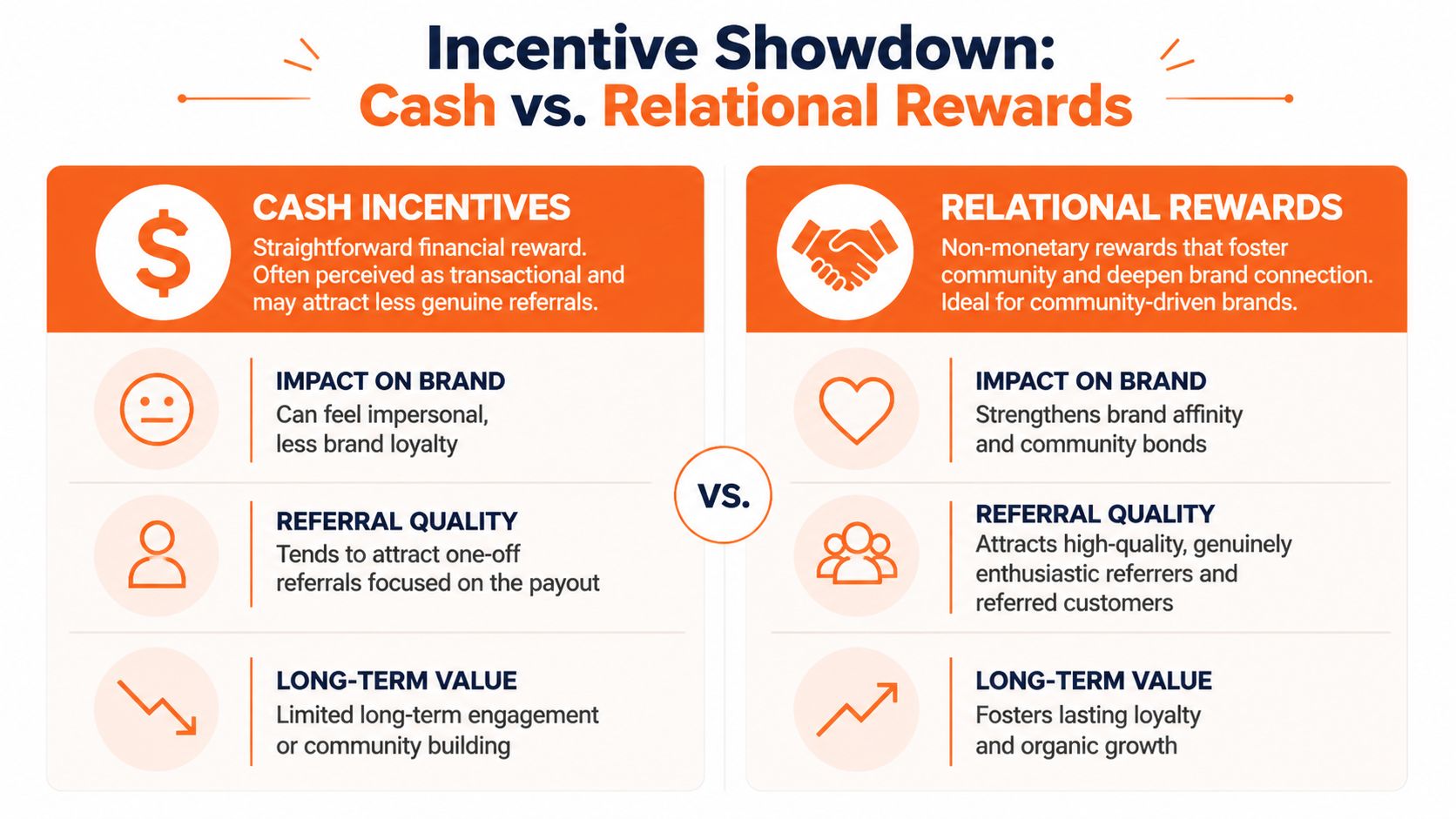
Cash rewards are simple to explain, but they often send the wrong signal. They tell your members, “Bring me anyone.” That is fine if you run a commodity business. It’s a bad move if your product is the quality of the people inside.
For a founder network, the reward itself teaches people what matters.
If the reward is cash, people optimize for volume.
If the reward is access, trust, or recognition, people think harder about who they bring.
Your referral program is a filter. Treat it like one.
That’s why I’d rather see a founder use relational incentives than default to discounts. Priority invites. Private dinners. A thoughtful intro. Public appreciation in the right room. Those rewards feel smaller on paper, but they often attract better behavior.
If you want a useful outside example of structured advocacy without turning your brand into a coupon machine, study these successful brand ambassador strategies. The overlap is simple: both ambassador programs and referral programs work better when people feel ownership, not when they feel bought.
Your program is part of your culture
A referral program isn’t a side tactic. It is culture with incentives attached.
That means your rules need to match your values. If you say you care about kindness, vulnerability, and hard work, then reward the people who bring more of that into the group. Don’t reward whoever can spray the most links into the internet.
I’ve seen founders overcomplicate this. They think they need a fancy growth mechanism. They don’t. They need a clear point of view about who belongs.
If you don’t know that, no software will save you.
Define Your Real Goal Before You Build Anything
Before you pick rewards, software, or copy, decide what success means.
If you skip this, your referral program will look organized and act confused. That’s like building a house from a stack of lumber with no blueprint. You might end up with walls. You won’t end up with something stable.

Pick one main outcome
A lot of founders say they want “more referrals.” That’s not a goal. That’s a channel.
A real goal sounds like one of these:
- Bring in better-fit founders who stay active
- Increase retention among referred members or customers
- Strengthen the community by bringing in people who participate well
- Reduce dependence on paid acquisition and lean more on trust
If you’re learning how to create a referral program, start with quality. The economics point that way. Referral programs deliver 3 to 5 times higher conversion rates, and referred customers have 16% higher lifetime value and 37% better retention, according to Rivo’s referral program statistics. Rivo also gives a simple example: if your average customer is worth $300, a referred one is worth $375.
That should change how you think.
Don’t ask, “How do I get more people to refer?”
Ask, “How do I get the right people to refer the right people?”
Don’t invite everyone to participate
Founders often get sloppy at this stage. They launch to everyone because that feels fair. It isn’t smart.
Your first referral partners should be your natural evangelists. The people who already show up. The people who reply thoughtfully. The people who have sent others your way without being asked. If someone likes your brand but doesn’t understand its values, they are a weak referrer.
Practical rule: Your first referrers should already act like hosts, not customers.
Use behavior, not vibes. Look at who engages in your emails, who attends events, who gives thoughtful feedback, and who has a network that overlaps with your ideal members.
Write down the few metrics that matter
You don’t need a giant dashboard on day one. You need a short list.
Start with:
Participation rate
How many invited people share?Conversion rate
How many referred people join, buy, or apply?Quality outcome
Do referred people stay, engage, and fit the culture?
A more software-focused breakdown can help if you want a second lens. This SaaS referral program guide is useful for seeing how teams structure mechanics, even if you end up using a more community-first reward model.
Later, once you know the goal, you can map the reward and the system to it.
Here’s a good walkthrough on setting goals and mechanics before you build:
Designing Incentives That Attract Kind Givers
At this stage, most referral programs get lazy.
They use money because money is easy to explain. But easy doesn’t mean right. For a community-driven brand, cash often flattens the relationship. It turns a thoughtful introduction into a transaction.
I prefer incentives that deepen belonging.
Use two-sided rewards
The strongest structure is a two-sided referral model, where both the referrer and the new person get something. That model is the most effective, and the reward should match the effort and your values, as explained in Salesforce’s guide to referral programs.
For a community, that can look like this:
- The referrer gets priority access to a small event
- The new member gets expedited onboarding
- The referrer gets a thoughtful introduction
- The new member gets a warm welcome in the group
- Both get something that feels human, not generic
That matters because referrals are social risk. When someone refers a friend, they are spending reputation. If only one side benefits, the exchange can feel lopsided.
Choose rewards that fit the room
If you run a founder community, your best incentives usually are not discounts. They are signals of trust and access.
Here’s the comparison I use.
| Attribute | Transactional Rewards (Cash, Discounts) | Relational Rewards (Access, Recognition) |
|---|---|---|
| What it says | “Bring me a lead” | “Bring me a good fit” |
| Emotional tone | Commercial | Personal |
| Who it attracts | People chasing payouts | People who care about fit |
| Effect on culture | Can cheapen the exchange | Can strengthen the group |
| Best use case | Commodity products, broad audiences | Vetted communities, founder circles |
| Examples | Gift card, discount, account credit | Dinner invite, fast-track onboarding, mentor intro, private thank-you |
Good rewards feel specific
The best non-cash rewards are concrete. “Exclusive access” is vague. “Priority invite to next month’s founder dinner” is clear. “Recognition” is fluffy. “A personal shoutout in the private group after your referral joins” is real.
Try options like these:
- Access: Early invite to a small dinner or workshop
- Status: Public appreciation in a private founder space
- Connection: One warm intro to someone relevant in your network
- Experience: A seat in a small off-calendar session
- Ease for the new member: Faster onboarding or a direct welcome thread
If you need a gut check on whether your reward builds the kind of trust you want, this piece on how to build trust with customers is useful. The same principle applies here. People refer when trust feels protected.
If your reward would make a thoughtful founder cringe, don’t use it.
My opinion on cash
Cash isn’t evil. It’s just blunt.
If your audience already has strong trust, cash can work as a light nudge. But if you lead with cash, you train people to think the referral is about the payout. In a confidential founder community, that’s a bad first impression.
I’d start with relational rewards first. Then, if needed, layer in a modest transactional element later. Keep the soul of the program relational.
That’s how you attract kind givers. You reward behavior you want repeated.
The Tech and Ops to Make Your Program Run
You do not need expensive software to start.
You need a system that is clear, trackable, and boring enough to run every week. Founders love tools. What they usually need is follow-through.

Start ugly
My favorite early setup is this:
- Google Form for the referrer to submit the person’s name and contact info
- Google Sheet or Airtable to track status
- Email tool like ConvertKit, Mailchimp, or Kit for basic automations
- Calendar reminder so someone follows up
That setup is enough to prove whether people want to refer and whether the referrals are any good.
Your spreadsheet only needs a few columns at first:
| Field | Why it matters |
|---|---|
| Referrer name | You need to know who made the intro |
| Referred person | Basic tracking |
| Date submitted | So nothing sits too long |
| Status | New, contacted, joined, rejected, rewarded |
| Reward sent | Prevents awkward misses |
| Quality notes | Quick note on fit and engagement |
Automate the obvious parts
The communication flow matters more than founders think. If someone refers a friend and hears nothing, your program feels broken.
A proven sequence includes an immediate auto-reply when someone shares, milestone emails when a referrer hits a target, and a re-engagement email around day 7 if nothing happens, according to KickoffLabs’ referral program walkthrough. They also point out that this works through conditional logic, whether you build it yourself or buy software.
So set up three things:
Instant confirmation
“Got it. Thanks for the intro. We’ll review and follow up.”Milestone celebration
If someone keeps referring strong people, acknowledge it right away.Re-engagement
If they signed up but never referred anyone, send a short reminder with a simpler path to share.
People don’t need more reminders. They need less friction.
Upgrade only when manual work hurts
Once your spreadsheet starts breaking, move to software with referral links, codes, and event-based triggers. Tools like KickoffLabs, Referral Rock, or a lightweight stack with Zapier can handle this well.
At that point, build around these rules:
- Track attribution clearly so you know who referred whom
- Validate referrals before rewards go out so you don’t reward junk submissions
- Send status updates so the referrer isn’t left guessing
- Document the workflow so this doesn’t live in your head
A simple internal process doc helps a lot. If you need a model, this guide on how to create standard operating procedures maps the mindset well. The same discipline applies here.
One practical note. Your referral page or form should include plain-language terms. Who qualifies. When rewards are sent. What happens if a referral is already in your pipeline. Keep it simple and visible.
If you want a community option in the stack, Chicago Brandstarters is one example of a vetted founder network with private dinners and group chat dynamics that can inform how you design high-trust referral flows. That matters when your “product” is the room itself.
Launching and Promoting Your Referral Program
Don’t launch your referral program with a giant blast.
That move feels efficient. It usually creates noise, weak referrals, and confusion. A referral program works better when it begins like a dinner party, not a parade. Start with the people who already get what you’re building.
The soft launch I’d use
I’d begin with a short list of your strongest advocates. Not “top customers” in a spreadsheet sense. I mean the people who naturally talk about you with care. The ones who already make intros thoughtfully.
Reach out one by one. Use email, text, or voice note. Keep it personal.
Here’s the structure:
- Tell them why you picked them
- Explain who is a fit
- Give them one simple way to refer
- Tell them what happens next
- Thank them before they do anything
That approach changes the energy. They don’t feel recruited into a campaign. They feel invited into a role.
The exact outreach email
Subject: Quick ask
Hi [First Name],
I’m opening a small referral circle for [brand/community].
I thought of you because you already understand the kind of people we want around this. Thoughtful, generous, hard-working, low-ego.
If someone comes to mind, you can reply with their name and context, or use this link: [insert form or referral link].
If they’re a fit and join, I’ll make sure both of you get something meaningful out of it.
More than anything, I care about fit. I’d rather have one great referral than ten random ones.
Thanks for always speaking about this with care.
[Your Name]
That copy works because it respects the relationship. It doesn’t sound like ad copy. It sounds like a founder asking another thoughtful person for help.
I’d rather personally invite ten strong referrers than blast a thousand people who barely know me.
Make sharing stupid simple
Founders lose referrals because they make people think too much.
Give your advocates plug-and-play assets:
- A one-line text they can send to a friend
- A short email template for a warmer intro
- A simple referral link if you use one
- A sentence on fit so they know who to send
For example:
Text version
“Hey, I’m part of a founder group you’d probably like. It’s thoughtful, honest, and low-BS. Want an intro?”
Email version
“Thought of you because this feels like your kind of room. Happy to connect you if helpful.”
Short beats clever. Personal beats polished.
Talk about the program in the right places
You don’t need to mention the program everywhere. You need to mention it where trust already exists.
Good places include:
- After a strong event
- In a thoughtful onboarding email
- In a thank-you note after someone says they got value
- In a private message after someone praises the group or product
Bad places include spammy popups, loud homepage banners, and generic social posts that invite anyone with a pulse.
A referral program grows best when it feels like an invitation, not a promotion.
Measuring Success and Avoiding Common Pitfalls
Most founders measure referral programs the wrong way.
They stare at signup volume because it’s visible. But volume can lie to you. A pile of low-fit referrals is not momentum. It’s cleanup work.
If you want to know whether your program is healthy, track trust and behavior after the referral.

Measure what happens after the intro
Soft metrics are a useful, yet often overlooked, angle. Emerging 2025 data points to 40% higher LTV from high-trust referrals, and it argues for tracking metrics like referral-to-active-chat-participation rate, as covered in LivePlan’s piece on launching a business referral program.
That’s the right idea for founder communities and relationship-heavy brands.
Track a small set like this:
Referral-to-accepted rate
How many referrals are good enough to bring in?Referral-to-active-participation rate
Do referred people join the chat, attend, respond, or contribute?Retention of referred people
Do they stay engaged over time?Source quality
Which referrers keep sending people who fit?
If retention is part of your larger growth plan, this guide on customer retention tactics is worth reviewing alongside your referral dashboard. Bad retention usually means the referral promise and the actual experience don’t match.
Build a simple dashboard
You do not need a business intelligence stack.
A clear sheet or Airtable view can track:
| Metric | What it tells you |
|---|---|
| Referrals submitted | Program activity |
| Referrals accepted | Fit quality |
| Referrals active after joining | Real engagement |
| Top referrers | Who to thank and nurture |
| Reward status | Whether you’re operating cleanly |
Review it on a set cadence. Weekly is fine. The point is to spot patterns before they become habits.
Avoid these mistakes
I keep seeing the same failures.
- Complicated rules: If people need a FAQ just to share, you lost them.
- Weak rewards: If the incentive feels generic, thoughtful people ignore it.
- Poor visibility: If nobody sees the program at the right moment, it won’t move.
- Slow follow-up: Delay kills trust.
- No thank-you: People remember when they were generous and you acted casual about it.
The fastest way to kill a referral program is to make generous people feel used.
My advice is simple. Keep the mechanics clean. Keep the rewards human. Keep your standards high.
That’s how to create a referral program that improves the brand instead of cheapening it.
If you’re building in the Midwest and want a room full of kind, hard-working founders who care about trust as much as growth, take a look at Chicago Brandstarters. It’s a free, vetted community built for people who want honest support, durable relationships, and a better way to grow.
Leave a Reply