
You've got a product idea, a handful of opinions, and no clear decision. One customer loves the concept. Your friend thinks the name is clever. Someone on LinkedIn says the pricing feels high. A poll gives you a neat answer that doesn't explain what anyone would do.
That isn't research. It's noise with a calendar invite.
Focus group facilitation gives you a practical way to turn messy reactions into usable direction. You don't need a research panel, a rented facility, or a large budget. You need a narrow decision, the right participants, a disciplined discussion guide, and enough control to stop politeness from masquerading as demand.
Why Most Founder Research Sessions Fail Before They Start
Most founder-led sessions fail before anyone joins the call. The founder starts with a product instead of a decision, asks broad questions, then reacts visibly when participants praise or criticize the idea. The group quickly learns which answer the founder wants.
That creates a polite consensus. People nod because the founder seems invested. One confident participant talks the most. Quiet participants disappear. Friends and family soften their answers because they care about the relationship. By the end, you've collected approval, not evidence.
The method has always required more discipline than casual conversation. The modern focus group developed during World War II, when Paul Lazarsfeld and Robert K. Merton used group interviewing at Columbia University's Bureau of Applied Social Research to study propaganda, radio broadcasts, morale, and media effects, as documented in this history of the focused interview method. The early format used controlled stimuli and guided follow-up questions, then later became common in marketing under the term “focus group.”
The founder traps that ruin the room
- Vague questions: “What do you think of this?” produces scattered reactions. Ask about a real behavior, decision, or obstacle.
- Leading prompts: “Would this save you time?” tells participants what answer sounds useful.
- Dominant voices: The loudest person can turn the session into a personal monologue.
- Groupthink: Early agreement pressures everyone else toward the same safe response.
- Founder participation: If you defend the product, you stop moderating and start selling.
Write one sentence before you recruit anyone: “After this session, I need to decide whether to change X, keep Y, or test Z.” That sentence controls the questions, the screener, and the final readout.
Practical rule: A focus group is a research session, not a pitch meeting with better snacks.
Use market research guidance for new products to place focus groups alongside other early-stage methods, then keep this method focused on reactions, objections, language, and decision context. A well-run 90-minute group with six strangers can give you more usable direction than a month of Twitter polls because you can ask why, challenge contradictions, and watch people respond to one another.
Define the Goal and Recruit the Right Six to Eight People
Recruitment starts with the decision, not the demographic profile. If you recruit broadly, you'll spend the session asking people who aren't buyers to imagine a problem they don't have.
Start with one decision-style question:
“Should we launch this product for independent fitness coaches, or should we reposition it for boutique gym owners?”
That question gives you a recruiting filter. It also keeps the conversation from drifting into general feedback about your entire business.
Turn the decision into a screener
Write a short screener with questions that verify behavior. For the fitness example, ask:
- What type of fitness work do you do?
- How do you currently manage client programming?
- When did you last pay for software related to your work?
- What did you choose, and why?
- Walk me through the last time your current process became frustrating.
You're screening for relevance and articulation, not polished marketing opinions. Ask applicants to describe a recent experience in a message or short call. Someone who gives a specific answer about what happened, what they tried, and what they did next will usually give you more to work with than someone who says, “That sounds cool.”
Founders without a panel can recruit from existing customers, a waitlist, niche communities, Slack groups, and lightweight posts on Instagram or LinkedIn. State the audience plainly and ask interested people to answer the screener. Don't publish the concept in detail before the session. You want participants who bring their own context, not people who arrive ready to reward your idea.
If you're still defining your audience, the EmailScout persona guide can help you translate customer traits into sharper recruiting criteria. Use it to describe who already has the problem, how they behave, and what separates a real buyer from a curious observer.
Keep the group small enough to manage
Training materials commonly treat six to eight participants as a practical focus group size because the group can include different viewpoints without making the conversation impossible to control, as described in this focus group workshop guide. Qualitative research doesn't aim for population-proportion estimates. It aims to surface language, patterns, conflict, and context.
Send each candidate a short message or schedule a 15-minute screening conversation. Confirm that they fit the audience, can describe recent behavior, understand the session format, and will speak comfortably in a group. Exclude close friends, family, direct reports, and anyone who has a personal relationship with you. Their kindness can compromise the data.
Build a Discussion Guide That Earns Honest Answers
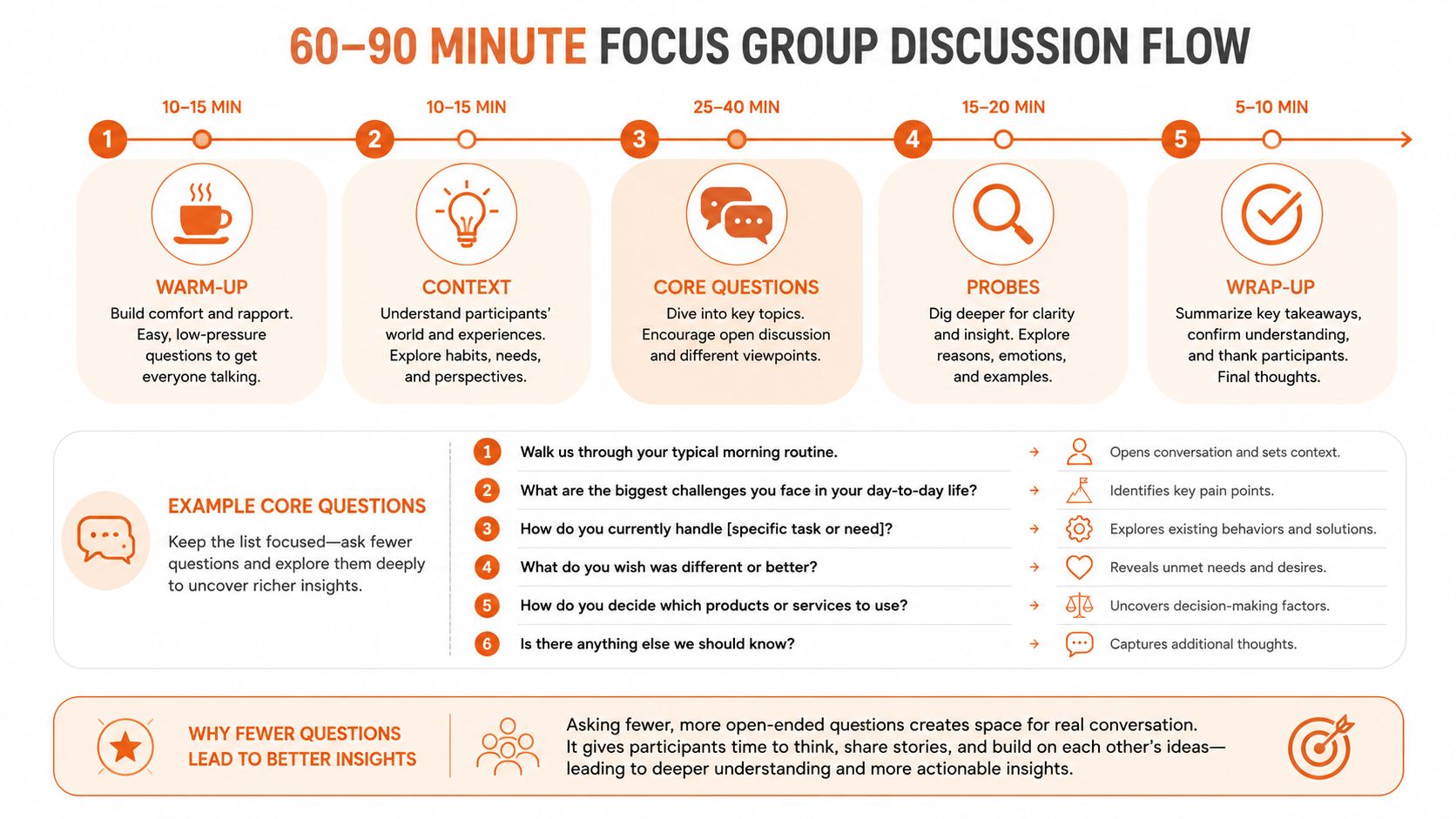
A good guide gives the group a path without turning you into a robot. For a 60 to 90 minute session, move from an icebreaker into context, then the core questions, follow-up probes, and a wrap-up, following the practical structure recommended in focus group facilitation guidance.
Use five to seven real questions
You don't need a list of 20 questions. Write five to seven substantial questions, then prepare probes underneath each one.
A product session might ask:
- “Walk me through the last time you tried to solve this problem.”
- “What did you use?”
- “What worked well enough?”
- “Where did the process break down?”
- “What did you do next?”
- “What would make you switch?”
- “What would have to be true for you to buy a new solution?”
A branding session can ask which words participants use when describing the problem, what they expect from a company in the category, and which parts of a message feel unclear. A pricing session should start with how they currently spend money, what they compare, and what makes a purchase feel risky. Don't begin by asking whether your proposed price “feels fair.” Participants can judge a number in theory without ever buying at that price.
Use open wording and ask one question at a time. “Can you say more about that?” works better than “Why do you think that?” because the second phrase can sound like a challenge, according to this moderator tips sheet.
Make participants do something
Silent writing can protect the room from early groupthink. Show a product concept, ask everyone to write their first reaction privately, then invite discussion. You can also ask participants to rank what matters most, circle confusing language, or rewrite a headline in their own words.
Place stimuli after you understand current behavior. If you show the product immediately, every later answer becomes a reaction to your design. First learn how participants handle the problem today. Then show the concept and ask what changed in their thinking.
Use laddering when a surface answer needs depth. If someone says, “I want it to be simple,” ask what simple would let them do, then what that would change in their work. Keep probing until you reach a decision, fear, habit, or desired outcome.
You can find a related interview structure in this guide to customer discovery interviews, but don't copy an interview into a group. A group needs room for comparison and disagreement.
Choose Your Format and Lock Down Logistics
Format changes the room before the first question. In person, you can read posture, eye contact, hesitation, and side conversations more easily. Remote sessions let you recruit across geography and record with less coordination, but they add failure points that can fracture the discussion.
A Zoom focus group can lose momentum when someone can't unmute, drops off the call, checks another window, or joins from a space where others can hear the conversation. A 2021 review of Zoom focus groups identified limited attendance, technical difficulties, low engagement, and privacy risks, with recommendations that included backup hosts, pretesting, waiting rooms, passwords, and shorter sessions in this review of online focus group methods.
Compare the trade-offs
| Variable | In-Person | Remote (Zoom/Lookback) |
|---|---|---|
| Rapport | Easier to build through shared space and natural conversation | Requires more active turn-taking and personal check-ins |
| Nonverbal cues | Easier to observe posture, eye contact, and side reactions | Limited by camera angle, lighting, and off-camera behavior |
| Recruitment | Restricted by geography and travel | Reaches participants across locations |
| Technical risk | Usually lower once the room is ready | Includes connection, microphone, camera, recording, and privacy failures |
| Stimuli | Printed materials and physical products work well | Screen sharing and digital files work well |
| Privacy | Requires a private room and clear consent | Requires passwords, waiting rooms, recording controls, and private participant spaces |
For a first session, choose in person or fully remote. Skip hybrid. A remote participant will struggle to enter a conversation dominated by people sitting together, and you'll miss much of what happens off camera.
If you meet in person, arrange chairs in a circle or semicircle so everyone can see faces. If possible, use a private room with one-way observation. Display ground rules covering confidentiality, respect, active participation, and the idea that listening matters as much as talking, following this facilitation checklist.
Lock the operating details
Confirm attendance 24 hours before the session. Send the calendar block with the address or dial-in, prepare printed stimuli or shared files, test recording permissions, and give observers one rule: they don't ask leading questions.
Budget a $50 to $150 incentive paid the same day. Tell participants the amount and payment timing before they commit. For remote sessions, ask people to use a quiet private space, test the platform, and keep a backup contact method available.
If your session needs a physical room and workshop-style interaction, review in-person workshop planning before you book anything.
Run the Room With Confidence
Moderation is mostly restraint. You need to keep the discussion moving without signaling which answer you prefer.
Open by stating the purpose, introducing yourself and the note-taker, confirming recording consent, and reminding participants that there are no wrong answers. Then explain the ground rules. Tell them you'll sometimes interrupt to make room for others, and that disagreement helps you understand the subject.
Use your guide as scaffolding, not a script. If a participant introduces a relevant issue, follow it. If the group spends 20 minutes debating a side detail, bring them back to the decision you wrote at the top of the guide.
Five moves that produce better answers
- Ask for the opposite: “Who sees this differently?” Agreement can hide uncertainty.
- Pause: Wait three full seconds after someone answers. People often keep talking when you don't rush to fill the silence.
- Invite the quiet voice: “I'm curious what you think, Maya.” Use a soft invitation rather than putting someone on trial.
- Redirect the dominant voice: “Let's hear from someone we haven't heard from yet.”
- Probe the decision moment: “Walk me through the moment you decided that.”
Stay neutral in your words and body language. Don't smile harder at praise or frown at criticism. Don't defend your product. If someone says the onboarding looks confusing, ask what they expected to happen next.
Watch what people do
Write down who leans in, who checks a phone, who laughs after another person speaks, and who changes posture when price appears. These cues don't prove what someone believes, but they tell you where to probe.
Assign one note-taker or capture audio with consent so you can stay present. A moderator who tries to listen, type, manage time, and share stimuli will miss the room.
End with one direct question:
“What would have to be true for you to actually buy this?”
Give everyone time to answer. Their conditions often tell you more than their general enthusiasm.
Turn Raw Notes Into Decisions You Can Defend
Start synthesis within 24 hours while you still remember the tone, pauses, and moments that changed the energy. Read the notes once without trying to make the product win. Record your first reactions separately, then compare them with what participants said.
Separate signal from polite consensus
If two people explain a problem with conviction and three others nod without adding detail, the two detailed accounts carry more weight than the nodding. Agreement can mean shared experience, politeness, uncertainty, or simple fatigue.
Pull exact participant language under each theme. Keep the quote tied to the context, the behavior, and the decision it may affect. Disagreement deserves its own space. When one participant says a feature would save time and another says it would create more work, don't average those views. Find out whether they have different workflows, budgets, roles, or levels of urgency.
A focus group can't tell you that a particular percentage of customers think something. It isn't statistically generalizable in the population-proportion sense, so claims like “X% of customers think Y” don't belong in your readout, as explained in this guidance on focus group design and saturation. Use the discussion to identify themes and decisions that need another test.
Build a simple affinity map
Write every distinct observation on a sticky note. Cluster similar notes, then label each cluster with one sentence that says what you learned.
For example:
- Current workaround: Coaches copy plans between spreadsheets and messaging apps.
- Purchase barrier: They fear another tool will create duplicate admin.
- Language: They say “client follow-through,” not “engagement.”
- Decision condition: They need proof that setup won't interrupt existing sessions.
Then write a one-page readout with four sections:
- What we asked
- What we learned
- What surprised us
- What we recommend doing next week
The recommendation must name an action. Rewrite the onboarding flow. Test the “client follow-through” message. Remove the feature that creates duplicate admin. Recruit another audience. Don't write “gather more insights” unless you can say exactly what uncertainty remains.
For a useful comparison between structured analysis approaches, review these survey insights for product managers and adapt the discipline to qualitative notes. A focus group is not a vote. Three people passionately describing the same pain can matter more than six people saying a feature sounds nice.
Common Pitfalls and Your First Session Checklist
Founders often worry about asking the perfect question. The quieter danger is letting a flawed session produce confident decisions.
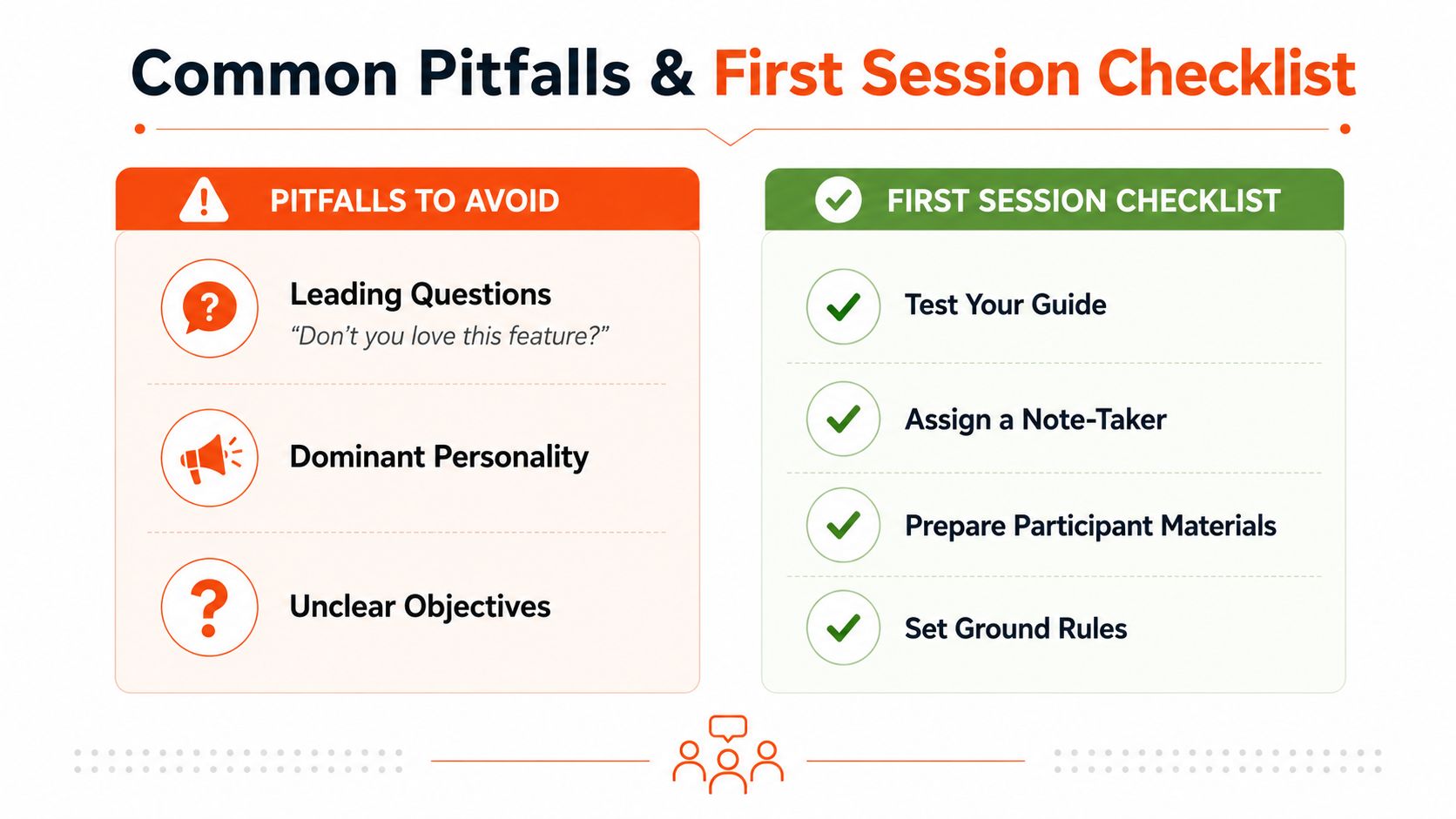
- Leading questions: “Don't you love this feature?” telegraphs the answer. Ask what participants noticed, expected, or would do.
- Dominant personality: One loud participant can set the group's vocabulary. Interrupt politely and invite someone else in.
- Friends and family: People close to you may protect your feelings. Recruit people with the problem and no relationship with you.
- One session treated as truth: A single group gives direction, not proof. Run more groups when important themes remain unclear, and look for information saturation rather than a neat vote.
- Ignoring silence: A quiet participant may lack confidence, disagree privately, or need more time. Invite them in and ask what they noticed.
- Politeness mistaken for agreement: A nod without a story is weak evidence. Ask for a recent example or a decision they made.
Focus group research guidance recommends multiple groups per audience, with one source suggesting three to four groups per target audience as a useful benchmark for recurring themes, as detailed in this focus group toolkit. You can still run a single afternoon session for a fast decision, but label the result correctly. It's directional input, not a market estimate.
Your afternoon checklist
- Write the decision: State the single choice the session should inform.
- Build the screener: Recruit for recent behavior, relevance, and willingness to explain.
- Draft the guide: Use five to seven real questions with probes.
- Confirm incentives: Tell participants the amount and pay the same day.
- Get recording consent: Test the device or platform before anyone arrives.
- Assign a note-taker: Keep yourself focused on the room.
- Set ground rules: Cover confidentiality, respect, participation, and listening.
- Plan the next action: Reserve time the next day to create the one-page readout.
Chicago Brandstarters gives founders a place to discuss practical research questions with a vetted community of Chicago and Midwestern builders through private 6–8 person gatherings and an active group chat. Visit Chicago Brandstarters to connect with peers who can pressure-test your research plan, recruitment approach, and next decision.
Leave a Reply