
Buy equipment before year-end to lower your taxes. That advice can leave you with a smaller tax bill and too little money to make payroll. I'd rather you keep a useful cash cushion than buy a machine you don't need for a deduction you can't use yet.
I treat taxes for less as a runway decision. You want to pay what you legally owe while keeping enough cash to build something customers will buy.
What Taxes for Less Means for Your Cash
Say you run a small product brand. You have supplier invoices coming due, an uneven sales calendar, and a tax estimate that looks larger than your available balance. Your first move shouldn't be another purchase. I'd start by separating money you can spend from money you already owe.
A deduction lowers the income you use to calculate tax. A credit reduces the tax bill itself. Think of a deduction as lowering the price tag and a credit as applying a coupon at checkout. Neither makes an unnecessary purchase sensible.
My cash rule: Judge a tax decision by what remains in your account after the purchase and the tax effect.
Start With Money You Already Spend
If you haven't reached profitability, don't shop for write-offs. Put your energy into clean accounts, complete expense records, and a reserve you can maintain through slow sales periods.
- Separate business money. Use a dedicated checking account and card so you can distinguish operating costs from groceries.
- Connect personal and business income. Your wages, side-hustle earnings, and pass-through income can meet on your personal return.
- Check the jurisdiction. Treat federal tax breaks as a starting point. Ask your preparer how your state and city handle the same transaction.
I want your tax plan to support rent, inventory, and payroll. A return with impressive deductions won't help if you can't fund your next production run.
The 2026 Numbers That Change Your Bill
Start with your filing status. Then look at the business provisions you might qualify to use. Don't build a purchase plan around the largest deduction on the page.
For tax year 2026, IRS Publication 505 lists standard deductions of $16,100 for single taxpayers and married people filing separately, $24,150 for heads of household, and $32,200 for married couples filing jointly or qualifying surviving spouses. You generally choose the standard deduction or eligible itemized deductions, rather than adding both together.
2026 Federal Figures Founders Should Look Up First
| Lever | 2026 federal figure | What it does | Cash warning |
|---|---|---|---|
| Single or married filing separately | Standard deduction $16,100 | Shields income before brackets | Compare eligible itemized deductions before choosing |
| Head of household | Standard deduction $24,150 | Gives you a larger personal shield | Confirm that you meet the household tests |
| Married filing jointly or qualifying surviving spouse | Standard deduction $32,200 | Shields income on your return | Check state treatment separately |
| Single bracket steps | 10% to $12,400; 12% next; 22% above $50,400; 24% above $105,700; 32% above $201,775; 35% above $256,225; 37% above $640,600 | Applies a separate rate to each slice | Don't apply your top rate to every dollar |
| Joint bracket steps | 10% to $24,800; 12% next; 22% above $100,800; 24% above $211,400; 32% above $403,550; 35% above $512,450; 37% above $768,700 | Gives joint filers wider steps | Confirm filing status before planning |
| Qualified business income | 20% deduction, now permanent | Reduces qualifying pass-through income | Check wage, income, and loss restrictions |
| Excess business loss | Permanent limitation, indexed for inflation | Restricts the business loss you can use currently | You still bear the cash loss |
| Section 179 | Expensing limit $2.5 million | Lets you expense qualifying property currently | Check taxable-income limits and available cash |
| Bonus depreciation | 100% for qualifying property acquired after January 19, 2025 | Accelerates the deduction into the first year | You leave less basis for later deductions |
The IRS guide for individuals and workers gives the 2026 marginal bracket rates and thresholds shown above. Read those brackets as stairs, not an elevator that carries all your income to the top rate.
Apply the Steps in Order
Using the standard-deduction figures, a single founder with $50,000 of income generally starts with $33,900 before applying brackets, subject to the rest of the tax rules. You apply the lowest bracket to the first slice of taxable income and the next rate only to the next slice.
That distinction matters when you price work or consider another sale. You don't lose the benefit of earlier brackets because you earn enough to reach a higher one.
Keep income tax separate from your complete tax forecast, too. A founder's reserve may need to cover self-employment tax, state tax, and other obligations beyond the federal income-tax calculation.
The business rows require more judgment than the filing-status rows. Before you count on them, ask your preparer to confirm the property, acquisition timing, business use, available profit, and elections. Don't treat an expensing ceiling as permission to spend up to it.
Ordinary Costs That Lower the Bill
I'd rather see you capture legitimate costs consistently than chase an exotic write-off. Start with expenses you already incur to operate: your workspace, software, inventory, paid help, and business travel.
Use a simple test. Does the cost belong to the business, and can you explain why you incurred it? An ordinary expense fits your trade; a necessary expense helps you conduct it. Personal spending doesn't become business spending because you use the company card.
Common Business Costs and the Proof You Keep
| Expense | Tax treatment | Proof you keep |
|---|---|---|
| Rent for a workspace | Deduct business-use rent | Lease and proof of payment |
| Software and subscriptions | Deduct ordinary operating costs; review prepaid or capital items separately | Invoices and card statements |
| Contractor fees | Deduct legitimate work costs under your accounting method | W-9, invoice, and payment evidence |
| Inventory and supplies | Account for cost of goods sold or supplies you use | Purchase invoices and inventory count |
| Business travel | Deduct eligible costs for a business-purpose trip | Receipts and trip log |
| Business meals | Generally deduct only the allowed portion | Receipt with attendees and purpose |
| Wages | Deduct eligible compensation under your accounting method | Payroll filings and payment records |
Don't treat buying inventory as identical to consuming office supplies. If you still hold products for sale, you need to account for that stock correctly. Your purchase invoice alone doesn't tell your preparer how much inventory you sold or still have.
The same care applies to mixed-purpose spending. If you extend a supplier trip for a personal holiday, separate those costs while you still remember them. Don't hand your CPA a hotel total and expect a defensible allocation from memory.
Make the Receipt Useful
- Capture the document. Upload the receipt or invoice to QuickBooks, Xero, or your bookkeeping folder while you have it.
- Write the purpose. Add the supplier meeting, project, customer, or job that explains the purchase.
- Use a consistent category. Keep meals separate from travel and inventory separate from general supplies.
- Resolve missing proof. Ask the vendor for a duplicate invoice instead of guessing at filing time.
A bank statement proves that you paid someone. It often won't explain what you bought. I want both the transaction and the business reason before I count an expense in a planning forecast.
Buy Lease or Wait Before You Deduct
I won't let a deduction make the purchase decision for you. Start with the work you need to accomplish, then compare ownership, leasing, and postponement.
Use these jars to think about when you give up access to cash.
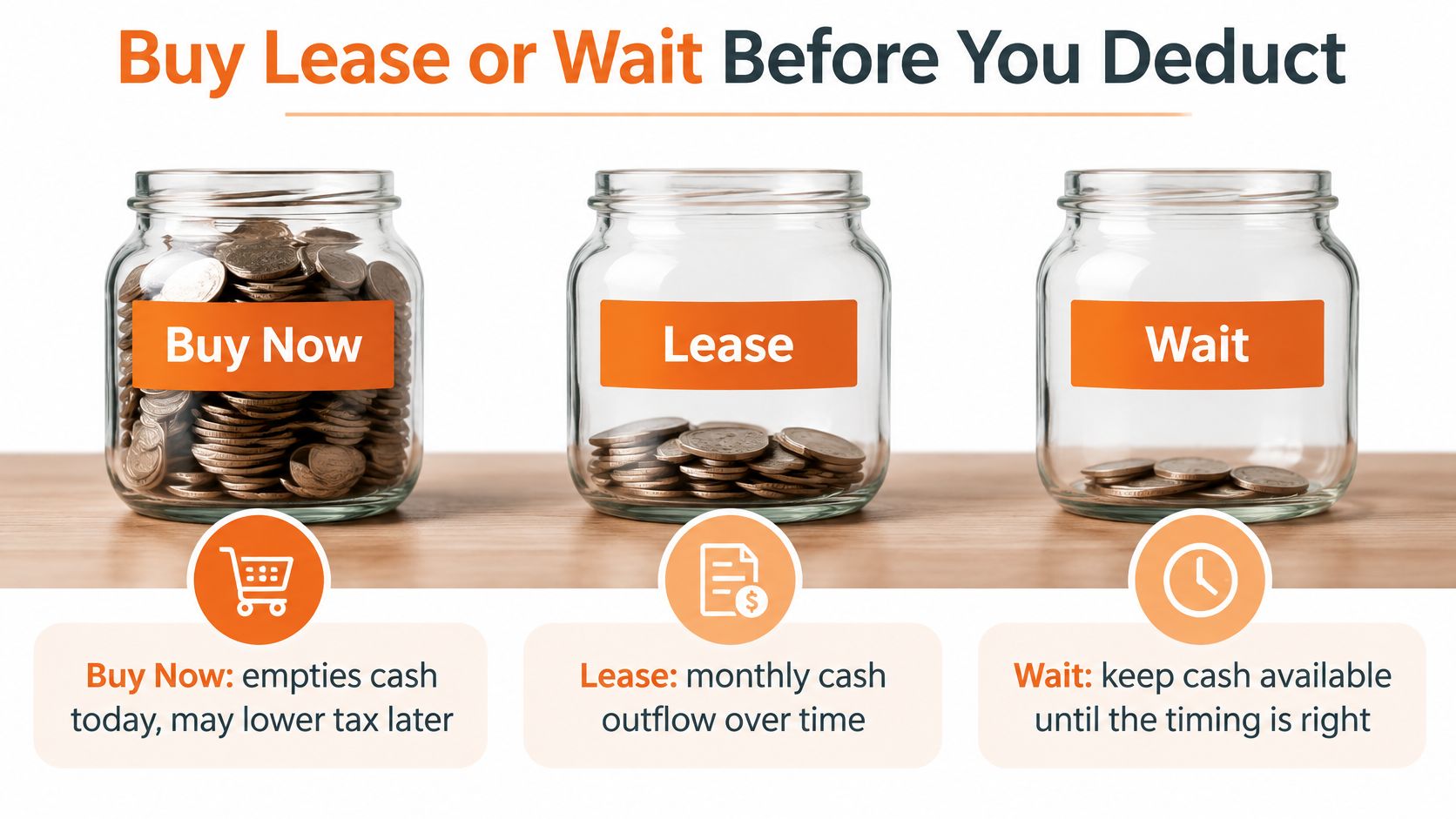
Compare the Cash You Keep
| Choice | Cash effect | Tax consideration | When I'd consider it |
|---|---|---|---|
| Buy now | Pay the purchase price or take on financing | Claim eligible depreciation or expensing | You have proven demand and productive use |
| Lease | Commit to payments over the contract | Review lease classification and deduction timing | You need capacity without a large upfront outlay |
| Wait | Keep cash available | Claim no deduction for an asset you haven't acquired | You're still testing demand |
The IRS Tax Guide for Small Business describes the permanent 20% qualified business income deduction, the permanent, inflation-indexed excess-business-loss limitation, the $2.5 million Section 179 limit, and 100% first-year depreciation for qualifying property acquired after January 19, 2025. Those provisions affect deduction timing and eligibility. They don't turn weak economics into a good purchase.
Say you're considering a packaging machine. If you already have repeat orders and spend heavily on outside packing, ownership may improve your operating cash flow. If you're still changing package sizes and testing your product, you could buy equipment you soon outgrow or abandon.
Ask Before You Commit
- Will it earn its cost? Compare expected labor savings or contribution profit with purchase, installation, maintenance, and financing costs.
- Can you use the deduction? Have your CPA model taxable profit, loss restrictions, and the effect on qualified business income.
- Can you survive the outflow? Leave enough for supplier deposits, payroll, returns, and slow customer payments.
- What happens later? Consider remaining basis, a future sale, and state treatment.
A paper deduction is a bad use of cash when you buy something you wouldn't want without the tax break.
I'd buy for established demand, lease when flexibility justifies the contract, and wait when the product still needs proof. Don't assume leasing always protects runway, either. Read the deposit, personal guarantee, cancellation terms, and total commitment before you sign.
Contractor Payments and the Cash You Set Aside
A missing tax form doesn't make income tax-free. Keep your duty as the payer separate from the recipient's duty to report earnings.
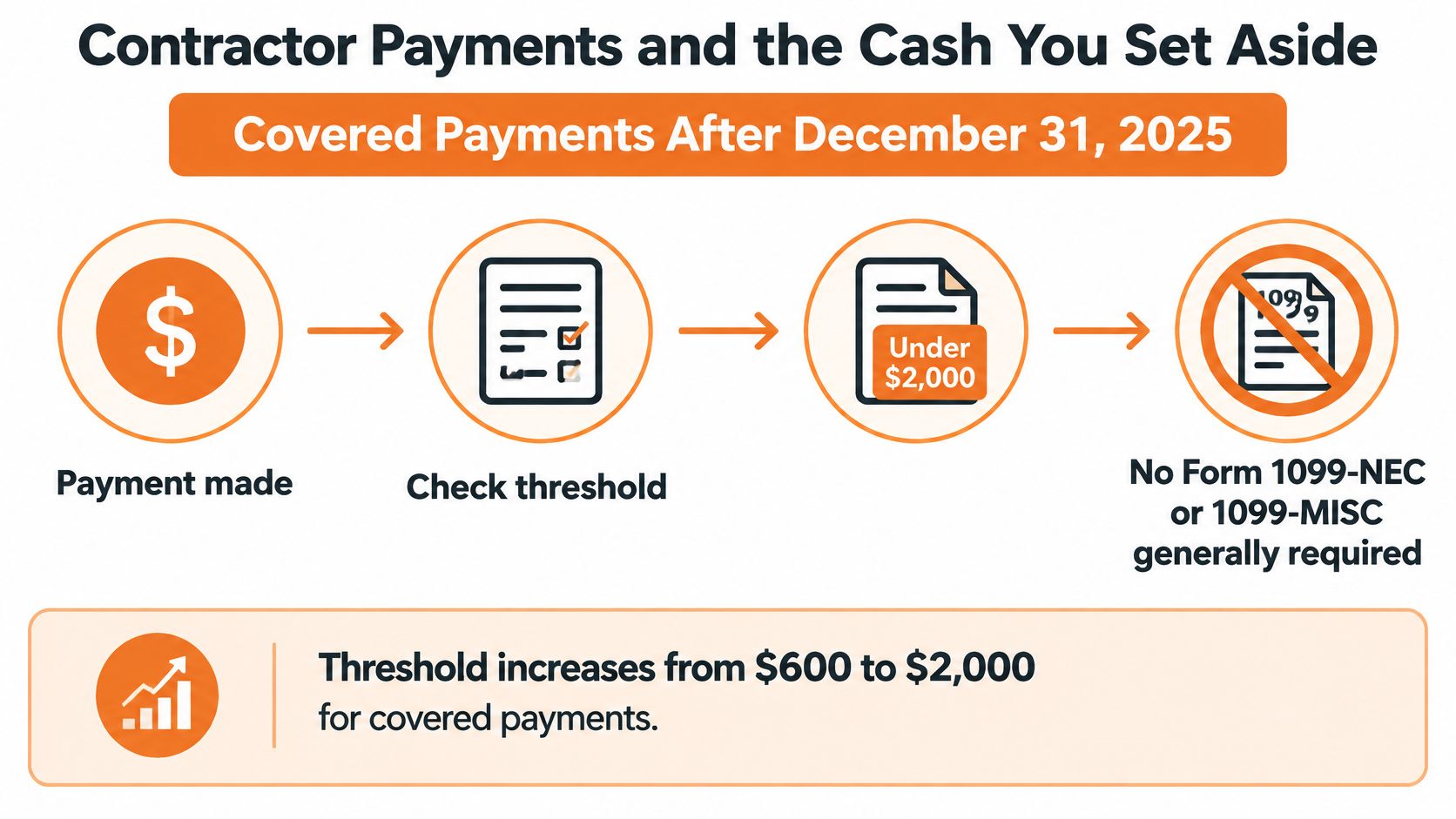
For covered payments made after December 31, 2025, the IRS Internal Revenue Bulletin generally raises the Form 1099-NEC and 1099-MISC reporting threshold from $600 to $2,000. The IRS says the change affects approximately 3.6 million taxpayers, about 98% of whom are small entities with gross receipts under $40 million.
Use this flow for the covered-payment threshold, then check payment-channel rules and recipient exceptions.
Payment Method, 2026 Reporting, and Records
| Payment method | 2026 reporting rule | Records you still keep | Is the income taxed |
|---|---|---|---|
| Check, ACH, or cash to a contractor | Generally issue 1099-NEC at $2,000 of covered payments | W-9, invoice, and proof of payment | Yes, even below the threshold |
| Covered 1099-MISC payments | Generally apply the same $2,000 floor after December 31, 2025 | Contract and payment log | Yes |
| Card or payment app | A processor may report instead of you; check the transaction type | Match deposits to invoices | Yes |
| Marketplace or platform payout | The platform may issue its own form | Export the payout report | Yes |
| Covered payments under $2,000 | Generally no information return under this threshold | Keep receipts and bookkeeping entries | Yes |
| Your own sole-proprietor profit | Don't issue yourself a contractor form | Separate account and profit log | Yes, and estimates may be due |
Build a Pay-and-Reserve Routine
- Collect the W-9 first. Get the contractor's tax information before the first payment, rather than chasing it during filing season.
- Identify the channel. Record whether you paid by check, ACH, card, or a platform. Don't assume every payment app handles reporting identically.
- Book the work promptly. Save the invoice and assign the expense to the correct project or category.
- Monitor covered annual totals. Review cumulative payments by recipient and have your preparer confirm which forms you must file.
- Fund the tax reserve. Move money when you earn profit, then update the reserve against your projected liability.
I wouldn't prescribe a universal reserve percentage without your household income, state, credits, and entity details. Ask your CPA to calculate a working percentage and estimated-payment schedule, then apply that percentage consistently.
For irregular revenue, separate the profitable launch from the quieter month that follows it. Don't spend the tax portion of a strong launch replenishing stock and assume future sales will cover the estimate.
Reconcile platform gross sales, fees, refunds, and net deposits. If you record only what reaches your bank, you can lose the detail you need to explain both revenue and expenses.
Entity Choice Credits and Retirement Plans
Entity choice deserves a spreadsheet, not a slogan. I'd compare your current structure with an alternative using the profit you can reasonably sustain, including the cost of running it.
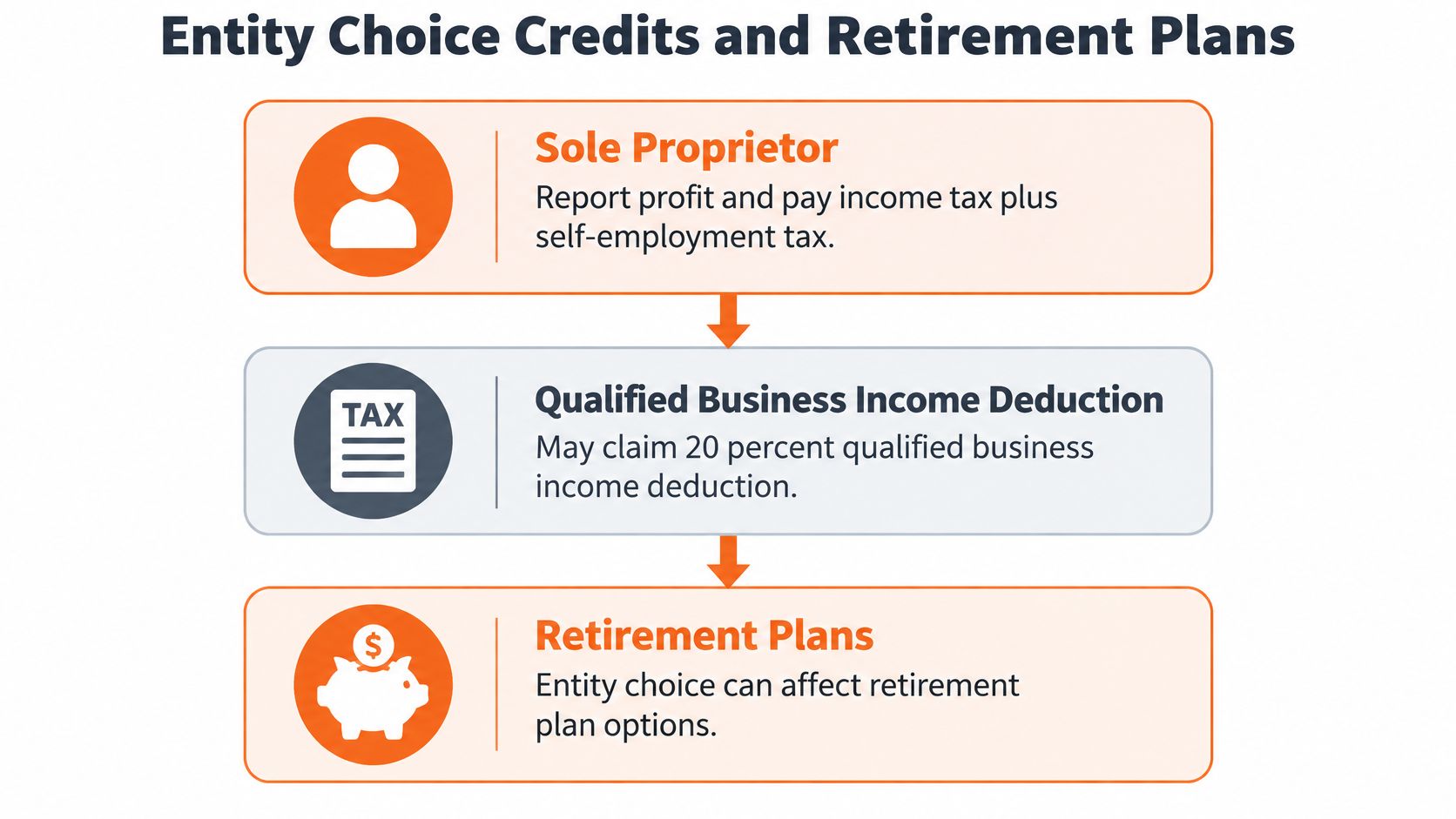
As a sole proprietor, you generally report business profit on your personal return and pay applicable income and self-employment taxes. If you qualify, you may also claim the qualified business income deduction. A single-member LLC doesn't automatically change that federal treatment.
Use this diagram as a starting point for the questions, not a recommendation to change entities.
Make the Salary Comparison Honest
With an S corporation, you must address reasonable compensation when you work in the business. You pay payroll taxes on salary; distributions generally don't carry employment tax in the same way.
That distinction doesn't guarantee savings. You also take on payroll administration, separate return preparation, state obligations, and a salary you can defend. Owner wages don't count as qualified business income, so include that effect in the comparison.
- Model the same operating profit. Don't compare a strong S corporation forecast with a weak sole-proprietor year.
- Include every recurring cost. Add payroll software, professional fees, and state charges.
- Stress-test a slower year. Check whether the structure still makes sense when revenue falls.
Keep Credits and Retirement Decisions Separate
Credits depend on eligibility, not enthusiasm. For tax year 2025, the IRS Earned Income Tax Credit tables list maximum credits of $649 with no qualifying children, $4,328 with one, $7,152 with two, and $8,046 with three or more. Don't substitute those amounts into a different tax year or assume you qualify without checking income and household rules.
Retirement planning creates another cash decision. A SEP IRA or solo 401(k) may let you deduct eligible contributions, but plan rules, compensation, contribution type, and deadlines govern the result.
Don't assume an owner contribution reduces self-employment tax or every measure of business profit. Have your CPA calculate the actual return effect.
I'd fund a retirement contribution from cash you can leave invested. If you need the same money for a committed production run, protect that obligation first.
Records That Keep a Deduction Standing
Your tax authority can compare your return with information from employers, processors, and other payers. I want you to find the mismatch before you file.
Build a workspace where you can connect each bookkeeping entry to its evidence.
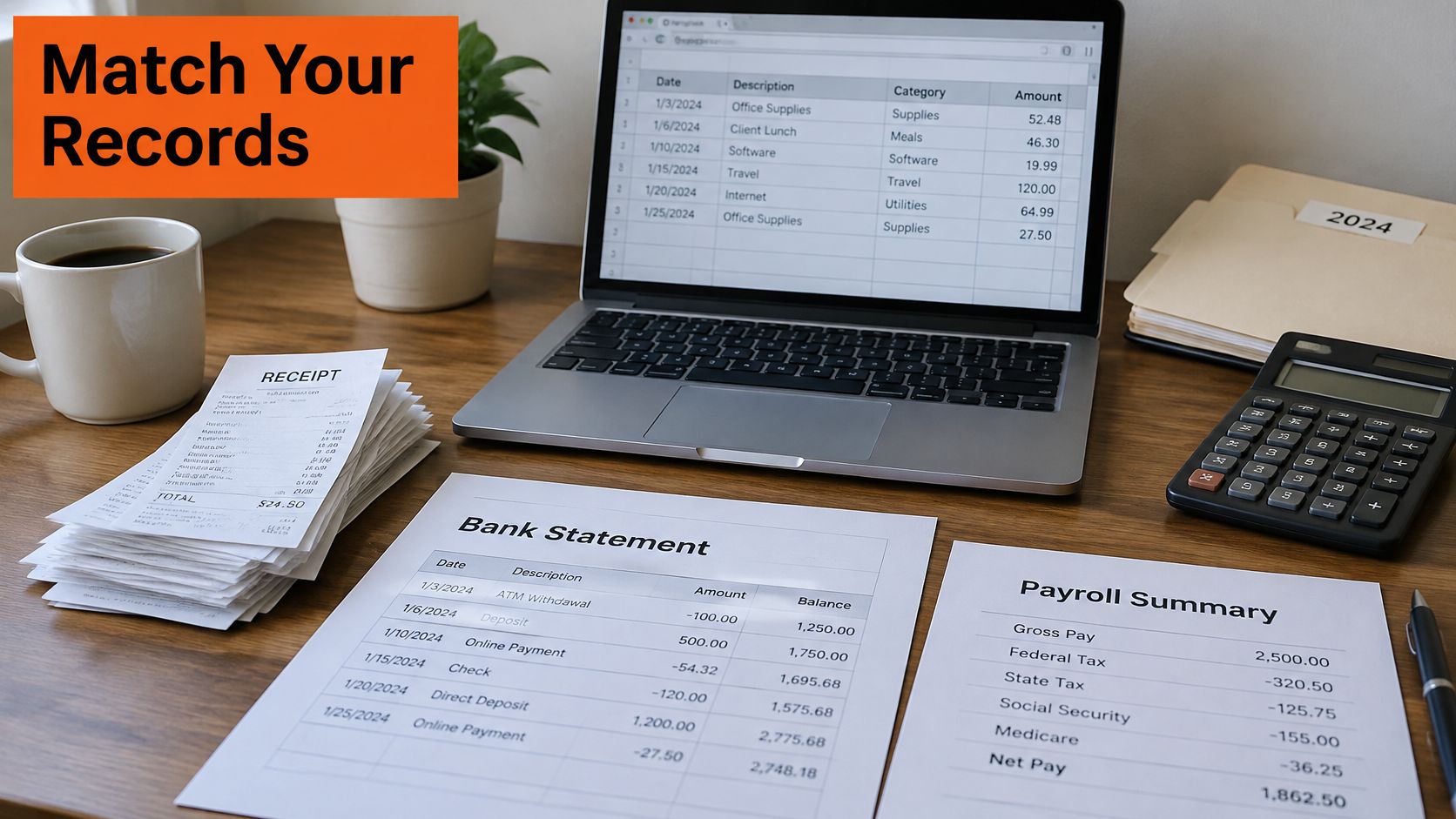
Reconcile the Monthly Piles
- Bank and card activity. Match transactions to invoices, receipts, transfers, and borrowing records.
- Payroll filings. Compare payroll reports with wage expense and tax payments.
- Processor and marketplace reports. Reconcile gross activity through fees and refunds to deposits.
- Customer and supplier invoices. Investigate unpaid balances, duplicates, and missing documents.
- Inventory records. Check purchases, sales, returns, damaged goods, and physical counts.
Don't automatically label an unexplained deposit as revenue. Put it on a review list and resolve whether you earned it, transferred it, borrowed it, or contributed it as owner capital. Likewise, seek replacement evidence for an expense before making a deduction decision.
The OECD report on tax-administration digitalisation discusses the use of structured information in tax administration. For your books, I'd translate that into a practical requirement: keep records you can reconcile, rather than a folder of disconnected screenshots.
Record the Questions Too
Use a consistent intake checklist with your preparer. Bring changes in household circumstances, business activities, ownership, payment channels, and major purchases to the conversation.
When facts conflict, investigate. If you claim a large expense against modest revenue, retain the contract and explain the business purpose. For a credit, bring the documents that establish eligibility rather than expecting your preparer to accept a confident answer.
Use the video alongside your own records review, then return to the unresolved entries in your ledger.
Keep a short decision note for an unusual position: the facts, amount, supporting documents, and reason for the treatment.
You don't need elaborate prose. You need enough detail that you and your preparer can understand the decision later without reconstructing the year from memory.
Book the CPA Before You Spend to Save
This week, open a separate tax reserve account if you don't have one. Ask your preparer for a reserve target based on your projected liability, and move the tax portion out of operating cash when profit arrives.
Each quarter, compare actual results with the forecast. Review deposits against invoices, reconcile payment-platform activity, and make any estimated payment you owe. Don't confuse a busy sales month with money you can safely withdraw.
Bring Decisions Before Transactions
Book a planning appointment before you commit when you face any of these choices:
- Entity changes. You have enough sustained profit to justify testing an S corporation salary and distribution model.
- Equipment purchases. You want accelerated deductions for a substantial asset.
- Retirement funding. You need to choose a plan, calculate a contribution, or meet a deadline.
- Credit claims. You need to establish eligibility and gather supporting documents.
- Reporting mismatches. Your books disagree with information returns or platform reports.
Bring your current profit-and-loss statement, balance sheet, cash forecast, and supporting records. Add the actual equipment quote or lease agreement if you're considering a purchase. Your CPA can compare real terms much more usefully than a vague intention to buy something deductible.
Ask for an After-Tax Cash Answer
Ask your CPA to show the purchase price, financing obligations, expected tax effect, and cash remaining under each option. Include state treatment and any effect on other deductions.
Keep the operating decision with you. A CPA can explain the tax result; you still need to decide whether customers justify the capacity and whether you can withstand a weak sales period.
For the lonely runway call, peer founders can help you question assumptions while your qualified preparer handles the tax treatment. Don't bring either group a shopping list and ask them to justify it. Bring the business problem you need to solve.
Chicago Brandstarters is a free, vetted founder community with private dinners and a group chat where you can discuss operating decisions candidly. Bring your buy, lease, or wait dilemma to other builders, while keeping tax advice with your CPA. Visit Chicago Brandstarters to explore the community and pressure-test your next use of cash.
Leave a Reply