

“Use USPS for small packages and UPS for heavy ones” gives you a starting point, not a shipping strategy. I'd match your parcel to the table below, then check your actual account price. The cheapest way to ship can change when you trim the box, cross a weight tier, or include the cost of an unsuccessful delivery.
Cheapest Carrier for Each Parcel Pattern
Cheapest carrier by parcel situation
| Parcel situation | Likely cheapest option | Fee to check |
|---|---|---|
| Light residential parcel under 1 lb | USPS Ground Advantage | None, no residential or fuel surcharge |
| Residential parcel near 10 lb or more | UPS or FedEx may win | Residential delivery fee on the current rate sheet |
| Heavy parcel to a long zone | Compare zone rates for each carrier | Zone distance changes the price |
| Oversize lightweight box | Shrink the box, then compare quotes | Dimensional weight |
| Parcel 22 to 30 inches long | USPS, if the price still fits the budget | $4.50 USPS oversize fee |
Treat those carrier choices as a shortlist. ShippyPro's carrier comparison identifies USPS Ground Advantage as a usual winner for residential parcels under 1 pound, with no residential or fuel surcharge, while UPS and FedEx often become more competitive above roughly 10 pounds or across longer zones.
For the service baseline, USPS Ground Advantage lists retail prices starting at $8.40, expected delivery in 2–5 days, tracking, and a 70-pound maximum. USPS also lists a $4.50 fee for parcels 22–30 inches long and a $10 fee for parcels longer than 30 inches.
Read each row as a quote request
For a light residential order, start with Ground Advantage. You get a useful benchmark without adding a separate residential charge to the comparison. Don't assume that its starting retail price equals the rate available through your business account.
For a heavier parcel, quote UPS and FedEx alongside USPS. The weight alone doesn't settle the choice. Your destination, carton dimensions, rate channel, and applicable fees determine what you'll pay.
For a bulky parcel, pause before you buy postage. You may save more by changing the package than by moving the same oversized carton to another carrier. Think of a delivery truck like a storage unit: empty space still takes up room.
Practical rule: Compare the same packed parcel, destination, and delivery requirement. Otherwise, you're comparing different purchases.
Keep the comparison useful
Use the last column of the table as your first inspection point. A cheap-looking private-carrier quote needs a residential-fee check. A long, light USPS parcel needs a length-fee check. A distant destination needs an actual zone-based quote.
If you're narrowing the decision to those carriers, use this UPS-versus-USPS cost comparison to frame the questions you bring to your rate calculator.
For a broader look at shipping tools and workflows, Next Point Digital's guide lets you compare shipping options for ecommerce brands. Use that kind of resource to build your shortlist, then choose with your own parcel measurements and account quotes.
I wouldn't select a permanent carrier from a general comparison chart. I'd select a default for each recurring parcel pattern, with an exception rule for orders that don't fit.
USPS Ground Advantage Rates by Weight and Zone
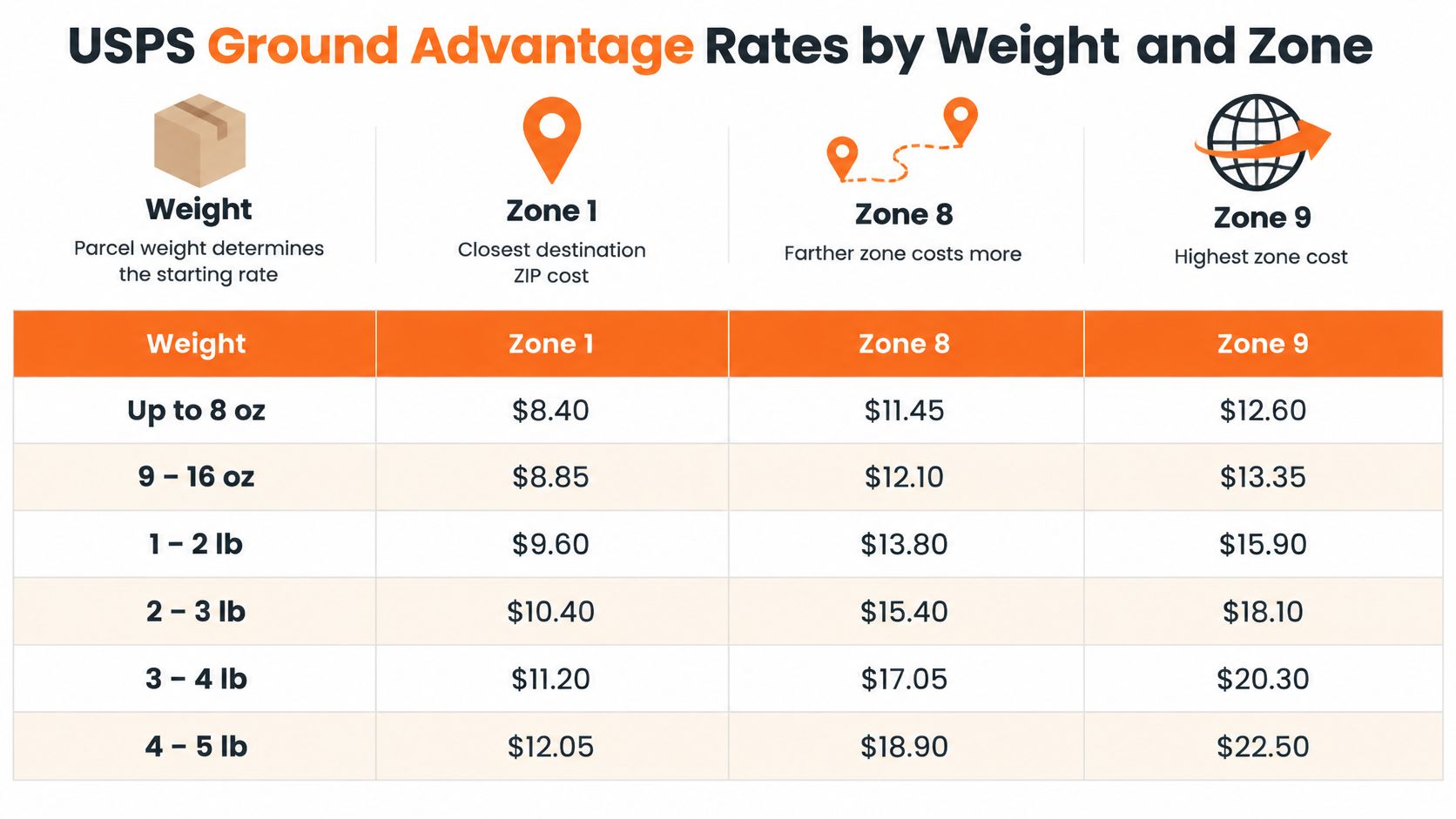
USPS Ground Advantage retail prices by weight and zone, from the USPS retail rate table:
| Package weight | Zone 1 | Zones 8 and 9 |
|---|---|---|
| Up to 8 oz | $8.40 | $10.20 |
| 12 oz to 15.999 oz | $10.05 | $13.65 |
| 2 lb | $11.30 | $19.80 |
The differences between those columns are $1.80, $3.60, and $8.50, respectively, calculated from the retail table. That's why I check the destination ZIP before recommending a shipping budget: the same product can produce a very different postage bill across the country.
Use this chart to see the relationship between parcel weight and destination zone.
Read the destination before averaging the cost
The lightest row has a smaller near-to-far price gap than the heavier row. If you sell a light accessory, you may find a national shipping allowance easier to manage. If you sell a dense product, you should inspect distant orders separately before promising the same shipping price everywhere.
An average can hide that difference. Your nearby customers may generate comfortable margins while your cross-country customers consume them. You won't spot the problem if you record postage only as a monthly total.
Also, treat the table as a retail benchmark, not a promise about your checkout or label-purchase rate. Compare it with the rate you can buy, using the same origin and destination.
Watch the ounce-to-pound boundary
USPS uses ounce-based tiers through the upper lightweight limit, then moves into pound-based pricing. Once you cross that boundary, a small amount of extra packing material can move the parcel into a different pricing structure.
That makes your finished package weight more useful than your product's catalog weight. Weigh the label, insert, mailer, cushioning, and product together. Don't build a checkout rule around the bare item.
If you use WooCommerce, consult Dotstore's USPS plugin guidance while configuring your shipping method. Check that your store passes the right product weights and package information into the quoting process.
For a visual walkthrough alongside your own rate checks, use this video.
Pull a nearby order, a distant order, and a typical middle-distance order. Look up each parcel's weight tier and zone, then record the applicable row. You'll get a more useful shipping baseline than you would from a national average alone.
Shrink the Box Before You Pay for Air
A large, almost-empty box can cost more to ship than a compact, dense one. You're buying space as well as weight, so I'd inspect the carton before spending time chasing a different carrier.
The USPS shipping guide applies dimensional weight to domestic parcels larger than 1 cubic foot, or 1,728 cubic inches, using length × width × height ÷ 139, after rounding fractional dimensions up. USPS charges the greater of actual or dimensional weight; its 24 × 18 × 16-inch example occupies 6,912 cubic inches and produces about 49.7 pounds, rounded to 50 pounds.
That calculation can overwhelm any saving you found in a headline rate. Your product doesn't need to weigh much if you surround it with enough empty space.
Know which divisor your quote uses
UPS's dimensional-weight guidance lists a divisor of 139 for Daily Rates and 166 for Retail Rates, producing rounded dimensional weights of 13 pounds and 11 pounds, respectively, for a 12 × 12 × 12-inch box.
Billable weight by carrier rate type
| Rate type | Divisor | Billable weight for a 12 x 12 x 12 inch box |
|---|---|---|
| UPS Daily Rates | 139 | 13 lb if actual weight is lower |
| UPS Retail Rates | 166 | 11 lb if actual weight is lower |
| USPS, parcels over 1 cubic foot | 139 | 13 lb mathematically, but this exact box does not exceed the size threshold |
The USPS distinction matters. Don't apply a dimensional-weight charge merely because you can calculate one. Check whether the package crosses the service's eligibility threshold first.
Likewise, the UPS figures describe dimensional weight, not an unconditional final billable weight. If your scale reading exceeds the dimensional result, use the heavier figure.
You can calculate a cheaper package before you buy a cheaper label.
Repack in a deliberate order
Weigh the finished parcel. Use a shipping scale after you add the protective materials and close the box. A product-only measurement won't tell you which tier you'll buy.
Measure the outside of the sealed carton. Use internal dimensions to decide whether your product fits, but use external dimensions for the carrier quote. Include any bulge rather than copying the nominal size printed on the box.
Calculate the applicable dimensional weight. Check the service threshold and account-specific divisor first. Compare the result with the scale weight, then retain the greater applicable figure.
Inspect your distance from a billing boundary. Don't remove protection blindly. Test whether a lighter insert, closer-fitting carton, or different cushioning material changes the billable tier without exposing the product to damage.
Quote a smaller carton and a suitable mailer. Keep the destination and account unchanged so you can isolate the packaging effect. Use a mailer only when the product can tolerate that packaging.
Pack a trial shipment. Check movement, compression, closure strength, and the customer's unpacking experience. A cheaper carton doesn't help if you need to replace its contents.
For fragile food products, Ovenbell's cookie shipping guide gives you a product-specific packaging reference. Use it when deciding what protection you need before cutting empty space.
I'd optimize protective fit, not chase the smallest possible package. You want enough room for the right cushioning, without paying to transport unnecessary air.
Lower the Base Rate Without Switching Carriers
Before moving your orders to another carrier, check whether you're buying your current service through the right channel. A retail counter purchase, an online postage purchase, and a business-account quote don't necessarily give you the same price.
Start with the changes you can test without disrupting fulfillment. Compare your online postage options, review commercial-rate eligibility, and ask your current provider what pricing applies to your shipping profile. Don't assume you need a large operation before asking the question.
Compare the lowest-effort changes first
| Lever | When I'd test it | What I'd compare |
|---|---|---|
| Online postage through Click-N-Ship | You still buy postage at the counter | Available online price against your current purchase price |
| Commercial or business pricing | You ship recurring customer orders | Your eligible rate against your existing account rate |
| Another buying channel | You already use shipping software | Final label price plus software or account charges |
| A regional-carrier quote | You have a concentrated Midwest customer base | Address coverage, collection arrangements, fees, and delivery requirements |
| Consolidated customer orders | A customer places compatible orders close together | Combined package cost against separate shipments |
| A different shipping origin | You're reviewing fulfillment locations | Postage and operating costs across your actual customer ZIPs |
USPS's online purchasing and business-pricing options make the buying channel worth checking before you abandon Ground Advantage. However, don't assume that every online price qualifies as the lowest available commercial price. Inspect the actual quote.
For regional service, request a quote rather than assuming a saving. Ask which destination addresses the carrier can serve, how you'll hand over parcels, and what happens when an order falls outside its network. A narrow service area can suit a concentrated customer base, but you still need a workable exception process.
Consolidate the right shipments
Combining compatible items for the same customer can remove a separate shipment. Quote the combined carton before changing your process, because the larger package may trigger a higher weight tier or dimensional charge.
Don't confuse batch processing with physical consolidation. Printing labels together can simplify your work, but sending unrelated orders to the same ZIP doesn't automatically reduce postage. You need an actual consolidation arrangement or a shared delivery destination to change the transportation purchase.
Customer permission matters, too. Don't hold an urgent order while waiting for another item merely to reduce your shipping expense.
Margin check: Accept a rate saving only after you subtract the extra software, handling, storage, or collection cost required to obtain it.
Treat location changes as a bigger decision
A shipping point closer to your customers may reduce destination-zone costs. But I wouldn't move inventory based on postage alone.
Compare receiving, storage, pick-and-pack, inventory transfers, and the work required to manage split stock. You can spend less on labels and more on fulfillment overall. Start with your current customer geography, then evaluate whether the operating change earns its cost.
Hidden Costs That Erase Cheap Postage
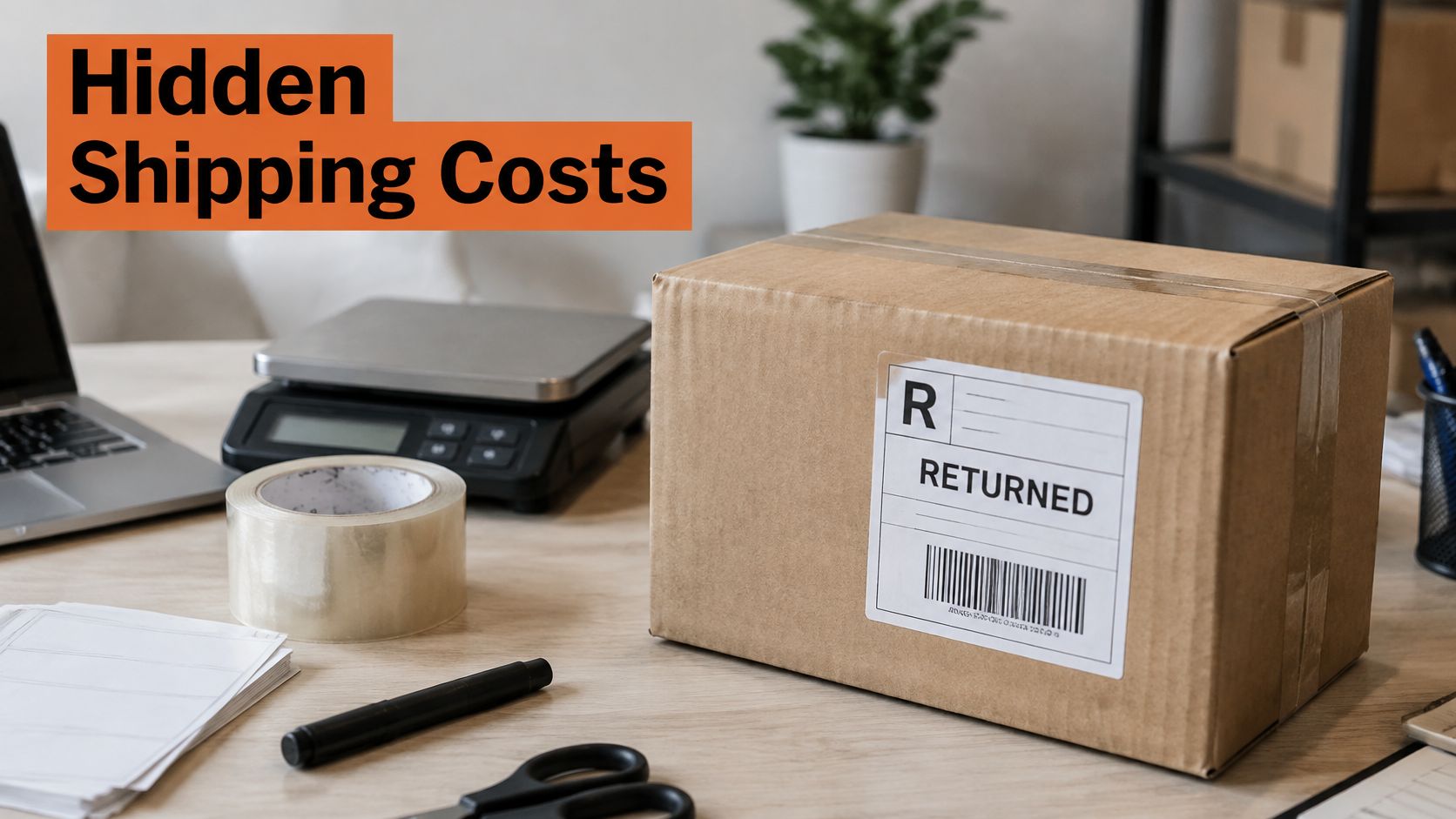
The label price is the smallest number on the invoice. The order becomes expensive when packaging, address corrections, failed delivery, replacements and returns are added to the same shipment.
In retail testing reported by Business Wire, average paid return shipping reached $10.92, rose to $16.36 in health and beauty, and fewer than 10% of retailers had home pickup for returns. A funded return can erase an outbound postage saving before support time or replacement stock enters the total.
Return reasons split the cost. A fit return points to size charts or product pages. A crushed carton points to packaging. A failed delivery points to address quality or carrier performance. Same outcome, different fix.
Price the entire order journey
Use cost per successful order to keep the comparison honest. Include the shipping-related costs you incur, then compare equivalent groups of orders.
- Outbound costs: Count postage, packaging, and applicable carrier surcharges.
- Delivery exceptions: Record reshipping, replacement packaging, and the labor spent resolving the problem.
- Return costs: Include any return label you fund and the shipping-related handling you perform.
- Recovery: Subtract reimbursements or credits you receive, since a claim is not cash until the carrier pays it.
Check delivery-area charges before promising free shipping to every address. For rural or remote customers, an attractive base quote may tell you little about the final invoice. A cheaper service can also price by dimensional weight, so carton choice can move the total more than the headline rate.
Keep product-return economics separate where necessary. If a customer returns an undamaged item because it doesn't fit, you still need to fund the return, but the fix belongs to sizing, merchandising, or product information rather than a carrier switch.
Give customers a clear default
Set the cheapest reliable service as your default. Let customers choose faster delivery when they want to fund it, and explain pickup, consolidated delivery, or reduced-packaging choices when you can support them.
Price each option from its actual cost, and do not call a lower-packaging choice environmentally preferable without evidence about that specific arrangement. Use this shipping and logistics guide when reviewing how checkout promises connect with your fulfillment process. If a promise requires manual exception work, the cheap postage is already gone.
Test Quotes on Your Own Orders Before You Commit
Run a 30-day order audit before changing carriers. That's a practical sampling window, not a claim that every brand has the same shipping mix. Choose a longer window if your recent orders don't represent your normal business.
You need comparable shipments and complete costs. A carrier can look cheap in a calculator and look different once you receive the invoice.
Build a quote sheet you can reuse
Export your orders. Group them by packed weight, external box dimensions, and destination zone. Keep unusual rush shipments separate from routine orders.
Request comparable quotes. Price USPS, UPS, and FedEx using the same parcel, destination, and required delivery window. Use the account pricing you can access rather than mixing public retail rates with discounted business rates.
Check the complete charge. Record residential, delivery-area, fuel, handling, and other applicable fees. Confirm whether the quote already includes each charge so you don't add it twice.
Attach outcome costs. Match delivered orders, failed deliveries, returns, replacements, and carrier credits to the same group. Use a consistent observation period so pending returns don't make a recent shipment group look artificially cheap.
Record these fields in your spreadsheet:
| Field | What to enter |
|---|---|
| Carrier and service | Exact service and rate channel |
| Total shipping cost | Labels, packaging, fees, and shipping-related exceptions |
| Surcharge amount | A separate subtotal for visibility |
| Failed or returned count | Outcomes within your chosen observation period |
| Successful-order count | Orders that meet your defined success criteria |
| Cost per successful order | Total relevant cost divided by successful orders |
Don't compare a group-wide cost with a single-parcel quote. Keep the numerator and denominator at the same level, and define success consistently.
Choose a default and keep exceptions
Select the lowest-cost service for your most common successful-order group. Then test a packaging change for the bulkiest group rather than forcing every order onto that carrier.
If storage and pick-and-pack costs dominate your result, compare ecommerce fulfillment approaches before renegotiating postage. Repeat your quote audit when carrier pricing, packaging, or customer geography changes, and schedule a yearly review.
Start your order export this week. Build the quote sheet before making a carrier commitment.
Chicago Brandstarters has a free, vetted community where Chicago and Midwest founders exchange practical tactics and discuss operating problems confidentially. Bring your shipping audit and packaging questions to fellow builders, and visit Chicago Brandstarters to learn about joining.
Leave a Reply