You baked two dozen cookies last night. The photos look good, and a neighbor already asked if you ship. Before you build a store, ask a harder question. Will this order still pay you after the fee, the mailer, and a box that sits on a warm porch?
I treat food online selling as a margin problem and a cold-chain problem. The website is the easy part. A $20 order can look like a win until the app takes a cut, the ice pack costs more than the cookie, and the soup arrives warm. Traffic then multiplies a loss.
I would start with the cheapest fix. Sell one product to people who can pick it up. Count what you keep. If that number is thin, more ads will not save you.
Check the Licensing Rules Before You Accept Orders
Can this product legally reach this buyer? That question sits in front of every price, photo, and shipping quote.
If you cook at home, you must check your state's cottage-food rules before you accept an online order. The rules are not the same from one state to the next. A cottage-food law summary says some states allow internet orders only when the buyer lives in the same state. Others limit sales to direct, in-person transactions or require the customer to pick up the order. Sellers may also need labels with the product name, ingredients, allergens, and a required home-kitchen statement. Sales across state lines can pull you into federal food rules instead of the simpler state cottage-food path.
Think of the law as a gate on the driveway. The cookie that is fine at a church table can be a different product the moment it rides in a mail truck.
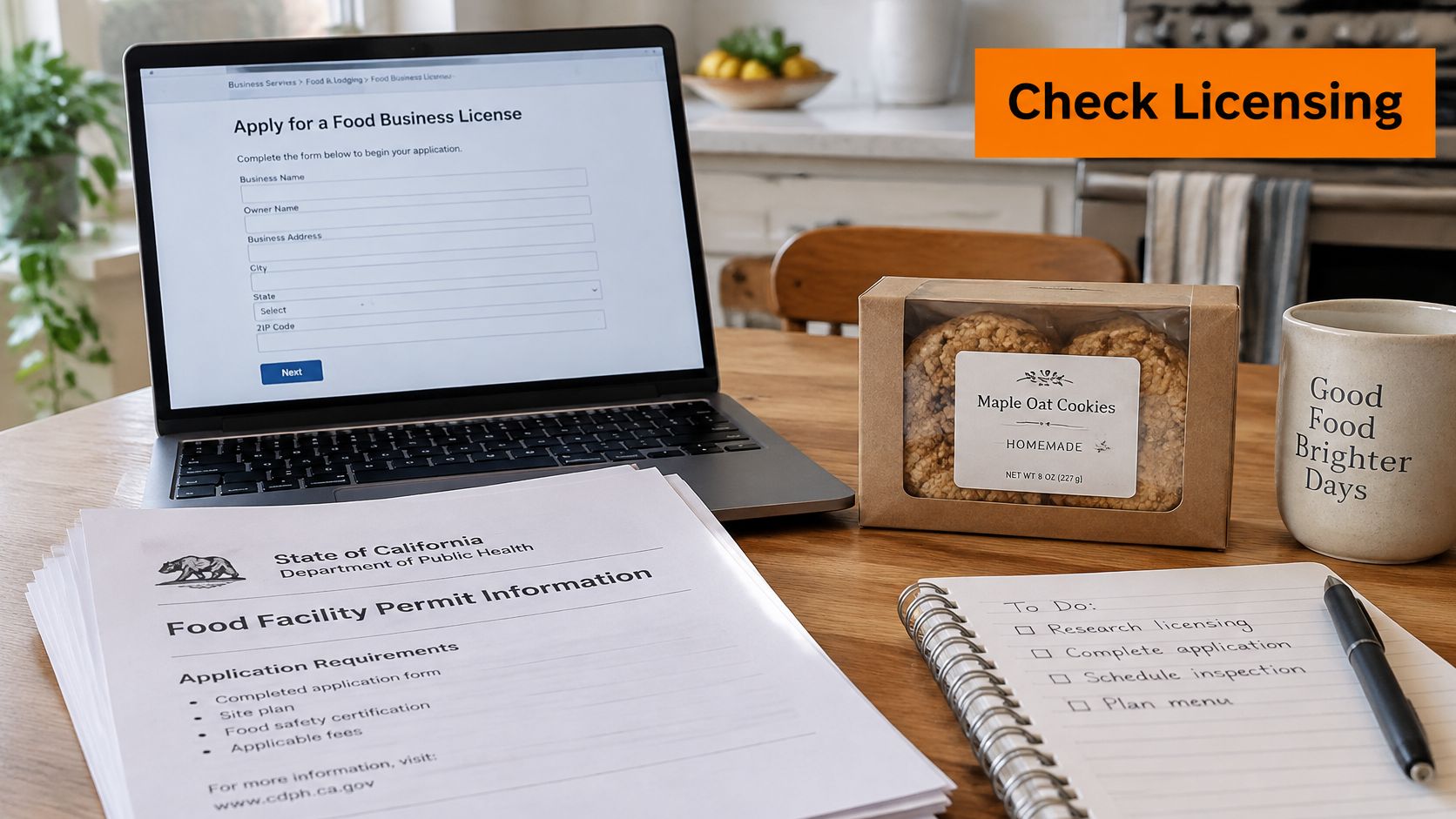
The form on your laptop is only half the job. Your recipe, your label, and your shipping plan have to match what the regulator allows.
Four cases that change the answer
| Sales case | What to check | Who confirms |
|---|---|---|
| Home kitchen, local pickup only | Whether your state allows this sale | State or county health department |
| Home kitchen, shipped within the state | Whether internet orders are allowed | State food agency |
| Home kitchen, shipped across state lines | Whether federal food rules apply | FDA and the state regulator |
| Refrigerated product | Whether home production is allowed at all | Health department |
| Any product | Label content: name, ingredients, allergens, home-kitchen statement | State labeling office |
Pickup is the narrowest gate. In-state shipping is a wider one. Crossing a state line is a different permit conversation. A refrigerated item may not fit a home-kitchen exemption at all, even if your neighbor loves it.
Run three checks in this order
- Find the cottage-food rule. Look up your state and see whether internet orders are allowed. You do this first because a checkout button can create a sale your state does not permit.
- Read the label out loud. It needs the product name, the ingredients, the allergens, and the home-kitchen statement when your state requires one. A missing allergen line is how a small order turns into a complaint you cannot unwind.
- Call with the plan. Tell your state or county health department the exact product and how it will travel, and ask for the answer in writing. A friendly phone nod disappears the week a customer complains.
Climb one rung at a time
Sell locally first. Write the recipe and keep a batch record. Test a shipment. Add a new state only after you have counted spoilage and complaints from the last one.
Practical rule: A product that is allowed for local pickup can need a different license, a different kitchen, or a different label once you ship it.
Rules change. Confirm with the regulator before you open each new state. If you sell from Chicago, check Illinois rules and anything Cook County or the city adds. The same three checks cover those local rules. Do not guess from a Facebook group and then take payment.
Pick a Channel and Check Your Margin
Pick the pipe the money runs through before you pick a logo. Each channel has a cost, a product that fits it, and a way it can eat the sale.
| Sales channel | Platform cost | Best for | Main risk |
|---|---|---|---|
| Own website | Payment fees and hosting | Shelf-stable goods shipped nationally | Shipping damage and cart abandonment |
| Delivery app | 15% to 30% per order | Ready meals within one city | Thin margin after commission |
| App pickup | 6% commission on pickup orders | Nearby buyers who collect their order | Smaller reach |
| Farmers market pre-order | Booth fee and card processing | Local baked goods and preserves | Sales limited to market days |
Your own website keeps the sticker price. You also have to bring the buyers. A delivery app brings the buyers and takes a cut that feels like rent on every ticket.
Third-party delivery platforms commonly charge restaurants 15% to 30% of each order, before some businesses add payment-processing, advertising, or premium-placement costs, according to the Independent Restaurant Coalition. A restaurant that sells a $40 order on a 30% plan keeps $28 before food, labor, packaging, taxes, and other expenses.
What the app plans actually cost
DoorDash's merchant plans show the spread in plain numbers. Basic charges 15%. Plus charges 25%. Premier charges 30%. Higher plans add a wider delivery radius, DashPass access, more visibility, and marketing support. Pickup orders carry a 6% commission across those plans. I would steer buyers who live nearby toward pickup. You give up some reach. You keep more of the ticket.
Run the same cut on three prices so the pattern is obvious.
- A $20 order keeps $15 at 25% and $14 at 30%, before food and the box.
- A $40 order keeps $30 at 25% and $28 at 30%.
- A $60 order keeps $45 at 25% and $42 at 30%.
The percentage looks flat. The leftover dollars are not, because packaging does not shrink when the ticket does.
Two sellers, two pipes
Say you bottle hot sauce. It is shelf-stable, it ships in a small carton, and your buyers are scattered. A website fits. You pay the card fee and the carton. You do not hand 30% to an app that cannot deliver a glass bottle across the country anyway. Your risk is a cracked bottle and a cart someone abandons when the shipping line appears.
Say you bake cookies three blocks from a busy corner. App pickup fits better than national shipping. The buyer walks over, you pay the smaller pickup commission, and the cookie never sits in a hot truck. Your risk is a shorter list of customers. That is a fair trade if the cookie spoils or crushes in the mail.
A 30% plan plus "free" shipping can turn the $20 order into a loss. Picture the cookie order again. The app keeps $6. The mailer, ice, and label cost $7 in this example. The dough, butter, and box cost $5. You are at $18 before the card fee. You worked for a couple of dollars, or for nothing.
The formula I want on a sticky note
Net per order = price − commission − packaging − product cost − payment fee.
Then name the costs that show up after the sale.
- Packaging: mailers, ice, tape, and inserts.
- Spoilage: the batch you cannot resell.
- Payment fees: the card cut on your site or at the booth.
- Ads and discounts: the dollars you spent to get the click or the coupon.
- Returns and delivery subsidies: refunds, remakes, and the part of delivery you promised to cover.
Run that formula on your three best-selling products before you print a price. If product two only works when you ignore the mailer, it is not a best seller. It is a hobby with a receipt.
I would rather have twelve profitable pickup orders than forty app deliveries that each lose a dollar.
Note three facts about the product before you pick the pipe. How long does it stay good? How much does it weigh? How far will a buyer travel, or how long will they wait? Start with one channel and one buyer group. A hot sauce can grow into national parcels later. A soft cookie should meet its buyer close to home first.
How to Pack and Ship Without Spoiling Orders
Packing is the product once it leaves your kitchen. A great jar that arrives at 60°F is a bad order.
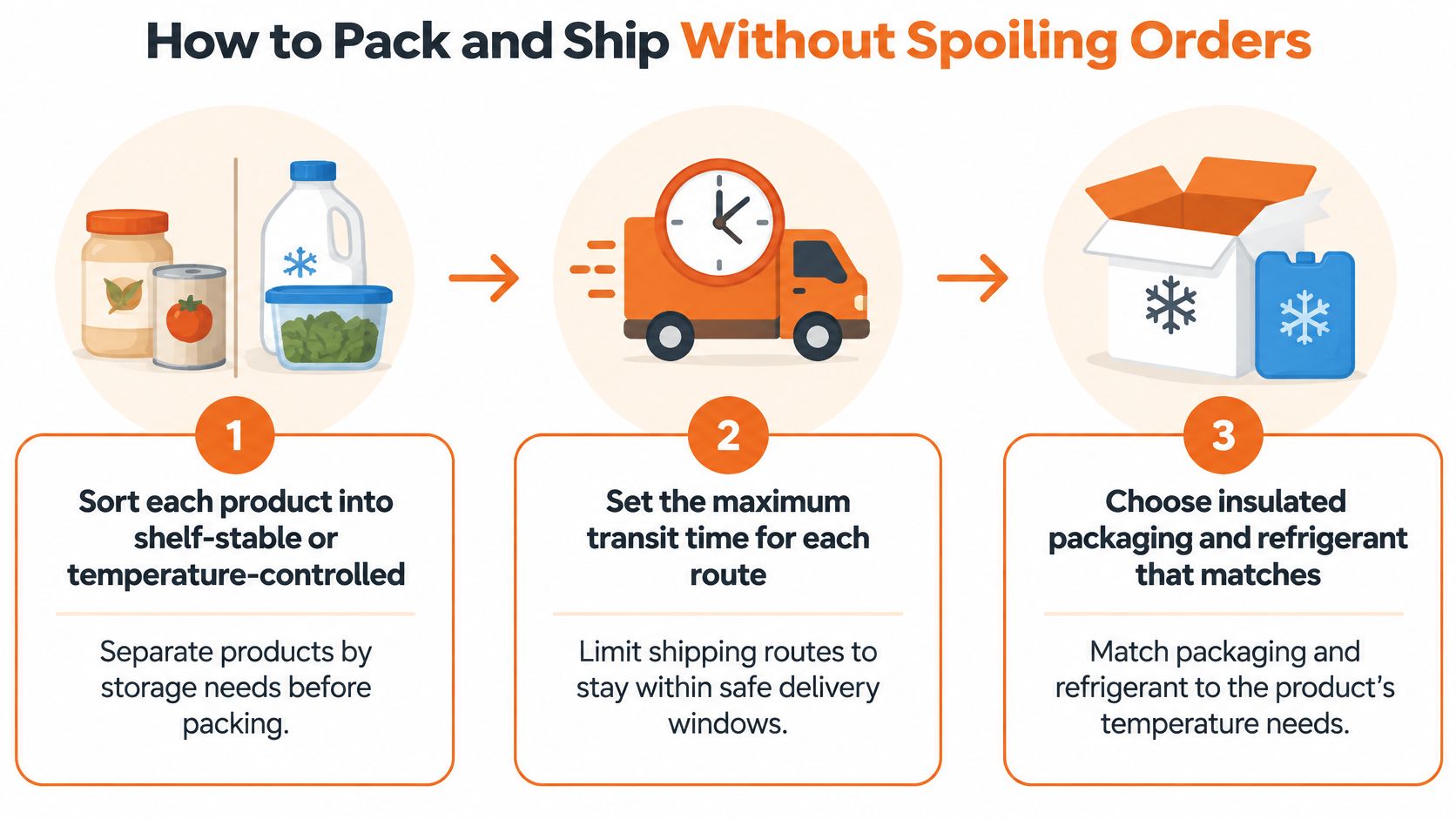
Sort, time the route, then match the box. This flow is the part I would tape above the packing table.
The FDA's best-practice note for online food delivery points sellers at preventive controls, packaging, temperature, contamination, and allergens. The FDA Food Code uses 41°F (5°C) or below as the receiving benchmark for refrigerated time/temperature-control foods. I use that number as the line the box must still be under when it reaches the buyer, not as a hope you write on the lid.
Do the work in this order
- Sort every product. Mark it shelf-stable or temperature-controlled. You cannot pack both the same way, and mixing them hides the item that can hurt someone.
- Set a maximum transit time for each route. A two-hour city drop and a two-day parcel are different products. Write the limit on the route, not in your head.
- Match the insulation and the refrigerant to that route. A thin mailer that works in October can fail in July. Buy the pack for the worst week you will ship.
- Seal temperature-sensitive items in contamination-resistant packaging, and keep allergen orders apart from the rest. A loose cookie next to a nut-free meal is a preventable mistake.
- Test the ugly case. Run the longest route, the hottest day, and a delayed handoff. Measure with a calibrated thermometer or a data logger. Color and "it feels cool" are not measurements.
- Write down dispatch and delivery times for every order. If something goes wrong, the clock tells you where the cold chain broke.
- Decide the missed-delivery rule before the first box leaves. Who gets the call, when you remake, and when you refund. Do not invent that policy while a customer is angry.
Mistakes that cost the batch
People trust a pretty liner. They leave cups unsealed at pickup. They ship with no plan for a buyer who is not home. Each of those fails in a boring way, and each one eats the margin you calculated earlier.
Say you sell soup. You test a 48-hour route in July. The logger shows the box still under the safe line at 24 hours. At 36 hours it has climbed past the limit. You then cut soups to a shorter window and you stop promising two-day delivery for that item. The sauce in a shelf-stable bottle can keep the longer route. The soup cannot.
A short walk-through of a cold pack test makes the logger reading easier to trust than a guess.
If you cannot hold a safe temperature, do not ship. Compare carrier quotes for each route. Add the shipping cost per box into the net-per-order formula before you publish a shipping price. A cheap rate that arrives warm is the most expensive rate you can buy.
Grow Orders Without Giving Away Margin
Spend on ads only after you can see where buyers quit. Otherwise you pay to send people into a leak.
Log product page views, add-to-cart clicks, checkout starts, payment failures, and completed orders. Split them by mobile and desktop, by traffic source, and by delivery zone. A citywide average hides the zone where your courier is always late.
Set a baseline over several hundred qualified sessions. Then change one thing. Clearer allergen text. Fewer checkout fields. A delivery fee the buyer can see before the cart. Better photos. A delivery-time promise you can keep. Two changes at once means you will not know which one moved the number.
Baymard's food-delivery UX research covers a large set of guidelines and reports one implementation that increased overall ecommerce conversion by 18.7%, with mobile conversion rising from 0.89% to 1.9%. I would not treat that case as your forecast. Traffic quality, category, price, and region all move the result. Your job is the direction of your own funnel, not a borrowed percentage.
Read the drop the way a cook reads a ticket
- High product-page exits usually mean weak trust. The photo, the allergen line, or the price does not answer the question.
- High cart abandonment usually means a surprise fee or a fuzzy delivery window. The buyer felt fine until the total changed.
- High payment failures usually mean the checkout itself, or a fraud screen that is blocking good cards. That is a technical fix, not a new slogan.
Judge orders by contribution margin, not by conversion alone. A coupon can raise the order count and still shrink what you keep. If mobile converts and desktop does not, fix the phone layout before you buy more desktop ads.
Two habits that protect cash
- Test demand with a small pre-order before you buy bulk ingredients. Five paid orders teach you more than a pallet of jars.
- Set a free-shipping threshold above your average order. If the typical cart is $28, do not give free shipping at $25. You will train people to stop at a losing ticket.
I would change the fee line before I change the ad budget. Surprise costs push people out of the cart. Honest costs keep the ones who were going to be profitable anyway.
Start Your First Local Test Order
Give yourself four weeks. Do not open every channel on Monday.
Week 1. Choose one channel. List the products you will make. Send each product's rules question to your state or county health department, with the way you plan to hand it off.
Week 2. Build the labels. Run a packaging test on your longest local route. If the logger fails, shorten the route before you take money.
Week 3. Run five to ten local test orders. Log every batch. Record the net margin on each order with the formula you already trust.
Week 4. Read spoilage, complaints, and margin per order. Then decide. Add a channel, raise the price, or widen the zone. If the margin is negative, do none of those. Fix the cost first.
Keep a log a stranger could read.
- Date and batch so you can trace a complaint.
- Product and price so you know what you sold.
- Fees and packaging cost so the net is real.
- Spoilage or complaint so you do not "remember" a clean week that was not clean.
Ask the health department for written answers and file them with the batch records. When you add a state later, you will want that paper more than you want a new flavor.
A small group of local founders can sanity-check the log with you. Chicago Brandstarters is a free community of Chicago and Midwest brand builders who meet in small private dinners and a group chat. It is one place to compare a real fee problem with people who are also shipping food, next to your own accountant and your health department, not instead of them.
Place one test order this week, even if the batch is small. You will learn more from that box than from another week of logo drafts.
If you are building a packaged food, bakery, catering, or beverage brand in Chicago or the Midwest, Chicago Brandstarters is a free, vetted community where founders trade practical fixes in small dinners and a private chat. Bring your margin math and your shipping questions, and sit with operators who are working the same problems. Visit Chicago Brandstarters and introduce yourself when you are ready to test the first local order with people who will tell you the truth.
Leave a Reply