

You spend a weekend with your team defining ambitious goals. Someone turns the notes into a polished Notion page. The next Monday, customer requests, product bugs, hiring questions, and cash decisions take over. A few months later, nobody remembers where the plan lives.
That pattern doesn't mean your team lacks discipline. It usually means the strategic planning process never reached the operating rhythm. A useful plan should shape weekly choices, resource allocation, and the work you stop doing. For a small team, it needs fewer slides, sharper trade-offs, and a short path from strategy to action.
Why Most Founder Plans Gather Dust
A six-person founder team can leave an offsite feeling aligned and still produce no change. During the retreat, everyone agrees to improve retention, enter a new market, rebuild the website, hire a salesperson, and publish more content. Each idea sounds reasonable in isolation. Together, they create a workload no small team can carry.
The document then becomes a record of good intentions. Nobody assigns a single owner to each goal. Weekly sprints track tasks, while the plan tracks aspirations. The team discusses strategy at the retreat and discusses execution in every other meeting, so the two conversations never meet.
Practical rule: If a priority doesn't change what someone does this week, it isn't operational yet.
The gap between planning and use has existed for decades. Strategic planning became a formal corporate discipline after World War II, with milestones including SRI International's The Strategic Plan in April 1963 and Igor Ansoff's Corporate Strategy in 1965. By the 1970s, nearly every Fortune 500 company reportedly had a strategic planning department, according to this history of strategic planning. Large firms built departments to keep planning alive. A founder team can't copy that structure, so it needs a lighter system.
Why small teams abandon plans
Three problems appear repeatedly:
- Vague goals: “Grow the brand” gives nobody a decision rule.
- Missing ownership: A shared ambition creates shared responsibility, which often means nobody owns the result.
- No feedback loop: The plan sits apart from product reviews, sales meetings, and weekly sprints.
Teams also write plans for investors instead of operators. They use polished language to describe a future state, then leave the team without a practical answer to questions like, “What do we stop this month?” or “Which customer segment gets our attention first?”
McKinsey's survey of nearly 800 executives found that only 45% were satisfied with their strategic-planning process, while just 23% said major strategic decisions happened within that process (McKinsey Quarterly). The lesson applies to a founder group too. A plan has value only when it helps you make real choices.
A living strategy for a six-to-eight-person team should fit on a few pages. You need a purpose, a current diagnosis, a small set of choices, named owners, and recurring reviews. A practical guide to setting business goals can help turn broad ambition into goals your team can discuss and track.
Set Your Purpose and Read the Map
Start with purpose before metrics. Your mission should answer one question in plain language: What problem do we exist to solve, and for whom?
Give each participant 15 minutes to write an answer alone. Don't let the loudest founder frame the discussion before quieter members have formed their own view. Read every version aloud, circle repeated ideas, and ask where the statements disagree.
A useful mission doesn't describe every product feature. It names the customer problem and the group you choose to serve. If your team can't agree on those two elements, annual goals will pull in different directions.
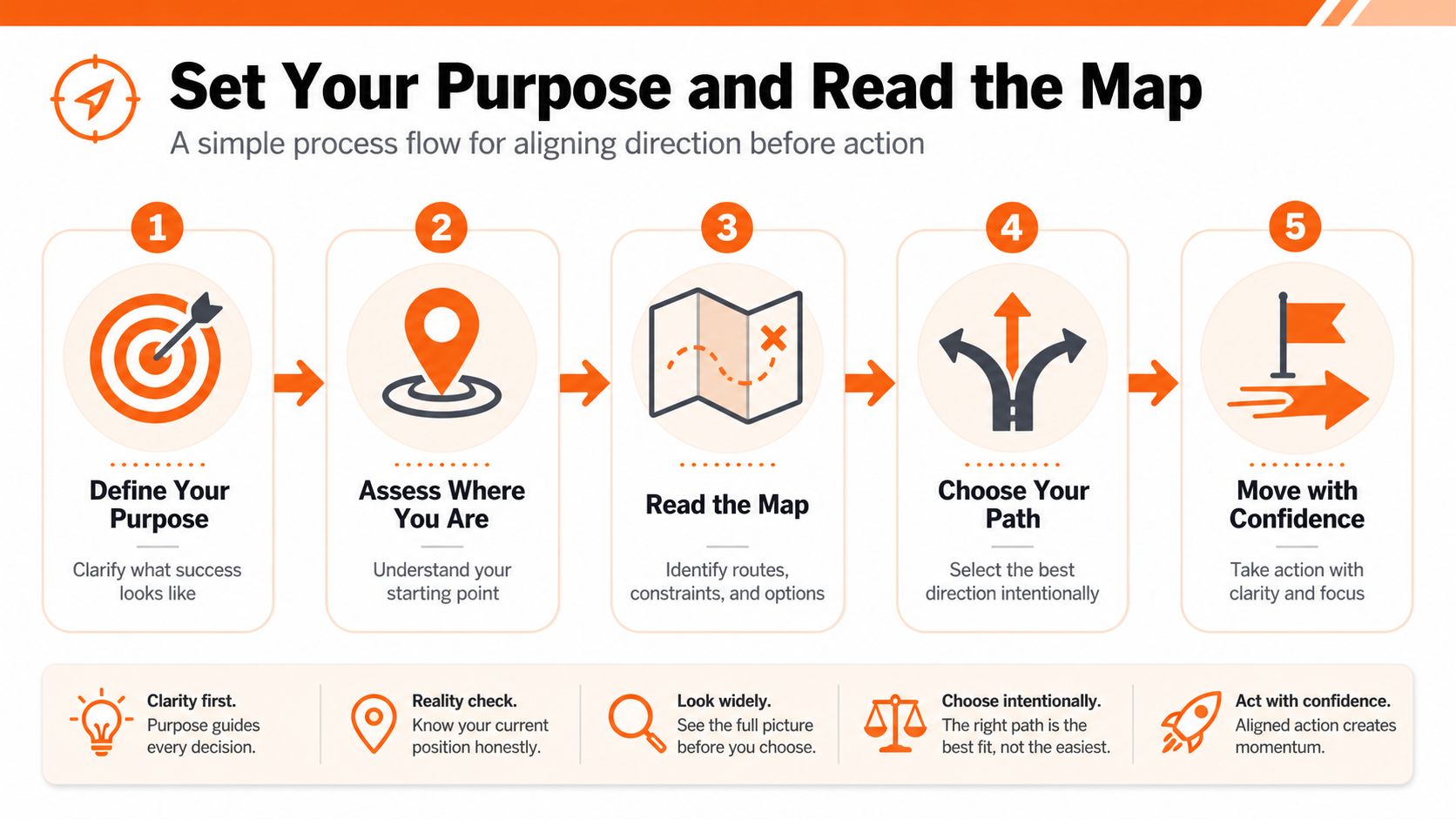
Use a small diagnostic
Next, assess the situation without turning the workshop into a research project. Use a focused SWOT with no more than three items in each quadrant:
- Strengths: What can we do better or faster than the alternatives?
- Weaknesses: Where do customers, cash, or capacity expose us?
- Opportunities: Which reachable demand could change our next phase?
- Threats: Which external condition could damage the current plan?
Pair the SWOT with a metrics snapshot. Bring current revenue, burn rate, customer retention, and pipeline health into the room. You don't need a dedicated analytics team. A shared spreadsheet with definitions and source dates will usually give you enough clarity for a planning conversation.
Ask every participant this question:
“What three external shifts in the last 90 days change our assumptions?”
Write each answer separately before debating it. Customer feedback, competitor moves, channel changes, and supplier conditions can expose assumptions that a static SWOT misses. For broader preparation around launching and operating online, founders can also use these online business setup tips as a practical checklist.
Set a distant anchor, then choose this year
Define a three-to-five-year vision anchor. Keep it directional rather than theatrical. Describe the customers, position, capability, or type of company you want to build. Then translate that anchor into annual OKRs.
For example:
- Objective: Make onboarding the fastest path to a customer's first useful outcome.
- Key result one: Raise completed onboarding from the current baseline to a defined target.
- Key result two: Cut median time to first useful action to a defined target.
- Key result three: Increase the share of new accounts reaching the activation event by a defined target.
Use your actual baseline and target values. Don't borrow numbers from another company or choose metrics you can't check. The Balanced Scorecard strategic planning basics describes the common cycle as defining mission and vision, analyzing the situation, setting goals, building action plans, then monitoring and adapting. That sequence works because it connects intention to behavior.
Make Strategic Choices and Resource Them
Goals describe a desired result. Strategy begins when you decide which path deserves scarce resources and which path must wait.
Consider a B2B SaaS team with six people. The founders can pursue a new vertical or deepen retention in the segment they already serve. The expansion path may create a larger future market, but it requires new messaging, sales research, product adjustments, and founder attention. The retention path may produce fewer headlines, yet the team already understands those customers and can see the product gaps more clearly.
Score each option against three constraints:
- Team capacity: Which people must change priorities?
- Runway: What cash, tooling, or hiring does the choice require?
- Founder energy: Can the founders sustain the sales, research, and decision load?
Then score candidate initiatives for impact and effort. Use a 90-day window, name one owner, estimate the work, and attach the required budget or headcount. A plan becomes usable when someone can answer, “Who owns this, what happens first, and what gets displaced?”
A sample prioritization view
The scores below illustrate the format. Your team should set its own scores after reviewing evidence.
| Initiative | Impact Score (1-5) | Effort Score (1-5) | Owner | Timeline | Resources Required |
|---|---|---|---|---|---|
| Improve onboarding for current segment | 5 | 3 | Product lead | 90 days | Product capacity, customer interviews |
| Test messaging for a new vertical | 4 | 4 | Founder, sales | 90 days | Founder time, interviews, landing page |
| Rebuild the entire marketing site | 2 | 5 | Marketing owner | Defer | External design budget, engineering time |
The table makes the trade-off visible. If the team chooses retention, it should state what happens to vertical research and the website rebuild. Saying “later” without a review date usually means “never discussed again.”
For a team under ten people, I recommend capping active strategic initiatives at three. This isn't a law of business. It's a practical limit that keeps weekly conversations focused. Put every other request into a parking lot with a reason and a review date.
Put resources where the team can see them
Create a one-page allocation view with four fields:
- Priority: The strategic choice this work supports.
- Owner: One person accountable for movement and escalation.
- Capacity: The people, hours, budget, or tools assigned.
- Next proof: The result or learning you expect within the 90-day window.
Bring that view to weekly standups. If a sales emergency takes the product lead away from onboarding work, record the change. Silent reallocation creates a plan that looks active while its resources disappear. A structured framework for making business decisions can help founders define the core problem before they compare options.
Measure What Matters and Catch Drift Early
Most strategic plans don't fail because the original idea was foolish. They drift because the team doesn't notice that daily work has moved somewhere else.
A small team needs a short scorecard, not a strategy office. Choose three to five leading indicators tied directly to your strategic bets. A leading indicator gives you an early signal, while revenue, churn, or market share may arrive later. For an onboarding priority, you might track completed setup, time to first useful action, support requests during setup, and activation by customer cohort.
Review the scorecard weekly for 15 minutes. Ask three questions:
- What moved?
- What didn't move?
- What decision follows from that information?
Don't turn the meeting into a status recital. Each metric should support a decision, an experiment, or an escalation.
Watch for drift signals
Drift often appears in behavior before it appears in the headline metric. Look for the following patterns:
| Drift Signal | What It Looks Like | Immediate Intervention |
|---|---|---|
| Initiative slippage | Milestones move repeatedly without a recorded decision | Reduce scope, change the owner, or reset the date |
| Quiet resource shifts | People leave a priority to handle urgent work | Reconfirm the trade-off in the next team meeting |
| Green check-ins, flat metrics | Everyone reports progress while customer behavior stays unchanged | Validate the metric definition and inspect the work quality |
| Unresolved blockers | The same dependency appears across multiple reviews | Assign an escalation owner and a decision deadline |
Run a monthly strategy pulse. Ask each owner to score confidence in each strategic pillar using a simple low, medium, or high label. Then record the blocker that could change that rating. The discussion matters more than the label, because it gives the team a regular moment to surface doubt.
One SaaS example shows why cohort-level measurement matters. A startup pursuing expansion tracked activation by cohort instead of waiting for churn data. The early cohorts exposed weaker activation in the new segment, so the team could question its onboarding and messaging before churn became the main signal. The specific metric will differ by company, but the logic stays consistent: measure the behavior closest to the strategic bet.
Execution data reinforces the need for active monitoring. One 2026 benchmark reports that 83% of leaders received no automatic signal when a priority drifted, and 60% of failing priorities were never cleanly resolved (strategy execution benchmark). A spreadsheet and a recurring conversation can close part of that gap for a small team.
Run a Repeatable Planning Workshop With Your Team
A half-day workshop works well for a six-to-eight-person team when participants arrive with facts and the facilitator protects the clock. Send pre-work in advance. Each person should bring a current revenue view, burn rate, retention notes, pipeline evidence, customer feedback, and one assumption they think the team may have outgrown.
Remote participants can add answers to a shared document before the session. Ask everyone to submit their independent mission draft, SWOT items, and proposed priorities before the live meeting. This prevents the first speaker from setting the group's frame.
Use four timed blocks
Block one, context and purpose alignment, 45 minutes. Share the financial and customer snapshot. Give everyone 15 minutes to write a mission sentence, then compare the drafts. Finish by agreeing on the customer problem and the three-to-five-year direction.
Block two, situation analysis, 60 minutes. Build the SWOT first. Limit each quadrant to three items. Ask, “What three external shifts in the last 90 days change our assumptions?” Force the group to rank the items before moving on.
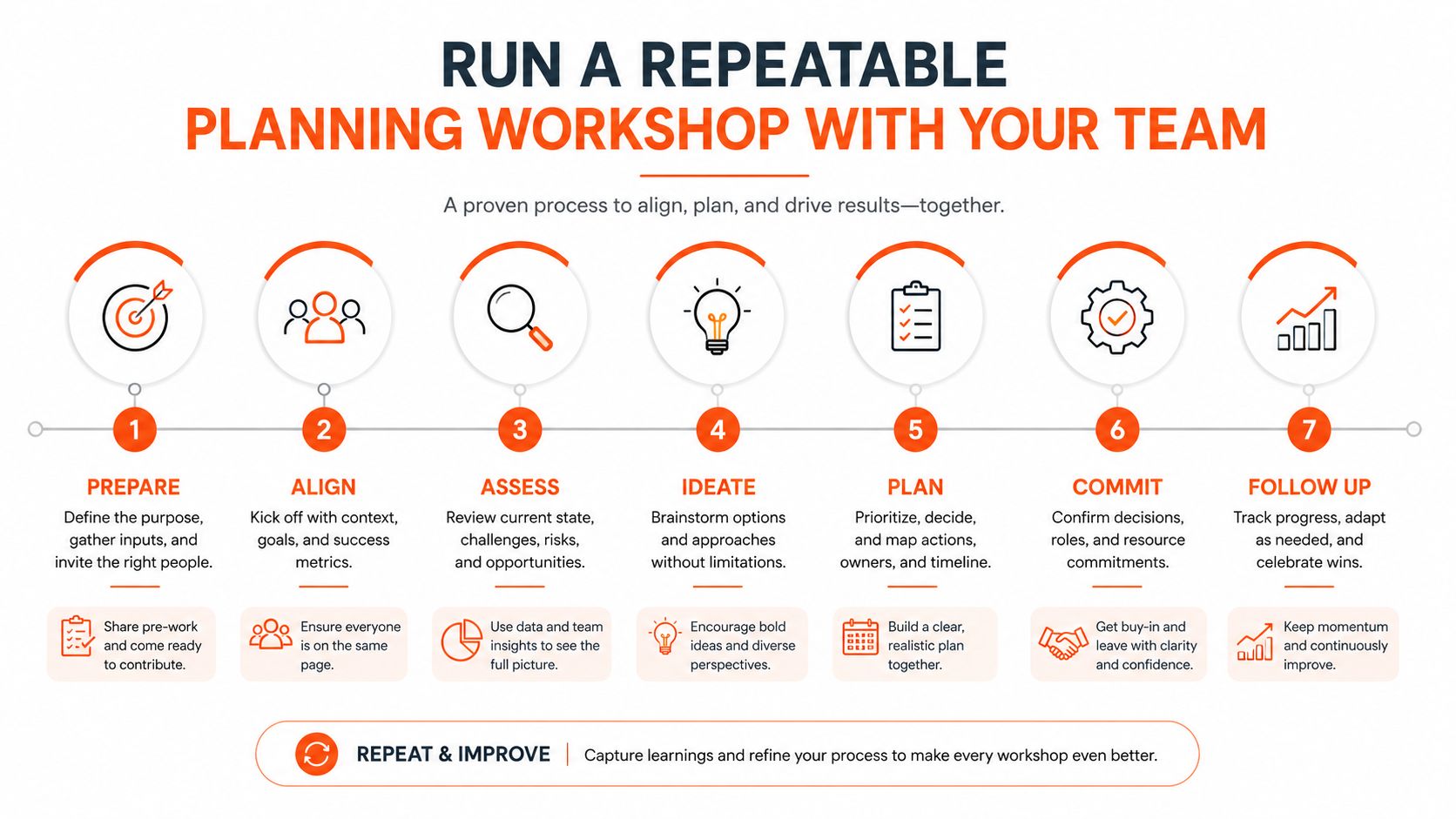
Block three, strategic choices, 60 minutes. Place initiatives on a 2×2 impact-effort matrix. Debate placement, then select the few choices that deserve the next 90 days. Use this prompt: “If we choose this, what will we stop doing?”
That question creates the kill list. Write down campaigns, features, meetings, customer segments, and experiments the team will pause. Without a kill list, new priorities sit on top of existing work.
Block four, resourcing and the 90-day sprint, 45 minutes. Give every selected initiative one owner, a first milestone, a timeline, and a resource note. Capture the result on one page with these fields: purpose, current facts, strategic choices, active initiatives, owners, leading indicators, review dates, and kill list.
Before the next session, decide how you'll streamline your team's schedule so reviews don't compete with customer work. A planning meeting has little value if the team can't protect the follow-up time.
For a founder peer group, each member can run the same format for their own company. Afterward, use a 30-minute hot seat per founder. Peers should challenge assumptions, ask what the founder will stop, and test whether the owner and metric make sense. They shouldn't rewrite the plan for someone else.
A full workshop every quarter keeps choices current. Use a monthly 60-minute check-in to adjust initiatives without reopening every strategic decision. The business workshop guide can provide another reference point for designing a focused session.
Use this video as a facilitation aid before you run the workshop:
Planning Mistakes That Waste Your Time
An annual plan feels orderly, but a fixed 12-month commitment can become fiction when customer demand, cash, or product evidence changes every quarter. Keep the three-year vision as an anchor and run strategy through 90-day sprints. The strategic planning process guide recommends repeating the full process at least once every three years, and sooner when external conditions change. For a founder team, shorter operating reviews should sit inside that broader cycle.
AI creates another trap. It can help synthesize customer notes, compare scenarios, examine trends, and support horizon scanning. Recent planning practice uses AI most for trend analysis at 69%, scenario development at 63%, and horizon scanning at 60%, according to enterprise planning trends. Those uses can speed preparation, but a tool can't replace customer proximity or the human choice to reject an attractive market.
Remove the theater
Teams can spend hours polishing mission language while avoiding the harder sentence: “We won't pursue this now.” A simple mission draft with a clear kill list beats elegant wording that leaves every option open.
More data can also become a hiding place. Early-stage founders rarely get perfect information. Set a confidence threshold that lets you act, state what would change your mind, and install a fast feedback loop. The plan your team reads during weekly work will beat the plan that looks impressive in a board deck.
One recent planning survey of 667 planning and PMO leaders across 43 countries examines decision cadence, scenario planning, value realization, and AI usage, pointing toward more continuous planning practices (2026 state of strategic portfolio management guide). More cycles won't automatically create better choices. Clarity, governance, and resource agility still decide whether the work moves.
A lightweight operating system gives your team a place to make those choices. Chicago Brandstarters brings founders into private six-to-eight-person peer groups where they can discuss decisions, execution problems, and practical next steps in a confidential setting.
If you want a practical peer environment for testing your priorities and sharpening your next 90-day plan, visit Chicago Brandstarters. Join a group of kind, hard-working founders who use honest conversations to turn strategy into weekly action.
Leave a Reply