
Most growth advice starts with a bigger number. More customers, more hires, more channels, more revenue. That advice ignores the part founders feel at 2 a.m., when orders rise but cash disappears, customers leave, and the team can't keep pace.
I've watched early Chicago brands mistake motion for progress. A viral post, a large wholesale order, or a busy quarter can create the appearance of momentum while weakening the business underneath. Sustainable business growth means building a company that can keep operating through ordinary setbacks, slower demand, rising costs, and founder fatigue.
The OECD found that around one-third of small and midsize businesses are environmentally engaged, and those businesses tend to show stronger productivity, wages, and sales growth than businesses that don't take those actions, as summarized in the UK government's Small Business Survey report. I don't read that as permission to add ESG theatre to your homepage. I read it as evidence that disciplined resource use can connect with better operations.
What Sustainable Business Growth Really Means
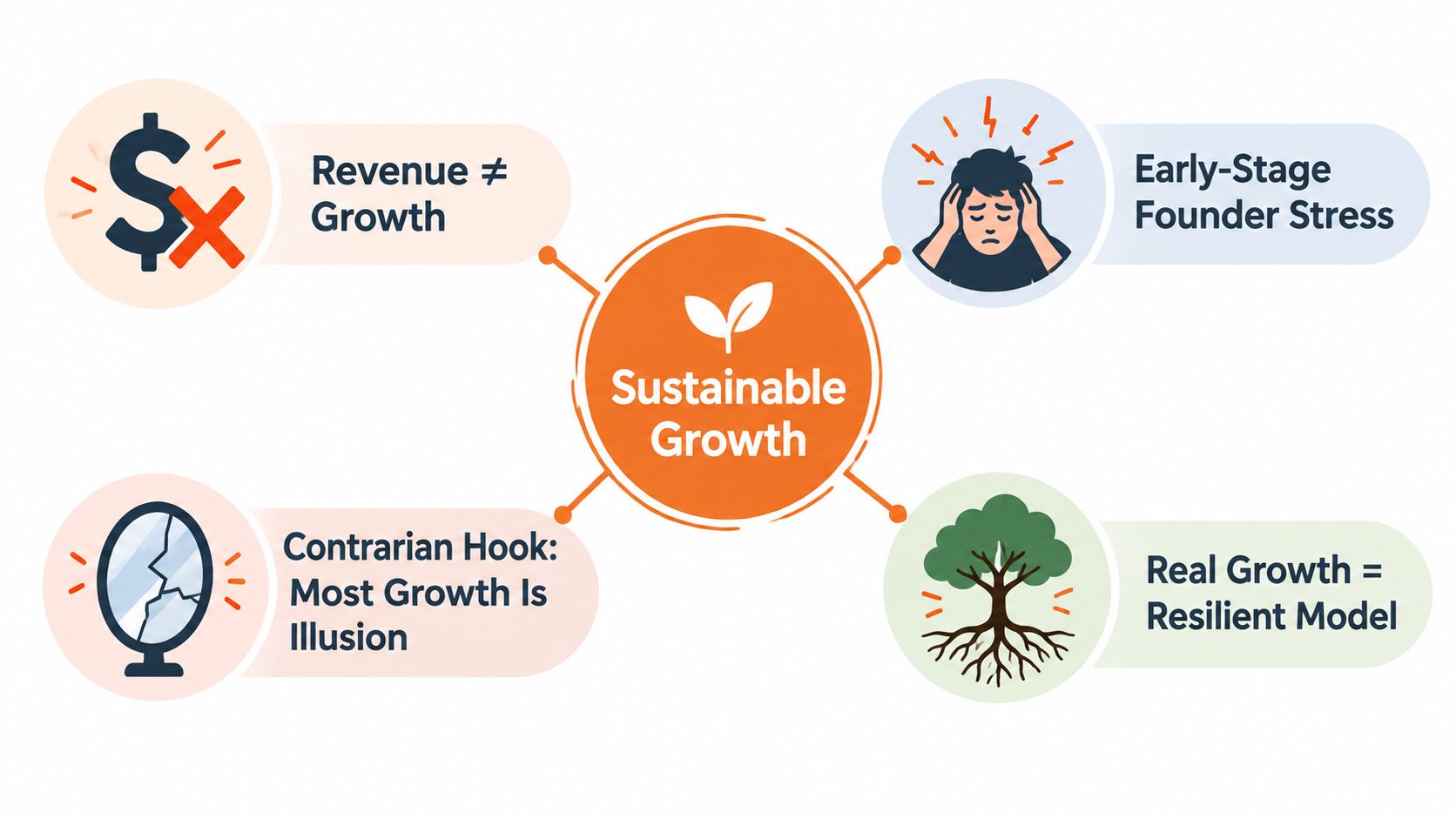
Most “growth” news is bloat dressed up in a press release. Revenue can rise while the founder works longer hours, customers churn faster, and every new sale consumes more cash than the last one.
I use three signals to judge whether a young brand has a durable model:
- Fatigue: You and your team keep adding hours because the business needs constant rescue.
- Customer churn: New buyers arrive, then disappear before they create a second order.
- Cash anxiety: Sales look healthy, yet you delay bills, inventory purchases, or payroll decisions.
Each signal points to a specific operating problem. Fatigue often follows hiring ahead of proof or adding manual work without fixing the process. Churn usually means acquisition has outrun product quality, customer experience, or repeat purchase design. Cash anxiety appears when founders confuse revenue with cash generation and ignore margin, payment timing, and inventory.
Durability beats speed
A lighter treadmill beats a faster treadmill. You want each sale to create enough contribution to fund the next sale, each operational improvement to reduce strain, and each hire to solve a proven bottleneck.
The Canadian study using the Higgins Sustainable Growth Model found that Canadian small and midsize businesses could support average sales growth of about 7.3% per year without additional financing during the 2000 to 2010 period, with rates ranging from 7.0% to 7.6% across business sizes, according to the study summary. That benchmark matters because healthy growth often looks moderate, repeatable, and financially supported. A company doesn't need explosive expansion to build a serious business.
Use this guide to business scaling when you need to separate repeatable operating capacity from a temporary sales surge. Sustainable business growth is an operating discipline, not a slogan or a checkbox.
Practical rule: If sales rise but your margin, cash position, customer behavior, and workload worsen, you haven't scaled. You've widened the problem.
A Plain-English Definition for Founders
Think about a small restaurant that can survive a slow Tuesday. It doesn't need a packed dining room every night. It needs enough pricing power, repeat guests, controlled costs, and capable staff to operate without panic when demand drops.
Sustainable business growth has four parts.
Customers you can keep
A first purchase proves curiosity. A second purchase proves usefulness. Build a product and customer experience that gives people a reason to return without begging them through constant discounts.
Your test this week: Look at recent buyers and ask how many came back without a sale, giveaway, or personal rescue from you.
Margins that hold when costs rise
Costs move. Packaging gets more expensive, shipping changes, suppliers adjust terms, and paid acquisition becomes less efficient. A durable brand keeps enough margin after direct costs to pay for people, software, service, and mistakes.
Your test this week: Take one popular product and subtract product cost, packaging, payment fees, shipping support, discounts, and fulfillment labor. See what remains.
Cash that lasts longer than your runway
Profit on paper won't pay a supplier if the customer pays late and your inventory sits in a warehouse. Track when cash leaves, when it returns, and how much stock you must buy before another sale arrives.
Your test this week: Write down the next cash obligations and the dates when customer payments should arrive. Circle any gap you can't cover from current cash.
A team that doesn't burn out
A business that depends on one founder remembering every task has a fragile operating model. Document recurring work, remove low-value steps, and give people clear ownership before volume forces a crisis.
Your test this week: Take one task you repeat every week and write the steps another person would need to complete it correctly.
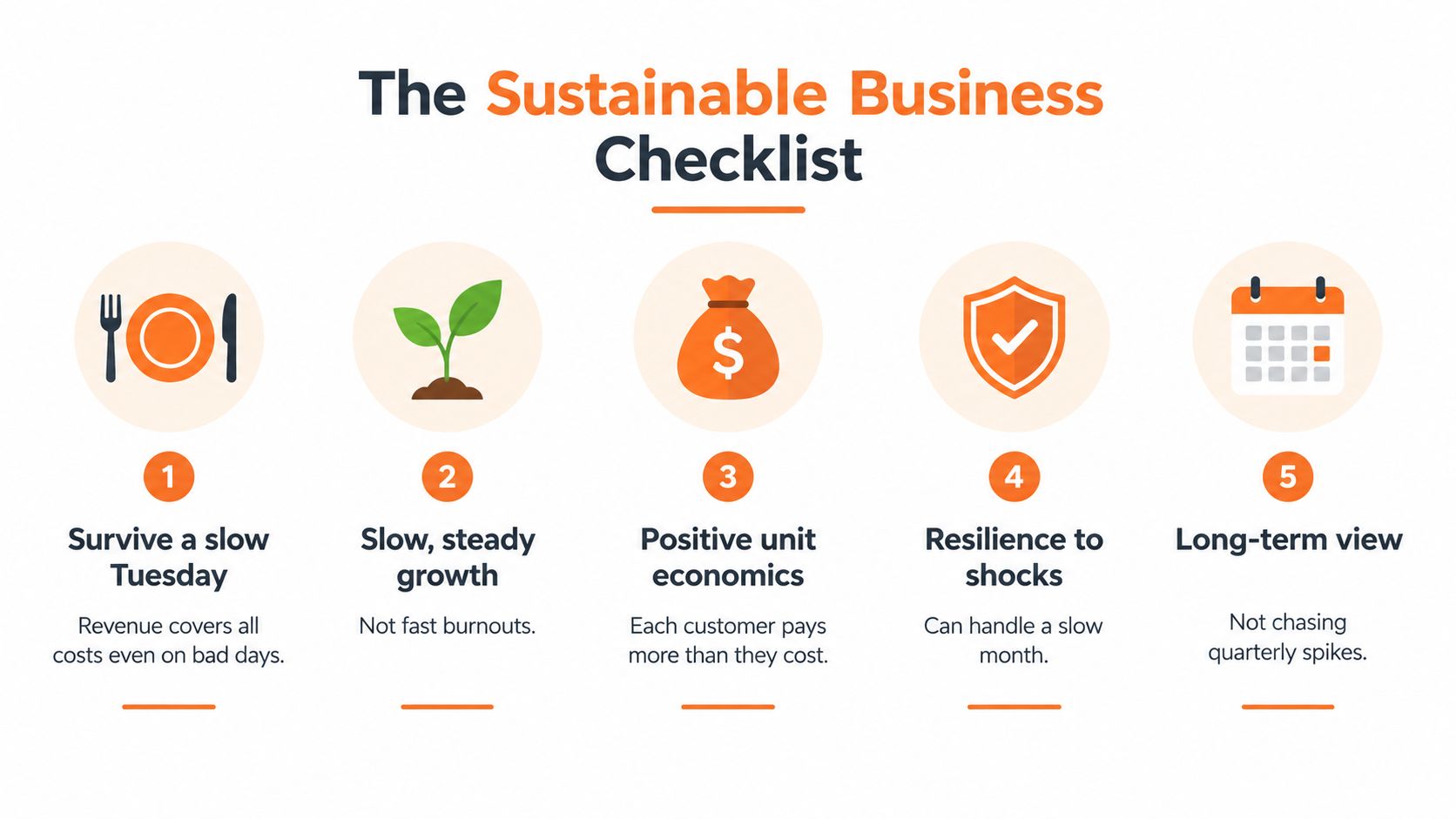
My working definition is simple: sustainable business growth is repeatable expansion that protects customer value, margin, cash, and human capacity.
The Core Metrics That Drive Long-Term Growth
You don't need a finance department to measure durability. You need a small set of numbers that answer one question: does each new customer make the business stronger?
Take a direct-to-consumer candle brand selling a $48 candle. Start with unit economics, the profit picture attached to one sale. If the candle, packaging, payment fee, fulfillment, shipping subsidy, and discount total $31, the contribution before overhead is $17. That $17 must help pay for marketing, software, labor, and operating costs.
Customer acquisition cost, or CAC, tells you what you spend to win one customer. If you spend $600 on ads and acquire 20 customers, CAC is $30. Customer lifetime value, or LTV, estimates the contribution a customer creates across repeat purchases. If the candle buyer returns enough times to produce $90 in contribution, the account can support acquisition. Keep your assumptions visible. Early brands often inflate LTV by counting hoped-for orders.
The LTV/CAC ratio compares customer value with acquisition cost. A ratio above one means the customer creates more contribution than the acquisition spend, though the quality of the ratio depends on timing and cash flow. Gross margin shows what remains after direct product or service costs. Watch it by SKU, channel, and offer. A wholesale order can grow revenue while producing less margin than direct sales.
Net revenue retention, or NRR, fits subscription and recurring-revenue businesses. It tracks how much revenue remains from an existing customer group after expansion, downgrades, and cancellations. A small product brand can use repeat purchase rate instead, because that tells you whether the first sale created a relationship.
For payback, use a plain rule: the sooner your contribution repays CAC, the less cash pressure growth creates. Track the time from first purchase to recovering acquisition spend. Founders below five figures in monthly revenue can measure unit economics, CAC, gross margin, cash, and repeat purchase with a spreadsheet and payment data. NRR becomes more useful once recurring billing or account expansion gives you enough customer history.
For a broader reference, startup KPIs from HireAccountants can help you build a consistent reporting sheet. Pair those numbers with days cash on hand so your growth plan includes timing, not only profitability.
| Metric | What It Tells You | Healthy Range |
|---|---|---|
| Unit economics | Whether one sale creates contribution | Positive after direct costs |
| CAC | What you spend to acquire one customer | Below contribution from expected customer value |
| LTV | How much contribution a customer may create over time | Higher than CAC |
| LTV/CAC | Whether acquisition can support itself | Above one, with sensible payback |
| Gross margin | How much remains for overhead and reinvestment | Stable by product and channel |
| NRR | Whether recurring accounts retain and expand revenue | At least stable over time |
| Payback period | How quickly growth returns acquisition cash | Short enough for your cash position |
Common Growth Traps Versus Steady Growth
A growth trap usually appears first as a dashboard win. The correction begins when you ask what the win costs.
The spike that floods the business
A viral post or one wholesale order can push revenue upward while operations buckle. Look for stockouts, expedited freight, overtime, and a lower contribution margin on the same dashboard period.
Steady growth caps demand until fulfillment, supplier terms, and margin can handle it. Take the order you can serve well. Don't accept volume that turns every sale into emergency labor.
The discount that buys a quarter
Discounting can hit a quarterly target and damage future pricing. Your warning signal is a rising share of orders using promotions, paired with weaker full-price conversion.
A steady brand uses offers for a clear purpose, such as introducing a product or moving aging stock. It doesn't train customers to wait for a code.
The audience chase that hides churn
Founders often chase new audiences while repeat purchase falls. The dashboard signal is simple: new-customer orders rise while the share of returning customers declines. If repeat purchase drops below 25%, treat that as a warning threshold for your review, not as a universal benchmark.
Retention deserves serious attention because research summarized in the INSEAD working paper reports that a 5% increase in retention can lift profits by 25% to 95%, based on the cited retention research. Build post-purchase education, replenishment reminders, useful service, and referral moments before adding another acquisition channel.
The premature team
Hiring ahead of revenue makes a company look larger than it operates. Check payroll against contribution, founder approval load, and the number of tasks the new hire can own without constant direction.
Steady growth hires against a repeated bottleneck. First prove the work exists, then document it, then assign it.
| Trap | Warning Signal | Steady Growth Pattern |
|---|---|---|
| Viral or wholesale spike | Revenue rises while margin and service quality fall | Accept demand your systems can handle |
| Quarterly discounting | Promotion share rises and full-price sales weaken | Use offers for defined inventory or trial goals |
| New-audience chasing | New buyers rise while repeat purchase falls | Fix retention before widening acquisition |
| Hiring ahead of proof | Payroll rises before a clear bottleneck appears | Hire for owned, repeatable work |
A Playbook for Chicago and Midwest Founders
Chicago, Milwaukee, Madison, Indianapolis, Detroit, and Columbus reward practical operators. You can often reach suppliers, stockists, manufacturers, and fellow founders without building a national machine first. Use the next 12 weeks to replace guesswork with a tighter operating rhythm.
Weeks one through three
Put the last 90 days of unit economics on one sheet. Calculate blended CAC, list every cost tied to each sale, and flag every SKU that loses money before you touch paid media, branding, or a new channel.
Ask a local accountant to check your logic if the sheet doesn't reconcile with your bank and inventory records. A bad dashboard creates confident bad decisions.
Weeks four through six
Run five customer retention interviews. Ask what made the customer buy, what nearly stopped the purchase, what they used, and why they did or didn't return. Set one north-star metric, such as repeat contribution or active subscribers, then rewrite your homepage around the customer action that metric depends on.
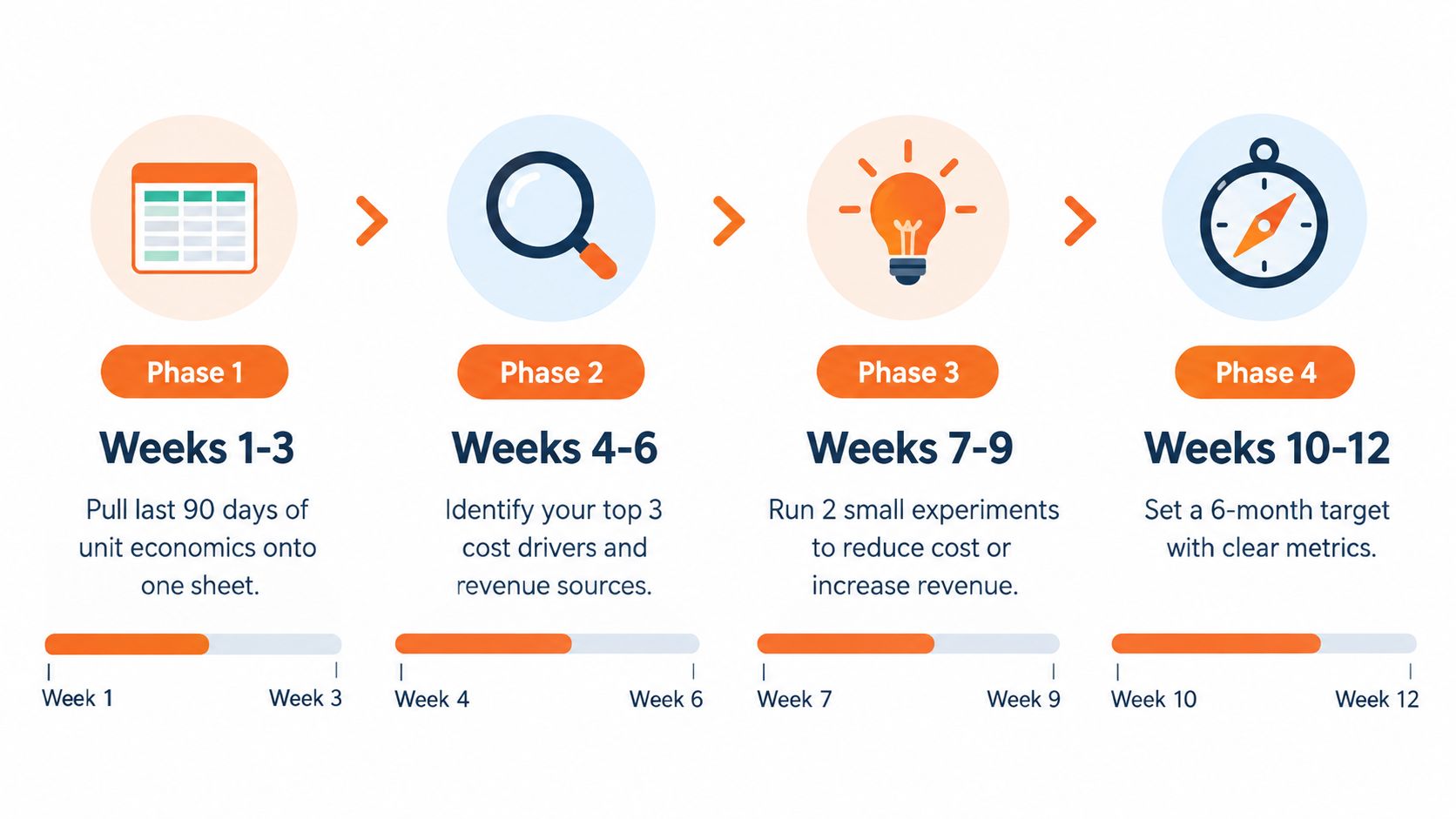
Weeks seven through nine
Replace one paid channel with one local activation. Test a pop-up, a retailer event, a maker collaboration, or a small founder-led gathering. Pitch one Midwest stockist or co-manufacturer instead of chasing national retail before your service model can handle it.
A SaaS founder may also compare peer structures with BAMF's SaaS founder program, especially if recurring revenue and product iteration create different accountability needs.
Weeks ten through twelve
Review cohort retention, kill the worst-performing offer, and write down the next quarter's operating target. Then join a small accountability group with a fixed cadence and clear reporting. The group should ask what you shipped, what changed in the numbers, and what you'll stop doing.
Operator standard: Every experiment needs an owner, a cost limit, a customer behavior to watch, and a decision date.
Real Founder Stories From the Trenches
A Lincoln Park skincare founder once grew from $40,000 to $280,000 in one year. The top-line result looked excellent until she opened the order data. Her repeat rate sat at 18%, and most reorders came through discounted bundles. The bundles increased order activity while compressing margin, so the brand worked harder for weaker economics.
She rebuilt the subscription tier around replenishment rather than discount depth. She also cut three SKUs that created small, inconsistent orders and complicated inventory. Within two quarters, the changes restored payback. The lesson isn't that subscriptions fix every consumer brand. The lesson is that retention and SKU discipline can matter more than another acquisition push.
A Pilsen beverage founder faced the opposite problem. A sudden regional grocery win created demand faster than the company could finance and fulfill it. The founder nearly broke under inventory commitments, distributor timing, and the pressure to keep every shelf stocked.
A small peer group forced a slower review. Members asked for the distributor agreement, checked payment terms, and challenged the planned inventory buy. The founder renegotiated terms with a Midwest distributor and reduced the overbuy before it consumed the company's cash. The group didn't create the grocery opportunity. It helped the founder survive it.
These stories contain the same operating lesson. Revenue creates options only when the business controls the terms around it. A subscription can become a margin trap. A retail win can become a cash crisis. The founder needs enough visibility to see the difference before the bank account does.
Why Peer Community Is Your Growth Multiplier
Large networking events create contacts. Small, vetted groups create accountability.
Industry peer networks for small businesses often use groups of 20 or fewer carefully selected members, meet in high-trust settings, and let members share management, marketing, company performance, and market information, as described in the research on founder peer networks. That structure matters because founders rarely need another generic introduction. They need someone willing to ask why CAC rose, why inventory doubled, or why they keep delaying a hard hire.
Research on entrepreneurial loneliness found that bonding social capital can reduce loneliness, while bridging ties help less with that specific problem, and the authors connect stronger bonding ties with wellbeing and business sustainability, in their study of social capital and entrepreneurial loneliness. Another study separates networking into “prism,” network quality, and “pipe,” network centrality, when examining new venture outcomes, in its discussion of networking behavior.
Chicago Brandstarters uses small private dinners every two weeks and an active group chat for founders building from idea stage toward seven figures. Members share practical problems, supplier knowledge, and operator support rather than performing success. The format fits the community building core concepts explained by Rebus, trust, repeated interaction, shared value, and participation.
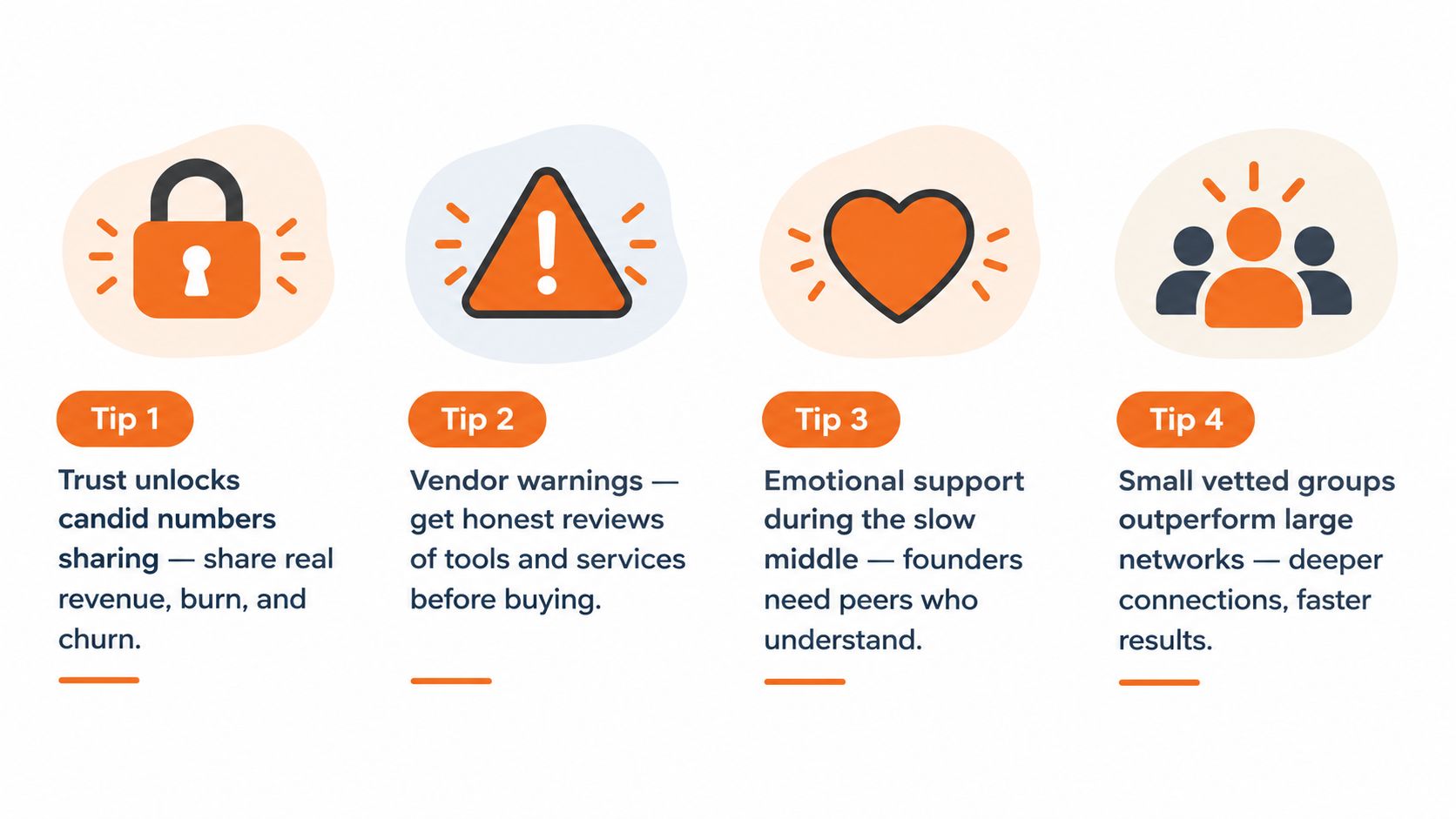
Use small mastermind groups for entrepreneurs as a model for your own cadence. Sign up for one dinner, bring one real metric on an index card, and schedule a 90-day check-in with two founders you meet there. Sustainable business growth is durability built through peer accountability, an unglamorous advantage many solo founders leave unused.
Chicago Brandstarters gives early-stage Chicago and Midwest founders access to small private dinners, a practical group chat, and candid peer support around the work of building a durable company. Bring your unit economics, retention question, or cash problem to a room built for honest discussion, then visit Chicago Brandstarters to join the free community.
Leave a Reply