
You've got a product roadmap packed with ideas, a site that looks respectable, and a sales pipeline that still depends on explaining everything from scratch. Buyers ask, “Why should I choose you?” You answer with a list of features, a broad audience, and a few words like “customer-first.” The conversation gets polite, then quiet.
I've watched early-stage founders lose weeks to this problem. They tweak the logo, rewrite the homepage, test another ad channel, and avoid the harder question: who is this really for, and why should that buyer choose you over the next option? Brand positioning strategy answers that question before your copy, channels, hiring plans, and pricing decisions harden around a blurry idea.
Brand positioning also affects whether buyers shortlist you, whether salespeople know what to say, and whether search systems can identify your company. This playbook gives you the definition, four working frameworks, Midwest examples, a 30-day plan, common mistakes, and a practical checklist for turning a positioning statement into a clear, verifiable brand entity.
The Founder's First Question About Brand Positioning Strategy
At 11:47 p.m., a founder I know had three product ideas open in separate tabs, a half-finished pitch deck, and no clean answer for a prospect who had asked why the company was different. The team had shipped real work. Customers liked the product. Yet the company still sounded like every other startup in its category.
That's the moment when positioning stops looking like a marketing exercise. You have to decide who gets priority, what buying situation you want to own, and which alternative you want buyers to compare against. If you avoid that choice, customers often make it for you. They compare your price, delivery speed, or feature count because you haven't given them a sharper reason.
The risk reaches beyond messaging. A vague position can make your company harder to shortlist in Google and AI search surfaces, according to the analysis of brand positioning as a business risk. It can also slow buyer confidence and leave salespeople improvising different versions of the company story.
Founder rule: If your team can't answer “why us for this buyer and this moment?” in one sentence, your brand isn't ready for scale.
I'd start this work before you lock the visual identity or spend heavily on acquisition. First, define the position. Then turn it into a value proposition, compare it against real alternatives, test it with customers, and publish the same claim across your site, deck, sales calls, and search profiles.
The rest of this guide treats positioning as an operating decision. You'll see how the frameworks connect, how narrow Midwest businesses can sharpen their claims, how to run the work in 30 days, and how to check whether your position survives contact with real buyers.
What Brand Positioning Strategy Actually Means
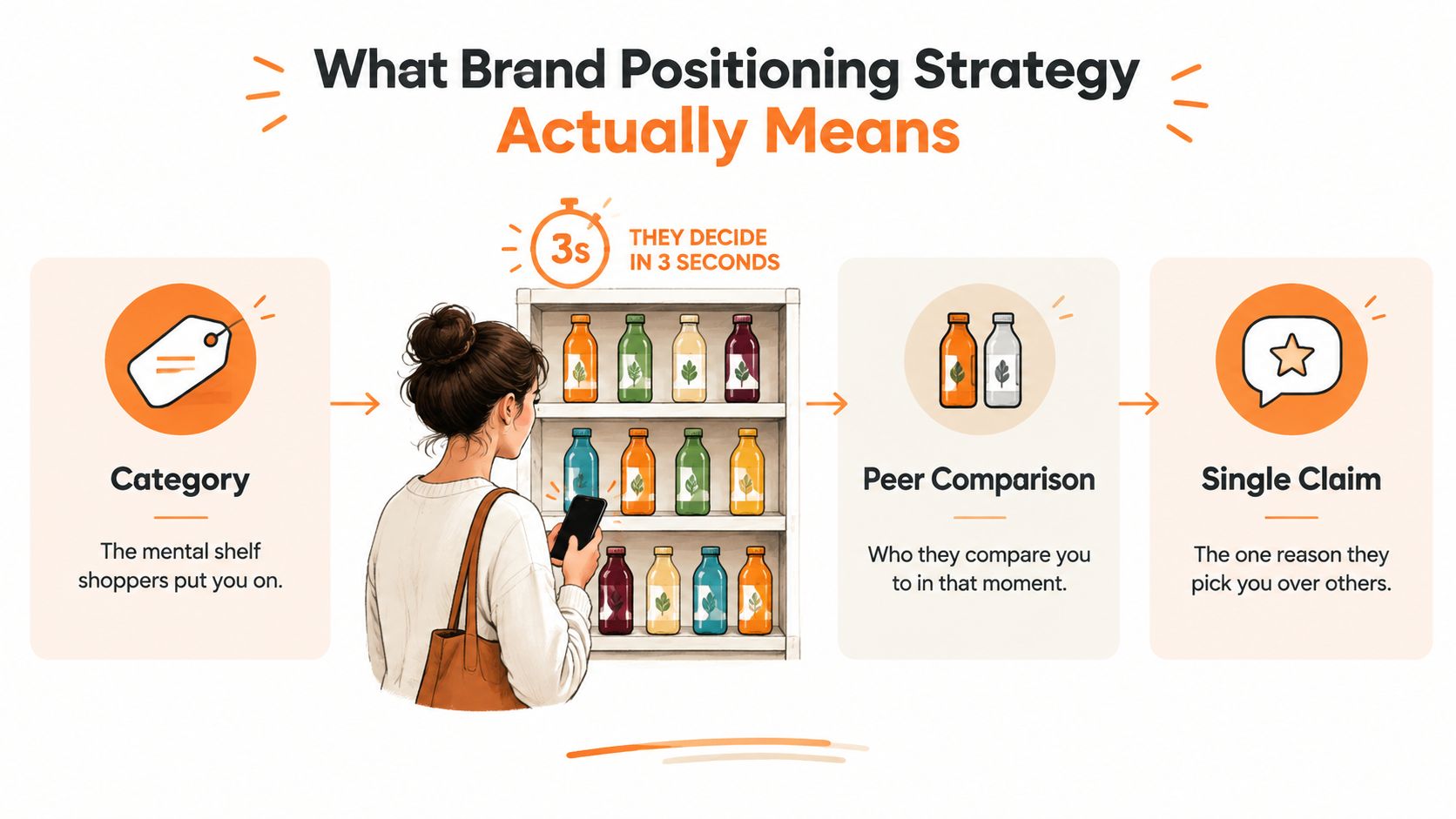
Walk through a grocery store and scan a shelf of twelve bottles. You won't study every ingredient panel. You'll first decide what kind of product you're looking at, notice the neighboring choices, and register the one claim that gives you a reason to pick one bottle.
That shelf gives you a useful model for brand positioning strategy. You choose the mental shelf where buyers place your company, the competitors they compare you with, and the single idea you want them to remember. The job isn't to describe everything you can do. The job is to make the right comparison easy.
Keep these layers separate:
- Brand positioning: The strategic choice of where you compete, who you serve, and why buyers should prefer you.
- Brand identity: The visual and verbal expression of that choice, including your name, design, voice, and messaging style.
- Branding: The ongoing work that builds recognition through repeated customer experiences and communications.
- Value proposition: The buyer-facing promise that explains what value someone receives in exchange for money, time, or attention.
Positioning comes first. If you design the identity before choosing the position, you may create attractive assets that support an unclear idea. If you write a value proposition without selecting a target buyer and competitive frame, you'll usually describe benefits that many rivals can claim.
Brand positioning as a formal strategy emerged in 1969, when Jack Trout published “Positioning is a game people play in today's me-too marketplace” in Industrial Marketing. Al Ries and Jack Trout expanded the idea in Positioning: The Battle for Your Mind, first published in 1981, as documented in this history of brand positioning. The useful lesson isn't the history lesson itself. It's the discipline of claiming a distinct place in a buyer's mind relative to rivals.
For daily decisions, use this definition:
Brand positioning strategy is the deliberate choice of the buyer, category, comparison, and memorable reason that your company wants to own.
Creators who need to narrow a broad personal brand can also use this practical guide to positioning strategy for creators. Apply the same test: who should remember you, for what job, and against which alternatives?
The Four Frameworks You Need to Know
Positioning gets messy when founders treat every framework as a separate branding assignment. I use four tools in sequence. Each one answers a different question, and each one gives the next tool better inputs.
1. Positioning statement
Start with an internal sentence that names the target buyer, the problem, your category, the benefit, and the proof. A practical structure looks like this:
For [target customer] who [pain or buying situation], [brand] is the [category] that [key benefit] because [proof or reason to believe].
A positioning statement usually contains five parts: target segment, brand name, category or frame of reference, points of difference, and reasons to believe, as explained in this positioning statement guide. Keep it internal and specific. Your homepage can use simpler language later.
2. Value proposition
The value proposition translates the strategy into language a buyer can act on. It answers, “What do I get, and why should I care now?” A B2B software company might position itself around invoice approval for mid-market manufacturers, then write a value proposition about fewer approval bottlenecks for finance and operations teams.
The positioning statement helps your team choose. The value proposition helps the buyer decide.
3. Competitive landscape
List direct competitors, indirect substitutes, and emerging alternatives. Then record the category each one claims, the audience it targets, the promise it makes, and the proof it uses.
Buyers may compare you with a spreadsheet, an internal hire, a consultant, or a familiar incumbent. Your competitive set isn't limited to companies with similar product pages. Research from Conveo recommends testing a small number of positioning territories, usually 2–3, against ownability, differentiation, credibility, emotional response, category associations, and the alternatives customers use in their minds. Read their brand positioning research framework before you run interviews.
4. Positioning map
A map turns the comparison into a visual decision. Put competitors on two axes that buyers use, not dimensions your team invented because they sound clever. For example, a manufacturer-focused software product might map “generic workflow” against “industry-specific workflow” and “manual setup” against “guided implementation.”
| Framework | Purpose | Format | Output |
|---|---|---|---|
| Positioning statement | Define the strategic choice | One sentence | Internal direction |
| Value proposition | Translate value for buyers | Buyer-facing copy | Clear promise |
| Competitive landscape | Test the choice against alternatives | Comparison table | Competitive context |
| Positioning map | Visualize clusters and gaps | Two-axis chart | Positioning decision |
A useful resource on differentiation strategies for competitive advantage can help you pressure-test the point of difference. You can also use this brand positioning framework for startups when your team needs a plain-language working document.
The sequence matters: strategy feeds the proposition, the tests examine both, and the map forces you to choose.
Chicago and Midwest Examples in the Wild
Narrow positioning often sounds risky until you watch a founder use it in a real buying conversation. The following Midwest examples show the pattern. Each founder began with a broad category claim, selected a specific audience or occasion, and watched for a buyer behavior that confirmed the change.
The Logan Square coffee roaster
A direct-to-consumer roaster in Logan Square started with “premium beans.” That phrase gave shoppers no useful reason to remember the company. The founder tested a sharper position on a landing page: Chicago-roasted, single-origin coffee shipped within 48 hours of roasting.
The new message gave buyers a place, a product distinction, and a freshness reason. The founder watched subscription behavior rather than collecting compliments. DTC subscription rates jumped after the change, which gave the team a stronger signal than general comments about the packaging.
The Cincinnati SaaS company
A Cincinnati B2B SaaS founder called the product a “workflow tool.” Buyers heard a familiar category and compared it with broad project-management and operations software. The founder replaced that language with “the fastest invoice approval for mid-market manufacturers.”
The team tested the claim in founder-led sales calls. The revised message opened conversations with finance and operations leaders who recognized the buying situation immediately. The company then gained two enterprise pilots, a concrete commercial signal that the narrower position created better entry points.
The Indianapolis apparel brand
An Indianapolis DTC apparel founder wanted to compete in lifestyle fashion. That audience was too broad, and the company had no reason to beat established apparel brands. The founder chose a narrower niche, trucker caps for second-generation drivers, and tested the idea at a local farmer's market.
The test let the founder hear the language buyers used, see who stopped, and learn which product stories created a purchase conversation. The position gave the brand a recognizable customer identity instead of another generic lifestyle promise.
| Company Type | Original Positioning | Refined Positioning | Test Method | Signal That Worked |
|---|---|---|---|---|
| Logan Square DTC coffee roaster | Premium beans | Chicago-roasted, single-origin, 48-hour-fresh | Landing page | DTC subscription rates jumped |
| Cincinnati B2B SaaS | Workflow tool | Fastest invoice approval for mid-market manufacturers | Founder-led sales calls | Two enterprise pilots |
| Indianapolis DTC apparel | Lifestyle fashion | Trucker caps for second-generation drivers | Local farmer's market | Stronger buyer response and purchase conversations |
You can find more context on the region's startup community through startup companies in Chicago, but the lesson applies anywhere. A position gets stronger when it names the buyer and the buying moment.
A 30-Day Playbook for Early-Stage Founders
You don't need a large research budget to get useful positioning evidence. You need a narrow question, a written comparison, and enough customer contact to catch language your internal team keeps missing.
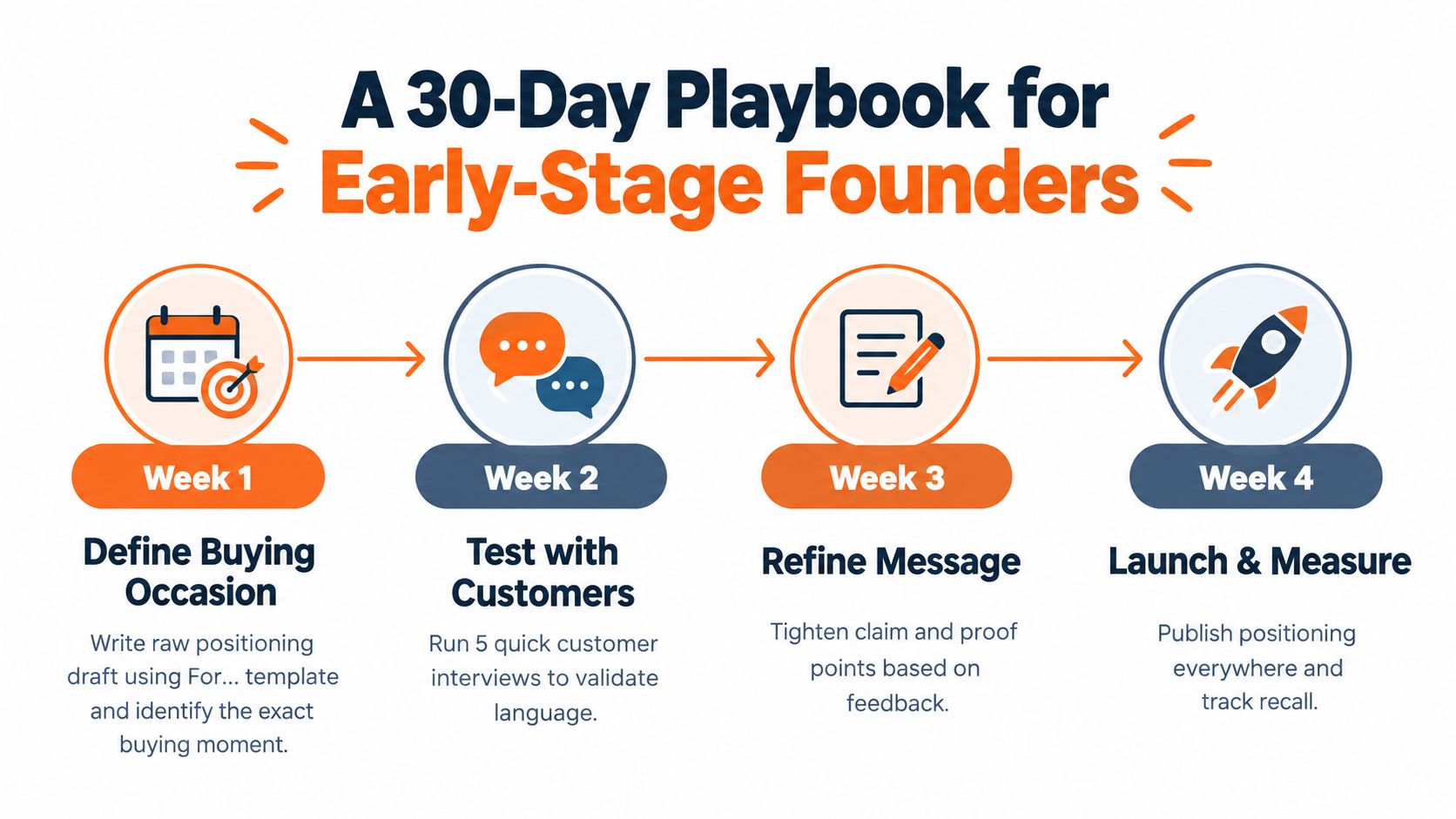
Week 1, define the buying occasion
Choose one situation that makes a buyer look for help. “People who care about productivity” isn't a buying occasion. “A controller at a mid-market manufacturer needs invoice approvals to move before month-end close” is much closer.
Write this rough draft:
For [target customer] who [pain], [brand] is the [category] that [key benefit] because [proof].
Then fill a one-page value proposition canvas:
- Target buyer: Who has the problem and authority to act?
- Buying occasion: What happens right before they search?
- Pain: What costs time, money, confidence, or momentum?
- Desired outcome: What changes after they choose you?
- Alternative: What do they use now?
- Proof: What can you show, demonstrate, or verify?
- Reason to believe: Why should the buyer trust this claim?
Don't polish the sentence yet. Capture the words customers already use.
Week 2, map the alternatives
Create a table with five direct competitors and five indirect competitors. Tag each by price, audience, and core claim. Include manual processes and internal workarounds. A competitor isn't only another startup. It's any option that takes the buyer away from you.
Look for repeated claims. If every company says “easy,” “powerful,” or “flexible,” those words belong in the category, not in your point of difference.
Week 3, force a visual choice
Draw a two-axis map using the dimensions buyers mention most often. Plot every competitor and your brand. If your chosen empty quadrant has no buyer demand or no proof behind it, leave it empty. White space only matters when customers care about it and you can credibly occupy it.
Week 4, test behavior
Run eight customer conversations, publish a $200 boosted LinkedIn post, and conduct one landing-page A/B test. Ask buyers to repeat what they think you do, name the alternative they'd use, and explain which phrase made the offer feel relevant.
Track only three positioning metrics:
- Branded search lift, so you can see whether more people search for your company by name.
- Qualified lead rate, so you know whether the message attracts the right buyers.
- Sales-call close rate, so you can see whether the position helps buyers commit.
Use this marketing positioning statement template to turn the raw draft into a shared team reference.
Use the video below as a supplementary walkthrough, then return to your draft and make one specific change based on customer language.
Common Mistakes and How to Avoid Them
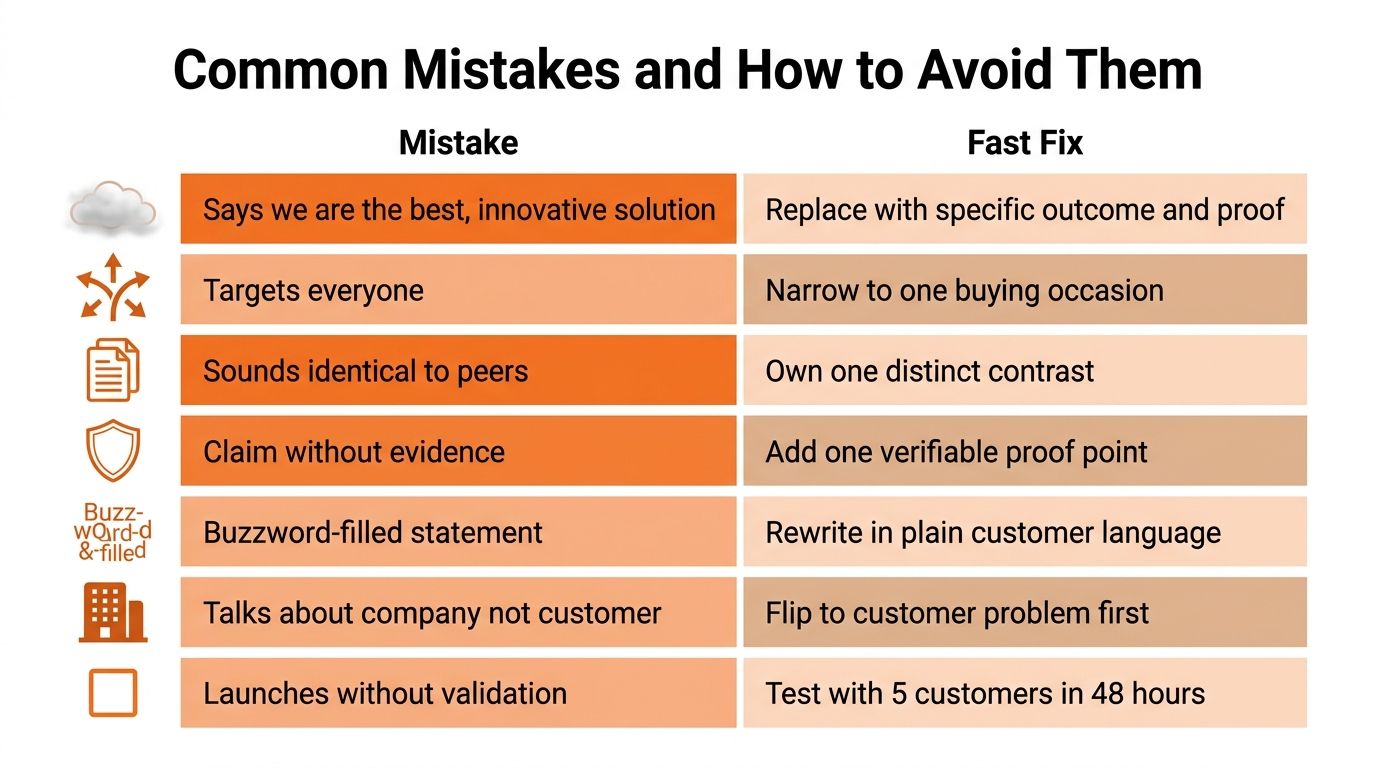
Most early-stage positioning problems come from trying to sound impressive instead of trying to be understood. Buyers don't reward fog. They reward a claim they can place, compare, and verify.
The four expensive mistakes
- Vague claims: “We're the best” and “solution” don't tell buyers what you do. Replace them with one concrete differentiator and one proof point.
- Fake differentiation: A feature your competitor already has doesn't separate you. Use a category-specific contrast that customers can recognize.
- Feature dumping: Ten capabilities create a scavenger hunt. Choose one job-to-be-done and write a single-sentence value proposition around its outcome.
- Ignoring competitors: Buyers already compare alternatives, even when you avoid naming them. Add an explicit contrast, such as “Unlike broad workflow tools, we help mid-market manufacturers approve invoices faster.”
Three traps founders miss
Copying a competitor's positioning verbatim makes your company easier to dismiss. Borrow the buyer problem if it's real, then claim a different solution, audience, proof point, or constraint.
Positioning on price alone gives you a fragile reason to win. Competitors can copy a lower price, and buyers may treat the offer like a commodity. Pair price with a specific audience, use case, or service experience if price drives the decision.
Writing for investors instead of buyers produces language about market size, technical architecture, and future potential. Buyers want to know whether you solve their current problem and why they should trust you.
A technical review of brand signaling links prestige, image, and credibility with perceived value, quality, information saved, risk, and purchase intention. The practical takeaway is simple: brand positioning evidence on value and credibility matters more than clever language.
Read your homepage headline aloud. Then ask a stranger, “What do we do, and who is it for?” If that person can't repeat your position after one listen, rewrite the headline before you buy another ad.
Implementation Checklist and What to Do This Week
In 2026, your positioning has to work in places where a human may never read your full page. AI search tools, zero-click results, and shortlisting systems need clear signals about your category, audience, alternatives, and proof. Recent analysis connects vague positioning and poor entity clarity with weaker inclusion in Google and AI search surfaces, so your brand needs a consistent description that machines can retrieve and people can trust.
Think of your brand as a record with structured fields. State the category plainly. Name the audience. Explain what you replace. Give one constrained benefit. Add proof that someone can verify. Repeat the same core claim across your homepage, About page, LinkedIn profile, sales deck, directory listings, and customer-facing documents.
This week
- Interview five customers: Ask what triggered the search, what they compared, and which words they'd use to describe your product.
- List three competitors: Include one indirect substitute and record each company's category and main claim.
- Draft the one-liner: Use the positioning statement template, then remove internal jargon.
- Check search visibility: Search your category and company name in Google and AI tools. Record how clearly the results describe your company.
Next 30 days
- Run a positioning map workshop: Plot competitors on buyer-relevant axes and choose a position you can support.
- Test the value proposition: Put one version on a landing page and use the same version in sales calls.
- Build proof into the page: Add customer language, product evidence, FAQs, and structured information that supports the claim.
- Keep the sentence stable: Change one variable at a time so you know what improved comprehension or lead quality.
Next quarter
- Refresh the message: Review buyer interviews, qualified lead quality, and sales outcomes.
- Align the system: Update the website, pitch deck, sales scripts, social profiles, and onboarding language.
- Train sales: Give every salesperson the same category, audience, contrast, and proof points.
- Test retrieval: Ask AI tools to describe your company and compare the answer with your intended position.
If you write advertorials or sponsored content, these AI advertorial template tips can help you keep the message structured and readable. Treat templates as a starting point. Your own proof still has to carry the claim.
Before Monday's standup: Choose one customer conversation, homepage change, or sales-script revision that puts your position in front of a real buyer.
Your commitment should fit on a calendar, not live in a strategy document. Pick the action, assign the owner, and ship it before the next Monday standup.
Chicago Brandstarters gives early-stage Chicago and Midwestern founders a place to work through decisions like this with a vetted peer community, private dinner conversations, and an active group chat. Visit Chicago Brandstarters to meet builders who can pressure-test your positioning and help turn a sharper brand claim into real progress.
Leave a Reply