
Your launch date looked safe when you planned it. Then design waited for a supplier quote, procurement waited for a final drawing, engineering discovered a missing requirement, and marketing asked for product details nobody had approved. The team stayed busy, yet the launch kept moving.
That pattern creates the wrong response. Founders often hire more engineers or pressure a manufacturer to work faster. Sometimes that helps. More often, loss sits between functions, inside approval queues, unclear specifications, late validation, and handoffs that force one team to wait for another.
Reducing time to market means shortening the entire path from committed resources to a product ready for sale. APQC defines time-to-market as the calendar days needed to design, test market, and manufacture or deliver a product, including both active work and waiting time, as described in this time-to-market benchmark overview. That definition changes the operating question from “How can engineering work faster?” to “Where does the product sit idle?”
The Hidden Delays Killing Your Launch
A launch can lose weeks without anyone making an obvious mistake. A designer waits for an approval. A buyer waits for a specification. A compliance reviewer sees the product after the team has already committed to tooling. Each delay looks small in isolation. Together, they create the schedule.
The first step is to map the complete cycle in calendar days. Start when the team assigns resources to the product, then stop when the product is ready for sale. Include queue time, blocked work, testing, supplier preparation, manufacturing readiness, release coordination, and customer validation. APQC uses percentile comparisons, including the 25th percentile, median, and 75th percentile, so companies can compare launch speed against peers rather than rely on optimistic internal estimates. APQC's benchmark context also makes clear that a shorter launch cycle can help a company reach demand earlier in a product's life cycle.
Find the idle time before adding people
Create a simple event log for every major deliverable. Record when work enters a queue, when someone starts it, when the work becomes blocked, and when the next function receives it. You don't need an elaborate platform at first. A shared board, a spreadsheet, or a procedure based on the guidance in this standard operating procedures resource can expose the gaps.
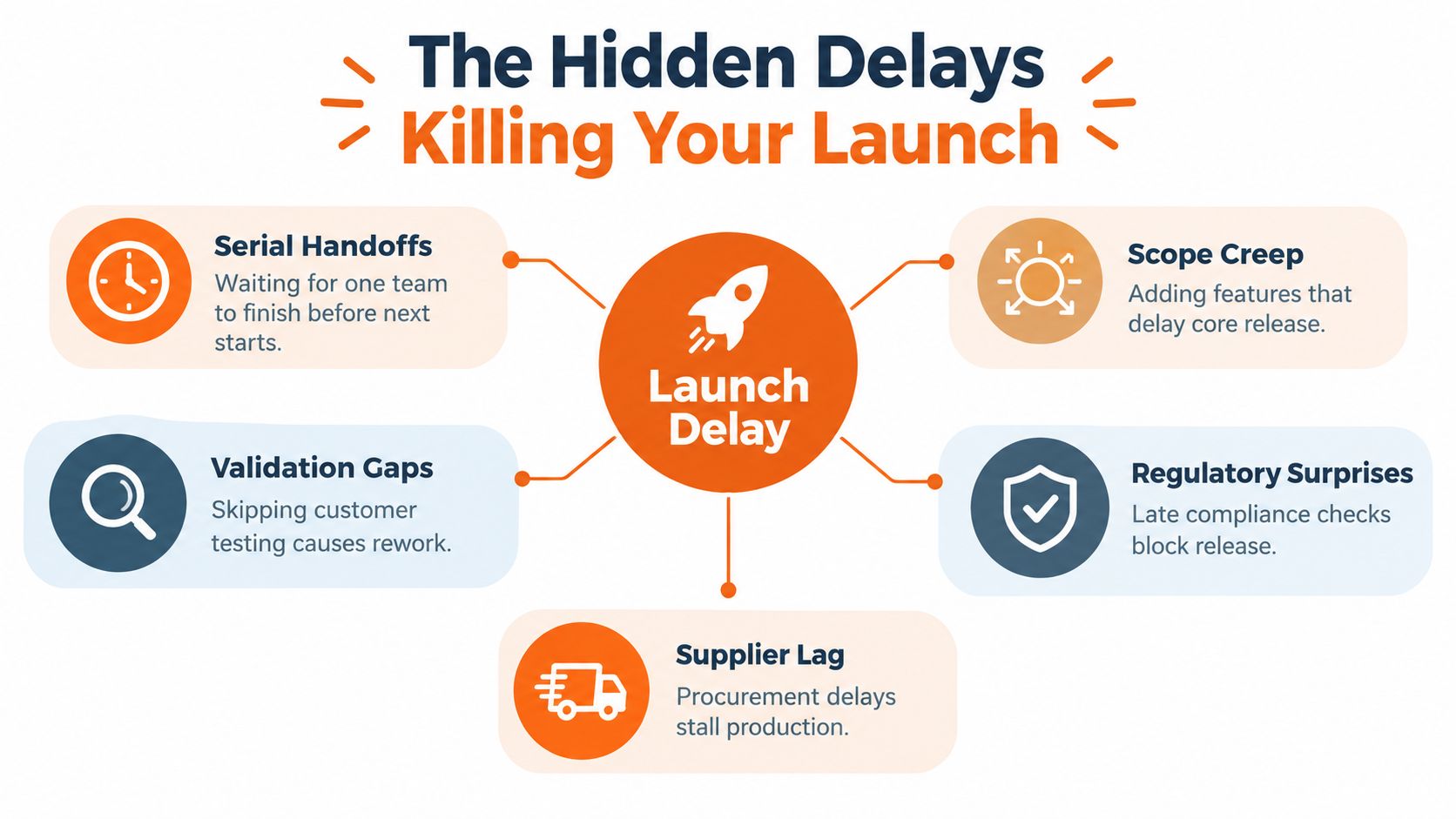
Look for five recurring causes:
- Serial handoffs: One function waits for another to finish, even when both could work from an agreed version.
- Scope creep: New features consume design, test, approval, and supplier capacity.
- Validation gaps: The team learns late that customers misunderstand or reject the product.
- Regulatory surprises: Compliance work blocks release because nobody checked requirements early.
- Supplier lag: Procurement and production wait for incomplete information or vague dates.
A reducing lead time guide can help physical-product teams examine supplier and production delays with more discipline. The useful habit is simple: separate active work time from waiting time, then attack the waiting time first.
Practical rule: If your dashboard only shows the final launch date, it tells you when you lost. Track every queue and blocker that created the loss.
Independent product-development benchmarking puts the median idea-to-launch journey at slightly less than 18 months, while one 2024 industry survey found an average journey of about 22 months. That survey found ongoing production needs took nearly a year, while the other three major stages each took roughly 3 to 4 months. The lesson isn't that every product should launch in the same window. It's that downstream production and scale-up can dominate a schedule even after design looks finished. (Product-development benchmarking data)
Ruthless Scope Control and Design Choices
Every feature creates a small contract with the future. You must design it, test it, document it, approve it, manufacture it, support it, and explain it to buyers. Founders often count only the build effort and ignore the coordination attached to each addition.
Start with one sentence: Who is the first buyer, what problem are you solving, and what must the product do for that buyer to pay? Put every proposed feature against that sentence. If a feature doesn't support the first purchase decision, move it out of the first release unless it protects safety, compliance, or basic usability.
Use a release filter
I use a four-question filter:
- Does the feature support the product's first promised outcome?
- Does the customer need it before trying the product?
- Does it create a regulatory, manufacturing, or support dependency?
- Can the team test and explain it without delaying the core release?
A “no” answer doesn't kill the idea forever. It places the idea in a later release. This distinction helps the team say no without pretending the idea lacks merit. For a more detailed way to rank competing ideas, use a structured feature prioritization framework.
For a physical product, remove surplus parts before you remove quality. A custom connector might become an established off-the-shelf connector. A bespoke fastener might become a standard size. A decorative surface treatment might wait until the team proves demand. ASME describes the same operating logic in its guidance on ways to improve time to market, including feature reduction, off-the-shelf parts, design for manufacturing, supply chain changes, and automation.
Design around the factory
Bring manufacturing knowledge into the first design conversations. Ask suppliers which tolerances create rework, which materials carry long procurement risk, and which parts already have reliable alternatives. A beautiful design that requires a fragile process can take longer than a simpler design that uses familiar equipment.
For software, the equivalent mistake is building a broad platform before proving one valuable workflow. Keep the first release narrow enough that product, engineering, sales, support, and compliance can describe the same behavior. A small surface area makes testing sharper and makes customer feedback easier to interpret.
Scope control doesn't mean careless cutting. It means protecting the promise you already made. Faster teams don't accept every good idea. They keep the first version small enough to move through the whole system.
Parallel Workflows and Stage Gates
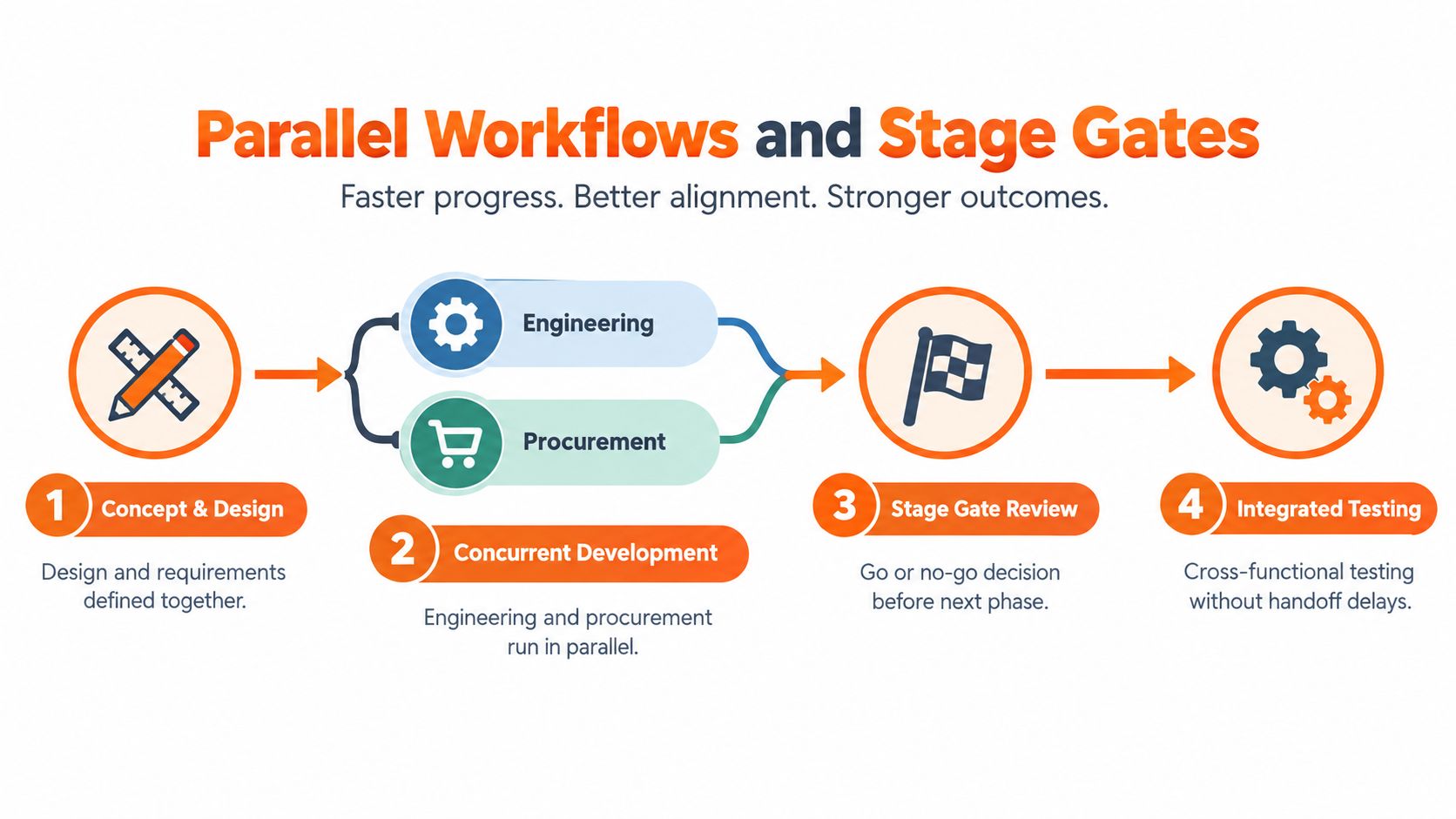
Serial development turns a product into a relay race. Design finishes, then engineering starts. Engineering finishes, then procurement starts. Procurement finishes, then manufacturing starts. Each handoff creates a queue, and each queue invites clarification.
A cross-functional team can run many activities together. The customer definition, design requirements, supplier conversations, compliance questions, and commercial preparation should inform one another early. The classic parallel-work approach recommends involving the customer at the start and giving a cross-functional team with authority responsibility for design, development, and manufacturing decisions.
Build four practical gates
You don't need a large committee. You need explicit decisions and clear evidence.
| Gate | Work running before the decision | Decision evidence |
|---|---|---|
| Concept and design | Customer problem, requirements, early industrial or technical design | A defined buyer, use case, and release boundary |
| Concurrent development | Engineering, procurement, compliance review, and commercial preparation | Feasible design, supplier path, and known constraints |
| Stage review | Prototype or working release preparation | A documented go or no-go decision |
| Integrated testing | Cross-functional tests, customer feedback, production checks | Open risks have owners, dates, and acceptable outcomes |
At each gate, assign one decision owner. Invite the people who carry the risk, then stop the meeting when the evidence supports a decision. A gate that only collects updates adds bureaucracy. A gate that kills weak scope, resolves ownership, or approves the next phase saves time.
Track each phase's planned duration against actual duration. Then separate processing time from queue time. A phase that takes a week of work but sits for three weeks awaiting approval deserves attention before a phase that takes a month of concentrated engineering.
A stage gate should function like a traffic light, not a conference. It should tell the team to proceed, stop, or fix a defined problem.
Give the team one shared product record. Use controlled versions for drawings, requirements, test results, supplier commitments, and launch materials. When people pull information from different files or inboxes, they spend time reconciling versions instead of moving the product.
This operating model also works in software. Product, design, engineering, quality, security, and commercial owners can review the same thin slice before the team expands it. Small increments make blocked work visible while the cost of changing direction remains manageable.
Use the following video as a visual complement to the parallel workflow model:
Technical Execution and Supply Chain Tactics
Once the team has a clean scope and parallel workflow, you can tune the mechanics. The best improvements usually come from shrinking batches, removing manual transfers, and giving every blocker a visible owner.
For software, reduce the size of each change moving through development. A large batch hides defects and creates a long review queue. A smaller feature or controlled slice reaches testing sooner, gives reviewers less to inspect, and makes rollback less painful. Improve CI/CD so every change receives automated checks, environment validation, and a repeatable deployment path.
DORA-style benchmarks classify elite teams as shipping in under 1 day, high performers in 1 to 7 days, and low performers above 30 days. Those categories come from the cycle lead-time benchmark, which also warns teams to distinguish calendar time from active work time. Use the benchmark as a diagnostic, not as a target that encourages reckless releases.
Instrument the work at feature level
For each feature, capture:
- Start time: When someone begins active implementation.
- Blocked time: When an external dependency stops progress.
- Review time: How long the change waits for approval or testing.
- Deploy time: When the change reaches the intended environment.
- Rework time: How much work returns because requirements or tests failed.
Watch P50, P75, and P90 lead times rather than relying on an average. Averages can hide the few large delays that make launch dates unreliable. The benchmark also reports a correlation between fast first deployment and product-market fit, with products launched in under 4 weeks showing a 36% 12-month PMF rate compared with 12% for launches taking over 26 weeks. Treat that as a correlation, not proof that speed alone creates fit. (Cycle lead-time benchmark)
For physical products, ask suppliers to confirm dates for material arrival, production start, production completion, quality control completion, and shipment. Replace “soon” with an explicit date and an owner. When a supplier misses a milestone, record the reason and decide whether to change the design, source another component, adjust the sequence, or accept the delay.
Automation helps when it removes repeated handling. Examples include automated purchase-order reminders, shared approval workflows, test fixtures, inventory alerts, and production status dashboards. It hurts when the team automates a broken process and makes the wrong sequence run faster.
Founders managing a crowdfunded physical product can also review this practical guide to navigating crowdfunding supply chain problems. For supplier planning, separate order processing, production, and shipping instead of calling all three “lead time.” The manufacturing lead-time guide provides a useful structure for requesting milestone dates and weekly status updates.
Validation Buffers and Regulatory Realities
A fast launch can still become a slow business if customers reject the product or a reviewer sends it back for more information. Speed only helps when the team moves toward a product people can buy, use, and trust.
Bring external validation into the build rather than waiting for a polished launch candidate. Give likely users a focused prototype, beta workflow, sample, or demonstration. Ask them to complete the job the product promises, then watch where they hesitate. Their confusion often reveals a requirements problem before it becomes a redesign.
The commercial team should work from the first release decision. Marketing needs a clear promise, sales needs usable proof, support needs documentation, and operations needs a fulfillment plan. Treating these functions as a final handoff creates another queue at the moment the launch schedule has the least room.
Budget for review friction
Medical devices show why nominal review targets don't equal calendar certainty. For U.S. devices using the FDA 510(k) pathway, the formal performance goal is 90 days. FDA's analysis says 90% of 510(k) submissions finish within 90 days, while 98% finish within 150 days, so a launch plan should include more than the nominal clock. (FDA 510(k) analysis)
The clock can pause when the FDA requests additional information. A 2026 database analysis reports an average of 146 days from submission to clearance for submissions cleared in 2025, roughly 5 to 7 months from submission to clearance. (510(k) review timing analysis)
Use those figures to create a planning buffer, not to predict your exact result. Ask compliance to review intended claims, test plans, labeling, documentation, and applicable requirements before the team locks the design. A late compliance discovery can force new tests, new materials, new claims, or a new submission.
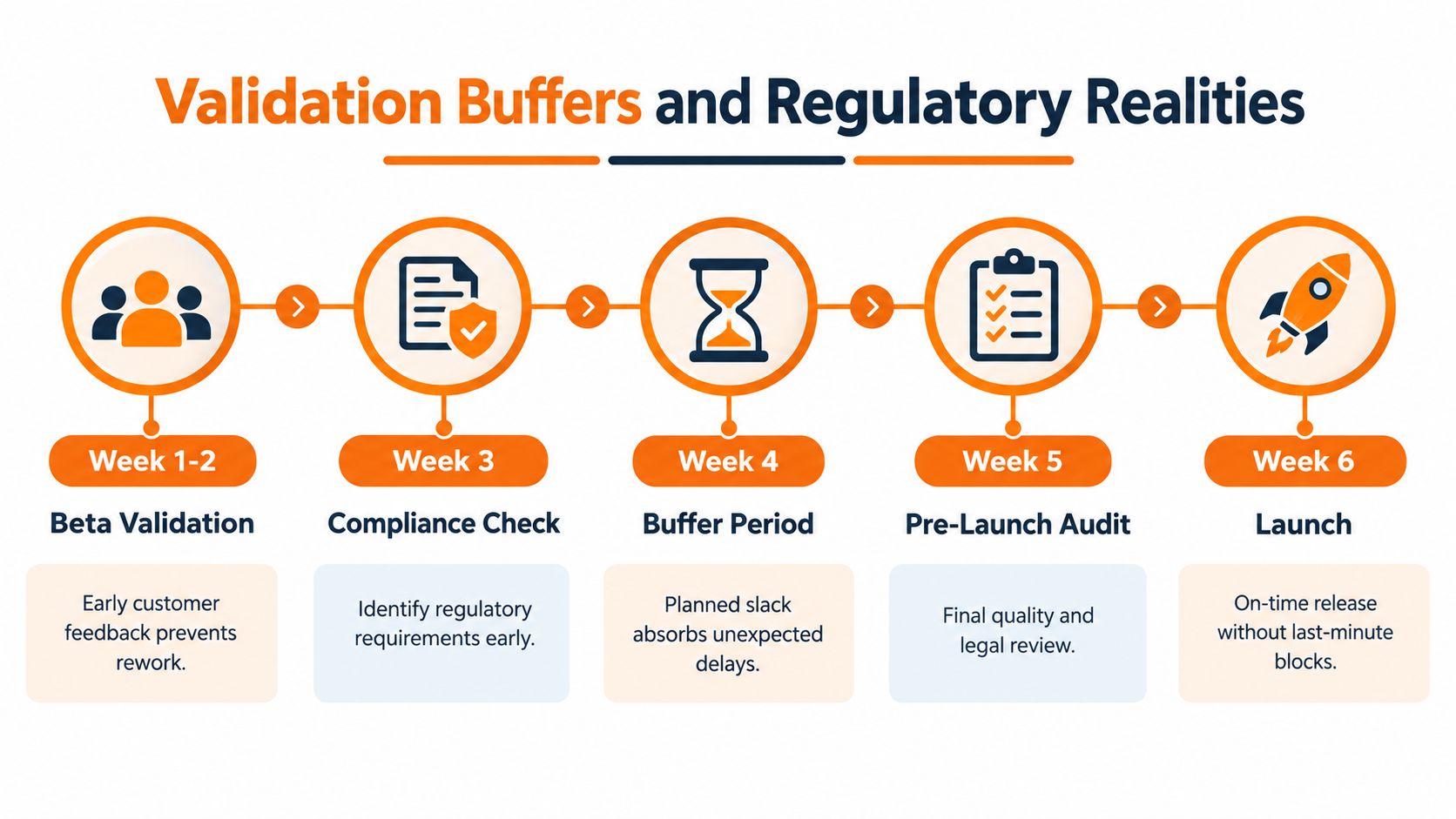
One practical sequence looks like this:
- Run beta validation with likely users.
- Review compliance requirements against the proposed claims and design.
- Reserve time for questions, rework, and supplier changes.
- Complete a pre-launch audit across quality, legal, documentation, and fulfillment.
- Release only after the accountable owner accepts the remaining risks.
Slower validation can create a faster total launch when it prevents a failed release. Historical academic work has challenged the idea that shorter development time automatically predicts commercial success, so pair speed with product fit and execution discipline. (Product-development benchmarking research)
Tracking the Metrics That Actually Matter
Most launch dashboards reward activity. They count tickets closed, prototypes made, code committed, or purchase orders issued. Those numbers can rise while the product remains stuck in an approval queue.
Track the full cycle from resource assignment to sale readiness, then decompose it into stages. APQC's calendar-day definition gives you the outer boundary, while P50, P75, and P90 views show where ordinary work ends and difficult work begins. (APQC time-to-market framework)
Build a delay-focused dashboard
Use a small set of measures:
- Total calendar lead time: The complete path from committed resources to sale readiness.
- Active processing time: Time when a person, machine, or system actively works.
- Waiting time: Time spent in queues, approvals, procurement, or scheduling.
- Blocked time: Time lost to missing information, dependencies, or unresolved decisions.
- Rework time: Time spent correcting requirements, test failures, or production issues.
- Stage duration: Actual time for concept, design, development, testing, manufacturing readiness, and release coordination.
- Percentile lead time: P50 for the typical case, P75 for a slower case, and P90 for serious schedule risk.
- First-deploy or first-build time: How long the team takes to produce a usable learning artifact.
Review the dashboard weekly with the people who can remove blockers. If approval time rises, change the decision path. If suppliers miss material dates, improve the purchase-order process or redesign the dependency. If testing creates repeated rework, move validation earlier or narrow the release.
Small improvements deserve attention because they compound across the process. A clear specification can remove a clarification loop. A shared file can eliminate version disputes. A smaller batch can expose a defect while the team still has options. These changes may look modest, yet they reduce the silent waiting that pushes launch dates away.
Operating principle: Measure the time the product spends waiting, then give someone authority to remove each recurring wait.
Review your metrics after every launch. Keep the practices that reduced queues, revise the ones that added overhead, and turn repeatable wins into documented procedures. That's how you keep reducing time to market without asking exhausted teams to run faster forever.
Chicago Brandstarters connects founders through free, vetted small dinner groups and a private group chat where members share practical operating advice, supplier lessons, and honest launch problems. Visit Chicago Brandstarters to meet kind, hardworking builders who can help you find the delays your team can't see alone.
Leave a Reply