

You're staring at your cash-flow spreadsheet after midnight. A supplier wants payment, a customer hasn't replied, and you can't decide whether your next move is sensible or desperate. You could post in a giant founder chat, but you don't want a sales pitch. You want someone who understands the problem and will tell you the truth.
That's the standard I'd use to choose an online business community. Forget the impressive member count. Find people you can ask for help before you've polished the story, then look closely at how the organizer makes that help happen.
What an Online Business Community Actually Is
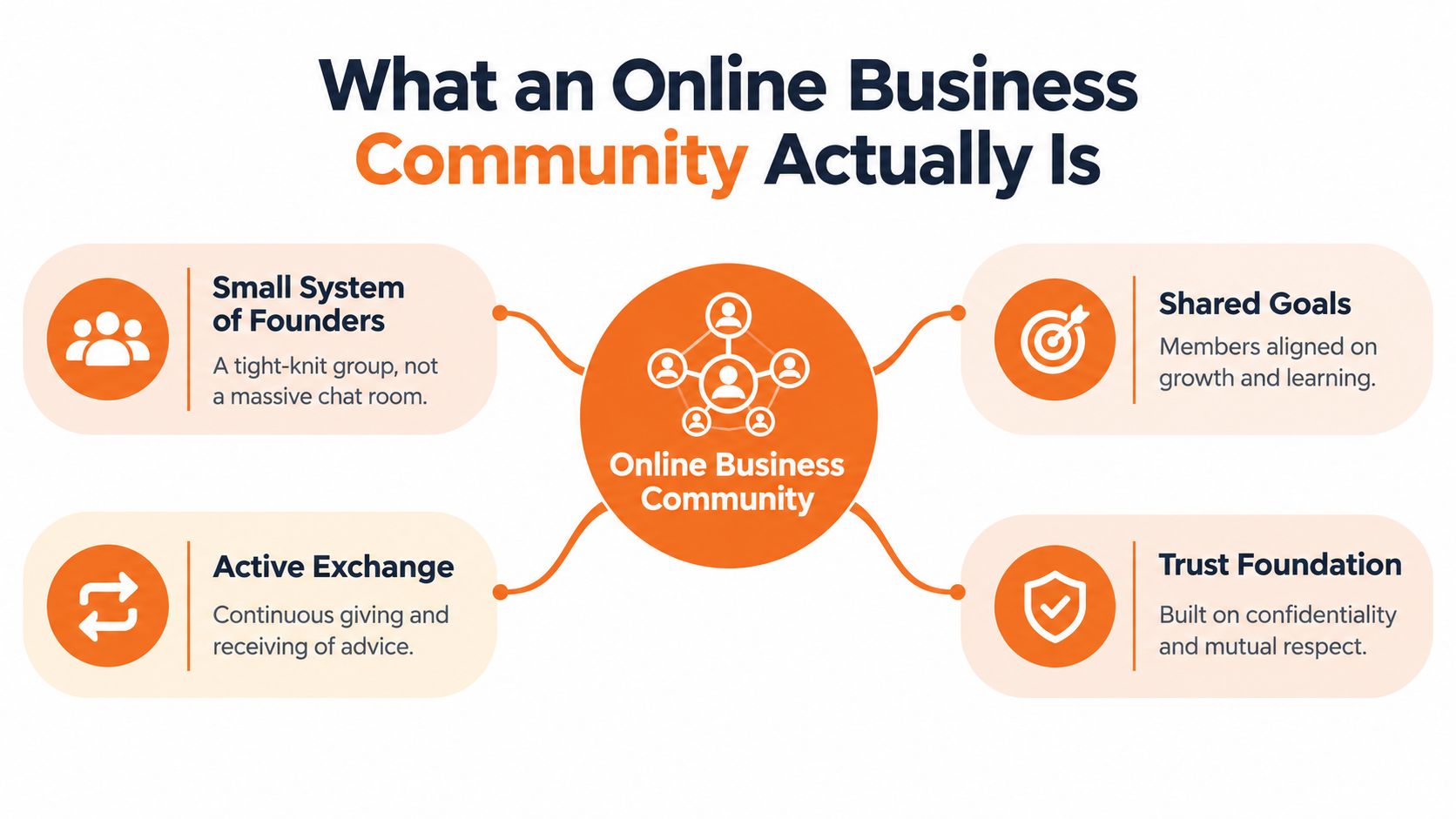
An online business community is a repeatable system for exchanging practical help with other business owners. You bring a decision, a question, or something you've learned. Other members respond with relevant experience, and you return later with what happened.
A Slack workspace is a container. So is a Discord server. Neither tells you whether anyone inside will help you negotiate a supplier agreement, challenge a pricing assumption, or admit that they made the same mistake.
Think team, not stadium
You wouldn't judge a sports team by counting everyone in the stadium. You'd look at who practices together, understands their position, and shows up when a teammate needs support. Apply the same test to founder groups.
You can use public forums to meet unfamiliar operators, private cohorts to discuss sensitive decisions, and paid masterminds to work through a defined agenda. You can also combine online conversations with local meals. Choose the arrangement around the work you need to do.
Use this diagram to separate the people and practices from the software.
Look beyond your existing circle
Your local friends may understand you without understanding inventory financing or product returns. I'd look for peers who bring experience you can't already access.
In a survey of more than 600 small-business owner-managers, over two-thirds used social media or online forums for peer support, and approximately one-third received online advice from someone they'd never met in person; researchers associated online-only advisers with business growth, rather than associating more advice with better performance (small-business research on local and online peer advice).
That finding supports a practical search strategy:
- Start with your missing experience. Look for someone who has handled your current problem.
- Check the exchange. Read actual questions and responses before judging the group.
- Keep your geography useful. Local relationships and distant expertise can coexist.
If you want another operator-focused option to investigate, you can join the operator peer network from MAJC. Apply the same test there: can you find relevant people and a clear way to ask for useful help?
The Three Main Models and Where Each One Shines
I'd choose a community the way I'd choose a workshop: by the job I need to finish. A room full of impressive people won't help if everyone works on problems you don't have.
The broad formats involve different commitments. Use this comparison as a decision aid, then verify each organizer's actual terms.
Online Business Community Models Compared
| Model | Best For | Typical Cost | Main Risk |
|---|---|---|---|
| Open forums and large Slack or Discord groups | Exploring unfamiliar topics and finding specialist contacts | Free access or an optional membership fee | Sorting through noise and unsolicited selling |
| Free vetted peer cohorts | Candid discussion with founders facing related decisions | No membership fee; confirm meal or travel expenses | Depending on an organizer without a sustainable workload |
| Paid masterminds or accelerators | Defined learning goals and structured business work | Program fee; check the full terms | Paying for access without useful instruction or accountability |
Use open groups for discovery
I'd start with an open forum when I don't yet know what I need to know. Search previous discussions, learn the vocabulary, and identify people who explain their reasoning.
Keep sensitive details out of public threads. Ask how others evaluate a supplier rather than posting a contract with customer names and payment terms. Treat public participation like browsing a hardware store: identify the tool before asking someone to help you use it.
The time commitment can expand without warning. Set a purpose before opening the app, then leave when you've completed it.
Use vetted cohorts for decisions
Choose a recurring cohort when you need people who understand the history behind your question. You shouldn't have to rebuild your entire business context every time you ask for feedback.
You'll need to attend, contribute, and tolerate direct questions. Don't join if you only want an audience for good news.
For a role-specific perspective, consider the peer group tips from SE Rockstars, from PreSales Unleashed GmbH, as another resource to evaluate. Ask whether the suggested format fits your work rather than copying it wholesale.
Pay for a defined job
Before paying for a mastermind or accelerator, name the deliverable you expect: a growth plan, management training, or focused feedback on an operating problem. Ask who teaches, how participants work together, and what happens between sessions.
I wouldn't pay just to borrow someone else's status. A recognizable guest speaker can't replace sustained attention to your company.
Practical rule: Pick the model that matches your stage, not your ambition.
If you're testing an idea around a day job, start with accessible peers. If you already manage a growing operation and need structured instruction, investigate a program with a clear curriculum.
Why Peer Interaction Actually Moves Revenue and Survival
A founder facing a cash shortfall needs more than encouragement. The right peer can challenge the assumptions behind a hiring decision, share what failed in their own business, and help the founder act before a problem worsens. That is the value to look for in an online business community: useful decisions, not a directory of impressive names.
Evidence supports taking peer contact seriously, but it does not promise the same results for every company. A review describes distinct findings: Chinese SME owners who met monthly increased sales by as much as 10%; Indian technology entrepreneurs paired with higher-quality peers built firms 28% larger and faced failure rates 10 percentage points lower; Senegalese network members with at least six months of participation achieved 9% higher revenue growth than shorter-term members (Mastercard Strive's review of peer-networking evidence). These studies cover different businesses and research designs. Don't combine their findings into an expected return on membership. Use them to judge whether a group has experienced peers, repeated contact, and reasons to keep showing up.
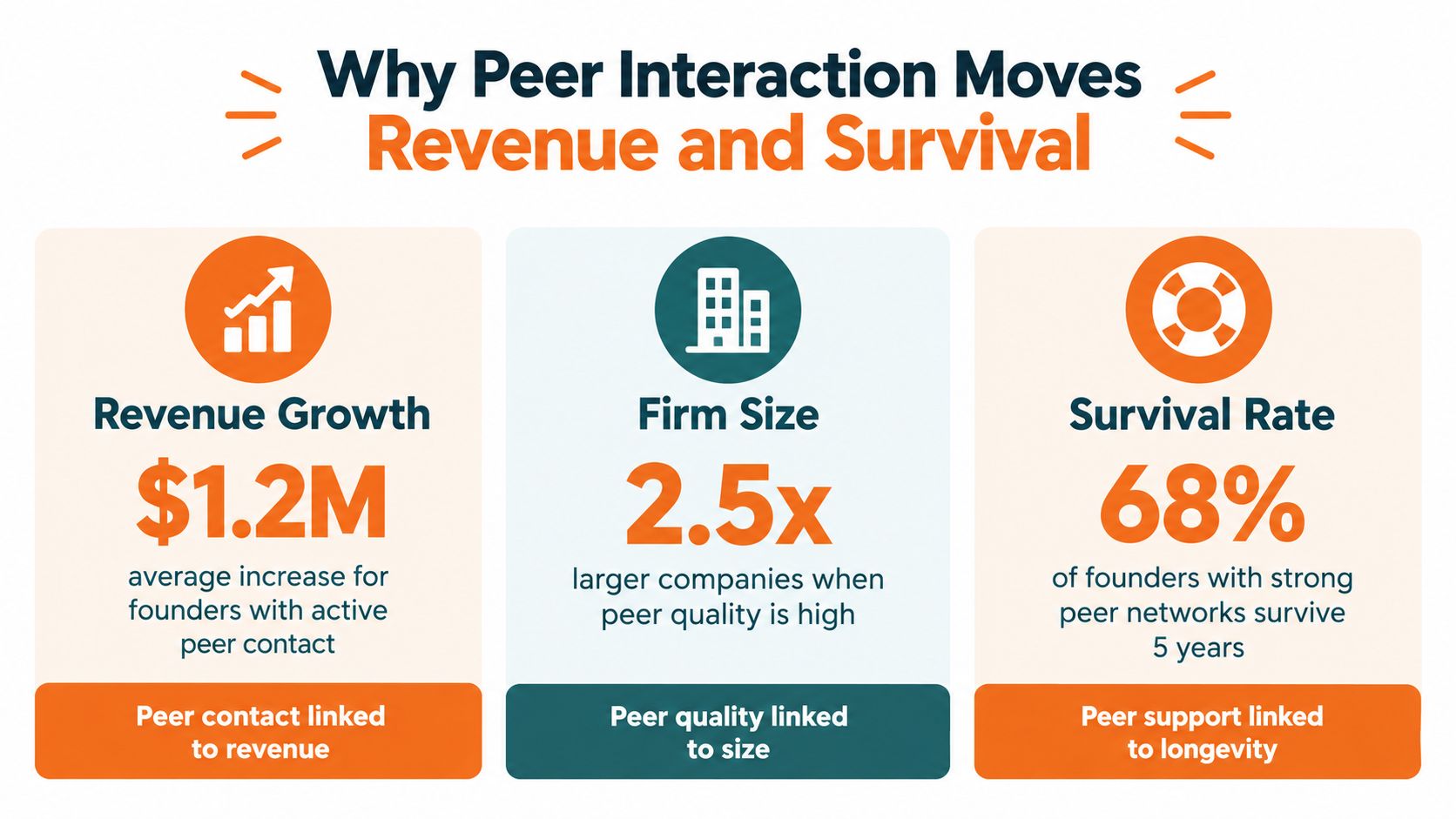
The graphic illustrates outcome categories, but its numerical claims should not be treated as a forecast. Check the cited research before drawing conclusions.
Choose experience over applause
For an inventory problem, I want a peer who can explain how they manage purchasing, not someone who merely praises my ambition. Peer quality means usable experience, including the ability to describe limits and mistakes. Ask what a prospective member tried, what they measured, and what they would change. Confidence without context is just performance.
Design for learning, not a busy member directory. Keep the same people in contact long enough to understand one another's businesses. Ask members to explain the reasoning behind advice, rather than dropping a recommendation or vendor name. Make contributions visible, especially when someone connects members across specialties.
Researchers studying business-to-business communities found that social interaction positively affected sales performance, with member network centrality mediating that relationship (research on community interaction, network position, and sales). Build connections across the group instead of making the host responsible for every introduction.
The video is an interview with operators discussing how they rebuilt peer groups after an unsuccessful first attempt. Watch it as a practical discussion prompt, then test their advice against your company's constraints.
A huge Discord can't remember every founder's problem. A compact, vetted dinner group may do better, if members return to the issue and examine what happened next. Choose the community where follow-up is part of the design.
The Mechanics That Make a Community Useful or Useless
A founder has to say, “We launched, customers hesitated at checkout, and I don't know whether to change the product or the marketing.” If the group rewards polished wins and punishes uncertainty, that problem stays hidden.
Psychological safety lets members take interpersonal risks without expecting embarrassment or punishment. A meta-analysis links it positively with team learning and performance, especially when participants have reasons to learn. Safety does not replace practical knowledge exchange (psychological-safety meta-analysis). Set the tone through clear rules, then make the conversation useful.
A problem owner should state the decision, evidence gathered, and deadline. That gives peers something specific to assess.
I need help with marketing.
A better prompt: “I'm choosing between customer interviews and another advertising test before placing my next inventory order. Customers understand the product, but hesitate at checkout. What evidence would you gather before I spend more?”
That question gives the group a real decision and a limit. It doesn't ask peers to redesign an entire company.
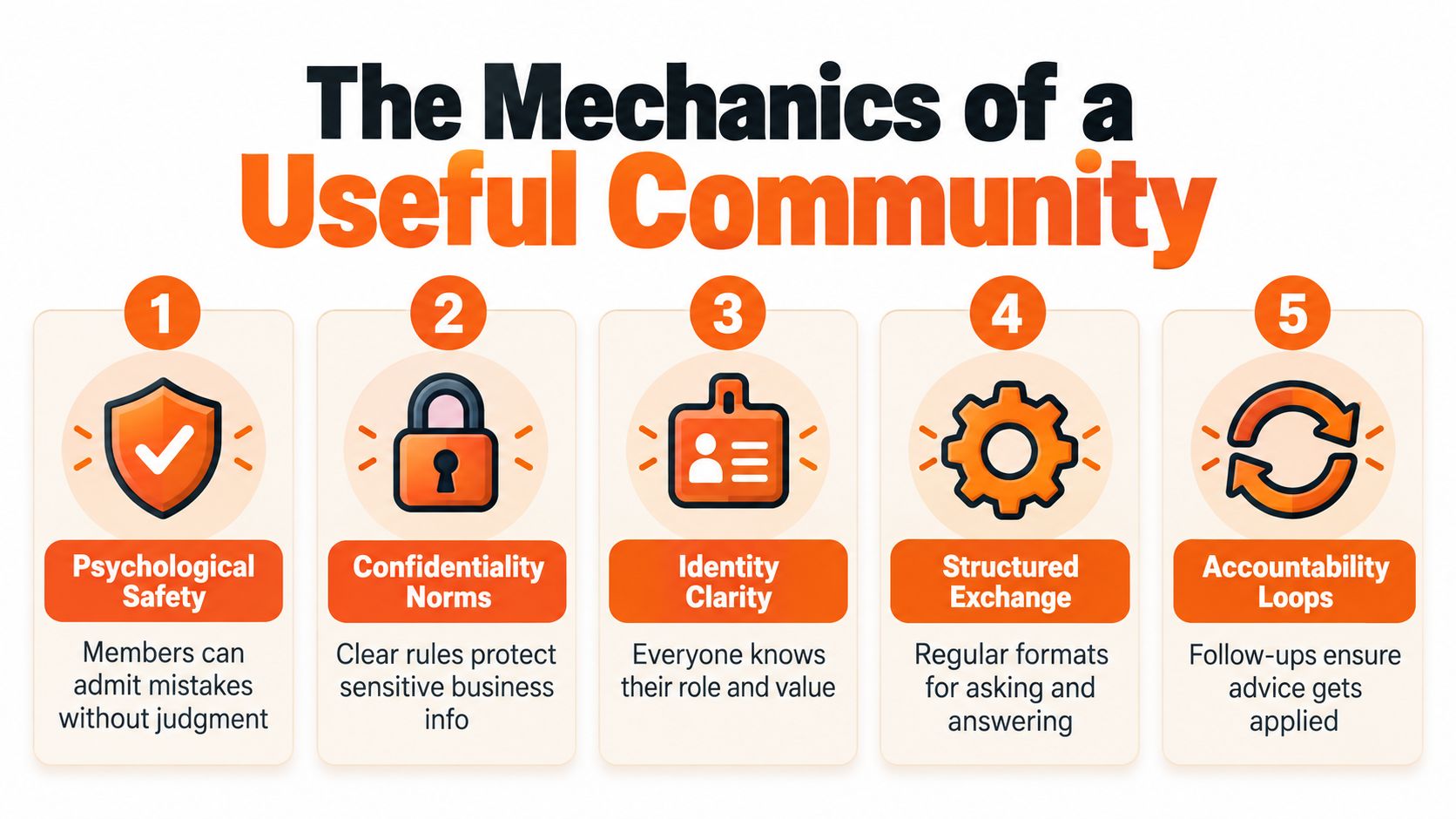
Rules only matter if organizers enforce them. Define confidentiality clearly: cover screenshots, recordings, customer details, financial information, and stories shared outside the group. Don't promise perfect protection. Explain member responsibilities and what happens after a breach.
Meeting structure should fit the group's purpose. Review this mastermind group format for an example. For larger online spaces, Sift AI's guide to social media moderation at scale covers moderation concerns. Keep a named person responsible for difficult calls.
Use these questions to test whether the rules work:
- Permission to be candid. Can a member admit uncertainty without being mocked?
- Specific privacy rules. Do members know what they may share, record, or repeat?
- Verified identities. Does the organizer check who joins and why?
- Useful exchanges. Do discussions address real decisions, with unsolicited pitches prohibited?
- Follow-through. Do problem owners report what they tested and what happened?
A community can listen without pretending to provide professional care. Members may compare experiences, but should not diagnose distress or replace an accountant, attorney, or mental-health professional. Define those limits before someone needs help.
Where Most Online Business Community Advice Falls Short
“Get out there and network” asks too much of a founder already balancing work, family, and an idea that is still taking shape. A room full of people asking about traction can make that pressure worse.
A useful community should make room for founders before revenue. Members can offer careful observations, honest feedback, and a willingness to help without proving their worth through sales figures.

Access is part of the design
In a founder survey, 52% identified lack of time as a support barrier, 41% cited cost, and 36% said caregiving responsibilities limited participation in accelerators, coaching, or mentoring groups (founder survey reporting on isolation and access barriers). Telling those founders to attend more events ignores the core obstacle. A well-designed group offers manageable ways to take part, including asynchronous discussion and smaller, focused sessions.
A global survey of 227 entrepreneurs across 46 countries found 26.9% experienced loneliness or isolation (reporting on founder loneliness). Collecting contacts alone does not solve that problem. A small group with verified members and clear expectations can give founders a more dependable place to ask for help.
You don't need an impressive business to ask a precise question.
Make participation useful and bounded
Set a modest routine: a small ask and a small contribution each week. Treat it as a way to participate, not a score to chase. Ask for feedback someone can give without becoming your unpaid consultant. For example, ask whether your product page makes clear who it helps, or what questions to bring to a supplier conversation.
Contribute from what you know:
- Give customer-level feedback. Explain where you hesitate or get confused.
- Share your investigation. Summarize what you learned comparing packaging options.
- Make a permission-based introduction. Ask both people before connecting them.
- Describe a failed test. State your assumption and what challenged it.
Keep the limits clear. Reviewing a draft is a bounded contribution. Running someone's marketing indefinitely is not.
Asynchronous participation works when posts include enough context for a useful reply. Skip “Can I pick your brain?” State the question, explain what you have tried, and ask for a specific response. That respects another founder's workload and makes peer support more likely to help.
Evaluating an Existing Community Before You Join
Treat membership like a purchase, even when you don't pay a fee. You'll spend attention, disclose information, and possibly rearrange your evenings. Ask for evidence before committing.
I'd begin with the organizer, a sample agenda, and an anonymized example of a resolved question. If you're comparing local options, use this business network group guide as another starting point, then conduct your own checks.
Ask the organizer directly
Use this script in a message or introductory conversation:
- Ownership. Who runs the group, and who handles problems when you're unavailable?
- Admissions. How do you verify identities and screen out people who mainly want to sell?
- Actual participation. What do members work on during meetings and between them?
- Boundaries. What can't members share, and what happens after a confidentiality breach?
- Commitment and exit. What attendance do you expect, and how can I leave or pause?
Listen for concrete procedures. “Everyone here is trustworthy” doesn't answer a question about screenshots.
Compare proof, not promises
Create a page for each candidate and mark every criterion clear, unclear, or missing. You don't need a complicated numerical score.
| Criterion | Evidence to request | My decision rule |
|---|---|---|
| Relevant peers | Member roles and business stages | Find experience that fits your current decisions |
| Moderation | Named owner and enforcement process | Reject unmanaged selling |
| Confidentiality | Written boundaries | Resolve ambiguity before sharing |
| Working format | Agenda and anonymized follow-up | Look for completed business work |
| Practical fit | Schedule, expenses, and exit terms | Choose a commitment you can maintain |
I'd walk away from vague privacy promises, constant alumni pitch nights, and organizers who answer every question with a success story. Ask what members do when someone brings an uncomfortable problem.
Choose the group you can contribute to consistently. Don't choose the group you hope will make you look successful.
Building Your Own Community Without Burning Out
If you can't find a suitable group, build a small cohort before building an organization. I'd start with 6 to 10 people, a shared channel, and a recurring meal or call every two weeks. Treat that as a proposed starting format, not a scientifically proven optimum.
Keep the first version boring
Write confidentiality and pitching rules before inviting anyone. Check LinkedIn profiles and hold a short conversation about motives, current work, and willingness to help.
Rotate meeting preparation and problem ownership. Keep summaries with permission, and record tested tactics rather than every personal detail.
- Skip the infrastructure. Avoid paid platforms, custom apps, sponsors, and guest speakers during your first six months.
- Protect the host. Don't make yourself responsible for solving every problem.
- Review your workload. Use these burnout prevention strategies to examine what you can sustain.
Give growing members somewhere to go
Start another cohort when you have enough suitable people and someone willing to run it. Don't stretch the original meeting until everyone gets less attention.
For members who need structured growth education, investigate Goldman Sachs 10,000 Small Businesses. Its program combines peer exercises, practical learning, and individualized growth plans; 71% of surveyed alumni reported revenue growth within 18 months (Goldman Sachs program education and alumni outcomes).
Keep the interpretation honest. Goldman Sachs describes internal program data and alumni surveys rather than a controlled experiment (Goldman Sachs program outcomes and methodology).
Your job is to help members find appropriate support. You don't need to keep them dependent on your group.
Chicago Brandstarters has a free, vetted community for Chicago and Midwest brand builders, with small private dinners, an active founder group chat, and confidentiality rules. If you want practical peer help without transactional networking, visit Chicago Brandstarters and explore joining with a concrete problem you're ready to discuss.
Leave a Reply