
You're staring at a decision you can't comfortably talk through with your employees, customers, or family. The numbers feel too personal for a networking event, and another motivational post won't tell you what to do about the customer who stopped replying. You want an entrepreneur support group where people understand the pressure and help you move.
I've hosted small founder dinners for years. The groups that work don't chase the biggest guest list. They create enough trust for people to name the problem, then enough structure to leave with a next step.
Why Most Founder Networking Leaves You Lonely
At two in the morning, a founder is awake because cash is tight, a launch has stalled, or a promising customer has gone quiet. Their friends care, but they don't know the business. At a networking event, the founder may meet a dozen people and still avoid saying what's wrong.
That gap is familiar to founders, and the evidence gives it a shape. A 2024 academic paper on entrepreneurial loneliness cites evidence that 30% of UK founders identified isolation as a concern. The same paper distinguishes close, trust-based relationships from looser connections across different groups. Support from family, friends, and entrepreneurs at a similar stage was associated with lower loneliness, while looser bridging connections had limited impact on it. The study of social capital and entrepreneurial loneliness points to repeated opportunities to build trust, not one-off introductions.
I've watched a founder leave an event with a stack of contacts and no one they felt safe calling about a missed payroll target. I've also seen a small dinner change the tone: one person admits they're stuck, another shares a mistake they made, and the room stops performing. That's not magic. It's what happens when people meet repeatedly and learn that honesty won't turn into a sales pitch later.
Big communities and online groups can help you find information or meet someone outside your usual circle. They can't guarantee the trust that lets you discuss stalled decisions, fear, or actual business numbers. A useful entrepreneur support group should help you answer two questions: Can I be candid here, and will I leave with a concrete next step? If it only gives you more names to follow up with, it's networking, not support.
What a Real Support Group Does Differently
A real group combines emotional support with practical help. Emotional support gives you room to say, “I'm worried this won't work,” without someone rushing to cheer you up. Practical help addresses the problem with a specific introduction, supplier lead, customer referral, or tactical suggestion.
The two needs shift as a venture develops. A longitudinal study of nascent entrepreneurs found that emotional support matters more earlier in venture development, while practical help can help persistence under particular founder conditions. It also found that advice doesn't benefit every experienced founder equally. The study of solo nascent entrepreneurs describes different interactions between human capital and informational or financial social capital, a reminder that peers should diagnose the need before handing out advice. Research on social support and persistence in nascent entrepreneurship offers a useful distinction: support should match the founder, not the group's favorite solution.
| Feature | Real Support Group | Typical Networking |
|---|---|---|
| Relationships | Repeated contact with a small, vetted cohort | A changing room of new contacts |
| Conversation | Honest problems, followed by focused help | Introductions, pitches, and surface updates |
| Privacy | Clear rules about what stays in the group | Expectations vary by person and event |
| Follow-through | Requests, owners, and next steps | Contact details, with no shared accountability |
Confidentiality should be a rule, not a vibe. SCORE's mentoring guidance offers a concrete example of formal protections: its volunteers agree to protect client information, put client business interests first, and avoid disclosure without consent, subject to legal requirements. SCORE says mentors can't sign individual nondisclosure agreements because confidentiality comes through their agreement with the organization. SCORE's explanation of how mentoring works gives you a model to consider when asking a group how it protects private conversations. For a practical definition of what confidentiality means in a peer setting, see Chicago Brandstarters' guide to confidentiality.
This kind of psychological safety matters in many support settings, not only business. A grief group with Be Your Best Self is one example of a community built around sensitive conversations, where trust and care matter more than contact accumulation.
Where to Find Groups Worth Joining
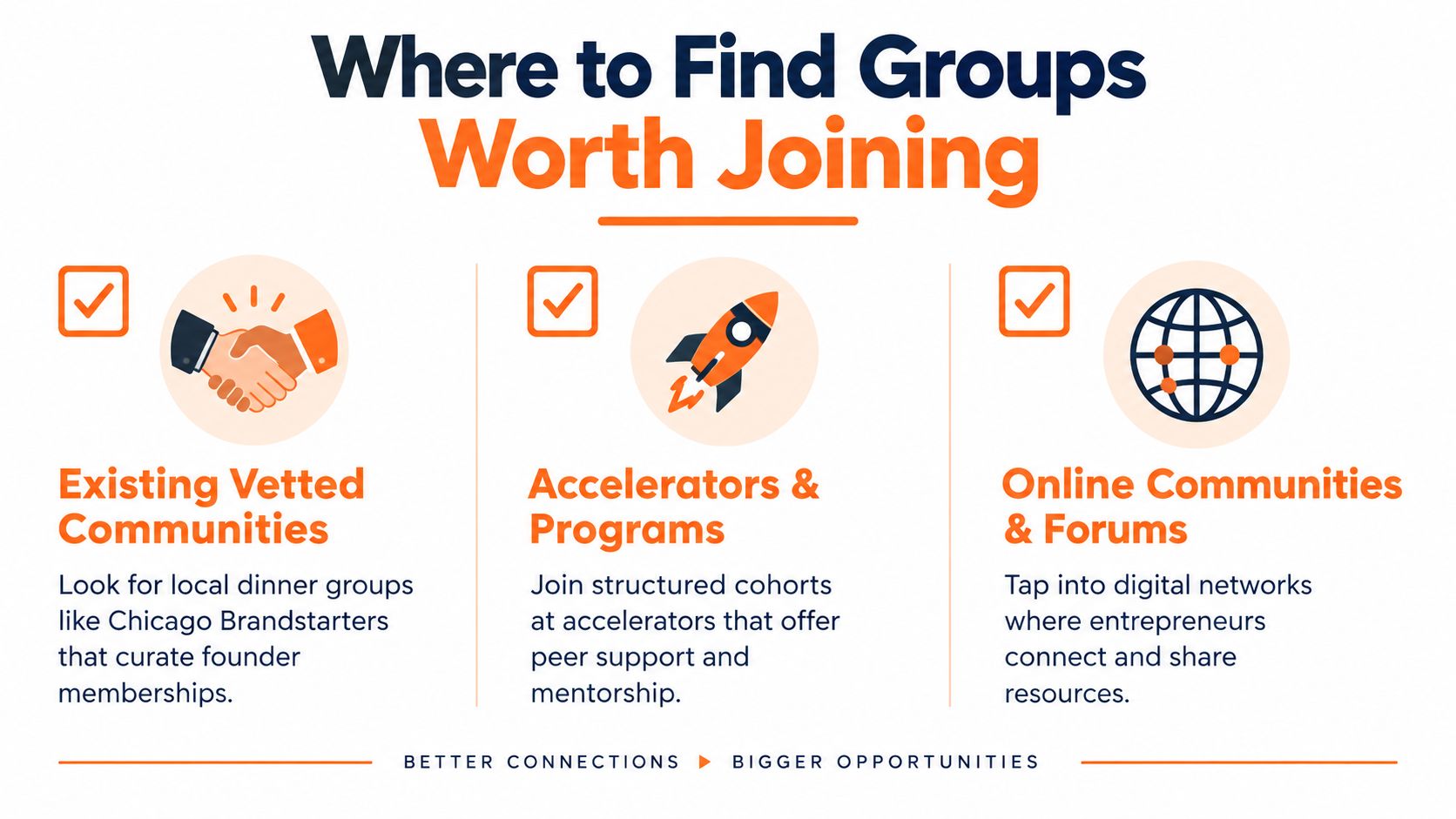
You have three sensible paths: join a vetted local community, enter a structured program, or build a small circle yourself. Pick based on the problem in front of you. If you need honest peers, start local. If you need a defined curriculum or experienced mentors, look at programs. If the available rooms don't fit your stage or values, recruit a few founders you respect.
Start with the room you need
Local dinner groups can work well if you want recurring contact and candid conversation. Chicago Brandstarters is a free, vetted community that meets in private dinners of 6–8 founders every two weeks and uses identity checks and LinkedIn vetting. You can explore networking groups for entrepreneurs to compare the kinds of communities available and decide what fits your needs.
For structured development, consider programs such as Goldman Sachs 10,000 Small Businesses or SCORE mentoring. Goldman Sachs reports that graduates of its 10,000 Small Businesses program create jobs four times faster than similarly sized U.S. businesses, and the program has more than 18,000 graduates. Its reported economic contribution exceeds $27 billion. Goldman Sachs' program information gives you a sense of the scale and follow-up behind one established option. Other possibilities include Y Combinator Startup School, EcomFuel, and Million Dollar Sellers. Check each program's current eligibility and format directly before applying.
Ask before you commit
A short conversation with the organizer can save you months in the wrong room. Ask who attends, what stage they're at, how the group vets members, and what happens when someone pitches a service. Also ask how often members meet and whether they follow up on requests.
Watch for pay-to-pitch events, groups with no privacy rules, and open forums where self-promotion goes unchecked. A polished brand won't make up for a room that doesn't protect trust. Attend once if you can, then judge the actual conversation, not the event description.
Designing the Group If Nothing Fits
If you can't find the right room, make one. Start with a clear purpose, such as helping early-stage product founders get customer conversations or giving solo operators a place to discuss hard decisions. A group built around a specific need is easier to curate than a broad “entrepreneurs welcome” invite.
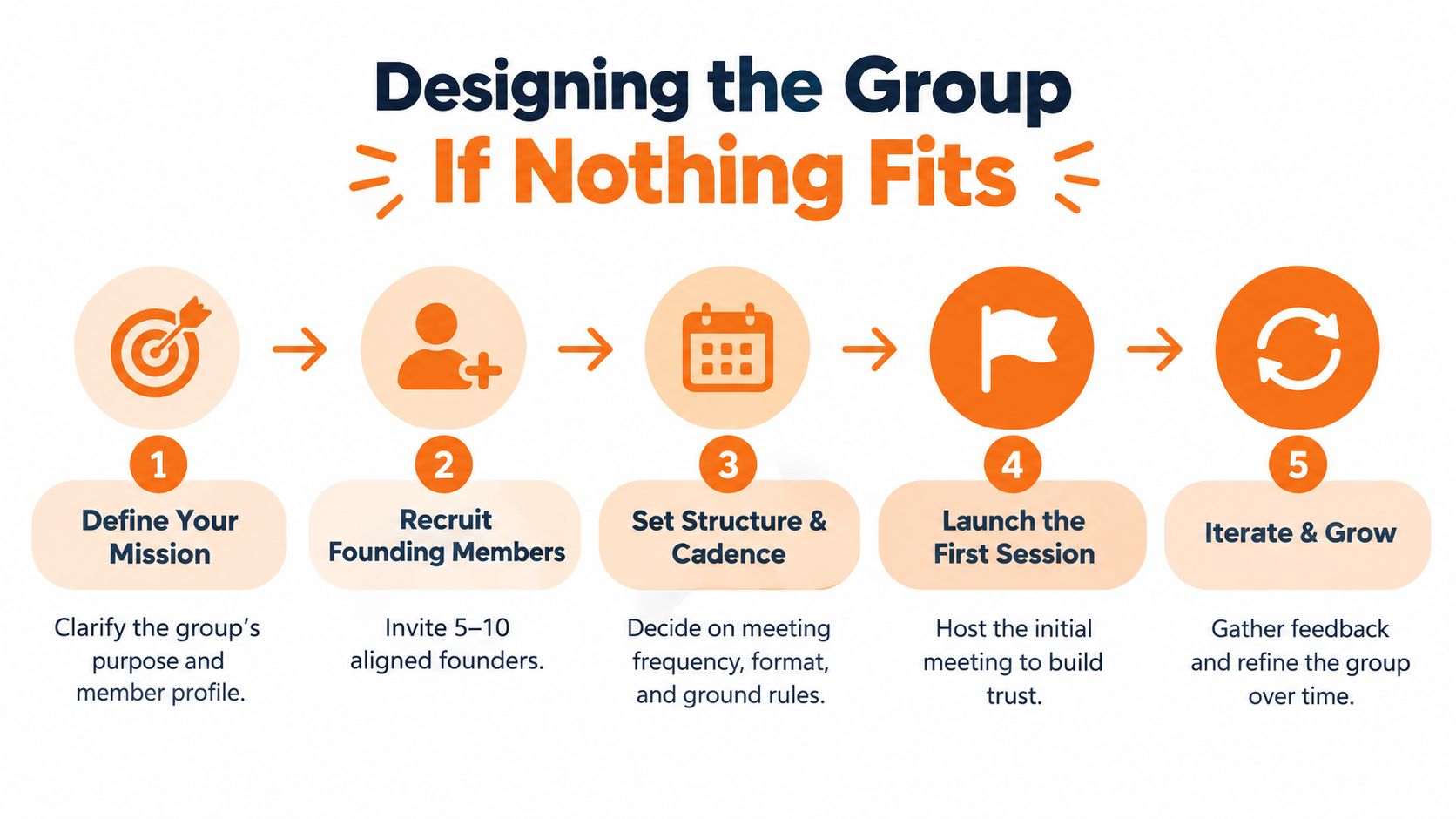
Invite 6–8 people who can contribute without turning every meeting into a sales opportunity. Meet every two weeks. For solo founders, that cadence leaves time to act on a discussion before the next one. Choose a quiet dinner spot or private room where members can talk without worrying that a neighboring table can hear their business details.
Screen for generosity and fit. Check identity through LinkedIn, then ask applicants what they're building, what kind of help they need, and what they can contribute. A waitlist gives you time to check references and protect the balance of the group. Don't accept someone just because they're eager or impressive on paper.
Write the rules down before the first dinner. Keep discussions confidential, vet members, ban solicitation, and expect follow-through. If someone breaks the privacy rule, remove them. A written agreement is clearer than a promise made over dinner.
Use a simple agenda you can repeat:
- Round-robin check-in: Each person shares a current win, worry, or decision.
- One deep dive: A member presents a specific problem, not a company history.
- Tactical asks: Each person makes one clear request, such as an introduction or feedback on an offer.
- Action recap: Record the owner and deadline for each next step, then send the notes the next morning.
Don't let the group chat become an all-day obligation. Set expectations for what belongs there: quick updates, specific requests, and follow-ups from the dinner. If the conversation gets noisy, slow it down and bring unresolved questions to the next meeting. A community of practice playbook can help you think through how a recurring group shares learning and keeps its work focused.
Running Meetings That Actually Produce Progress
A dinner becomes an operating tool when members leave with decisions and actions. Start with a brief personal check-in, then give one member the room to work through a defined problem. The problem owner should explain what they've tried, what's blocked, and what decision they need to make.
Keep the deep dive focused. Give each person a short turn to offer relevant experience or a concrete resource, and have the problem owner summarize what they'll test. A vague struggle like “marketing isn't working” needs a sharper question: Which customer are you trying to reach, what message are you using, and what will you test next?
Turn discussion into a test
Use prompts that force useful answers:
- What's the smallest experiment you could run this week?
- Who specifically can help, and what would you ask them for?
- What would success look like 14 days from now?
Those questions turn advice into an action someone can report back on. A member might leave with an outreach message to test, a customer to interview, or a decision deadline. The group can then ask what happened at the next meeting instead of restarting the conversation from scratch.
End with a written recap that names each owner and deadline. Send it within 24 hours, and start the next session by checking the previous commitments. Don't use the recap to record sensitive details that don't need to travel beyond the room. Keep it practical and limited to the agreed actions.
Good meeting habits help product teams stay focused too. Meeting best practices for product teams can give you ideas for agendas and clearer participation. In a founder room, the same discipline applies: define the question, keep feedback specific, and make sure the person with the problem decides what to do. If a member needs help giving or receiving candid advice, use Chicago Brandstarters' guide to feedback.
Troubleshooting the Stuff That Breaks Groups
A room can feel friendly and still fail its members. In a Balderton survey of 230 founders and co-founders of venture-backed companies, 53% reported loneliness or isolation, 61% said it was difficult to find support from people who understood founder-specific challenges, and 69% said a strong peer group positively affected their ability to perform at work. Balderton's founder wellbeing report gives a good reason to protect the conditions that make peer support useful, rather than assuming attendance alone means the group works.
Here are the failure modes I watch for:
- One person dominates: Use a timer. Give the group a quiet moment to think before anyone responds.
- Advice piles up: Ask the problem owner to restate the decision they need before the room offers suggestions.
- Everyone rushes to positivity: Let the silence sit. A founder who feels heard is more likely to explain the actual obstacle.
- Someone breaks confidentiality: Set a written rule and remove the person if they share private details outside the group.
- Members start pitching: Enforce no-solicitation rules and give members dedicated turns for requests, not sales.
Emotional support has limits. A founder group can listen, check in, and help someone find a next step. It isn't therapy, and members shouldn't try to manage serious distress as if they were qualified providers.
Stay if people protect privacy, listen fairly, and act on commitments. Reset the rules if the group has one fixable problem. Leave if low-signal talk keeps winning, members repeatedly ignore follow-through, or people treat the room as a place to sell. A group that costs your trust and time without helping you think or act is the wrong group.
Your First 90 Days in a New Group

Give a new group a fair test, but don't confuse time spent in a room with progress. At first, listen closely and contribute without performing. Learn what each person is building and notice whether members protect privacy, ask useful questions, and keep their word.
By the next phase, take a problem-solving turn and follow through on the action you accept. Learn three members' businesses well enough to make a useful introduction or ask a specific question. As the group settles, bring a practical request to each meeting and record whether you acted on the help you received.
At the 90-day mark, ask yourself:
- How many meetings did I attend?
- Which asks did I complete?
- What experiments did I launch?
- Do I dread Mondays less than I did before?
The answers matter more than a busy calendar. Keep going if the room helps you make decisions and take action. Reset expectations or leave if it doesn't. Bring in a coach, therapist, or experienced operator-mentor when the problem needs expertise or care that peers can't provide.
For a closer look at founder community and collaboration, watch this video:
Chicago Brandstarters runs a free, vetted community with private founder dinners, a group chat, and clear expectations around confidentiality and self-promotion. If you're building in Chicago or the Midwest and want a small room for honest peer support, visit Chicago Brandstarters to learn how to join.
Leave a Reply