
You've got a sales number that won't move, a supplier who hasn't answered, and a decision you can't put off much longer. It's late, your usual friends don't run businesses, and another hour of searching online has left you with more opinions than answers. That's when the right small business community can help: not by cheering you on, but by helping you decide what to do next.
A good peer group won't make every hard part easy. It can give you a trusted place to test an idea, hear from someone who's faced a similar problem, and leave with a concrete next step. The difference between useful support and noisy networking comes down to who's in the room and how the group works.
The 2 A.M. Problem Every Founder Knows
You're staring at the same sales dashboard you checked before dinner. The number hasn't changed. You wonder whether the problem is the offer, the price, the audience, or your ability to sell at all. In the quiet, each possibility feels like proof you've made the wrong bet.
That moment doesn't mean you're bad at business. It means you're trying to make a consequential decision without enough useful feedback. Friends may care about you, but they might not know how to assess your landing page, supplier terms, or cash flow. Search results can help you learn, but they can't tell you which detail matters most in your situation.
A good peer community changes the quality of the conversation. You can explain what you've tried, hear how an operator handled a comparable problem, and decide what to test next. It won't guarantee the answer is right. It can help you stop spinning alone.
A useful community turns a vague worry into a decision you can act on.
If stress is starting to affect your sleep or health, don't treat a founder group as a substitute for proper support. The Acheloa Wellness founder support guide has practical guidance for managing the strain of running a business. And if the isolation feels bigger than a business problem, Chicago founder mental health resources can help you consider what support might fit.
What a Small Business Community Actually Is
A small business community is a recurring place where founders trade honest information with peers they can trust. It functions as a gym for operating decisions. You show up regularly, see how others handle similar challenges, and get a chance to correct your approach before a small mistake grows.
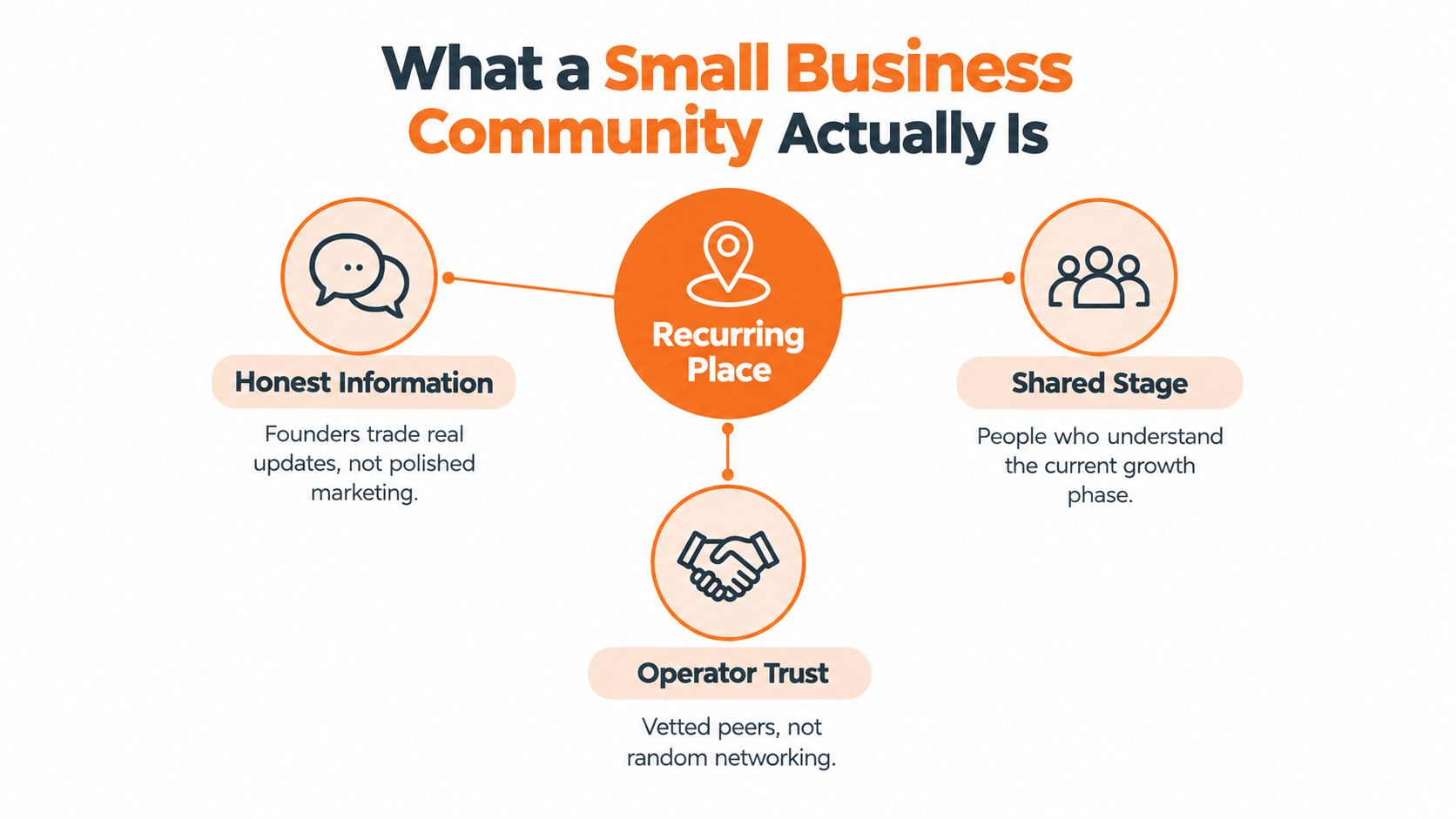
The structure matters more than the label. A useful group brings together recurring contact, shared stage, operator credibility, and confidentiality. Members come back often enough to build context. They understand the kinds of decisions you face now. They've run businesses or solved the problems they discuss, and they respect the boundaries that let people speak candidly.
A large online group may have thousands of members and still lack those basics. If the conversation mostly consists of introductions, self-promotion, and generic encouragement, you've found an audience, not a working community. A good group makes it easier to ask, “My first customers like the product, but they don't reorder. What should I inspect?” and get thoughtful questions in return.
Who benefits from a founder group
You don't need to have a company with employees or a polished business plan to belong. Solo founders, early-stage product and ecommerce builders, people testing a side hustle alongside a job, and experienced operators can all benefit when they meet peers whose perspective fits the problem at hand. Mentors and investors can contribute, too, if they show up to help rather than pitch.
The test is simple: does the group help you talk about a real decision and identify a useful next move? If it does, it's community. If you leave with a stack of contact details and no clearer thinking, it's networking.
The Four Main Types of Founder Communities
Founders often choose a group by its name or member count. I'd choose by the work you need it to do. A chamber can open doors in your city. A small peer circle can help you work through a pricing decision. An online forum can answer a tactical question quickly. Those are different jobs, so expect different trade-offs.
| Community Type | Best For | Watch Out For |
|---|---|---|
| Local chambers and city business groups | Local credibility, public events, and introductions to established businesses | Some groups center on ceremonies and broad business mixers rather than candid operating advice |
| Niche peer groups | Advice from people in your industry or at a similar stage | The fit can disappear if your company's model or stage differs from the group's focus |
| Vetted private communities | Confidential conversations, recurring peer support, and practical problem-solving | Screening and strong facilitation matter; a private label alone doesn't guarantee quality |
| Open online hubs and forums | Broad reach, quick questions, and learning from public discussions | Threads can drift into self-promotion, shallow advice, and competing opinions |
A chamber makes sense when you need to meet local partners, learn how business works in your area, or become known among nearby organizations. It's less useful if you need a confidential review of a struggling sales channel. If you're weighing structured support for an early business, this guide to small-business incubators can help you compare that option with peer groups.
Niche groups can be excellent when members share a business model. An ecommerce founder may get more useful feedback from operators who understand inventory and fulfillment than from a general business crowd. But if you're still testing demand, a room of mature brands may not understand your immediate constraints.
Private groups depend on the quality of their screening, facilitation, and norms. Open forums can help you gather perspectives, but you'll need to filter the advice yourself. Choose the community that fits your decision today, and reassess when your problems change.
Why Small and Vetted Beats Big and Loud
A packed conference can introduce you to plenty of people. It can't guarantee that any of them will tell you what they'd do about your supplier problem. In a smaller group, you have time to explain the context, hear a relevant perspective, and ask a follow-up question. That's a better use of attention when you need a decision, not another stack of contacts.

Small groups work when members trust the room. Confidentiality gives founders space to discuss real setbacks, uncomfortable numbers, and decisions they haven't announced publicly. Identity checks can make it harder for a sales pitch to masquerade as peer advice. Regular meetings give members enough history to recognize when a founder keeps hitting the same obstacle.
The need for connection is real, but “more events” is a lazy answer to loneliness. Enterprise Nation's Small Business Barometer found that 50% of small-business owners felt lonely some of the time, while 29% felt lonely often (Enterprise Nation's findings on business loneliness). Separately, the British Franchise Association reported that 44% of UK small-business owners felt lonely or isolated (the BFA's discussion of leadership isolation). Those figures describe different surveys, but both point to a problem that casual introductions don't necessarily solve.
A meal or small-group session can create room for a more candid exchange, but size alone won't do it. The host needs to set expectations, protect confidentiality, and keep the conversation focused on members' actual work.
Treat the room like a working session, not a performance. Bring one problem, explain what you've tried, and ask for the kind of feedback you can use.
How to Vet a Community Before You Join
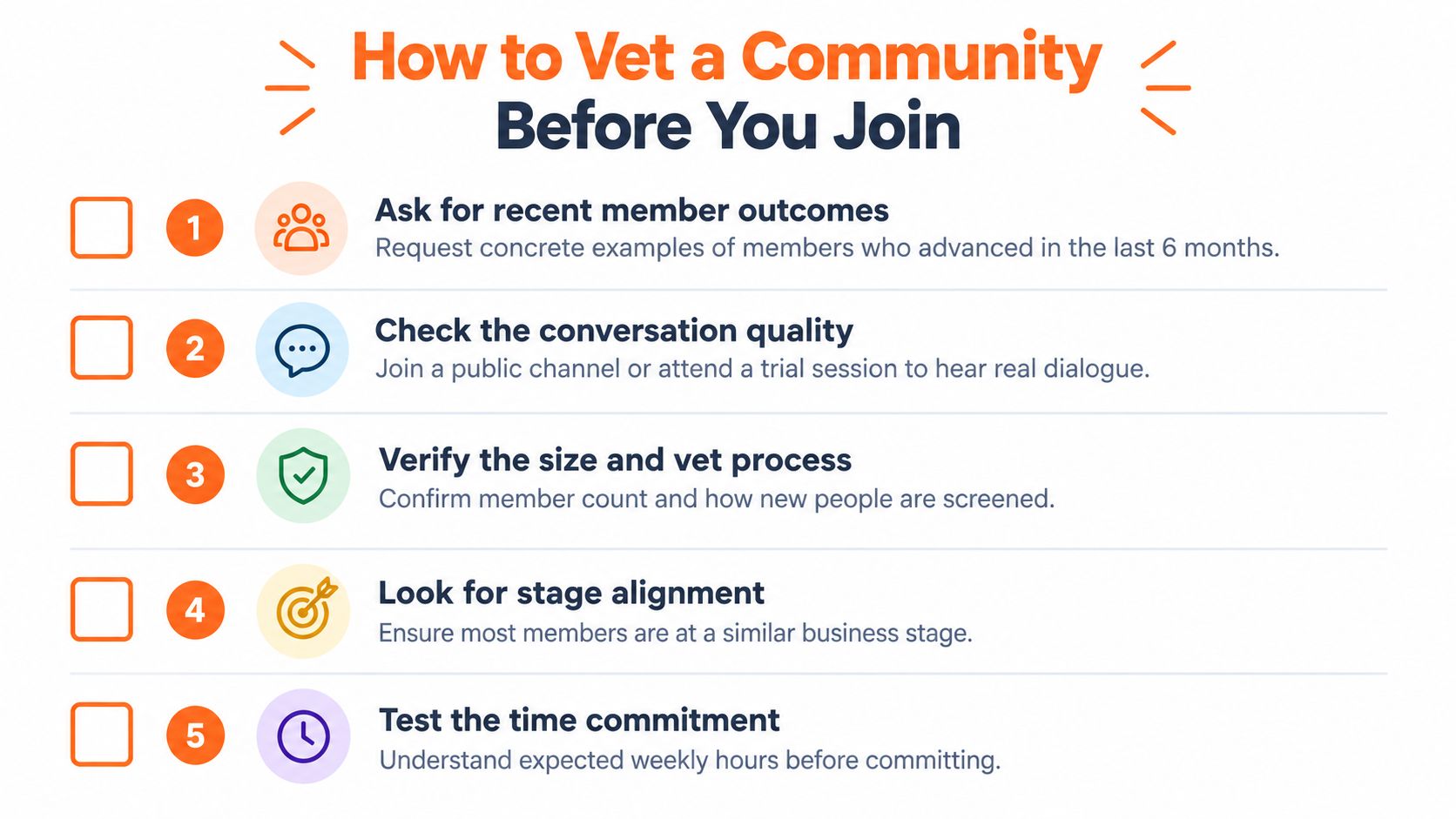
A weak community costs more than its membership fee. It takes your attention, fills your calendar, and can leave you with advice that doesn't fit your business. Before you commit, ask a few direct questions.
Ask about the room
- Who checks membership? Ask whether organizers verify identities and business backgrounds. A group that can't explain who belongs may not be able to protect the quality of the conversation.
- How do members meet? Find out whether the group runs small recurring sessions or occasional large events. Repeated contact helps members learn each other's context.
- Can members pitch? If service providers can use every gathering to sell, expect advice to come with an agenda. Ask how the host handles unsolicited promotion.
- What does confidentiality mean here? Look for clear norms, not a vague promise that people “respect privacy.” Ask how the group handles sensitive business details.
- Are members near your stage? Mentors with deeper experience can help, but you also need peers who understand your current constraints. A room full of people several stages ahead may miss the problem you're trying to solve now.
Listen for how the organizer talks about outcomes. Can members describe a decision they worked through together, or does the pitch focus on vague connection and access? If possible, join a trial session or talk with current members before you decide.
Green flag: Members ask follow-up questions before they prescribe a solution.
Watch for an active group chat where people share real operational problems, not only polished announcements. Ask whether members have stayed involved, how the host keeps discussions useful, and how much time the group expects from you. A clear, grounded answer is more useful than a promise that one community can fix every business challenge.
From Idea to Seven Figures Without Doing It Alone
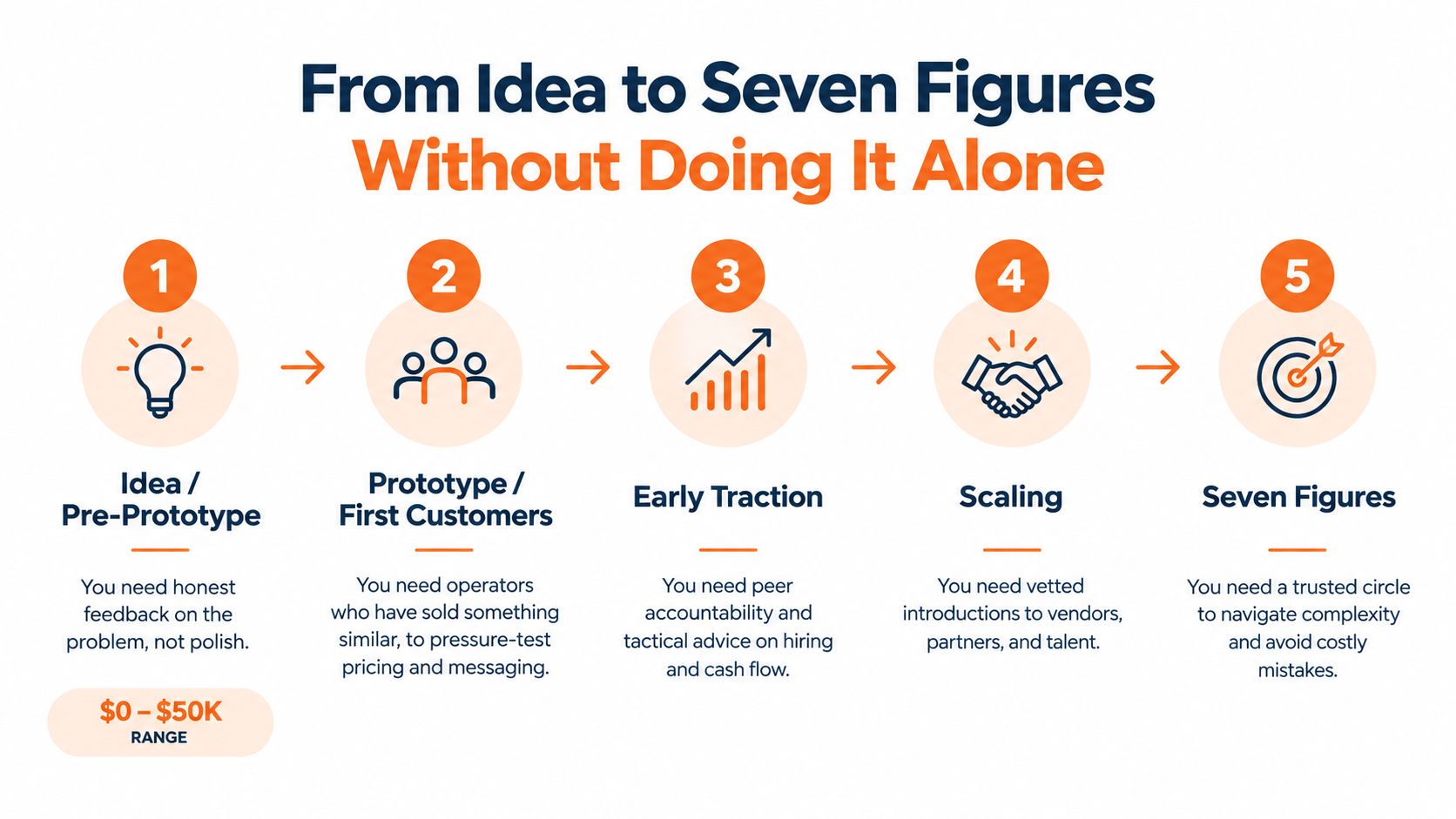
The people who help you test an idea may not be the same people you need to run a larger company. Your community should change as your decisions change. The goal isn't to collect memberships. It's to find peers who can help with the problem in front of you now.
Match the room to the work
At the idea or pre-prototype stage, look for people who will pressure-test the customer problem before you spend heavily. You need direct questions about who has the problem, how they handle it now, and what would make them pay for a different solution.
At prototype and first-customer stage, talk with operators who have sold something similar. They may spot a weak price, a confusing message, or a channel that doesn't reach the people you want. Once you have early traction, cash flow, hiring, and repeatable operations become more pressing. Find peers who've handled those decisions firsthand.
As you move into scaling, you may need a different mix of expertise and introductions. A company approaching seven figures has new questions about systems, finance, vendors, and team culture. For help thinking through that transition, this resource on scaling your business to seven figures can help you frame the planning work.
Programs such as Goldman Sachs 10KSB, EcomFuel, and Million Dollar Sellers may suit founders who have outgrown a very early-stage circle. They're distinct options for different business needs, so check their current criteria and focus before joining. A group that helped you test your first offer doesn't have to remain your only room forever.
Don't leave a good community just because you've grown. Leave when its members can no longer help you think through the decisions you face, or when its discussions no longer fit your stage. Keep the relationships that still work, and find a new room for the problems you've outgrown.
The Networking Trap and What to Do Instead
A full contact list can make you feel productive while leaving your business decisions untouched. Connections matter when they help you find a customer, get a relevant introduction, or make a better choice. Otherwise, collecting contacts is another task competing for time you don't have.
That distinction matters for founders in regional markets. Experian's Q2 2025 Main Street Report found that large banks approved 13% of small-business loan applications in that period (Experian's Q2 2025 Main Street Report). In the same report, 32% of regional small businesses said they had a good support network and access to needed resources. Those figures describe different barriers: a peer group can help you work through choices, but it can't promise a lender's approval.
The useful question isn't only “Where can I apply?” It's “Which path fits my stage, cash flow, collateral, location, and relationships?” A founder who has worked through that choice with experienced peers may spot a weak assumption sooner. The group still can't replace a lender, attorney, or qualified financial adviser.
Measure a community by the decisions it helps you make, not by how many people you meet.
Before you attend another event, name the problem you want to solve. Then decide what kind of person could help: an operator who has hired, a founder who has managed inventory, or a local contact who understands financing options. If you want to build professional friendships that support your work, start by being specific about what you need and what you can contribute.
Practical Resources and Your Next Move
Books can give you a useful framework, but they can't choose your next move for you. Match the reading to the work: Nail It Then Scale It for testing a problem and offer; Ready, Fire, Aim for action and growth; Traction or Scaling Up for building operating systems; and Making Money Is Killing Your Business for thinking carefully about cash and profit. Influence can help you study persuasion, while Warfighting and 10x Is Easier Than 2x offer broader approaches to planning and ambition. Read with a live business question in mind, or the ideas can stay abstract.
For a founder ready for more structured support, Goldman Sachs 10KSB, EcomFuel, and Million Dollar Sellers are possible next-stage options. Check each program's current focus and eligibility before investing your time. The right room depends on the business you're building, the decisions you face, and the experience you need around you.
Mentoring can make the relationship more practical when the mentor has operated a business and stays in touch. A randomized trial in Kenya found that mentoring from an experienced entrepreneur in the same community increased short-term profits for inexperienced women running microenterprises by an average of 20%, and mentees who kept meeting their mentors retained the gains (evidence on business mentoring). That finding isn't a promise of the same outcome for every founder. It does support choosing mentors with relevant experience and regular contact.
If money decisions are making you hesitate, this guide to how to shift your money mindset can give you another way to examine your assumptions. Then take a practical next step: find a vetted peer group, attend two sessions, bring one real business problem, and judge the quality of the questions and advice you receive.
Chicago Brandstarters is a free, vetted community for Chicago and Midwestern founders building brands from idea stage toward seven figures, with private small-group dinners and an active chat for sharing practical problems and advice. If you want to work through a real decision with peers who understand the founder's seat, visit Chicago Brandstarters.
Leave a Reply