
You typed "small business owners" into a notes app last night and felt smart for about ten minutes. Then you opened your inbox. Every lead wanted something different. One person sells cupcakes. Another runs a two-person machine shop. A third wants a logo by Friday and a warehouse by next month.
I have been there. I picked a pond so wide I could not see the far shore, then wondered why nobody bit.
If you want to learn how to make a niche, start with a smaller promise. I will walk you through a definition, a short list, public data, customer interviews, three ways to position, and a five-person test you can run before you spend real money.
What a Niche Is and How Narrow to Go
Last spring I tried to sell bookkeeping help to "small businesses in Chicago." Every call started the same way and ended somewhere else. A bakery needed payroll before Friday. A contractor needed job costing. A clinic needed insurance codes. I had a crowd. I did not have a buyer.
A niche is a small segment of a broader market that you choose to serve instead of trying to sell to everyone. The U.S. Chamber of Commerce uses jewelry for new moms as the picture. Jewelry stays wide enough to support demand. New moms are specific enough to guide product choices and marketing.
A fishing pond offers a useful comparison. A huge lake looks exciting until you realize you brought one rod and no map. A smaller pond works when the fish are there and you can reach them. You do not need the only pond in the state. You need a pond you can walk around.
Too wide and too tight
I use two gut checks before I fall in love with a label.
Specific enough: You can name the person, the moment, and the job they are trying to finish. "Chicago founders who hate transactional networking" is a person. "Entrepreneurs" is a crowd.
Wide enough: Enough of those people exist, and they already spend money or time on a workaround, so the niche can pay the bills. A club of twelve friends is a dinner, not a business.
The tension is real. Go too wide and every lead looks different, so your message turns bland. Go too small and you can describe the buyer perfectly, then run out of buyers in month three.
Practical rule: If you cannot picture five real people who fit, the niche is still a slogan. If you can only picture five people in the whole country, it may be too small to support you.
I do not research in this step. I only write the boundary. Who am I not serving, and what problem am I willing to ignore for now? That sentence becomes the fence for every test that follows.
Listing Candidate Niches from Problems You Understand
Once the fence is up, I need options, not a masterpiece. I aim for three to five candidate niches, then I stop. More than five and I start daydreaming instead of testing. This is the messy middle of how to make a niche. You generate options before you marry one.
An identity niche names who someone is. Job title, city, hobby, life stage. "First-time ecommerce founders in the Midwest" is an identity niche. It is easy to say at a party. It is often hard to sell, because people who share a label do not share a bill to pay.
A problem niche names a repeated task or friction people already pay to fix. Slow shipping. Sizing returns. A founder who leaves every mixer with a stack of cards and the same stuck decision. Identity can sit inside the sentence. The friction is what makes someone switch.
Where I steal the raw material
I do not invent pain in a blank doc. I pull from three places I already know.
Past work: Jobs where I watched the same mess every week. Late invoices. Bad handoffs. A form nobody finished.
Repeated complaints: The same gripe in a Facebook group, a Slack channel, or a local meetup, said by people who do not know each other.
Workarounds already in use: Spreadsheets, group texts, a cousin who "just handles it," a paid tool they hate but will not quit.
Write each candidate as one sentence
I force every option into one line. A specific person, a specific problem, and a specific context.
- Midwest side-hustlers who cannot tell a real supplier from a polished ad before they place a first order.
- Idea-stage Chicago founders who leave mixers with contacts and still cannot decide on Monday.
- Specialty food makers who lose weekend sales when a delivery window slips and the customer blames the jar, not the carrier.
"I like food" is a hobby. "Helping entrepreneurs" is a billboard. The sentence has to survive a stranger reading it once.
I stop here on purpose. No surveys yet. The list is the input for the checks that come next. If a candidate will not fit in one sentence, I do not understand it well enough to test it.
Checking Market Size and Competition with Public Data
A sharp sentence can still describe a ghost town. I run each candidate through six questions from the U.S. Small Business Administration. You test whether customers want the product, how many people might buy, what income and employment conditions affect demand, where customers live, how many similar options already exist, and what customers pay for alternatives. I gather that with surveys, questionnaires, focus groups, and in-depth interviews, plus public facts on age, wealth, family status, interests, and where people cluster.
Six questions and what they mean for you
| Question to Ask | What the Answer Tells You |
|---|---|
| Do customers want this? | Whether the problem shows up in their words, not only in yours |
| How many people might buy? | Whether the segment can pay rent, not only fill a group chat |
| What income and employment conditions affect demand? | Whether buyers can still pay when hours, wages, or local hiring shift |
| Where do customers live? | Whether you can reach them with the channels you actually have |
| How many similar options already exist? | Whether you are walking onto a crowded shelf or a thin one |
| What do customers pay for alternatives? | The price band buyers already accept, including the cost of doing it themselves |
Personal excitement is a terrible score. Two candidates can both excite me. Only one may have buyers in a place I can reach with the time I have.
How I read a competitor's price
Price is a confession. If three alternatives charge a monthly fee, buyers already expect to pay for relief. If every stand-in is a free Facebook group, you may be looking at a nice conversation with no budget behind it.
I write strengths and weaknesses in plain language. Who is faster? Who is vague? Who hides fees? A full inbox of compliments is not a market.
A price people already pay for a clumsy workaround is stronger evidence than a room that nods.
I compare candidates on size, location, and competition, then I drop the one that only wins because I like the story. The survivor still needs a human story, which is the next conversation I book.
Interviewing Customers to Find Real Pain Points
Public numbers tell me a segment might exist. They do not tell me what hurts. Shopify recommends talking with potential customers about their needs and pain points, then using a landing page, waitlist, or pre-order to measure early demand. Clicks, sign-ups, and deposits beat a polite "sounds cool."
I book a twenty-minute call. I show up with a notebook, not a pitch deck.

A call that sounds like this
I open with the last time, not the dream. "Tell me about the last time this problem showed up." Then I shut up.
Maya runs a small hot-sauce label. She did not say she wanted community. She said she drove to a mixer, traded cards with three agencies, and still could not decide whether to change her jar size. Her notes app was full of advice that disagreed with itself. That is pain with a timestamp.
Questions I keep on one card:
Last time: When did this happen, and what were you trying to finish?
What you tried: Which tool, person, or hack did you use? Did you pay, or did you burn a Saturday?
What it cost: Money, hours, a missed order, or a reputation hit with one buyer.
Polite agreement sounds like "Yeah, networking is tough." Real pain sounds like a workaround they already built. A shared spreadsheet. A cousin on speed dial. A second account used only to message suppliers.
From stories to a behavior test
After several calls, I put the offer on a simple page. A waitlist. A pre-order. A date they can accept. I treat it like a movie trailer. I show enough of the offer to see if the right person moves, and I do not film the whole movie first.
I watch three behaviors.
Click: They opened the page because the headline matched a job they recognize.
Sign-up: They gave an email or finished a short form.
Deposit or date: They put down money or locked a calendar slot.
A comment that the idea sounds good is a wave from the dock. A deposit is someone getting in the boat. If you want a quick look at how a small test keeps you from building the full product too soon, this walkthrough is the one I send founders.
If nobody describes a workaround and nobody takes an action, I do not try to educate the market. I rewrite the candidate or I drop it. Interviews collect stories. The page collects proof.
Comparing Niche Options and Positioning on Proof
By now I have a list, some public answers, and a few stories. I still have to choose a type of position. I sort the options into three buckets.
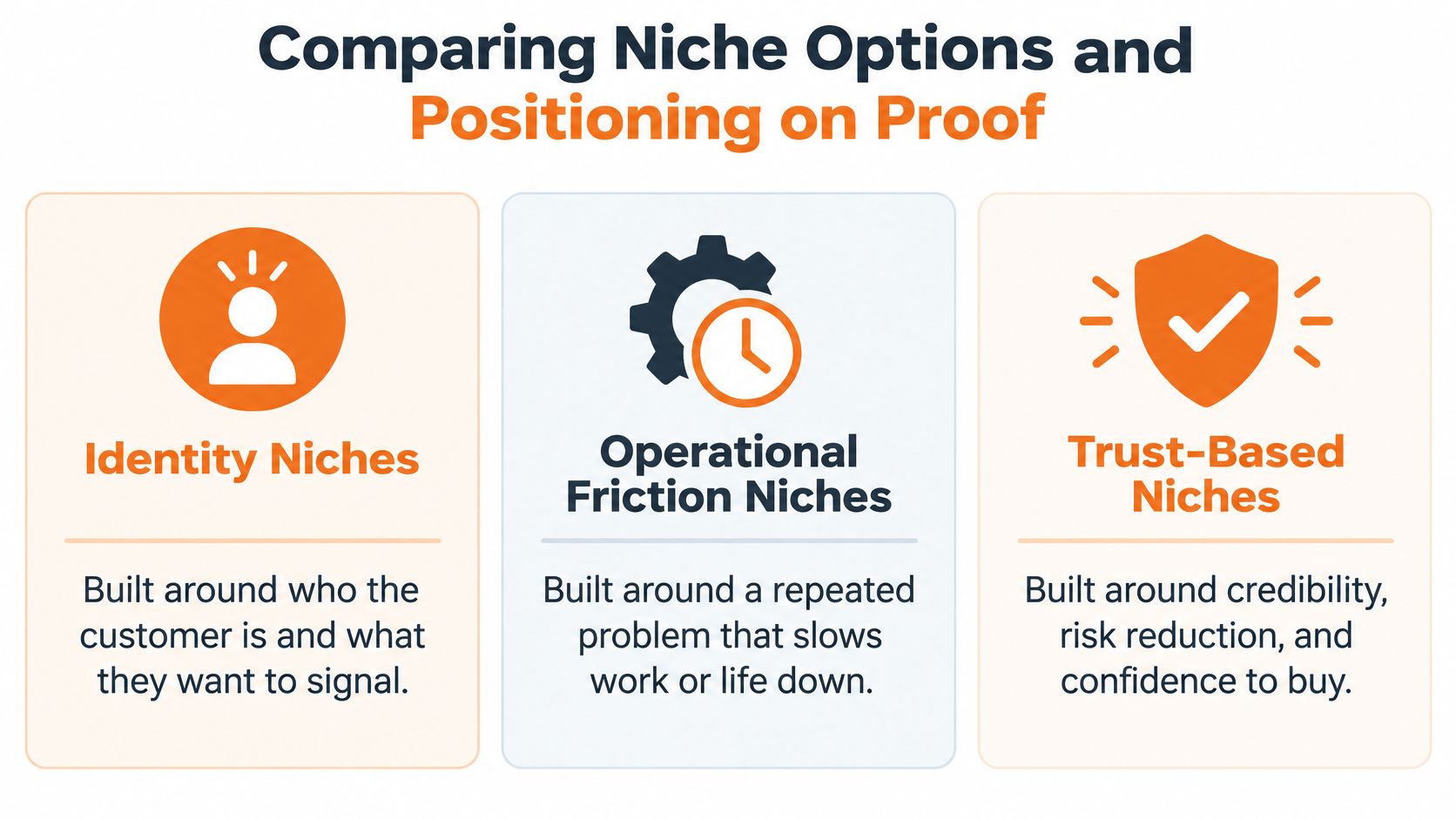
Three positions side by side
Identity niches are built around who the customer is and what they want to signal. New moms. Remote designers. Chicago food founders. You can write the homepage in an afternoon. Selling is harder, because a shared label does not mean a shared urgent job. I have watched pretty identity brands collect followers and almost no orders.
Operational friction niches are built around a repeated problem that slows work or life down. A delivery that misses the window. Sizing that triggers returns. A product page that hides the one fact a buyer needs. People already feel the cost in time or refunds. "We cut sizing returns for tall runners" is easier to test than "we celebrate runners."
Trust-based niches are built around credibility, risk reduction, and the confidence to buy. Transparent sourcing. A human who explains the recommendation. A clear line on when a photo or suggestion was made by software. You are not trying to outspend a bigger brand. You are giving one buyer a reason to believe you.
Adobe's 2025 retail trends report puts numbers on that gap. 75% of consumers consider cross-channel consistency important, but only 41% believe brands deliver it. 74% say retailers should disclose when AI-generated content, recommendations, or images are used. I read that as room for a promise you can check, not as a speech about being authentic.
How I pick without falling for the slogan
I run the same offer twice when I can. One version is generic. One version states a concrete promise. Who is in the room, what stays private, and what you will not do. Then I compare conversions, referrals, repeat purchases, or preorders. The winner is the version that gets action, not the version my friends call clever.
Chicago Brandstarters is one trust-based format I mention when the friction is lonely, transactional networking. It is a free, vetted community for Chicago and Midwest builders. Members meet in private dinners of six to eight people, with identity verification and a confidentiality expectation so the room is not a pitch fest. I treat it as one format among others. A supplier-vetting circle or a factory-tour club can use the same trust shape if that is the job your buyers keep failing.
Pick the position that makes a stranger spend time, money, or reputation. A warmer sentence is not proof.
If identity wins the beauty contest and trust wins the sign-ups, I keep trust. If friction wins both, I lead with the task and let identity sit in the second sentence.
Running a Five-Person Test This Week
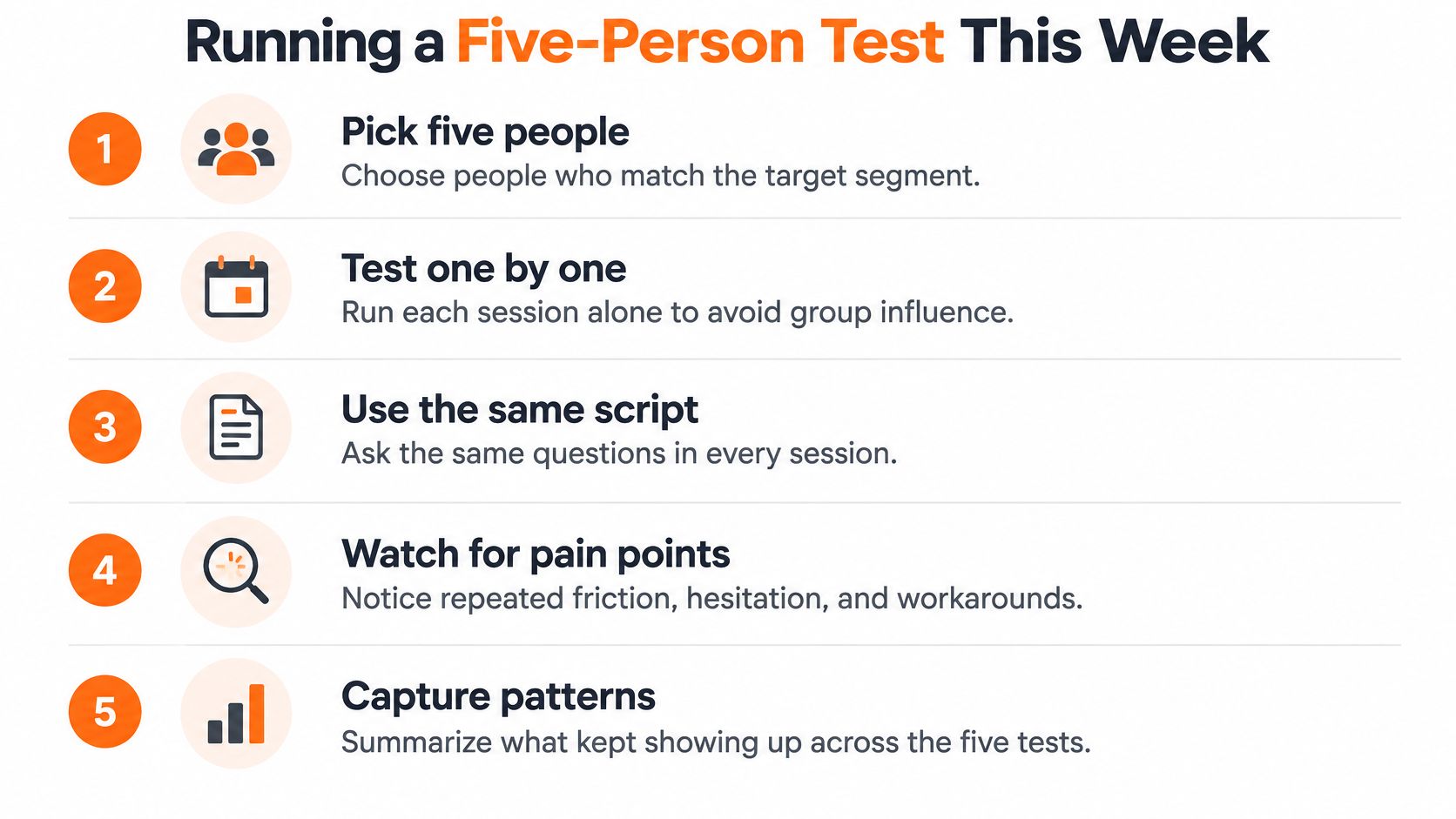
I do not buy ads to settle a hunch. I copy a Design Sprint habit. Test a realistic prototype with five target users, each in their own session. You watch how each person attempts the main tasks, and you record comparable reactions. You do not ask a group to agree.
Five people will not tell you market share. They will show you broken wording, a form nobody finishes, and a promise that does not match the job.
Who gets in the room
Recruit people who match the segment on their own. Idea-stage operators. First-revenue shop owners. Midwest side-hustlers. Leave out friends, people who sell services into the room, and anyone who would break a confidentiality rule you plan to keep.
Give every person the same scenario. They review the positioning, complete a short vetting form, choose an offer, and say what would make them come back.
Score what they do
I score each behavior from 0 to 2. Zero means they stalled or refused. One means they hesitated and needed a nudge. Two means they did it cleanly.
Understands the promise: They can repeat who it is for without your help.
Completes screening: They finish the form instead of abandoning it.
Accepts the commitment: They take a date, a deposit, or another scarce yes.
Names a specific problem: They point at one stuck decision, not "growth" in general.
Expresses intent to return: They ask for the next session without you begging.
Add the scores. Look for the same miss across people. If four of five fail the same line, fix the line before you print anything.
Five sessions expose usability and messaging failures. They do not estimate penetration or long-term retention.
What you do in the next seven days
Put five names on a calendar this week. Run the same script. Then make one call. Keep the niche, adjust the promise, or drop it. Keep it only when a clearly defined segment repeats the action and names a problem your format solves better than ordinary networking.
Do that before you spend on branding, inventory, or a custom platform. A landing page and one pilot beat a month of logo revisions.
If you are a Chicago or Midwest builder who wants a niche tested in a room that is not a pitch fest, Chicago Brandstarters hosts free, vetted small dinners and a confidential founder chat from the idea stage onward. You can compare notes on customers, pricing, and positioning with people who are building too. Visit Chicago Brandstarters and see if a seat fits the way you want to work.
Leave a Reply