
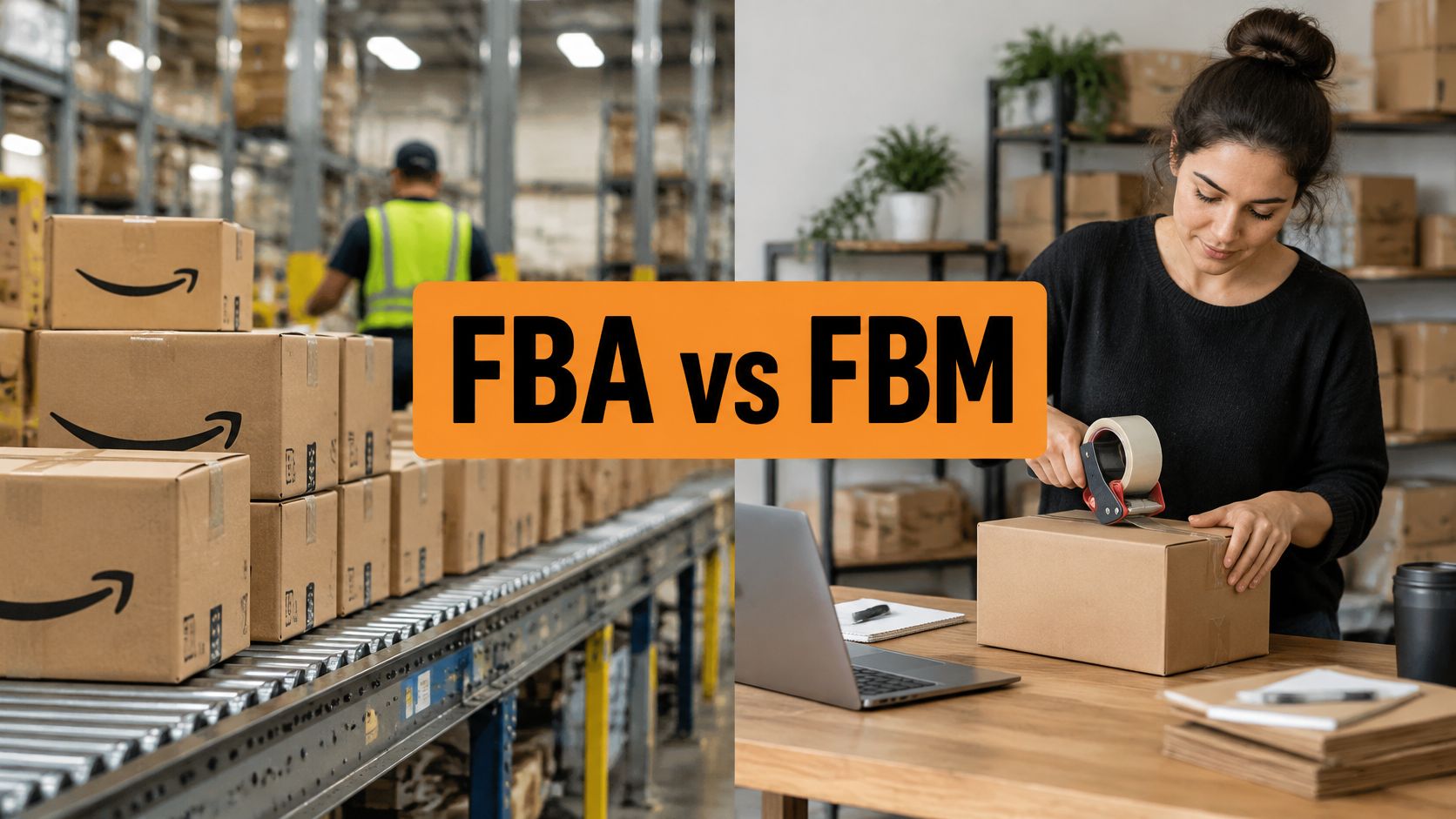
You have one SKU, a stack of mailers, and two ways to get tonight's order out. One quote sends the carton into Amazon. The other keeps the boxes in your space and puts a label on them yourself. I have priced both on a spreadsheet more times than I like. FBA vs FBM is unit economics plus a backup plan, not a badge you copy from a bigger brand.
FBA vs FBM Starts With Your Numbers
You are in a small Chicago brand, or somewhere else in the Midwest, with one product and packaging on the floor. Two shipping quotes cover the same SKU. Quote one is inbound freight into Amazon. Quote two is a carrier pickup from your own address before the cutoff. I have sat at that table. The clean quote is not always the cheap one.
Do not pick FBA because most sellers use it. Do not pick FBM because sending boxes to Amazon feels like you lose the product. Both habits skip the question that pays the rent. Can this unit pay for the way you fulfill it, with the cash you have this month?
I am using this guide for three jobs.
See the work. You need a plain map of who stores the goods, who ships, and who talks to the customer.
Load the actual cost. A fee by itself is not a cost. Labor, postage, rent, returns, and your evening hours belong on the same page.
Match the model to the product. Selling price, size, speed of sales, and whether you already have a place to ship from decide the pick. A fast small item and a slow bulky item should not share a default.
A founder I worked with had both quotes printed. The Amazon inbound number looked tidy. The self-ship number looked lower until she wrote her own hours at a real wage. That gap is what I want you to catch before you fall in love with either model.
Practical rule: If you cannot name the ship-from address and a monthly unit count, you are choosing a feeling. Get those two numbers first.
The choice is operational. You hand the box to Amazon's network, or you keep the line in your building. I am going to force a number. You will see who touches the carton, what the order costs at a few prices, and whether one pile of inventory is enough. If you already have a garage, a scale, and a carrier account, that changes the math. If you have a product idea and a credit card, that changes it too.
What FBA and FBM Actually Handle
Start with the hands on the box. Price comes next.
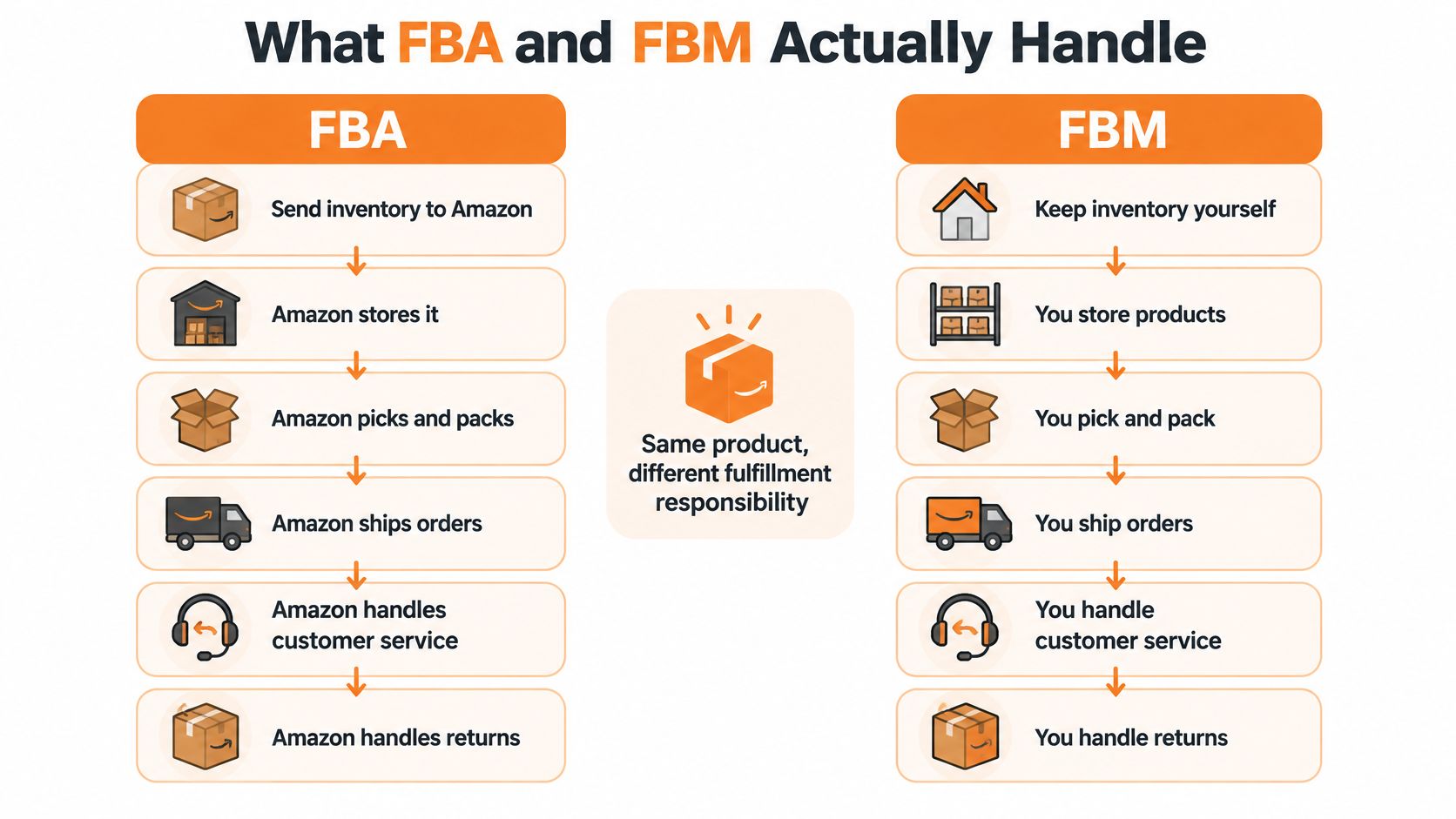
With Fulfillment by Amazon (FBA), you send inventory into Amazon's network. Amazon stores it, picks and packs each order, ships it, handles customer service, and processes returns. You pay a per-unit fulfillment fee based on size and weight, plus storage on the daily average volume your inventory occupies. Stock that sits longer than 181 days can draw an aged-inventory fee, so a slow unit costs more than the ship fee, as Fulfillment by Amazon's own fee description lays out.
Fulfilled by Merchant (FBM) flips the owner of that work. You, or a warehouse you hire, store the goods. You pick the packaging and the carrier. You ship to the customer. You own service and returns. Amazon still sets performance rules. For US returns, Amazon auto-enrolls you in prepaid return labels and expects a response within 24 hours in Manage Returns, which Amazon's seller guidance on FBM states directly.
How the two paths grew up together
FBA began in 2006, one year after Prime. Amazon started it with five sellers and seven fulfillment centers. By 2025, Amazon stated that independent sellers had shipped more than 80 billion units through FBA, and more than 9 billion items reached Prime customers the same day or the next day in the prior year, according to Amazon's account of independent seller growth. I am not asking you to admire that. I am asking you to see the deal. Prime speed and FBA grew as one system. You rent that speed, or you build a version of it yourself.
A kitchen you rent or a kitchen you run
FBA is renting a finished kitchen. The line is already staffed. You do not pick the pans. FBM is cooking in your own kitchen. You can season the pack-out however you want if you can keep the line moving when orders hit.
Who touches the box:
- FBA touch list: You send it in. Amazon stores, picks, packs, ships, answers the buyer, and takes the return.
- FBM touch list: You store it. You pack it. You buy the label. You answer the message. You handle the return inside a day.
If you cannot point to a person for each of those steps, you do not have a model yet. You have a hope.
Compare FBA Fees With FBM Costs
Who does the work is settled. What you keep on the order is the next fight.
Build a fully loaded FBA stack you can copy into a sheet. Referral fee, fulfillment fee, storage, expected aged-inventory cost, and inbound freight. In the U.S., the fulfillment fee follows size and shipping weight. Storage follows daily average cubic volume. On top of the fulfillment fee, Amazon lists a 3.5% fuel-and-logistics surcharge beginning April 17, 2026. The published low-price small-standard example is $2.43 for items at 2 oz or less, before that surcharge. Those figures are in Amazon's 2026 U.S. fee schedule.
Put the FBM stack beside it. Pick-pack labor, packaging, postage, rent or a 3PL fee, software, returns, customer service, and your time. If you price your time at zero, FBM will always look like the winner. It is not.
The 2026 shift is a break-even check
The same 2026 U.S. schedule raises FBA fulfillment fees by an average of $0.08 per unit. Products priced below $10 get a larger average fee discount of $0.86 per unit versus products at $10 or more. I want you to feel how odd that is. A cheap, light item can still look fine on FBA after you assumed merchant shipping had to be cheaper.
Test contribution margin at $8, $15, and $30. Split the rows by size tier and by how fast the unit sells. Do not use one blended cost for every SKU.
| Cost line | FBA | FBM |
|---|---|---|
| Referral fee | Charged on the sale | Charged on the sale |
| Fulfillment | Per unit by size and shipping weight, then the 2026 surcharge | Pick-pack labor you pay or do yourself |
| Storage | Daily average cubic volume | Rent, home space, or a 3PL bill |
| Slow stock | Aged-inventory cost if units linger | Cash stuck on your shelf |
| Inbound | Freight into the network | Usually none if stock is already with you |
| Pack and postage | Inside the fulfillment fee | Mailers, tape, and carrier postage |
| Returns and service | Inside the fulfillment charge | Your labels, refunds, and messages |
| Your hours | Lower on a normal day | The line that flips a "cheap" FBM order |
Where I pick on cost alone
Compact product, fast turns, and you have no warehouse. I pick FBA and I watch weeks of cover so storage does not eat the fee discount. Bulky unit, slow unit, or you already ship well from a Midwest dock. I pick FBM and I write labor at a wage you would pay a hire. If the $8 row dies on FBA and the $30 row dies on your postage, you do not have one model. You have two SKUs.
Prime Speed Against Seller Control
Cost told you what you keep. This part is what the buyer sees, and what you give up to get it.
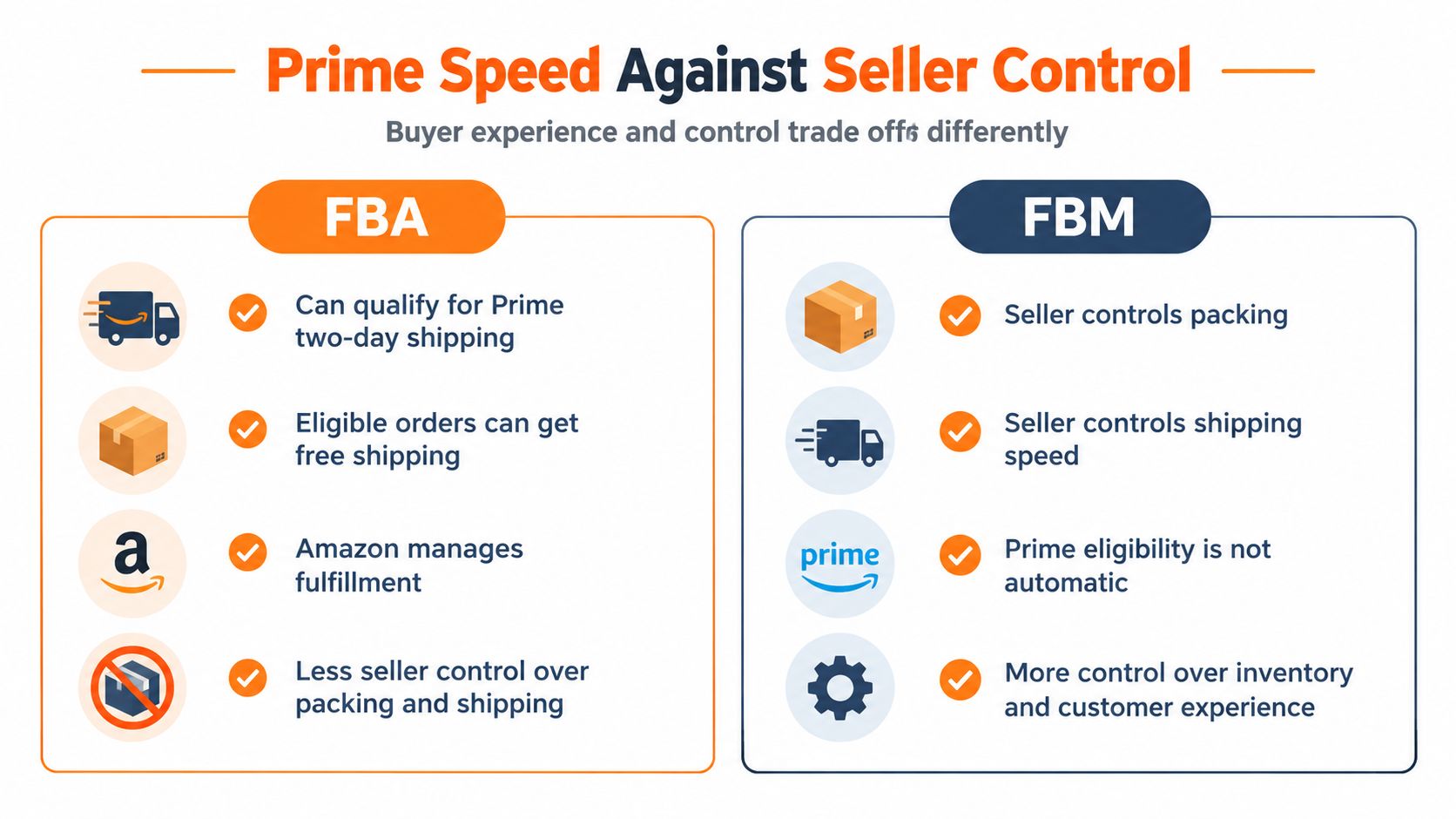
FBA units can qualify for Prime two-day shipping and free shipping on eligible orders, with no separate charge for each Prime shipment. Amazon calls the model pay-as-you-go. You pay storage and a fulfillment charge, and that charge covers picking, packing, shipping, customer service, and returns. Amazon's seller FAQ on fulfillment is plain about that split. You live inside storage rules. You do not design the unboxing.
On FBM, you choose free shipping, a flat rate per order, or a rate by weight or price. You absorb the work behind that promise. The stamp can look cheaper. The promise is the hard part.
The bar if you want Prime without FBA
You can chase Premium Shipping or Seller Fulfilled Prime only after you qualify. Seller Fulfilled Prime needs prequalification, a domestic U.S. default shipping address, a Professional selling account, and a successful 30-day trial. Amazon watches late-shipment rate, valid-tracking rate, cancellation rate, and a minimum package volume. That list is on Amazon's Seller Fulfilled Prime page.
The benchmark is reliable two-day execution, not a cheaper postage stamp.
What I tell a Midwest brand
If your regional warehouse hits carrier cutoffs and covers the map cheaper than FBA, keep the control. You pack it your way. You set the speed. You own the inventory location. If you are packing at a kitchen table and the zone map is a guess, stop. FBA is the simpler path to nationwide speed on small standard parcels. You trade the unboxing and some inventory freedom for a delivery promise you do not have to staff.
I do not treat Prime as magic. I treat it as a conversion tool you either rent or earn with metrics. If you cannot hold tracking, cancellations, and on-time ship during a trial, you are not "almost" on Seller Fulfilled Prime. You are on FBM without the badge, and the buyer will shop the offer that has it.
Match Products to FBA or FBM
Stop comparing features. Sort the thing in your hand.
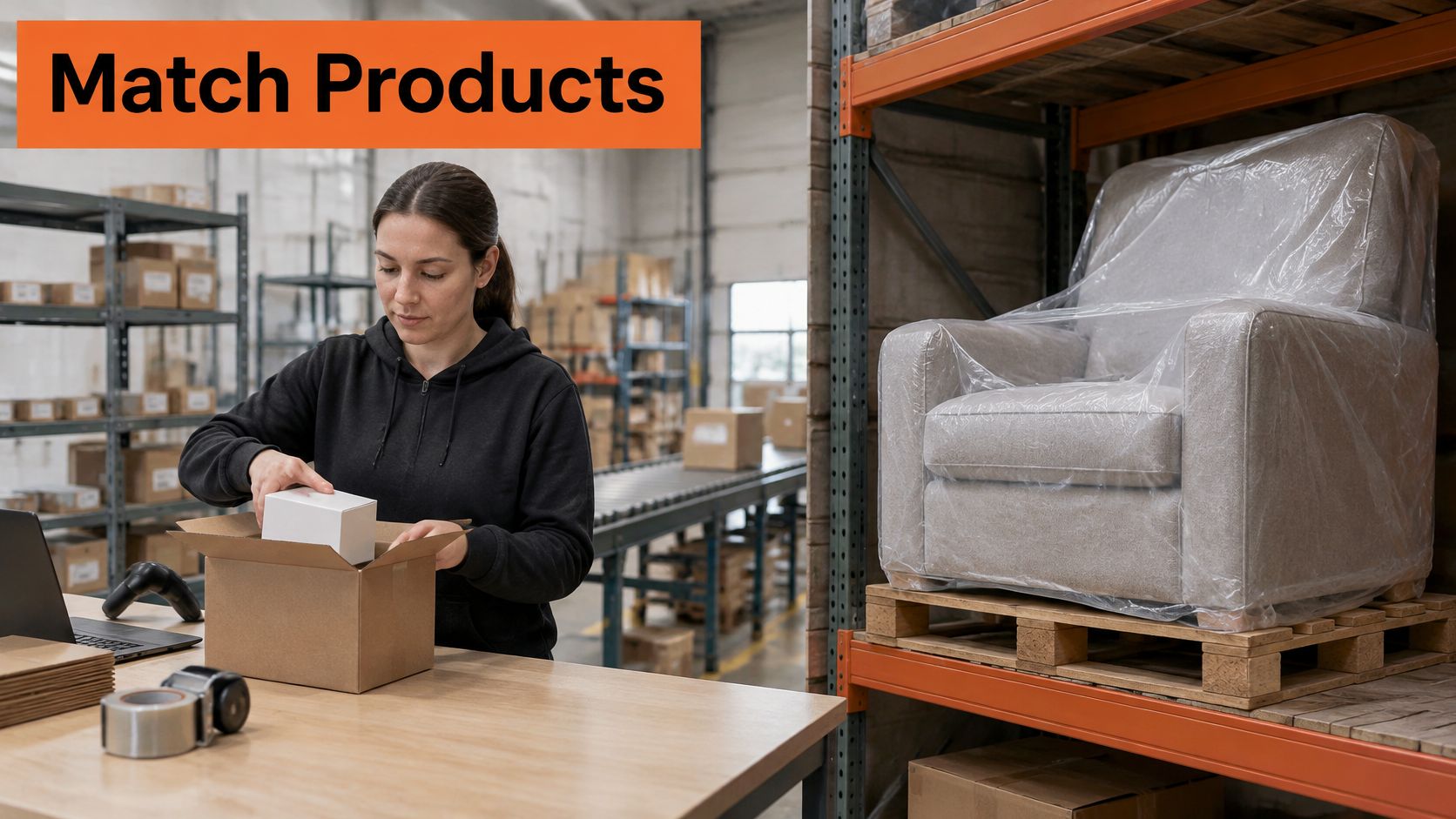
A small bottle or a flat accessory that sells every day is my FBA SKU. The unit is compact, it turns, and Prime plus outsourced packing can earn the fee. You are not winning a trophy. You are buying time so you can reorder before you stock out.
A chair, a bulky kit, or a carton that sits for months is my FBM SKU. Storage and aged inventory eat a thin margin while the unit waits. If you can ship it from your dock on a negotiated rate, you keep more of the sale than a size-tier fee will leave you.
A candle that hates heat, a custom bundle, or a high-margin item where the pack-out is the brand belongs with you. You want your tape, your insert, and a person who checks the unit before it leaves. Handing that box to a standard line is how you get a return you could have prevented.
What other sellers actually run
A 2024 seller survey is context, not a verdict. It reported that 82% of Amazon businesses used FBA and 34% used FBM. Those shares overlap because some merchants use both. In the fulfillment-method subgroup, 64% used FBA only, 14% used FBM only, and 22% used both. Another cut of the same coverage swaps the hybrid and FBM-only shares depending on the question, so I do not treat one percentage as law. The stable point is simple. Most serious sellers use Amazon fulfillment for some inventory, and about one third keep a merchant-fulfilled path. The figures are in the 2024 Amazon seller survey breakdown.
The same comparisons reported that 28% of FBM sellers exceeded $25,000 in monthly revenue versus 12% of FBA sellers. 35% of FBA sellers reported margins above 20%, versus 38% of FBM sellers. These are correlations. FBM does not cause the higher revenue. A heavier, higher-ticket catalog can show up in the FBM column because that is where the fees stop making sense.
Sort your SKU on physics and speed, not on which column has the larger club. Fast and small goes to FBA. Awkward, slow, custom, or sensitive stays on FBM.
See the split in motion before you copy someone else's catalog.
Run a Hybrid FBA and FBM System
You do not have to marry one model. I run a split when each pile has a job.
FBA inventory feeds the Amazon offer that needs Prime conversion. FBM inventory feeds Shopify, wholesale, retailer replenishment, oversized units, or a temporary stockout on the FBA side. Same brand. Two addresses. You choose the path per order instead of pretending every channel wants the same box.
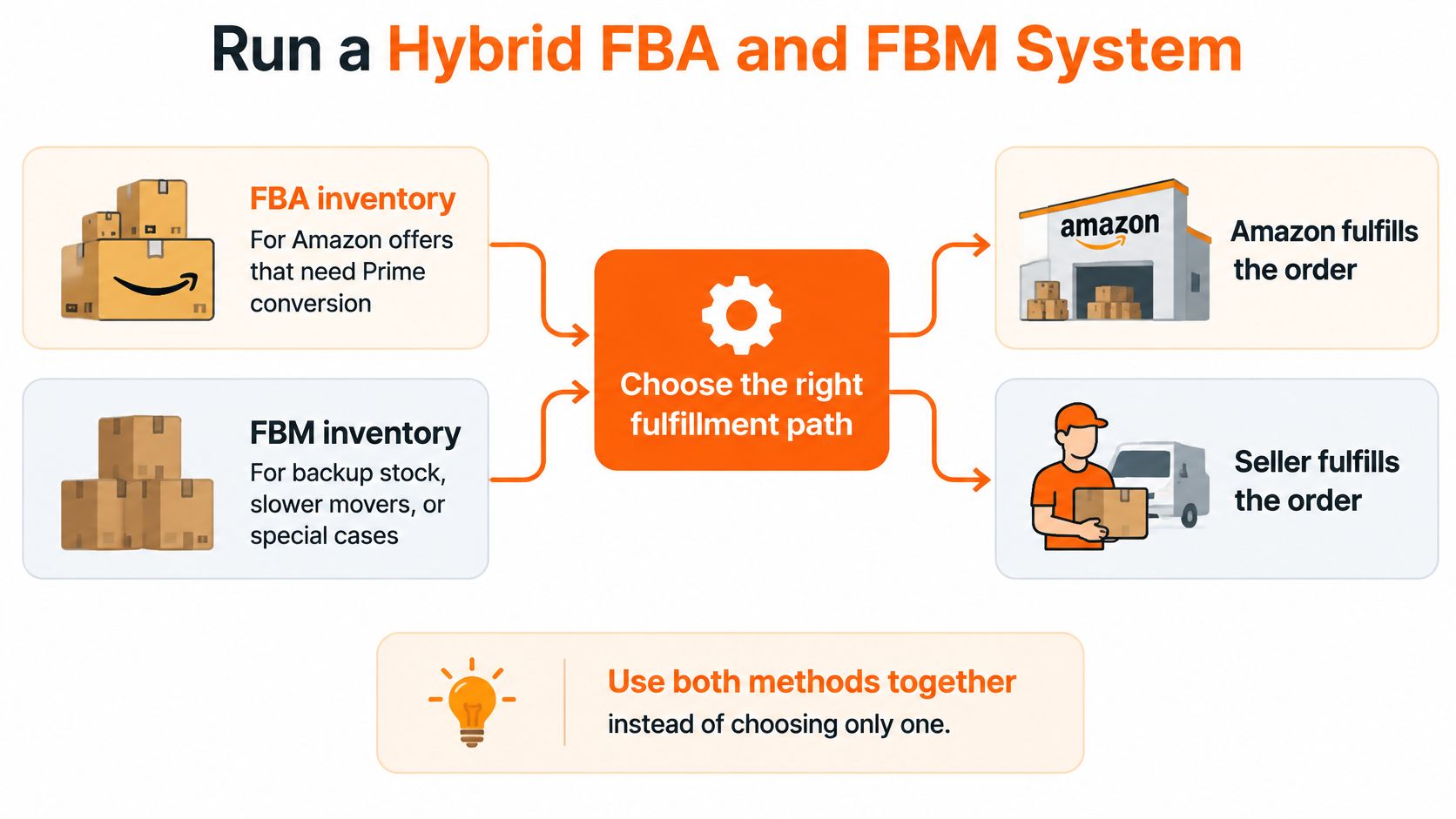
When the split helps and when it hurts
A split can lower your dependence on one path. If inbound to Amazon slips, you still ship. If a retailer wants a pallet, you do not raid the Prime pool and then apologize to Amazon buyers.
A split can also hurt you. You buy extra safety stock. Forecasts get sloppy. Units strand in the wrong building. The customer gets a different pack-out depending on the channel. If you cannot forecast both piles, one pool is simpler. I would rather have one honest location than two half-empty ones.
Triggers, not trivia
Remote Fulfillment with FBA terms took effect in January 2025. The 2026 fee materials describe a fuel-and-logistics surcharge on FBA fulfillment fees in the U.S. and Canada beginning April 17, 2026. I treat dates like that as alarms, not headlines.
My playbook is short.
- After a surcharge: Rerun unit economics on the live SKUs before you send the next carton.
- Each week: Watch weeks of cover. A slow FBA pile is a storage bill with a shipping label on it.
- Before you need it: Keep an FBM fallback that can meet the delivery promise, not a pile in a closet with no carrier account.
FBM is not only the cheap substitute. For a growing brand it can be backup capacity. FBA is the conversion and delivery layer, not the whole system. Split when Amazon needs a Prime offer and another channel needs its own stock. Stay on one model when you cannot staff the forecast.
Choose Your Model and Take the Next Step
Pick from the situation, not from a meme.
Choose FBA when the item is small, it turns fast, and Prime speed is worth the fee stack. You do not have a dock, and you do not want to staff two-day ship.
Choose FBM when you already ship well, or the item is bulky, slow, custom, or sensitive. Your postage and labor beat Amazon's fee, and you can hold the performance metrics without a heroic Friday.
Choose a hybrid when Amazon needs a Prime offer and another channel needs its own stock. Do it only if you can forecast both piles and you have a fallback that ships on time.
A spreadsheet still hides founder time. I want a person across the table who has missed a cutoff and paid a storage bill.
Chicago Brandstarters is a free vetted community for kind, hard-working Chicago and Midwest brand builders, led by Kevin Tao. You get private dinners of six to eight people every two weeks, plus a group chat for honest operating stories. Identity checks and LinkedIn vetting keep out self-promoters. What you share stays in the room. As brands grow, the group points people toward programs such as Goldman Sachs 10KSB, EcomFuel, and Million Dollar Sellers. It is one room among the operator circles you might use, and it is built for this kind of unglamorous math.
Write your three price-point margins, at $8, $15, and $30, with labor included. Bring that page to a peer who has shipped both ways. Ask which line you are undercounting before you send the first carton.
Chicago Brandstarters is a free, vetted room for Chicago and Midwest founders who are pricing real orders, not collecting slogans. Bring your FBA versus FBM margin page, sit with operators who have shipped both ways, and pressure-test the line you keep ignoring. Visit Chicago Brandstarters and bring the spreadsheet.
Leave a Reply