You've shipped a scrappy v1 from a coworking desk in Fulton Market. Your landing page has no traffic, your Twitter account has no audience, and you need your first ten paying users before Friday. Posting another launch announcement won't solve that problem. You need people who already feel the pain, enjoy trying unfinished tools, and will give you enough real feedback to make the product sharper.
That's where early adopter marketing begins. You find a small group of people who buy into the future of your product before the polish, proof, and broad awareness arrive. In Chicago and across the Midwest, those people usually come through warm introductions, focused communities, former coworkers, and direct conversations, not expensive ad campaigns.
What Early Adopter Marketing Actually Means for Your Startup
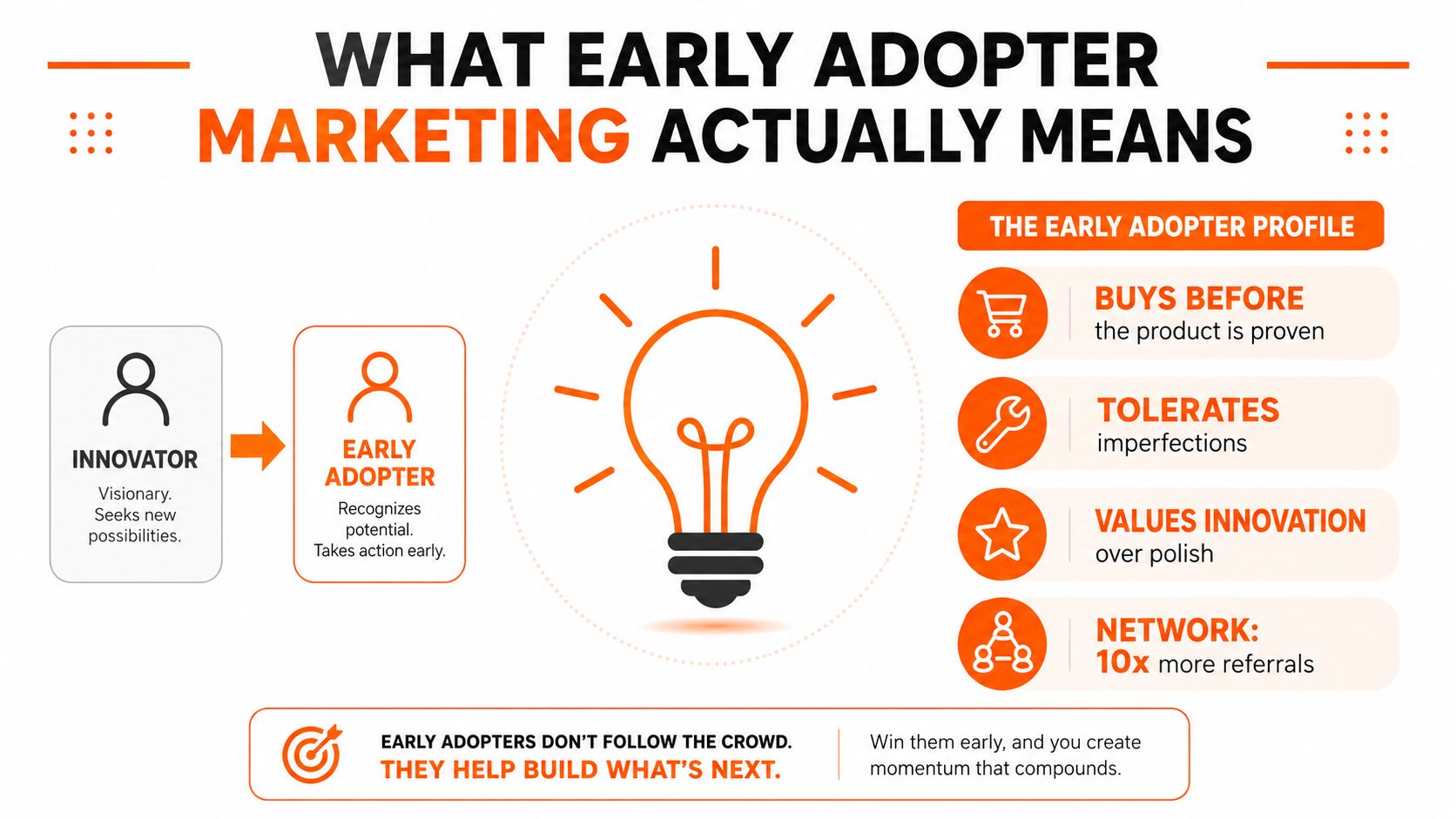
An early adopter buys because they believe your product could change how they work. They can tolerate a rough interface, missing integrations, and a roadmap that still has blank spaces. A mainstream buyer usually wants reassurance first. An early adopter wants access first.
Everett Rogers' diffusion model places innovators at 2.5% and early adopters at 13.5% of a market population, followed by the early majority at 34%, the late majority at 34%, and laggards at 16%, as summarized in this overview of Rogers' technology adoption segments. Early adopters sit between the tiny experimental group and the larger audience that waits for proof.
That position changes your job. You don't need to convince everyone that your category matters. You need to locate people who already understand the problem and can judge whether your unusual approach deserves a test.
A 2020 YouGov study across 25 global markets found that early technology adopters made up 18% of consumers on average worldwide, a larger share than the classic 13.5% estimate in Rogers' model (YouGov's global technology study). The difference matters because your real audience depends on the category, market, and behavior you're measuring.
Sell possibility before certainty
Early adopters don't need you to pretend the product is finished. They need a clear reason to believe that your product can solve a problem they already care about.
Write your launch message around:
- The painful job: Name what they currently do by hand, patch together, or avoid.
- The unusual promise: Explain what your approach changes.
- The honest boundary: Say what the first version doesn't handle yet.
- The invitation: Ask them to test a specific workflow, not “check it out.”
A founder building a procurement tool might say, “Send me one messy vendor comparison and I'll help you turn it into a usable shortlist.” That creates a concrete test. “Join our procurement platform” creates homework.
Use your first conversations to validate the problem and the buyer before you refine your brand. This product validation guide can help you structure those early checks. For a practical outreach sequence, this guide on early adopter outreach gives you another useful starting point.
Practical rule: Recruit people who match the problem your product solves, not people who simply enjoy new software.
The Four Early Adopter Archetypes You Can Recruit From
You don't need to chase every curious person in Chicago. Pick one buyer type for the next few weeks, then watch how that person talks, researches, and spends money.
| Archetype | Key Behavioral Signal | Where They Hang Out | Best Product Fit |
|---|---|---|---|
| Frustrated Veteran | Describes workarounds and recurring pain | Reddit threads, trade groups, private Slack communities | Tools that replace a clumsy process |
| Tinkerer Hobbyist | Builds side projects and tests new tools for fun | Indie hacker groups, maker spaces, GitHub, university circles | Developer tools, creative software, automation |
| Outcome-Obsessed Operator | Talks about a business result tied to their work | Founder groups, operator communities, LinkedIn, local events | Products tied to revenue, time savings, or throughput |
| Mission-Driven Insider | Pushes for change inside a system they understand | Healthcare, education, civic, and nonprofit networks | Products that solve a personal or institutional problem |
The Frustrated Veteran
This buyer already has a workaround. They might maintain a spreadsheet with fragile formulas, copy information between systems, or pay for a service they dislike because no better option exists.
Look for posts that contain specific complaints and detailed explanations. A person who writes, “I've tried three tools and none of them handle this workflow,” gives you more to work with than someone who clicks a poll about productivity.
Show this person how your product removes one painful step. Don't lead with a feature list. Ask for the current workaround and build your demo around it.
The Tinkerer Hobbyist
The hobbyist likes to test products before anyone asks them to. They'll break your onboarding, try unusual inputs, and send you screenshots when something behaves strangely.
That makes them useful for technical discovery, though they may not become a durable customer. Give them sandbox access, a clear challenge, and permission to experiment. Avoid treating their enthusiasm as proof that a business buyer will pay.
The Outcome-Obsessed Operator
This buyer has a result on the line. They care about the tool because a missed target creates personal pain, team friction, or lost time.
Lead with the result they want. If you can help a recruiter organize candidate follow-up or help a retailer spot inventory issues, show that workflow with their language. This archetype often pays sooner because the product connects to a current business obligation.
The Mission-Driven Insider
Chicago has deep networks across healthcare, education, government, and community organizations. People inside those systems often adopt because they personally understand who gets hurt by a broken process.
They may move slowly through formal purchasing, but they can provide sharp context. Ask what blocks adoption inside their institution, which stakeholders need reassurance, and what a safe first test would look like.
Choose one archetype and write a one-page profile. Include the trigger that makes them search, the workaround they use today, and the proof they need before they pay.
Finding and Reaching Your First 50 Believers
Start with your personal 1,000, even if that number feels theoretical. Search former coworkers, college friends, clients, suppliers, neighbors, and people you contacted during your last job. You don't need to pitch all of them. You need to find the few who work near the problem or know someone who does.
In Chicago, map your product against communities such as Built In Chicago Slack, 1871, MHub, the Chicago Product Management Association, Northwestern founder circles, and UChicago founder circles. Each community has different norms, so read recent conversations before posting. A useful community gives you context and introductions. A broad blast gives you ignored messages.
Run three outreach plays.
The unsolicited Loom message
Record a short screen share that uses the recipient's situation.
“Hey [Name], I saw you mention [specific workflow]. I made this short walkthrough showing how I'd handle that problem with [product]. It's rough, and I'm looking for one person who'll tell me where it breaks. Want to try it with a real example?”
Keep the video focused on their problem. Don't spend the first half explaining your company.
The industry-thread email
Find one Reddit thread or public discussion where someone describes the issue.
Subject: Your [workflow] thread
Hi [Name], I found your post about [specific problem] in [community]. I'm building [plain description] for people who deal with that problem. I'm not asking you to sit through a sales demo. Could I send you the current version and ask three questions after you try it?
The reference proves you did basic homework. It also gives the recipient an easy reason to reply.
The warm introduction request
Send a mutual contact a narrow request.
“Could you introduce me to [person] if you think the fit makes sense? They work on [workflow], and I'm testing a product that helps with [specific job]. I'd like twenty minutes to learn how they handle it today. I won't send a sales deck.”
For the next 14 days, aim for 5 DMs, 3 introduction requests, and 1 useful post each day. These are activity targets, not performance claims. Log every reply in a simple Google Sheet with the person, archetype, pain language, current workaround, response, and next step.
Read customer acquisition strategies 2026 for a wider channel-planning view, then keep your own test narrow. Your early word-of-mouth marketing starts with a conversation worth repeating.
Turning Your First Users Into a Feedback and Referral Engine
A pilot becomes useful when every interaction has a job. In a Chicago launch with no audience, that rhythm keeps you close to users without turning them into unpaid research participants. Use five planned touches, then adjust based on actual behavior.
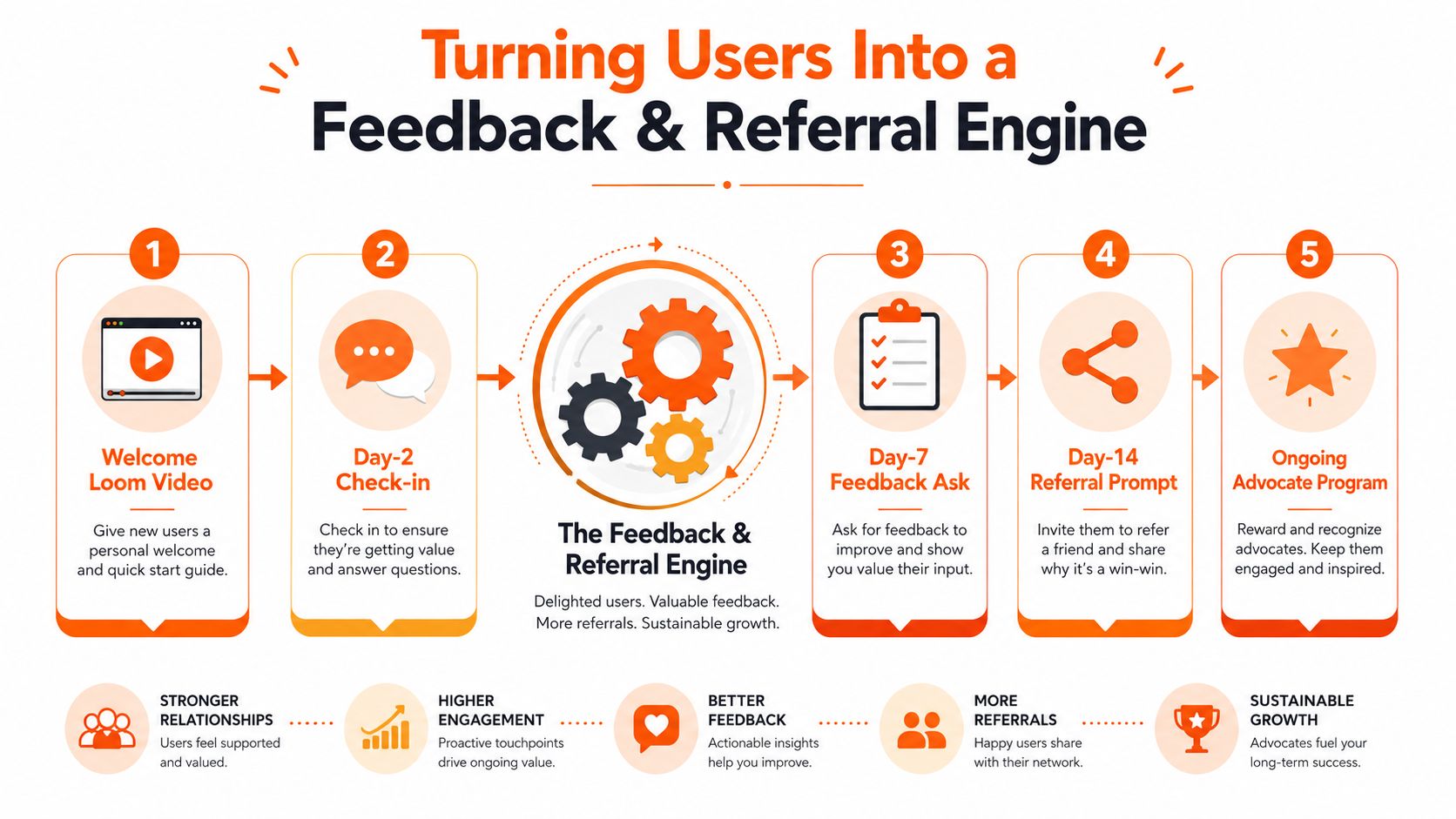
Send a short welcome Loom showing the first task. On day two, ask whether the user reached it and where they stopped. On day seven, hold a brief interview. On day fourteen, invite them to office hours. On day thirty, ask whether the product helped enough for them to consider a case study.
Ask about the job, not the wishlist
Use questions that expose behavior:
- What were you trying to accomplish when you signed up?
- What happened that made you search for a solution?
- How did you handle the problem before this product?
- What nearly stopped you from trying it?
- Which part felt useful enough to repeat?
- Who else deals with the same problem?
A feature request describes a preferred solution. The underlying job matters more. If three users request different features that address the same task, you have a product pattern worth testing.
Keep one Notion database or Airtable base for every user. Record role, use case, activation status, interview notes, a simple “would you recommend this?” score, and referral potential. Rank the list monthly by usage, feedback clarity, willingness to introduce you, and fit with the customer you want more of.
Use a consistent customer feedback collection resource to keep interviews, notes, and follow-up decisions organized.
Ask for a personal introduction
A referral link asks the customer to become your marketer. A personal request gives them a specific, low-pressure way to help.
“You mentioned that [specific outcome] helped your team. Do you know one person who deals with the same problem? If so, would you feel comfortable introducing us by email? I'll keep the conversation focused and won't pressure them.”
YouGov reports that 77% of U.S. early tech adopters say they like recommending things for people to try, compared with 55% of the overall U.S. population (YouGov early adopter audience data). Treat that as a reason to make a clear ask, not as proof that every user will refer someone.
Close the loop with a changelog email or an in-product note. Tell users what changed because of their feedback, including when you declined a request. Each week, review new replies, schedule interviews, send one personal referral request, and record the next product decision. A referral only matters if the introduction reaches someone with the same urgent problem.
Incentives That Work Without Killing Your Margin
An incentive should match the reason someone wants to join. A hobbyist may value access. A pragmatic operator may value a lower price. A domain expert may value influence over the roadmap.
| Incentive | Cost to Founder | Motivation Triggered | Best-Fit Archetype | Main Risk |
|---|---|---|---|---|
| Free lifetime access | Future revenue and support | Curiosity and goodwill | Tinkerer Hobbyist | Attracts free users with weak need |
| Founder pricing | Discounted revenue | Practical value | Outcome-Obsessed Operator | Anchors the buyer to a price you can't sustain |
| Equity or advisory shares | Ownership and legal complexity | Influence and long-term belief | Mission-Driven Insider or domain expert | Gives away too much before fit |
| Exclusive beta access | Product access and support time | Status and participation | Tinkerer Hobbyist | Creates excitement without usage |
| Public recognition or case study | Founder time and exposure | Reputation and contribution | Frustrated Veteran or advocate | Rewards attention rather than results |
I usually start with access plus recognition for people who actively teach others how to use the product. For pragmatic adopters, pair a meaningful early price with a case study only after they reach a real outcome. Reserve equity for a domain expert who will shape decisions over time and understands what that arrangement means.
Don't hand out blanket discounts because you're nervous about asking for payment. Customers remember the first price, and you may create a negotiation problem before you learn what the product can support. Free access can also fill your pilot with people who enjoy trying tools but never face the problem often enough to use yours.
Decision rule: Choose the incentive that matches the buyer's underlying motivation, not the loudest request in your inbox.
Metrics That Tell You If Your Early Adopters Will Scale
A founder dashboard should tell you whether users reach value, return, pay, and introduce the product to someone with the same problem. It shouldn't reward you for collecting names.
Use a simple two-week scorecard with these measures:
| Metric | What It Measures | Early-Stage Benchmark | Why It Predicts Scale |
|---|---|---|---|
| Activation within 7 days | Whether signups complete the first useful action | Set your own baseline by cohort | Users who reach value can explain the product |
| Week-4 retention | Whether the workflow becomes repeat behavior | Compare cohorts over time | Continued use gives you proof beyond launch curiosity |
| Painkiller interview score | Whether users describe relief from a real problem | Use a simple internal rating | Strong language reveals urgent demand |
| Organic referrals per user per month | Whether users create introductions | Track by segment | Recommendations can reach similar buyers |
| Time to first aha | How quickly users understand the benefit | Compare paths through onboarding | Faster value reduces support burden |
| Paid conversion from beta | Whether early use supports payment | Compare invited users with trial users | Payment separates enthusiasm from commitment |
| Would-recommend score | Whether users would attach their name to the product | Segment by role and use case | A blended score can hide weak customer fit |
Some metrics in your product analytics may need custom definitions. Write the event that counts as activation before you measure it. For a design tool, activation could mean exporting a finished asset. For a workflow tool, it could mean completing one task from start to finish.
A high sign-up count won't tell you whether users care. Neither will follower count, press mentions, or email open rates. Those numbers can rise while retention stays flat and referrals remain absent.
Add segment labels
Never average every early adopter together. Separate the Frustrated Veteran from the Tinkerer Hobbyist, and separate a paying operator from a curious observer. A strong overall score can hide a product that works for one narrow group and fails everywhere else.
At each review, answer three questions:
- Acquisition: Which channel brought people who activated?
- Onboarding: Where did interested users stop?
- Product: Which repeated job created return usage?
Push acquisition when one segment activates, retains, pays, and refers. Fix onboarding when people describe a strong problem but fail to reach the first useful action.
Common Mistakes That Burn Your Early Adopter Cohort
A pilot user in Chicago gives you an hour between client calls. If your signup flow burns that hour on forms, fake urgency, and vague questions, the relationship may end before the product gets a fair test.
Fake scarcity
A countdown timer on an unknown product feels theatrical. If you have no real capacity limit, do not invent one.
Warning sign: Visitors ask whether the deadline is real instead of asking how the product works.
Damage: Trust weakens before users have a reason to believe you.
Correction: Use honest limits. Cap the pilot because you can personally support a defined group, or say you are accepting a small number of design partners for hands-on onboarding. For a pre-seed founder starting with no audience, a direct note to former colleagues, local operators, or a Midwest industry group will usually create more credibility than a timer.
Ignoring silence
Founders often treat unanswered messages as a copy problem. The audience may not have the problem, or you may have contacted the wrong role.
Warning sign: People respond politely but will not share a real example, book a test, or return after trying the product.
Damage: You keep polishing for people who feel no urgency.
Correction: Ask about the last time the problem occurred. “What happened the last time this slowed you down?” gets better evidence than “Would this be useful?” If nobody can recall a recent trigger, revisit the customer profile before adding features.
Over-instrumenting onboarding
You need product signals, but a new user should not feel watched at every click. Forms, tooltips, permissions, and surveys can make the first session feel like an audit.
Warning sign: Users complete setup but never perform the task that creates value.
Damage: Your analytics may look detailed while the customer leaves before the product earns trust.
Correction: Track one meaningful first action. For a workflow product, that might be completing one task. Ask for the rest in a conversation or after the user has received value. Early sessions should teach you something without making the user do your research work.
Treating users like unpaid testers
Your early cohort is not a labor pool. Members give you access to their workflow, judgment, and reputation.
Warning sign: You request repeated feedback but never explain what changed.
Damage: Users stop responding because their effort disappears into a black box.
Correction: Send a short changelog after each meaningful release. Name the problem, state the change, and tell users how to test it. In a small Chicago or Midwest network, people compare notes quickly, so visible follow-through matters more than a polished promise.
Confusing compliments with commitment
“Love the idea” costs nothing. A real signal looks like a calendar booking, payment, repeated use, or personal introduction.
Early adopters may be more willing to discuss a product with friends and family, but enthusiasm alone does not prove demand. Ask for a specific introduction after the user has experienced a clear benefit.
Warning sign: Your notes contain glowing comments but no completed workflows or payments.
Damage: You mistake social warmth for demand and make roadmap decisions on praise.
Correction: End interviews with a commitment question: “Would you use this again next week?” Follow with one action, such as scheduling the next session, paying for access, or introducing a colleague.
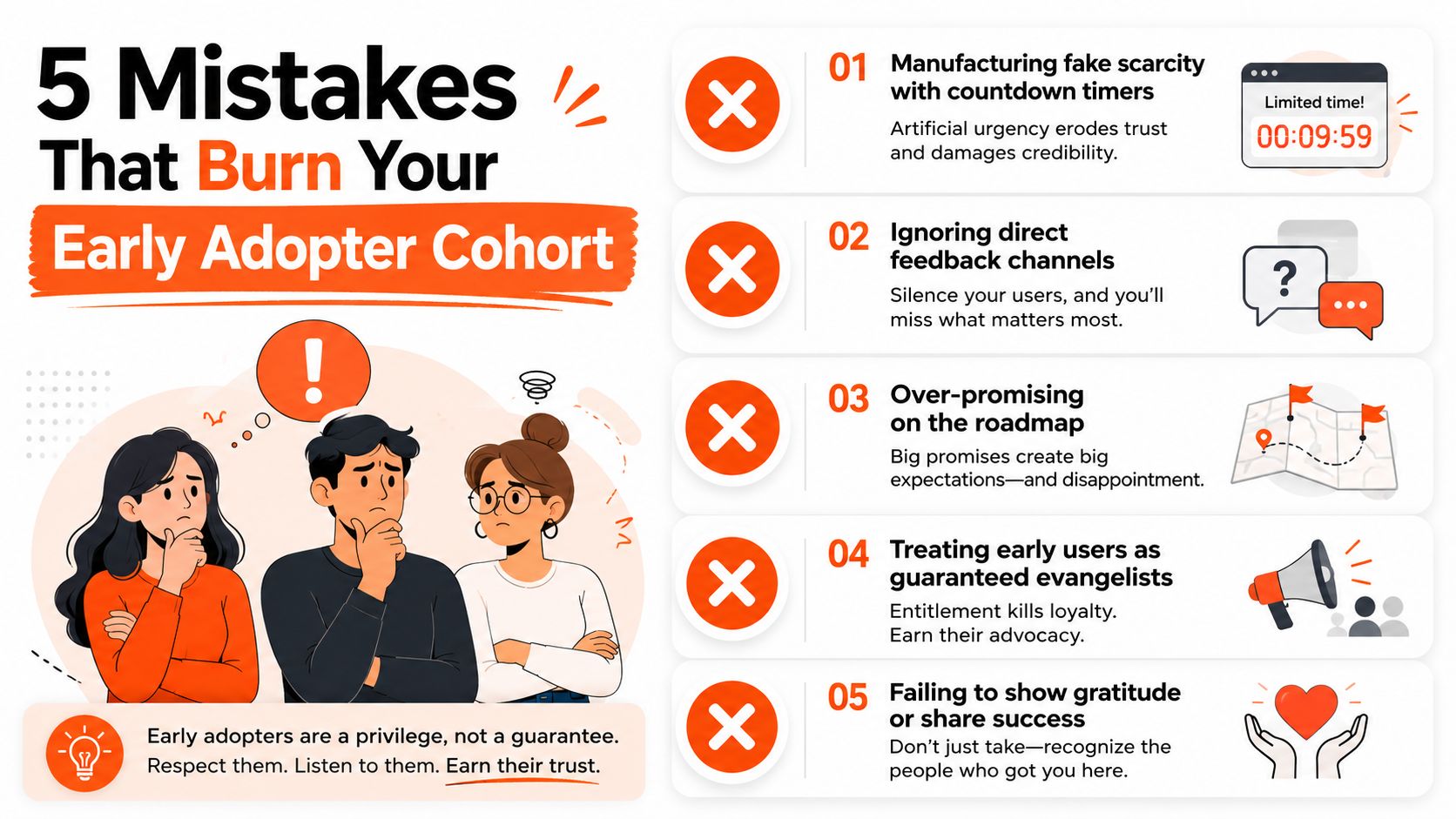
Run a weekly audit. Review who activated, returned, paid, referred, or went quiet. Thank the people who helped, remove friction from the first task, and change your target customer when the evidence points elsewhere.
Chicago Brandstarters gives Chicago and Midwest founders a free, vetted community with private dinners every two weeks and an active group chat for sharing launch problems, introductions, and practical feedback. Visit Chicago Brandstarters to meet builders who can help test your first offer, find warm paths to early adopters, and keep moving without an audience.
Leave a Reply