
You've got a product idea, a day job, and a laptop that stays open long after everyone else has gone to bed. You search for the Chicago startup community, find a calendar packed with events, and still wonder where the actual founders are. The public rooms can feel busy while the useful conversations happen somewhere quieter.
I've sat through enough founder dinners to know the difference. Some rooms are full of people collecting contacts. Others contain a manufacturer who can answer your production question, an operator who has already made your mistake, or a founder willing to tell you that your offer makes no sense yet. Chicago rewards the second kind of room, but you have to choose carefully.
What the Chicago Startup Community Looks Like From the Inside
At 11 p.m., Chicago's founder scene looks nothing like an event photo. You are at a kitchen table in Logan Square, Hyde Park, or a downtown apartment. Your day job is over, your side project is open, and one friend keeps asking when you will launch.
Then a dinner changes the picture. You meet a former buyer testing an ecommerce brand, a software engineer validating a workflow tool, a food founder searching for a dependable manufacturer, and a solo consultant turning a service into a product. They may not use the word founder yet. They are doing founder work.
Chicago's technology base has depth, though older figures need the right context. As far back as 2017, the city had 14,014 technology businesses and approximately 341,600 technology workers, including about 4,000 more workers than the prior year, according to Chicago technology industry data. More recently, Chicago-area startups completed 317 venture-capital deals in 2024 and raised more than $2.5 billion, according to Chicago Inno's reporting on the local venture market.

What people actually build here
Chicago builders work across artificial intelligence, healthcare, life sciences, logistics, supply chain technology, consumer brands, manufacturing, and professional services. That range creates useful collisions. A logistics operator can help an AI founder understand procurement. A brand builder can show a software founder how customers make buying decisions. A manufacturer can expose a product flaw before it becomes an expensive lesson.
The social style matters just as much. Chicagoans may not rush across a room with a polished pitch, but they will introduce you to a cousin who owns a warehouse, a former colleague in procurement, or a friend who knows regulatory counsel. Those introductions carry weight because they grow from repeated contact. Midwestern manners can outperform aggressive networking when the goal is trust rather than a full contact list.
Public events have their place, especially when you need broad exposure. Idea-stage builders should spend more time in smaller rooms, where people share confidential questions, give blunt feedback, and stay helpful after a missed launch date. Use the Chicago founder hubs guide to identify where those rooms form, then attend consistently instead of collecting event registrations.
My rule: If everyone leaves with the same number of business cards, nobody learned enough about anyone.
This guide suits you if you are validating an idea, building a first product, running a young brand, or working toward repeatable revenue. It is a field guide to choosing useful rooms, spotting self-promoters quickly, and building the small circle that helps you make better decisions.
The Shape of Chicago's Startup Ecosystem
Chicago works as a network of distinct founder rooms rather than one concentrated startup district. Neighborhoods, universities, accelerators, labs, funds, operators, and customer industries each serve a different stage and type of company.
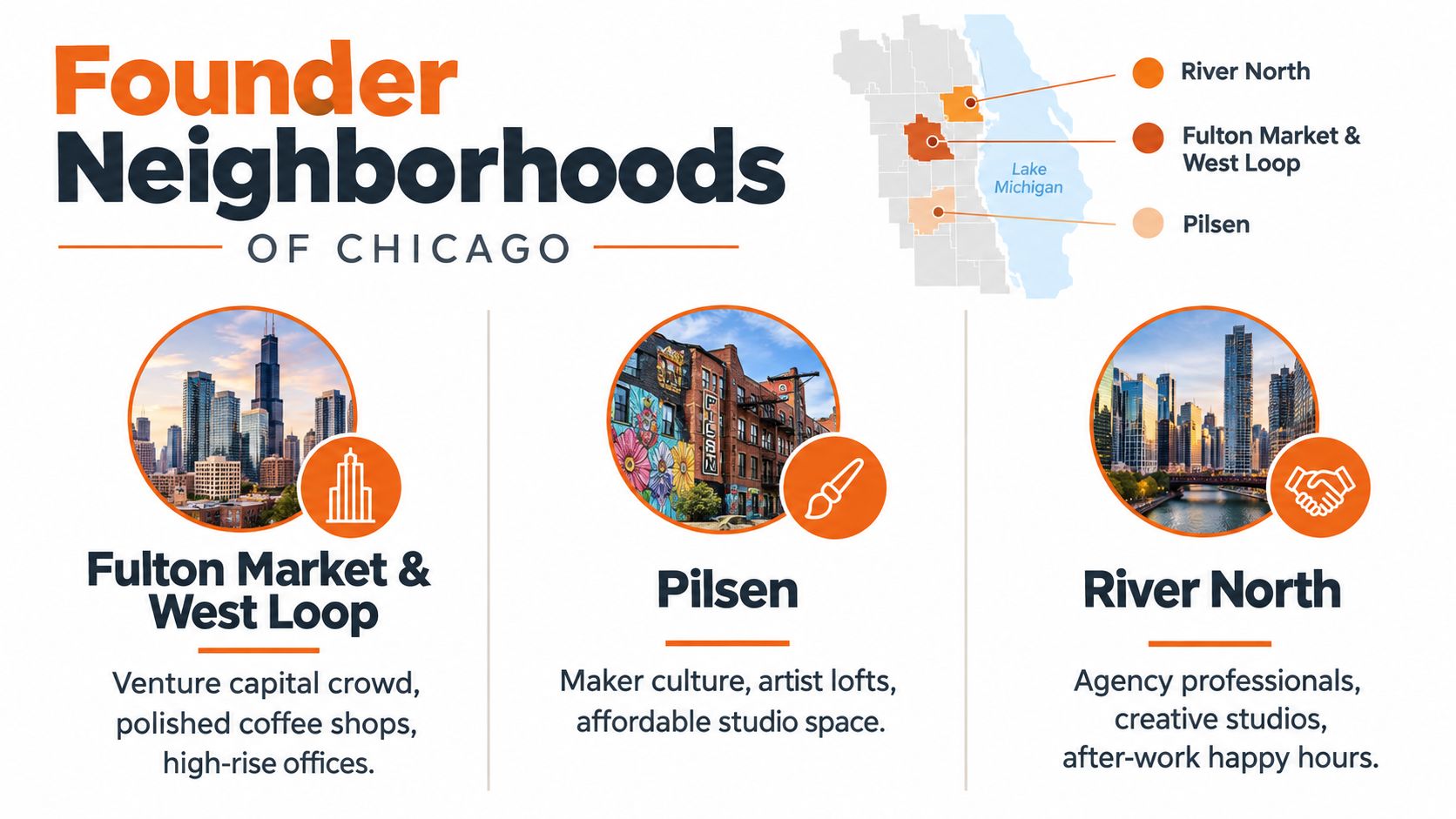
Fulton Market and the West Loop draw venture firms, startup offices, agency teams, and polished coffee meetings. Hyde Park and nearby university districts connect technical researchers, student founders, and teams commercializing science. Pilsen has stronger maker energy, with small-batch production, creative work, and physical products. River North brings together agencies, consultants, creative studios, and product-minded operators.
The funding picture requires a clear head. Chicago's metro economy ranks third in the United States by GDP, while one PitchBook comparison placed the city tenth nationally for venture-ecosystem strength. That gap explains the city's trade-off: founders can find customers, talent, and experienced operators locally, while larger financings may require relationships beyond Chicago.
Chicago startup ecosystem at a glance
| Metric | Figure | What It Means for You |
|---|---|---|
| Fourth-quarter 2024 venture deals | 64 | Capital access can tighten within a quarter, even when the full year appears healthy. |
| Annual venture funding milestone | More than $1 billion in 2018 | Chicago had moved beyond isolated financings into sustained institutional activity by that point. |
These figures matter less than the pattern behind them. A founder should treat Chicago as a strong operating base, then build outside relationships before a financing round makes them urgent. The Chicago venture capital guide is useful for mapping the investor side, but investor meetings should not be the first destination for every young company.
The sector mix gives Chicago a clearer advantage than a citywide funding total. A 2024 Chicagoland profile identified 286 Chicago-headquartered AI and machine-learning companies, 116 local funds investing in AI, and $4.2 billion in venture and private-equity capital raised by the sector since 2019, according to the Chicagoland AI and venture profile. Healthcare, life sciences, logistics, and supply chain companies made up 20% of local AI companies but attracted more than two-thirds of the sector's capital.
That concentration points founders toward practical problems. Chicago understands hospitals, freight, manufacturing, food, finance, and large operating systems. A startup that connects technology to one of those industries can get sharper customer conversations than a vague consumer app receives. The trade-off is obvious: industry knowledge creates access, but founders still need to prove that their product fits how those organizations buy.
The university layer
University programs give research-heavy founders another route into the ecosystem. During the University of Chicago Polsky Center's reporting year from July 2024 through June 2025, its programs facilitated more than $5.5 million in investment and recorded more than 150 ecosystem startup engagements, according to the Polsky Center impact report.
For a new founder, the practical point is simple. You may need a technical advisor, a customer interview, a prototype test, or an intellectual-property conversation before you need a fund meeting. University programs can supply that specialized help, while experienced operators can test whether the problem deserves a company at all.
Choose rooms based on the problem in front of you. A research question belongs near a university. A manufacturing question belongs near operators and suppliers. A financing question belongs with investors who understand your stage. Chicago rewards founders who make those choices deliberately instead of collecting introductions.
How Founders Actually Plug Into the Community
You don't need to attend everything. You need an order of operations.
Start with one public meetup where you can observe the room. Don't pitch everyone. Listen for who asks clear questions, who follows up with useful context, and who turns every conversation toward selling a service. A public event gives you a map, not a support system.

Choose the room for the problem
Your stage should decide your next room.
- Idea stage: Talk to potential customers, experienced operators, and people who understand the industry you want to enter. You need sharper questions before you need an accelerator application.
- Prototype stage: Find technical feedback, early testers, suppliers, and a peer who can challenge your assumptions.
- First customer stage: Use demo nights, founder groups, and customer introductions to improve your offer and sales process.
- Early revenue stage: Compare acquisition costs, retention, margins, hiring decisions, and financing options with founders a step ahead of you.
University resources make sense when your problem requires specialized help. The University of Illinois lists an Entrepreneur-in-Residence program with free consulting, Illinois I-Corps for research commercialization, a FAST Center for SBIR/STTR funding assistance, and an intellectual-property clinic for patent and trademark questions in its entrepreneurship resources. Don't ask a general networking group to solve a patent issue. Use the right specialist after peers help you frame the question.
Accelerators make more sense once you can explain the customer, the problem, the product, and the next measurable milestone. Before applying, ask what the program supplies. Does it provide customer access, technical help, investor preparation, or only a calendar of workshops?
If you want broader investor context, review curated lists of top US early-stage investors. Use them to learn how investors describe their focus. Don't treat a list as a substitute for a warm, relevant introduction.
A small private group works best when you need repetition. Chicago Brandstarters, for example, has a free, vetted community for founders moving from idea stage toward seven figures, with private dinners and a confidential group chat. You can compare that format with the wider Chicago business network before choosing your first recurring room.
Your next two weeks
Book one public event, one focused conversation with a founder who is slightly ahead of you, and one session where you can ask a real operating question. Bring a one-sentence description of the customer problem, not a ten-slide deck.
Then follow up with something useful. Send a customer introduction, a relevant supplier name, a thoughtful question, or a clear answer to a problem someone mentioned. Chicago relationships grow through evidence that you're a giver, not through repeated requests for favors.
Neighborhoods Where Founders Actually Hang Out
Chicago's founder pockets have different manners, clothes, calendars, and business problems. Pick the neighborhood that matches your work instead of chasing the address with the most startup logos.
Fulton Market and the West Loop
This is the easiest place to find venture conversations, startup offices, polished coffee shops, agency teams, and people who know the language of fundraising. It works well if you're raising capital, hiring technical talent, selling software to larger companies, or looking for someone who has scaled a venture-backed operation.
The trade-off is obvious. You can spend a whole afternoon around startup people without speaking to a customer. Treat these neighborhoods as useful for capital, hiring, and partnerships. Don't mistake proximity to investors for progress.
Pilsen
Pilsen suits founders who make something physical or culturally specific. Think food, apparel, art, packaged goods, home products, small-batch manufacturing, and creative brands. The conversations tend to move toward materials, production, retail, visual identity, and customer behavior.
You'll get less value here if you only want a fundraising pitch review. You'll get more value if you need to find a maker, test packaging, compare suppliers, or understand how a real customer reacts to the product in hand.
River North
River North sits where agency work, creative production, consulting, and product development overlap. It's a practical fit for a founder turning expertise into a repeatable offer, building a design-heavy product, or partnering with a studio.
The danger is service-provider gravity. You may meet talented people who want to sell you work before they understand your business. Ask what they built, who they served, and what problem they solved. A friendly conversation still needs a filter.
The university districts and the North Side
Technical founders, student entrepreneurs, researchers, and life-science builders often find better early conversations near university campuses and research institutions. These districts suit founders who need technical validation, lab access, research partnerships, or help translating a discovery into a company.
The North Side can also work well for side-hustle founders who want a less corporate setting. You'll find neighborhood businesses, independent operators, and founders building around family, work, and limited time. That constraint produces honest conversations. Everyone understands that the business has to fit real life.
The Weekly and Monthly Rhythm of Chicago Founder Life
A founder community works like a gym. One heroic visit won't build strength. A modest routine, repeated long enough, changes how you operate.
Chicago Brandstarters runs small private six-to-eight-person dinners every two weeks, with an active group chat where founders share war stories, tactics, and confidential support, according to Chicago Brandstarters. That cadence matters because the second conversation usually gets better than the first. People remember what you said, notice whether you acted, and can respond to the actual result.
Build a repeatable week
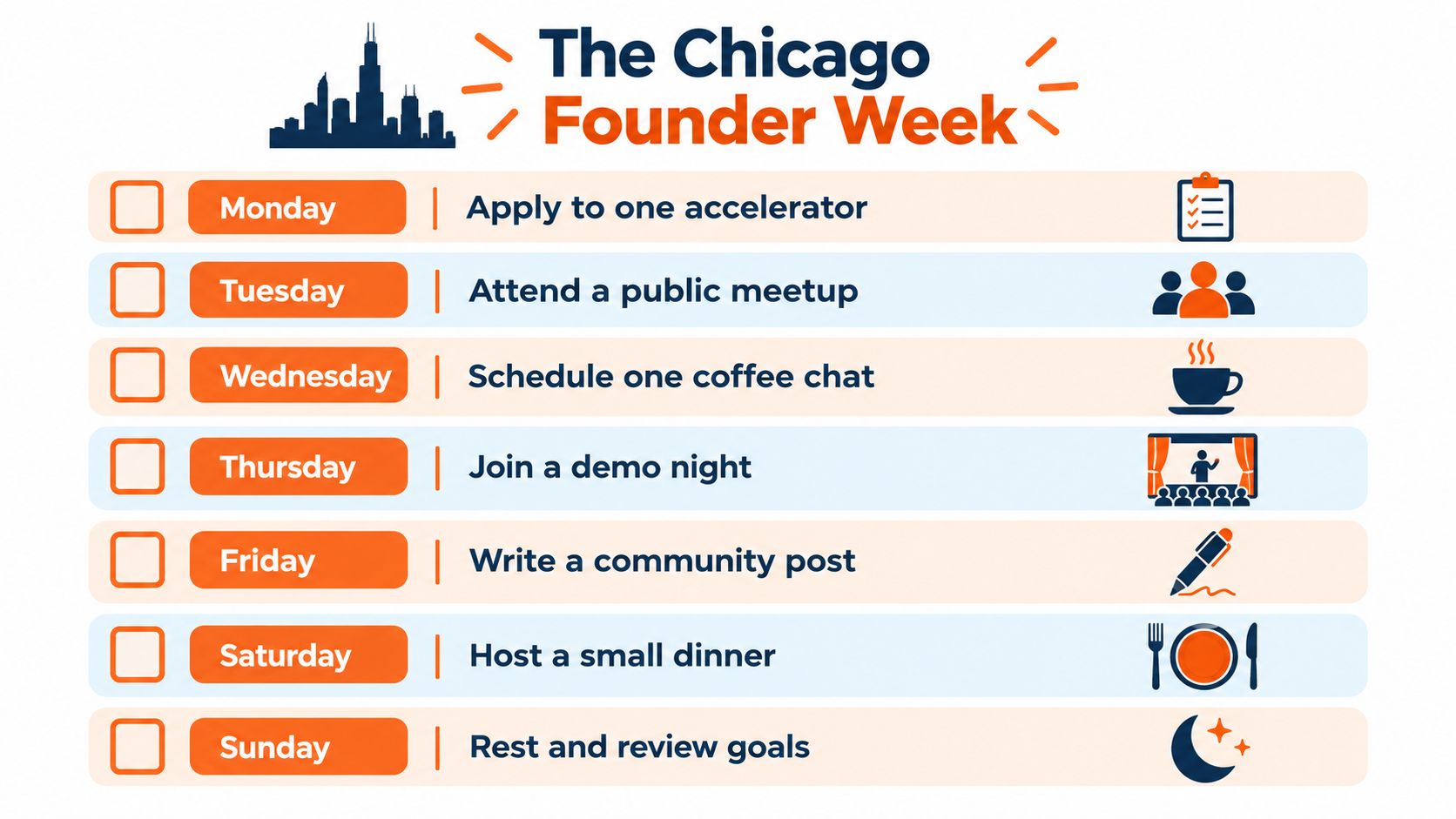
You don't need a packed calendar. You need a few actions with different jobs.
- One public room: Attend a meetup, panel, or demo night to learn what people are building and which organizers create useful discussions.
- One private conversation: Speak with a founder who has already solved a problem you're facing.
- One customer-facing action: Run an interview, send a proposal, test an offer, or ask for a referral.
- One written update: Share what you learned and what you're testing. Clear writing attracts better feedback than vague announcements.
- One review block: Look at your commitments and remove events that produce no learning, customers, partners, or trusted relationships.
The calendar should get quieter as your business gets clearer. You don't need to attend a conference every week. You need enough contact with the right people to keep your assumptions honest.
Monthly rhythm beats random enthusiasm
Show up twice a month for six months before you judge a community. Early conversations can feel ordinary because trust takes time. A founder may not share a supplier problem, cash concern, or hiring mistake with someone they met ten minutes ago.
Use a simple after-event note. Write down who you met, what they're building, what they need, and what you promised. Follow through before the next gathering. This habit turns casual contact into a working relationship.
A good month leaves you with fewer guesses. You should know more about the customer, the product, the people you need, and the next decision.
Keep conferences for moments when you have a clear reason to attend. A founder with a specific customer target, supplier question, or hiring need can use a large event well. A founder who wants to “meet people” usually comes home with a full phone and no useful next step.
Why Small Vetted Groups Often Beat Big Conferences
“Network more” is lazy advice for an idea-stage founder. You don't have a networking shortage. You have a trust, feedback, and prioritization shortage.
A large conference gives you range. You can meet investors, vendors, potential hires, customers, and other founders in one day. That range helps once you know what you need. Before that point, the room can bury you in polished pitches and generic encouragement.
A dinner with six to eight vetted builders creates a different pressure. You have enough people for varied opinions, but few enough that everyone has to participate. Someone can ask why customers haven't paid, whether your supplier has real capacity, or what evidence supports your pricing. That question may sting. It can also save you months.
What vetting protects
Vetting doesn't mean everyone agrees with you. It means the group filters for people who can respect confidentiality and contribute without turning every exchange into a sales call.
Look for:
- Clear membership standards: You should know who gets invited and why.
- Confidentiality: Early ideas, customer problems, and personal doubts need room to stay private.
- Operator presence: Founders should discuss decisions they made, not only services they sell.
- Useful variety: The group should include different industries and stages without becoming random.
- Follow-through: Members should act on commitments and return with updates.
Chicago has a strong supply of polite people. That helps the first conversation. The group still needs enough candor to make the second conversation useful.
The practical advantage
A small group can help you find a manufacturer, test a landing page, prepare for a customer call, or decide whether an accelerator fits. It can also reduce the emotional cost of building alone. You stop treating every setback as a verdict on your ability because other founders show you the normal messiness of early work.
The right group won't flatter you into staying stuck. It will help you turn a fuzzy problem into a next action. That is worth more than another stack of business cards.
Putting It Together and Plugging In This Week
Choose one public meetup this month, one recurring small group, and two conversations with founders one or two steps ahead of you. Bring a real question, follow up with something useful, and return to the same room long enough for people to see your progress.
Move toward an accelerator or investor when you can explain your customer, show evidence of demand, and name the next milestone the money will fund. Until then, peer feedback and customer contact deserve most of your time. For practical ideas on measurement and audience research, you can browse our AI analytics blog.
Chicago's advantage, in my view, comes from founders who combine kindness with work ethic. That combination won't replace product quality or customer demand, but it makes the right relationships easier to sustain.
Chicago Brandstarters gives Chicagoans and Midwesterners a free, vetted place to meet in private six-to-eight-person dinners every two weeks and exchange practical support in a confidential group chat. If you want a room built for honest founder conversations instead of contact collecting, visit Chicago Brandstarters and see whether the community fits your stage.
Leave a Reply