
You're at the laptop again, it's late, and the same three questions keep circling. Do I hire now or wait, do I keep pushing this product line, and who can I talk to who won't nod politely and then change the subject? That's the gap a peer advisory group fills when you build a company alone.
A good one is small, private, and practical. It gives you a recurring room of non-competing founders who trade real numbers, real mistakes, and real next steps under a clear confidentiality rule. The rest is structure, vetting, and enough discipline to keep the dinner from turning into another friendly chat.
If you want the deeper logic behind why small founder circles work, the cleanest read is the history of the model itself. The modern version is commonly traced to 1957, when Milwaukee executive Robert Nourse gathered local leaders under two simple rules, non-competing industries and strict confidentiality. That model later became Vistage, which cites more than 45,000 members across 40 countries in its organizational history Vistage's history of the model.
If you've ever wondered why a private dinner can feel more useful than a bigger room full of “connections,” that answer sits in the rules. The group works because people can speak plainly without worrying that the person across from them is a competitor, a prospect, or a gossip. If you want a nearby example of how that can look in practice, Chicago Brandstarters runs a peer support program built around small, confidential founder dinners.
For a good mental model on the social side, I like pairing this with CBT and DBT tips for friendships. Different topic, same lesson, trust gets built through clear rules, not wishful thinking. If you're wondering whether this format fits you, the quick test is simple, you need recurring decisions, a small circle, and a place where honesty matters more than impressing anyone.
What a Peer Advisory Group Actually Is
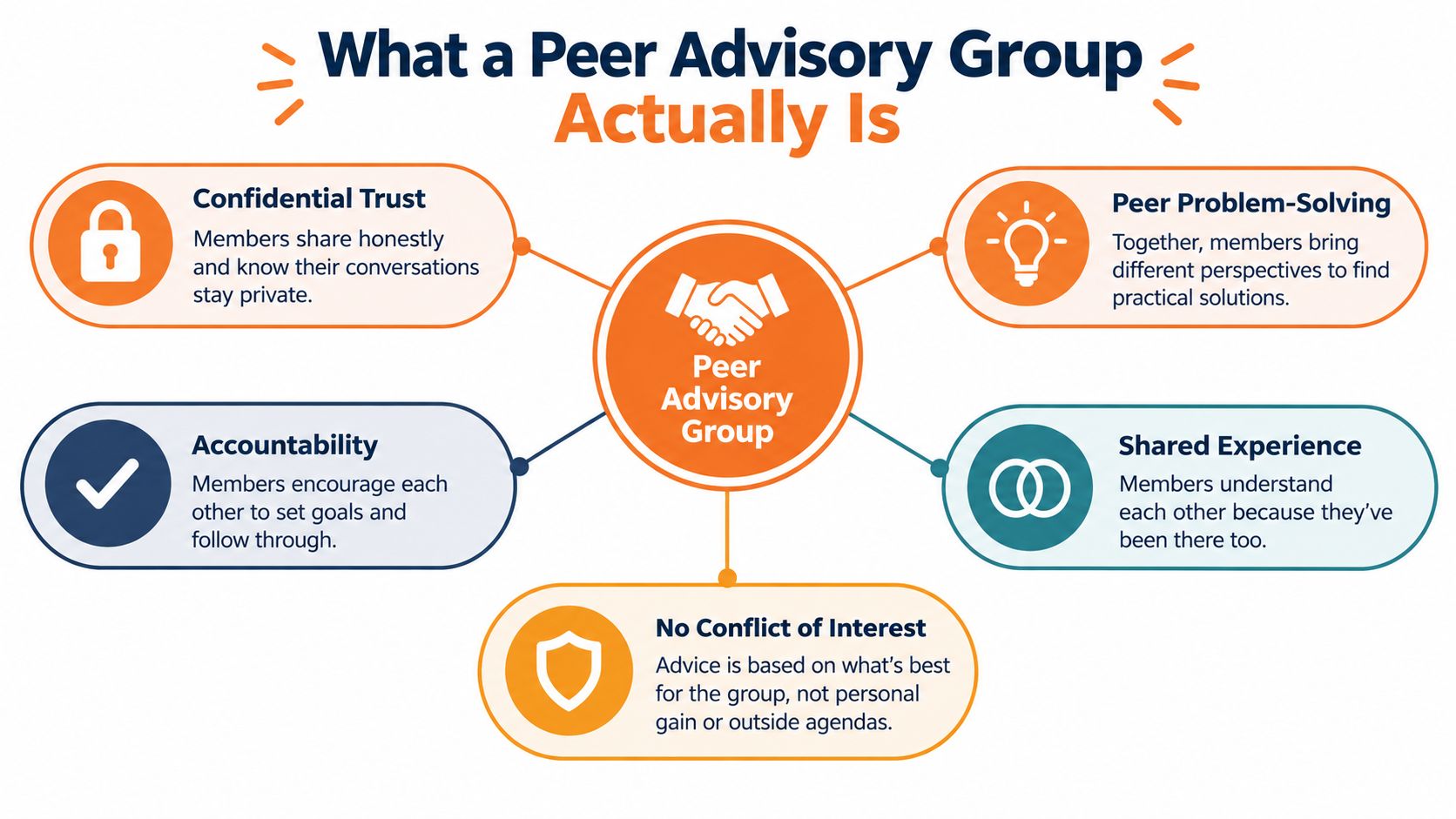
You're staring at a hiring note at 11 p.m., your spreadsheet is still open, and the people around you can offer sympathy but not a useful answer. A peer advisory group is built for that moment. It is a small, vetted group of non-competing founders or operators who meet on a fixed cadence, bring real business problems into the room, and keep the conversation confidential.
The value is not networking for its own sake. The value is a recurring room where peers can pressure-test decisions, compare what they have already tried, and leave with something concrete to do on Monday. In practice, it works like a small board of equals, only without the formal governance layer.
Practical rule: if the room can't handle your cash-flow problem, your bad hire, or your messy customer decision, it is not a peer advisory group, it is social time.
Start with five checks. Does the group meet on a repeat schedule? Is the roster small? Are the members from non-competing businesses? Does it protect confidentiality? Does it push people toward action instead of chatter? If the answer is yes to all five, you are looking at the genuine article.
The two rules that shaped the early model still matter, non-compete and confidentiality Vistage's history of the model. That is why serious groups screen members carefully and keep the room tight. When the setup is done well, the group feels less like a social club and more like an operating tool.
If you are a solo founder or a small-team operator, this format usually fits when you are making decisions with incomplete information and very little peer context. If you mainly want broad introductions, it can feel narrow. If you want a room that understands payroll pressure, product delays, and founder loneliness, the tightness is the point. Chicago Brandstarters runs a peer support program built around small, confidential founder dinners, which is a useful example of the format in practice.
For the social side of trust, I like pairing this with CBT and DBT tips for friendships. Different topic, same lesson. Clear rules beat vague good intentions.
Peer Advisory vs Mastermind vs Mentorship vs Board
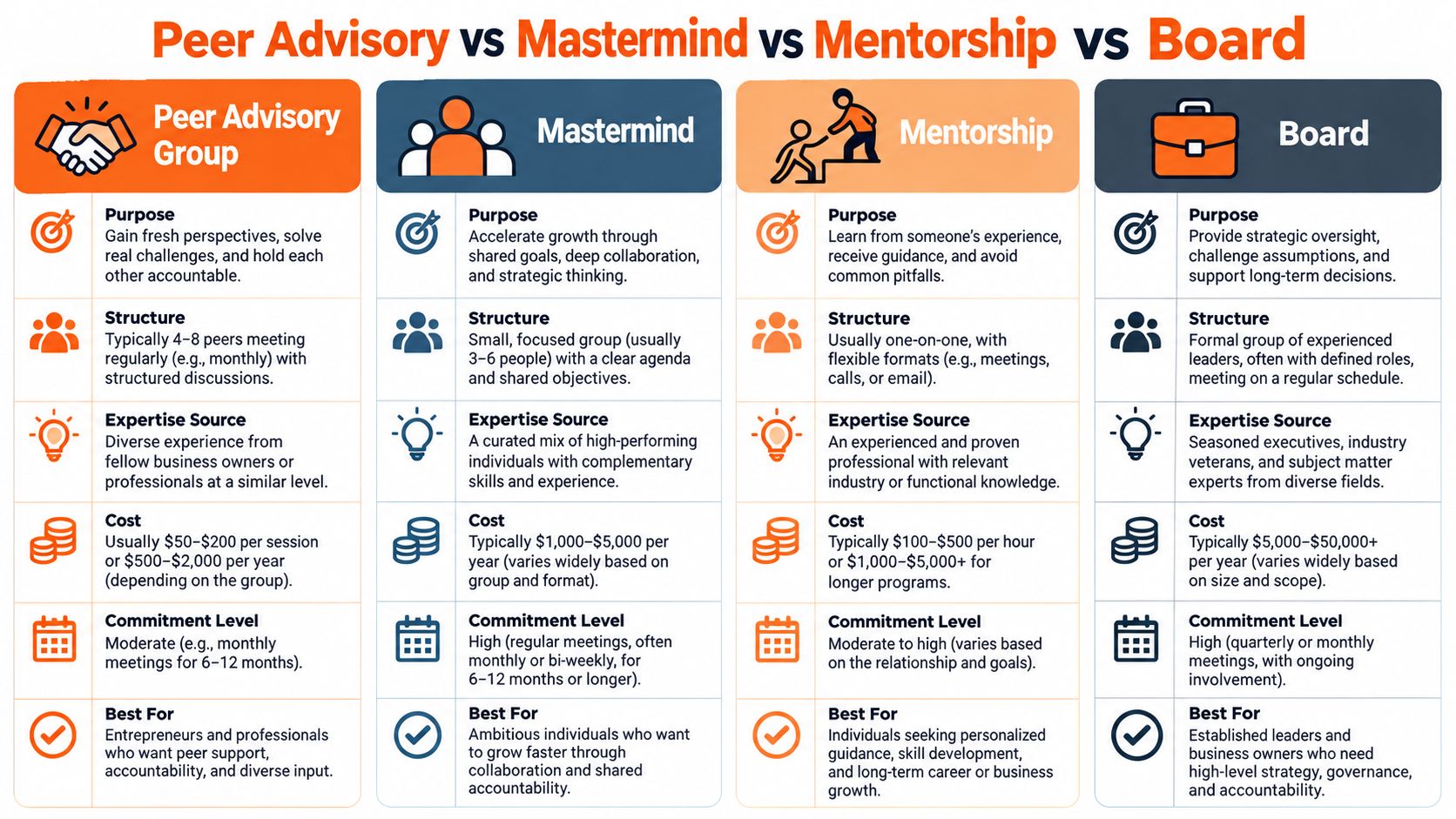
The labels get mixed up all the time, and that confusion wastes months. A peer advisory group is built for equals. A mastermind usually has looser structure. Mentorship is one-to-one guidance from someone ahead of you. A board is a formal governance body with fiduciary duties.
| Format | Who is in the room | Who leads | Best fit |
|---|---|---|---|
| Peer advisory | Non-competing peers at a similar operating level | A facilitator, chair, or rotating lead | Recurring decision support for founders who need honest peer feedback |
| Mastermind | Mixed peers, often self-selected | Usually the members themselves | Brainstorming, accountability, informal support |
| Mentorship | One founder and one more experienced person | The mentor | Specific guidance from someone with deeper experience |
| Board | Directors and executives, sometimes investors | Board chair | Governance, oversight, strategic review |
A 2022 doctoral study described executive peer advisory groups as meetings of 6 to 16 members, usually monthly, with confidentiality and vulnerability built into the structure peer advisory group study. That fits the table above. The format is defined by peer equality, a recurring cadence, and a facilitator or chair who keeps the room focused.
The design choice matters because each format solves a different problem. If you need deep operational feedback on hiring, pricing, or product decisions, a peer advisory group is the only one of the four that gives you a small private board of equals without the formal burden of a real board. That is also why founder dinners work best when they stay narrow, recurring, and protected.
In short: a mastermind is looser and self-selected, mentorship is one-to-one, a board governs, and a peer advisory group is the format that gives you a small private board of equals.
If you are weighing a peer advisory group against a mastermind, structure is the difference. A mastermind can be useful, but it often depends on who happens to show up. A peer advisory group has a stronger filter, a fixed cadence, and a tighter promise around confidentiality, which is why it tends to work better for serious operational decisions.
For a more specific compare-and-contrast on founder rooms, you can also look at mastermind groups for entrepreneurs. Use it as a contrast point, not a substitute. One is a loose peer circle, the other is a disciplined operating room.
Matching and Vetting Members You Would Actually Trust
A bad room ruins the format fast. One self-promoter, one gossip, or one person who treats every dinner like a sales pipeline, and the whole thing turns soft. So I'd vet like I'm hiring for a role that touches the P&L, because in a small group, that's basically what you're doing.
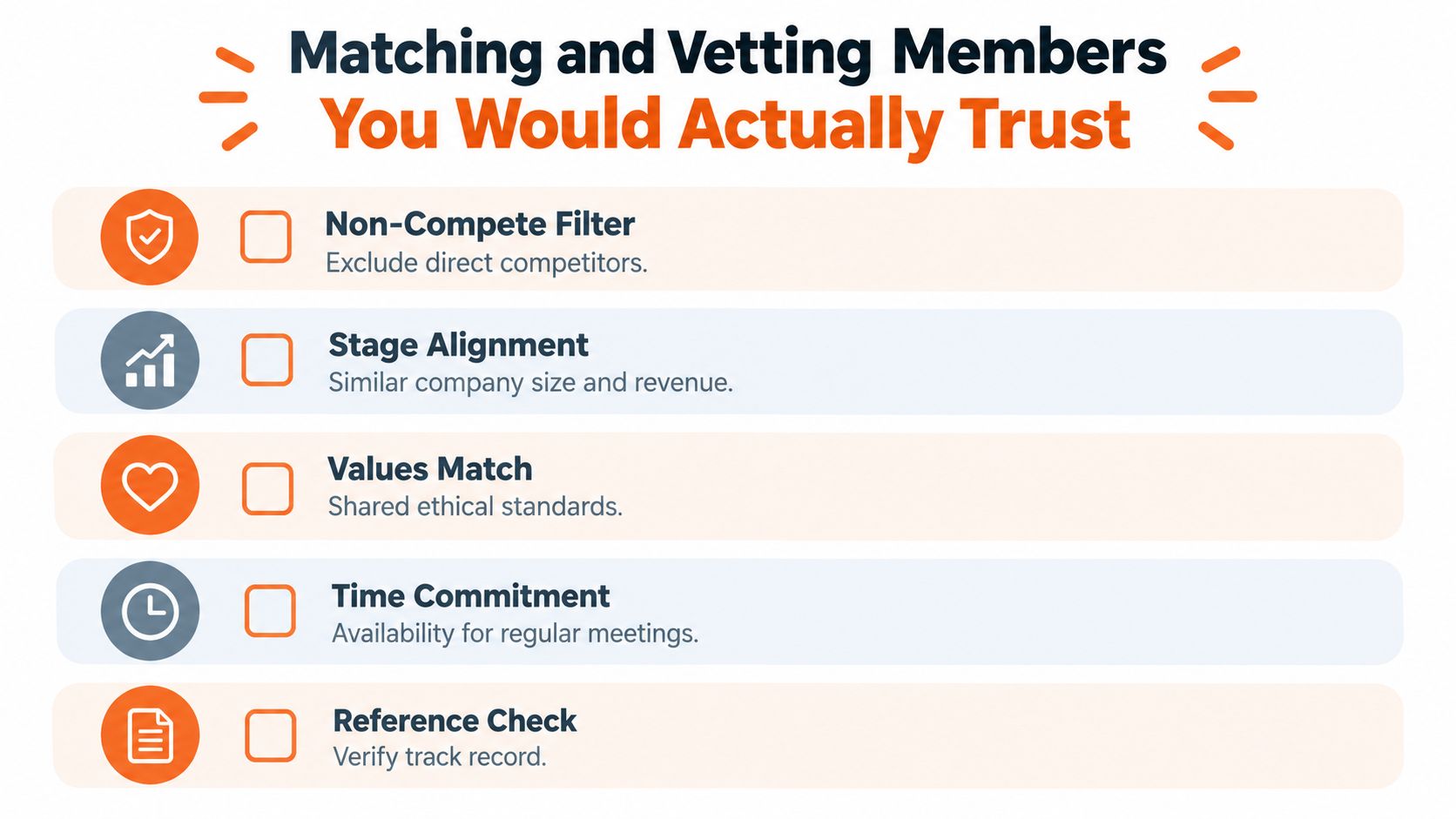
Start with the non-compete filter
The first screen is simple, no direct competitors. You want people who understand the pain, but don't profit from your mistakes. That protects candor and keeps advice from turning into strategy leakage.
Then check stage fit. A founder pre-product and a founder running a seven-figure brand often need different advice, even if they share the same title. If the room mixes wildly different realities, airtime gets wasted explaining context instead of solving the problem.
A useful culture screen can come from assess candidate culture alignment. Use it as a reference point, then keep your own version short and practical. I'd ask three things, how they make decisions, how they handle confidentiality, and what they do when they disagree with a peer.
Keep the room small enough to breathe
The satisfaction research matters here. Analysis of 2,869 member responses across 540 entrepreneur mutual-aid groups found that group climate, leadership, and group size were the big drivers of satisfaction group satisfaction study. In plain English, the room works when people trust the tone, trust the facilitator, and get enough time to speak.
That's why 6 to 8 people is the sweet spot for most founder dinners. At 6, you get depth. At 8, you still have airtime. At 15, somebody starts dominating, side conversations creep in, and quieter members stop bringing the hard stuff.
If you can't hear everyone's actual problem in one meeting, the group is too big.
A simple application template should ask for company stage, role, industry, biggest current challenge, whether they sell to peers, and who can vouch for them. Then do one reference call. The call isn't about flattery, it's about whether the person is steady, discreet, and useful under pressure.
For a rejection script, keep it clean. “Thanks for applying, but this group is built for non-competing founders at a similar stage, and this isn't the right fit.” You don't need a debate. You need a boundary.
Confidentiality, Non-Solicitation, and What Actually Stays in the Room
Trust dies when people have to guess the rules. So write them down. Don't rely on a warm vibe, because a warm vibe won't stop someone from repeating your supplier issue, pitching you at dinner, or using your comment to sell a service later.
Vistage treats confidentiality as a foundation for honest discussion and says many business groups use written agreements that bar members from using another participant's information for competitive advantage and from trying to sell products or services to fellow members Vistage confidentiality guidance. That's the right shape for a founder group too. Keep information private, and keep the room free of sales pressure.
Plain rule: if someone shares it in the room, you don't repeat it outside the room, and you don't turn it into a lead.
I'd put the policy in one short page. Name the duty to keep member information private. Name the no-solicitation rule. Then add what happens if two members work in adjacent niches, if someone leaves the group, or if a member wants to share a win publicly.
For the awkward cases, I use one sentence at the table, “If this comes from the room, it stays in the room unless the person who shared it says otherwise.” That line removes guesswork fast. If you need a legal framing reference while drafting your own terms, Florida founders' agreement protection is a useful place to compare language and boundaries.
If you want a good internal benchmark for how to think about this, the Chicago Brandstarters page on what is confidentiality and why is it important gives a useful plain-English view of why the rule matters. The group doesn't need legal drama. It needs a shared promise that makes honest talk feel safe enough to happen.
A Repeatable Template for Your 90-Minute Meeting
A founder dinner gets sloppy when nobody knows what the clock is doing. The fix is a simple agenda you can reuse every time. I like 90 minutes because it gives enough room for one real problem without dragging the night out.

Minutes 0 to 5, check-in. Each person says one sentence on what they're working through right now. Keep it tight. The failure mode is story time, where everyone tries to summarize their whole week.
Minutes 5 to 30, one deep dive. One member presents a single problem with context, options, and the decision they need to make. The prompt I like is, “What choice feels stuck, and what evidence do you already have?” If the presenter brings three problems, pick one and park the others.
Minutes 30 to 60, round-robin questions. Everyone asks focused questions before giving advice. This is the part that keeps the room honest. The wrong move is jumping straight to solutions before you understand the actual constraint.
The research on peer advising backs that up. A randomized controlled trial involving 167 startups found that advising peers improved the usefulness of founders' own business ideas, though it didn't improve novelty in a comparable way, and the effect was stronger for experienced entrepreneurs startup peer advising trial. That fits what I've seen in rooms that work, helping someone else sharpen their logic sharpens yours too.
Minutes 60 to 75, tactics share. Everyone offers one tactic, one caution, or one contact that might help. Keep it specific. “Try this framework” is weak. “Ask these three customer questions before you hire” is useful.
Minutes 75 to 90, written commitment. Each person writes one action, one due date, and one person who will check back. The meeting ends when the commitments are written, not when people feel done talking. That's how the room turns into execution.
A simple note-taking format helps here too, problem, options, decision, next step. You don't need a fancy system. You need the discipline to make every dinner produce one clear move.
How to Tell If Your Group Is Actually Creating Value
A lot of founder groups become dinner with friends. That's fine if that's what you wanted. It's not fine if you thought you were building a decision tool.
A 2025 survey of 1,593 U.S. small-business owners found that more than one-third didn't collaborate with peers at all, while those who did most often exchanged referrals (36%) or vendors (21%) small-business peer collaboration survey. The same survey said two-thirds reported little meaningful engagement with networking or lead-generation groups, and 71% said chambers of commerce delivered little or no value. That's a good warning sign, more activity doesn't automatically mean more business value.
Track outcomes at 30, 60, and 90 days
I'd keep the scorecard light. At 30 days, ask whether people showed up, shared a real problem, and left with a next step. At 60 days, ask whether those next steps got executed. At 90 days, ask whether the group changed anything concrete.
Use four buckets. Revenue or pipeline gains. Costs avoided. Hires or partnerships made. Decisions made faster. That keeps the measurement tied to business movement, not just feelings.
You can also track leading signals that matter in a founder room. Did members disclose weak spots sooner. Did they ask better questions. Did they stop carrying a hard issue alone for months. Those are small signs, but they usually show up before the financial result.
A group that never creates a decision, a referral, a cost saving, or a cleaner next step is just a recurring dinner.
If the scorecard stays flat for two or three cycles, change the room or retire it. Replace weak members. Tighten vetting. Shrink the agenda. If the group is working, double down on the format that created the result.
For a 6 to 8 person group, a quarterly review is enough. Ask each member what problem the group helped solve, what didn't move, and whether they'd renew the same room as it is today. You don't need a consultant for that. You need honesty and a short memory for excuses.
Mental Health, Kindness, and the Limits of Peer Support
A founder dinner eventually lands on burnout, grief, divorce, or panic. That moment needs a rule, not improvisation. Peers can listen, normalize, and help someone find the next practical step, but they can't play therapist.
A 2026 study of 2,225 U.K. female founders found that 78% saw human connection as central to entrepreneurship, peer networks ranked as the most valued support at 39%, 14% named loneliness or isolation as their biggest challenge, and 27% reported mental-health pressures including burnout and self-doubt female founder support study. That lines up with what many small rooms already feel, founders need practical support and human contact, but they also need boundaries.
A kindness clause should be plain. Members keep confidences, avoid selling in the room, respect identity checks, and can ask for practical help without apology. If someone raises a crisis, the group listens, then points them toward licensed care or trusted support, not amateur diagnosis.
The cleanest rule is this, we support the founder, we don't replace professional care. That keeps the room useful without pretending it can handle everything. It also keeps peers from accidentally making things worse when a topic is bigger than the table.
If you want a Chicago-based place that already works this way, Chicago Brandstarters runs small, confidential dinners and a private group chat for founders who want practical support without sales pressure. If that's the kind of room you need, visit Chicago Brandstarters and see whether the format fits your stage.
Leave a Reply