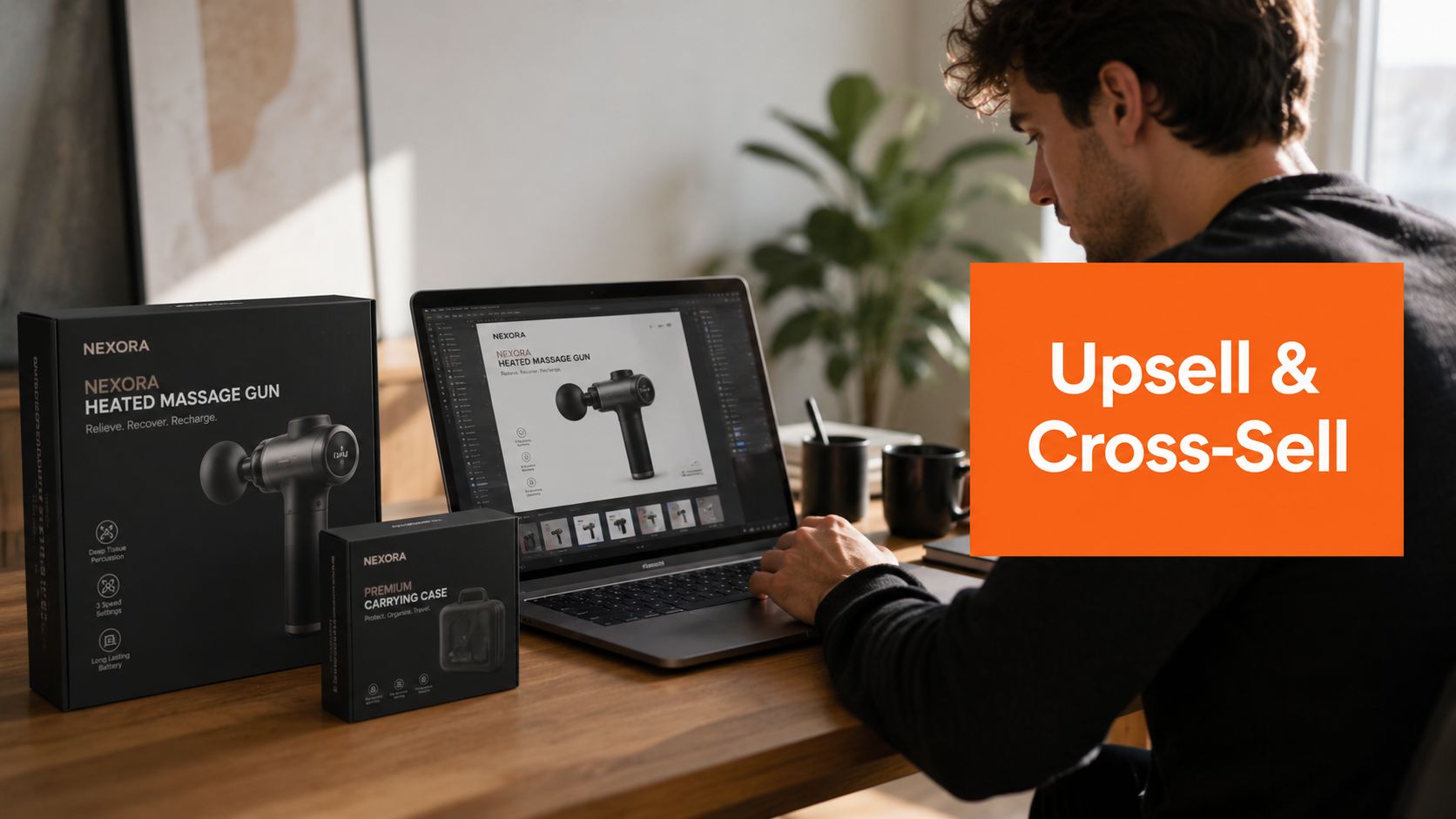
You've got the same problem most founders hit around order 20, order 200, and order 2,000. A buyer is already in motion, they almost leave, then one smart add-on or upgrade prompt turns a near-miss into a better order. That moment is where upselling and cross selling stop being “sales tricks” and start acting like a founder habit.
I've seen teams treat this like a polish project. That's backwards. You need a simple system, clean triggers, and a short script for each buying moment, or you'll either leave money on the table or annoy people who were ready to buy.
This guide uses four lenses, the offer itself, where it lives, who sees it, and how you test it. If you handle those well, you can grow order value without turning your funnel into a junk drawer.
The Founder Moment That Makes This Topic Matter
The cleanest upsell I ever saw was also the least dramatic. A shopper added one item, hovered on the cart, then saw a single add-on that made the original purchase feel incomplete without it. They bought both. No hard sell, no circus, just a timely nudge that matched what they were already trying to do.
That's the founder lesson. You don't need a bigger funnel. You need sharper decisions at the exact moment someone is ready to spend.
Upselling and cross selling belong in your operating system because they turn one order into more useful revenue. The point isn't to squeeze buyers. The point is to help them make a better choice, faster, with less friction.
Practical rule: if the add-on makes the first purchase work better, sell it. If it feels like a random extra, leave it out.
There's another reason this matters. Selling to an existing customer is 60% to 70% more likely than selling to a new prospect, according to the benchmark cited in the summary on upsell and cross-sell statistics, and cross-selling contributes about 10% to 30% of e-commerce revenue in industry summaries. That's not a side quest, that's a core revenue lever, and the economics show up again and again in commerce and software settings. See the benchmark summary on upsell and cross-sell statistics.
The rest of the playbook is simple. First, know what each tactic is. Then place the offer where intent is highest. Then segment by buyer stage, price the offer correctly, and test one thing at a time.
Upselling and Cross Selling Defined Without the Jargon
Upselling means you point the buyer to a more expensive or higher-tier version of what they already want. It's the premium seat on a flight, the extra legroom, the nicer room with the same trip built in. The original decision stays the same, you just move the customer up one rung.
Cross selling means you add a related item that solves an adjacent need. It's the rental car plus the GPS, or the phone plus the case and charger. The buyer doesn't replace the first item, they complete it.
That difference matters because the copy, timing, and placement change with the job. An upsell needs a clear upgrade path, usually on the same decision axis, like speed, quality, capacity, or convenience. A cross sell needs complementarity, something the buyer will understand as “I need this too.”
Here's the clean version. Upselling deepens value per buyer, cross selling widens the basket. If you blur them together, your offers get sloppy fast.
Buyer's rule of thumb, if the extra item makes the first purchase better, it's a cross sell. If the extra item replaces the first choice with a better version, it's an upsell.
The Salesforce learning centre draws the line plainly, upselling means steering a customer to a more expensive, higher-end version of the item they already want, while cross-selling means offering a related or complementary add-on instead of a replacement. Salesforce also says both tactics usually target existing customers, not brand-new ones, which is why you should build these offers around customer behavior, not broad traffic. See the definitions in Salesforce's cross-selling learning centre and its note on existing-customer expansion.
| Dimension | Upselling | Cross Selling |
|---|---|---|
| Core move | Upgrade the same choice | Add a related choice |
| Buyer question | “Should I get the better version?” | “What else do I need with this?” |
| Best use | Quality, speed, capacity, status | Completeness, convenience, fit |
| Copy angle | Better, faster, more capable | Missing piece, companion item, bundle |
| Placement | Checkout, in-app, plan prompts | Product page, cart, post-purchase |
Why the Revenue Math Hits Harder for Early Brands
Early brands feel every order. A small lift in average order value changes cash in the bank, and a better attach rate reduces how often you need to buy growth with ads. At low volume, upsells and cross sells stop being a nice-to-have and become part of the revenue model.
Benchmarks in the brief point to 10% to 25% average order value lifts from strong recommendation systems, and some organizations see upsell and cross-sell activity lift revenue by about 42%. Treat those as planning anchors, not promises. For an early brand, the question is simple, what happens to weekly cash if more buyers add one more item? The recommendation benchmark is summarized in the Shopify-focused source on upsell and cross-sell statistics, and that revenue-lift figure appears in the same benchmark summary cited above.
A closer read of the research brief makes the point sharper. The literature review found that upselling initiatives consistently linked to incremental sales, revenue, and purchase intentions, while most cross-selling studies also showed positive effects on incremental sales, revenue, and profitability. That means this is a conversion problem, not a branding problem. Put the offer where purchase intent is already high, and keep the ask tied to the buyer's current action.
Founder rule: do not ask “Can this tactic work?” Ask “Where does it pay back faster than more ad spend?”
The source brief also notes that experience-led growth strategies can increase cross-sell rates by 15% to 25%. Use that as a signal to improve relevance, not to chase discounts. Good targeting beats cheap offers every time.
| Metric | Typical Range | What It Means at Low Volume |
|---|---|---|
| AOV uplift from recommendations | 10% to 25% | One extra item per order can change weekly cash flow fast |
| Revenue lift from upsell and cross-sell activity | About 42% in some organizations | A strong program can move the whole order base |
| Cross-sell rate lift from better relevance | 15% to 25% | Better targeting can matter more than deeper discounting |
| Existing-customer sale likelihood | 60% to 70% more likely | Expansion is usually cheaper than prospecting |
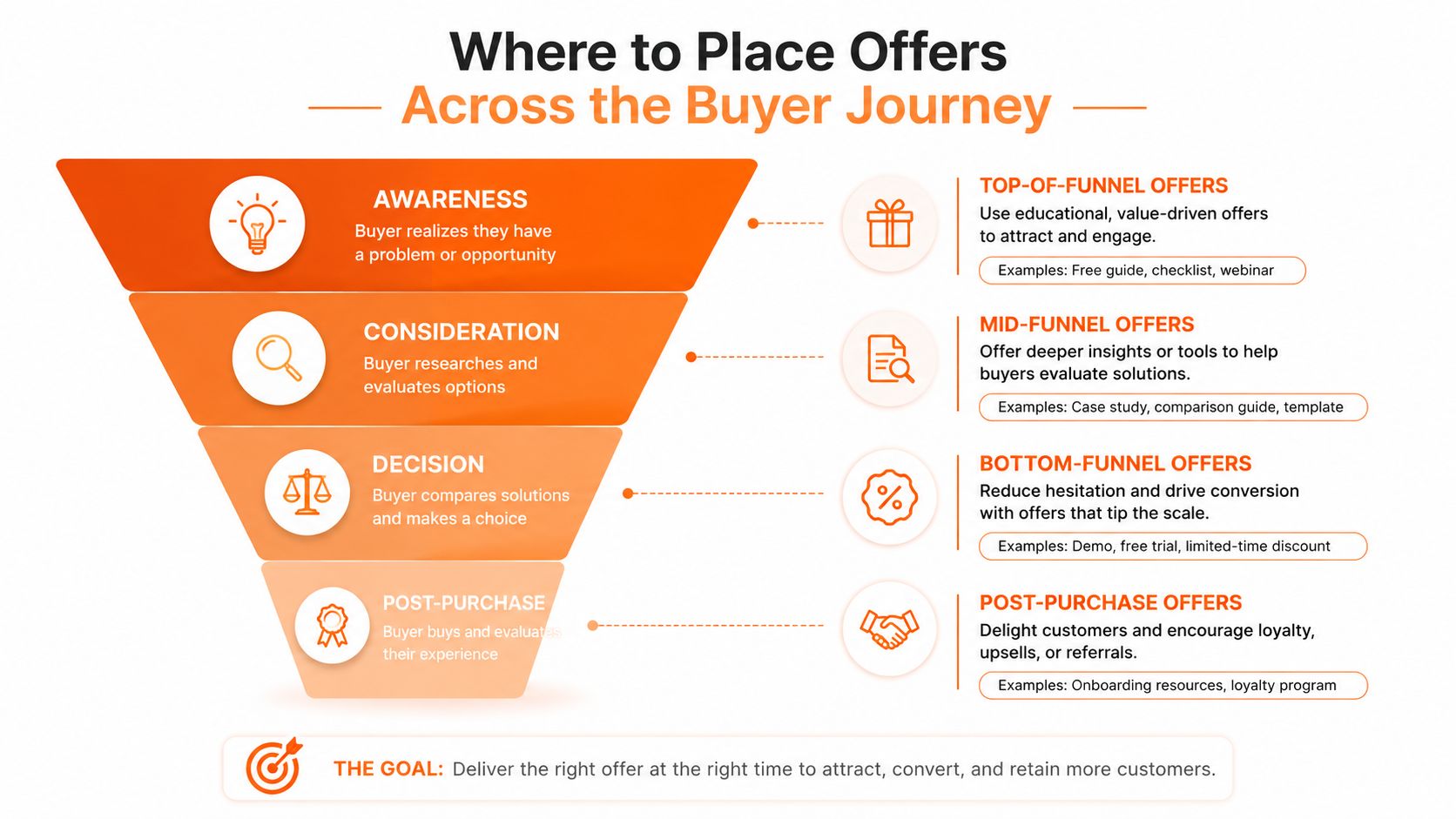
Where to Place Offers Across the Buyer Journey
Place the offer where the buyer already has a reason to say yes. That's the rule. If you guess, you create clutter. If you read intent, you get clean lift.
Browse and product page
Use cross sells here. Show the thing that completes the purchase. A product page is where buyers compare, so the add-on should feel natural, like a companion rather than a distraction.
A script can be blunt and useful. “Customers who bought X added Y in 60% of orders.” If you can't support that claim with your own data, use softer copy like “Pairs well with X” and move on.
Cart and checkout
You earn last-minute upgrades with expedited shipping, bundle swaps, and premium versions. The buyer has already committed, so keep the ask short.
“Add a 2-pack for $X more and save Y%” works better than a paragraph. So does “Upgrade to priority shipping for $Z.” The offer should feel like a finishing touch, not a detour.
Post-purchase and retention
Post-purchase is where you sell with less friction because the core decision is done. A confirmation page or follow-up email can handle a gentle upsell, especially when you frame it as convenience or speed. Retention flows should push replenishment, add-ons, or a higher plan after the customer has already seen value.
For a practical Shopify angle, I'd point you to Quikly's Shopify cross-sell guide, because it focuses on placement and offer logic instead of generic theory. If you're mapping the same channel to a broader growth stack, the internal guide on ecommerce growth strategies is a useful companion.
Segmentation, Pricing, and Timing That Match the Right Buyer
Good offers don't go to the crowd, they go to the right buyer at the right stage. If you sell the same upgrade to every person, you're doing spray-and-pray with prettier buttons.
Read the signal before you price the offer
Start with three buckets, new visitor, repeat buyer, VIP. Then add cart value bands, under $30, $30 to $75, and $75 plus. New visitors usually need clean cross sells at full price. Repeat buyers can take bundle savings. VIPs should get exclusive add-ons or access, not tired discounts.
The sequence matters too. First purchase gets a starter bundle. Second purchase gets a category cross sell. Third purchase earns a premium upgrade or subscription pitch. That's how you move with the customer instead of talking at them.
Practical rule: if a buyer still looks unsure, sell simplicity. If the buyer already trusts you, sell depth.
For pricing, anchor the per-unit cost against the total, or frame the upgrade as a save instead of a spend. A decoy tier can help, too. Put a weaker middle option next to a slightly better one, and the middle choice stops looking safe.
If you want a clean pricing lens for new offers, use the guide on how to price a new product as your internal check before you launch anything with an upsell attached.
| Segment | Intent Signal | Best Offer | Discount Ceiling | Trigger Moment |
|---|---|---|---|---|
| New visitor | Browse depth, first session | Complementary cross sell | Full price | Product page or cart |
| Repeat buyer | Repeat rate, email engagement | Starter bundle or category add-on | Moderate bundle savings | Second purchase |
| VIP | High repeat rate, strong engagement, support history | Premium add-on, subscription, exclusive access | Minimal discount | After proof of value |
| High cart value buyer | Larger basket, faster checkout | Upgrade, priority service, pack size change | Light incentive | Checkout or post-purchase |
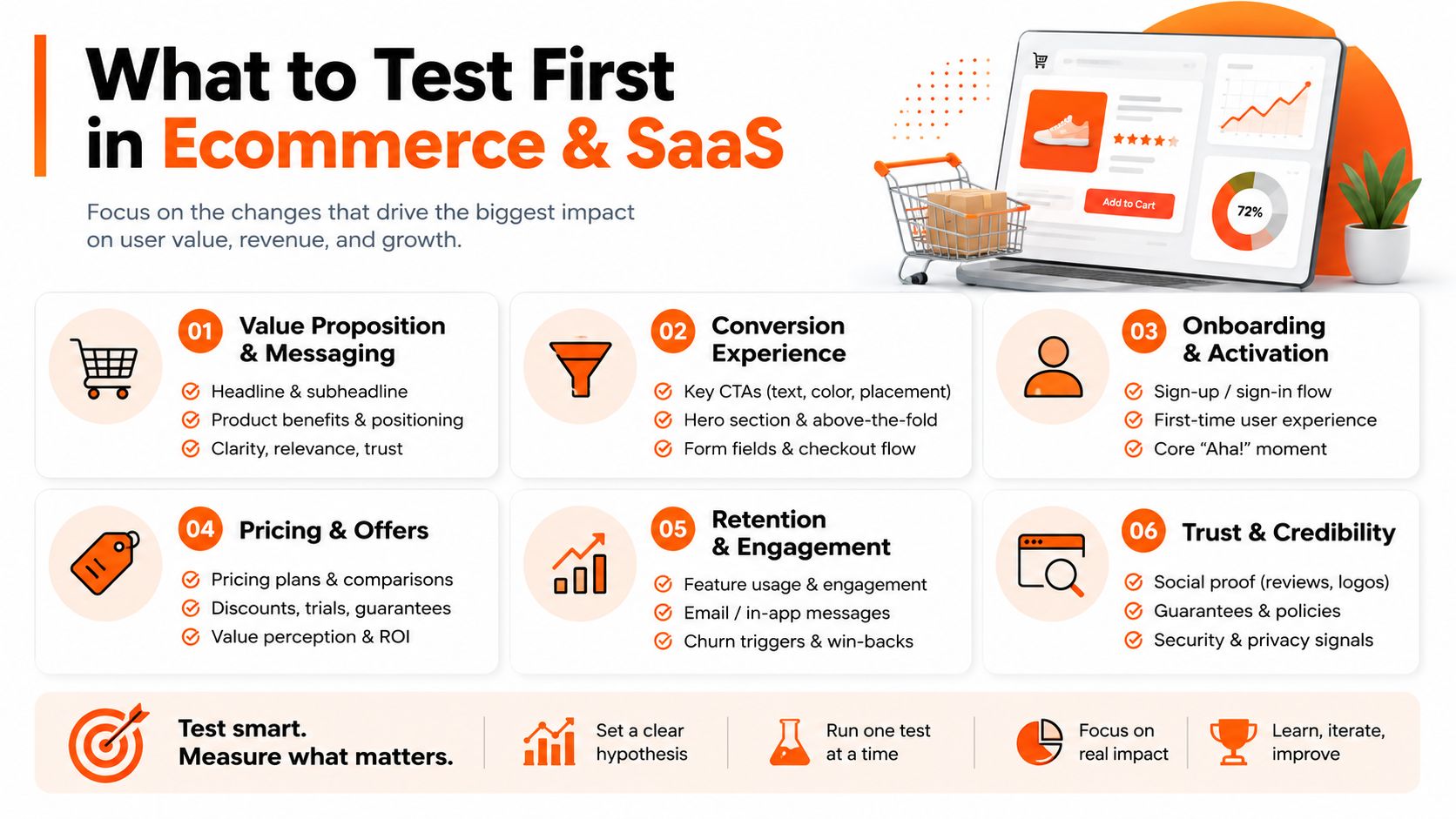
What to Test First in Ecommerce and SaaS
If you run ecommerce, test the lowest-friction move first. A one-click post-purchase upsell usually beats a checkout upsell because the buyer already said yes, and you're not fighting form fatigue. Then test cart bundles. Then test segmented email cross sells.
If you run SaaS or a digital product, start inside the product. Usage thresholds are your friend. A user who hits a limit or clicks a locked feature gives you a clean reason to ask for an upgrade.
Ecommerce test order
Post-purchase one-click upsell
Hypothesis, buyers will accept a related upgrade after checkout.
Variable, one offer, one placement.
Success metric, upsell take rate and AOV.
Decision, keep if it lifts order value without creating complaint volume.Cart bundle
Hypothesis, a paired offer increases basket size.
Variable, bundle composition only.
Success metric, attach rate.
Decision, ship if the bundle beats the single-item path.Segmented email cross sell
Hypothesis, recent buyers will respond to a relevant companion item.
Variable, one audience segment.
Success metric, click-through to purchase.
Decision, kill fast if the offer reads like a generic blast.
SaaS test order
In-app upgrade prompt at a usage threshold
Hypothesis, users upgrade when they hit a real limit.
Variable, one prompt, one trigger.
Success metric, upgrade conversion.
Decision, keep if the prompt matches the exact pain point.Annual plan nudge during onboarding
Hypothesis, committed users prefer the lower-friction annual choice.
Variable, one plan framing.
Success metric, annual share.
Decision, keep if it lifts commitment without hurting activation.Seat-based add-on after activation
Hypothesis, teams add seats once value is visible.
Variable, one add-on, one moment.
Success metric, expansion conversion.
Decision, keep only when usage already proves need.
If you want to tighten your test discipline on the commerce side, the internal guide on conversion rate optimization for Shopify is the right companion. The rest is simple, run one test at a time, or you'll never know what worked.
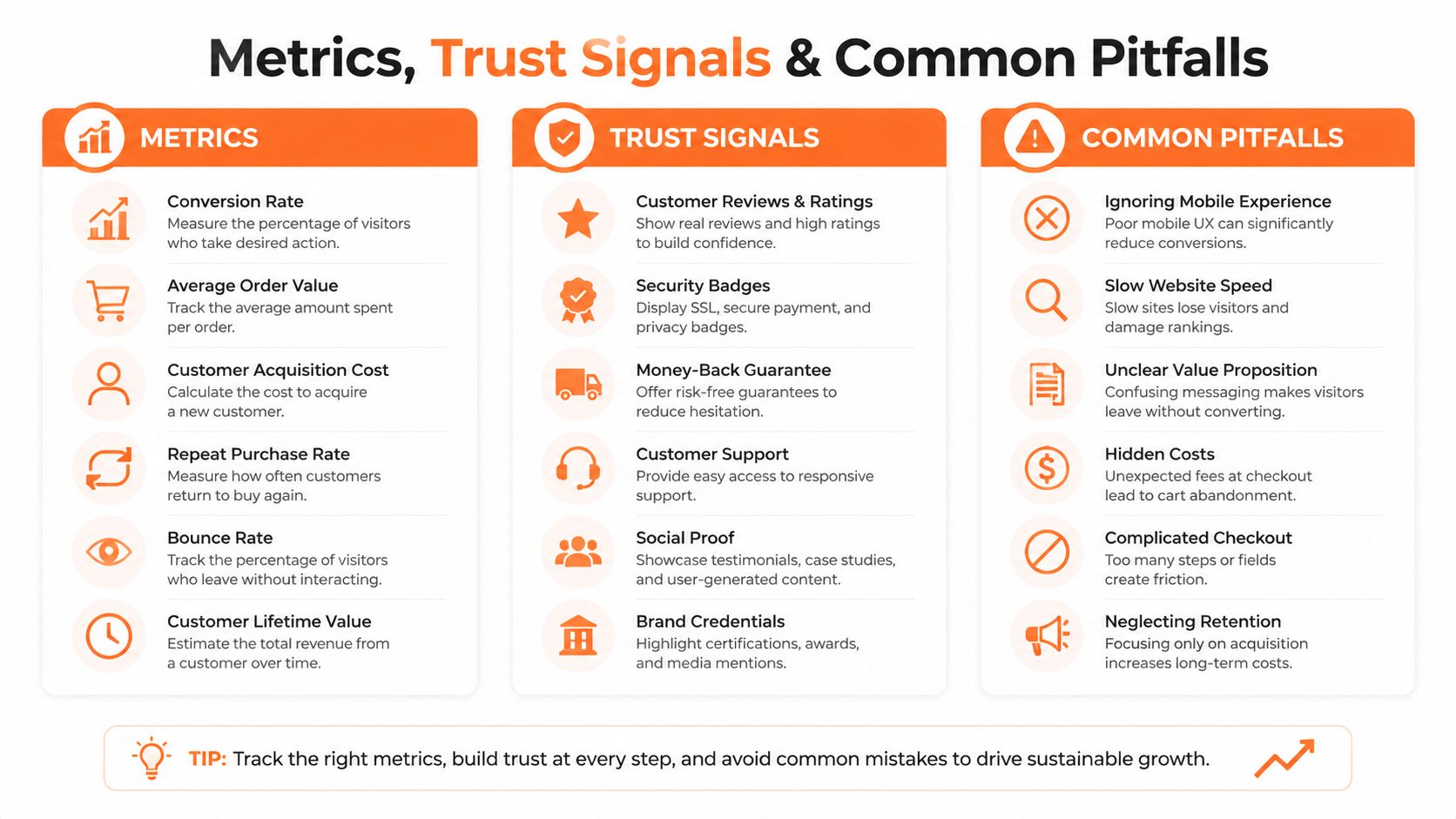
Metrics, Trust Signals, and Common Pitfalls
If you track the wrong numbers, you'll defend bad offers longer than you should. Track AOV, attach rate, upsell take rate, repeat purchase rate, refund or churn rate on upgraded offers, and incremental margin per order. Ignore vanity metrics that don't tell you if buyers trust the offer.
Here's the clean decision rule. If attach rate stays below 8% after 200 exposures, the placement is wrong, not the product. Fix the moment, the copy, or the audience before you touch price.
Trust signals do real work here. A visible review count on the upsell page helps. A clear cancel-anytime line matters for subscription bumps. Showing savings in absolute dollars beats vague percentages because buyers can feel the difference in plain language.
For retention context, the 9 retention tactics for eCommerce in 2026 piece is worth a look because it keeps the focus on customer behavior after the first sale, which is where expansion either compounds or dies. That's the same lens I use when I judge whether an upsell is helping or draining trust.
Common mistakes I'd cut fast
- Burying the offer: If the upsell appears on a lonely thank-you page with no context, most buyers will ignore it.
- Pitching too early: A premium tier can feel tone-deaf to a first-time buyer who still needs onboarding.
- Over-discounting bundles: If the discount eats margin, you built a volume trap.
- Ignoring support tickets: Complaints around confusion or surprise charges tell you the offer is hurting the relationship.
Track the three numbers, scan support tickets, then decide whether to keep, fix, or cut the offer. That weekly rhythm beats debate.
Your First Two Weeks of Upselling and Cross Selling
Start small. You do not need a grand system, you need one clean launch and a baseline.
Week one is observation. Pull the last 30 days of order data, flag the top repeat SKUs, map two natural cross-sell pairs per hero product, and pick one post-purchase page plus one email touchpoint. If you can't explain why the pair fits, it's probably junk.
Week two is execution. Ship one post-purchase upsell and one cross-sell email to a 30-day buyer cohort. Set your baseline for attach rate, then let the data speak without tinkering midstream.
The keep-or-kill rule is simple. If the offer beats your current AOV by at least 5% and does not raise refund tickets by more than 1 point, keep it. If it misses, fix the trigger or cut it.
For the KPI side, the merchandising KPIs for online stores guide is a good way to sanity-check whether your offer list is doing real work or just looking busy. I'd use it once you've got your first two-week results in hand.
The best upsell makes the customer feel smarter for buying. It doesn't squeeze them for an extra 8%. Done well, this becomes a quiet growth engine. Done badly, it taxes trust.
If you want a sharper growth playbook for your brand, Chicago Brandstarters is where kind, hard-working founders trade real tactics, honest war stories, and support without the networking theater. If you're building from idea stage to real revenue, come meet people who care about the same problems and want to help you solve them.
Leave a Reply