
You're probably staring at a shelf of boxes, a Shopify dashboard, and a shipping bill that feels too high for the margin you thought you had. That's the usual moment when founders realize ecommerce logistics isn't a back-office nuisance, it's the operating layer between your ads and your customer. If that layer is sloppy, you can sell the right product and still lose money every time you ship one.
I'd treat ecommerce logistics like a kitchen, not a carrier contract. You need to know where inventory sits, who touches it, what gets boxed, how it moves, and what happens when it comes back. If you can draw that on a napkin, you're already ahead of most first-time brands.
U.S. ecommerce grew much faster than total retail, with e-commerce retail sales up 175% between 2010 and 2017 while total retail rose 29% in the same period, which is why ecommerce logistics has to scale differently than store-based retail systems. You don't build that on vibes. You build it by making the logistics layer boring, repeatable, and cheap enough to survive a holiday spike without wrecking margin. For a broader framework, the ecommerce logistics guide is a solid starting point, and if you're a Chicago founder, keep this shipping and logistics tag close.
What Ecommerce Logistics Means for Your Brand
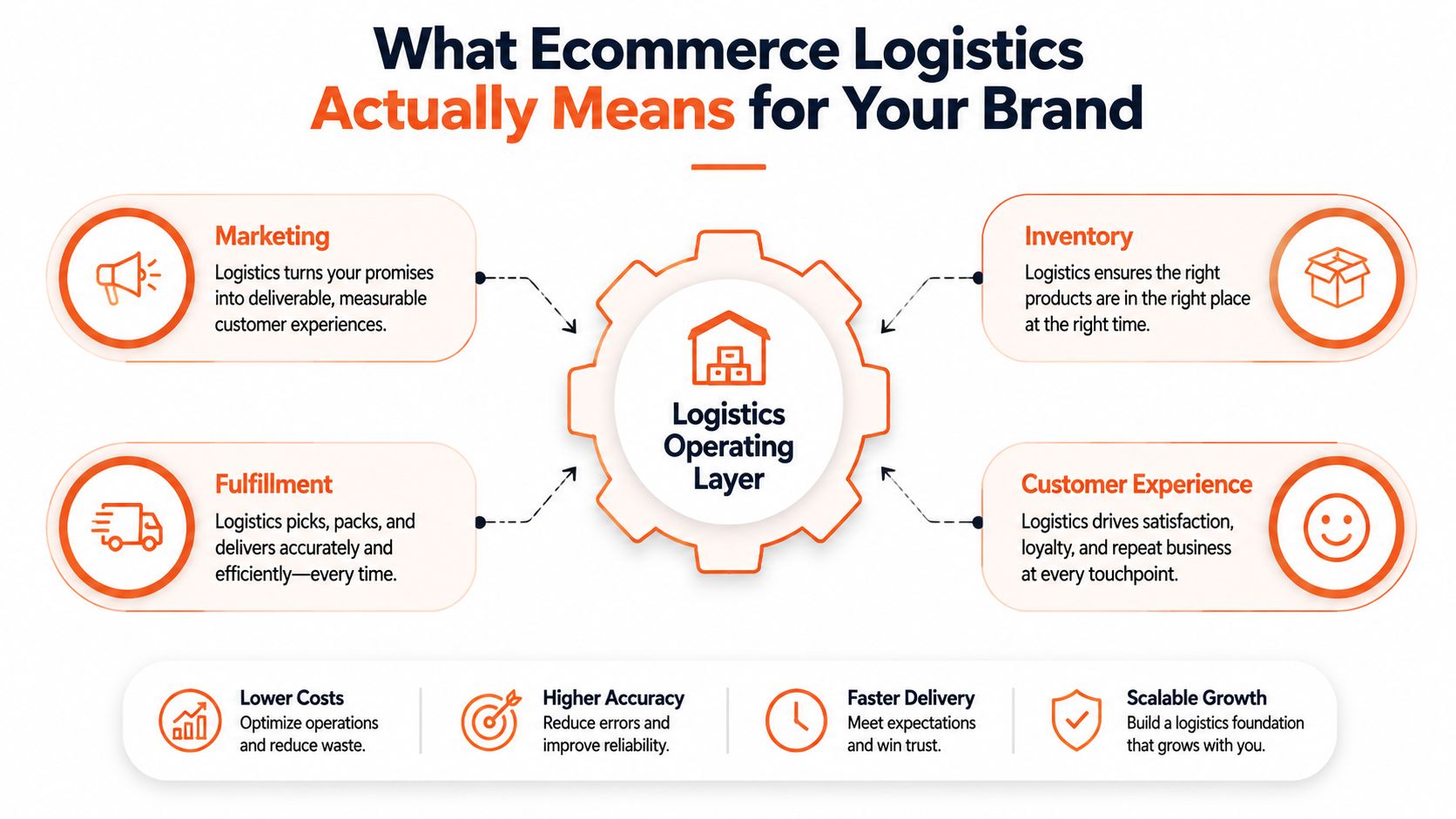
Ecommerce logistics is the system that turns a customer's click into a box at the door without burning cash in the middle. It covers inventory placement, warehouse work, pick and pack, carrier selection, delivery promises, and returns. If any one of those slips, the customer blames your brand, not the process behind it.
Your ads create demand. Logistics decides whether that demand becomes repeat revenue or a stream of refunds, complaints, and margin leaks. Two brands can sell the same product with the same creative and still end up with very different profit because one stores inventory closer to buyers, packs orders faster, and routes shipments with discipline.
Practical rule: if you cannot pinpoint where the delay happened, you cannot fix it.
The founder decision is straightforward. You choose the warehouse strategy, the packaging rules, the return policy, and the carrier mix. A 3PL handles execution if you use one, and the carrier handles line-haul and delivery. Your job is to design the system so each partner has fewer chances to waste time and create avoidable cost.
Why the same ad spend can produce different profit
A growing ecommerce brand does not scale like a storefront. Every order adds more parcels, more exceptions, more split shipments, and more customer service tickets. That is why logistics becomes a margin question fast. If your delivery promise is sloppy, you pay for it in support time, reships, and trust you do not get back easily.
I like the napkin test. Can you name the five moving pieces, warehouse, inventory, fulfillment, carriers, and returns, and point to the one most likely to fail first in your business? If not, you are still treating logistics like shipping labels instead of a system. The best founders do not obsess over carrier marketing. They obsess over control points.
If you want a broader starting point, the ecommerce logistics guide gives the wider framework, and this shipping and logistics tag is worth keeping handy if you are building in Chicago or anywhere in the Midwest.
Rule of thumb: if marketing brings the customer in and logistics disappoints them, you pay for both sides of the mistake.
The Five Moving Pieces Inside Every Ecommerce Logistics System
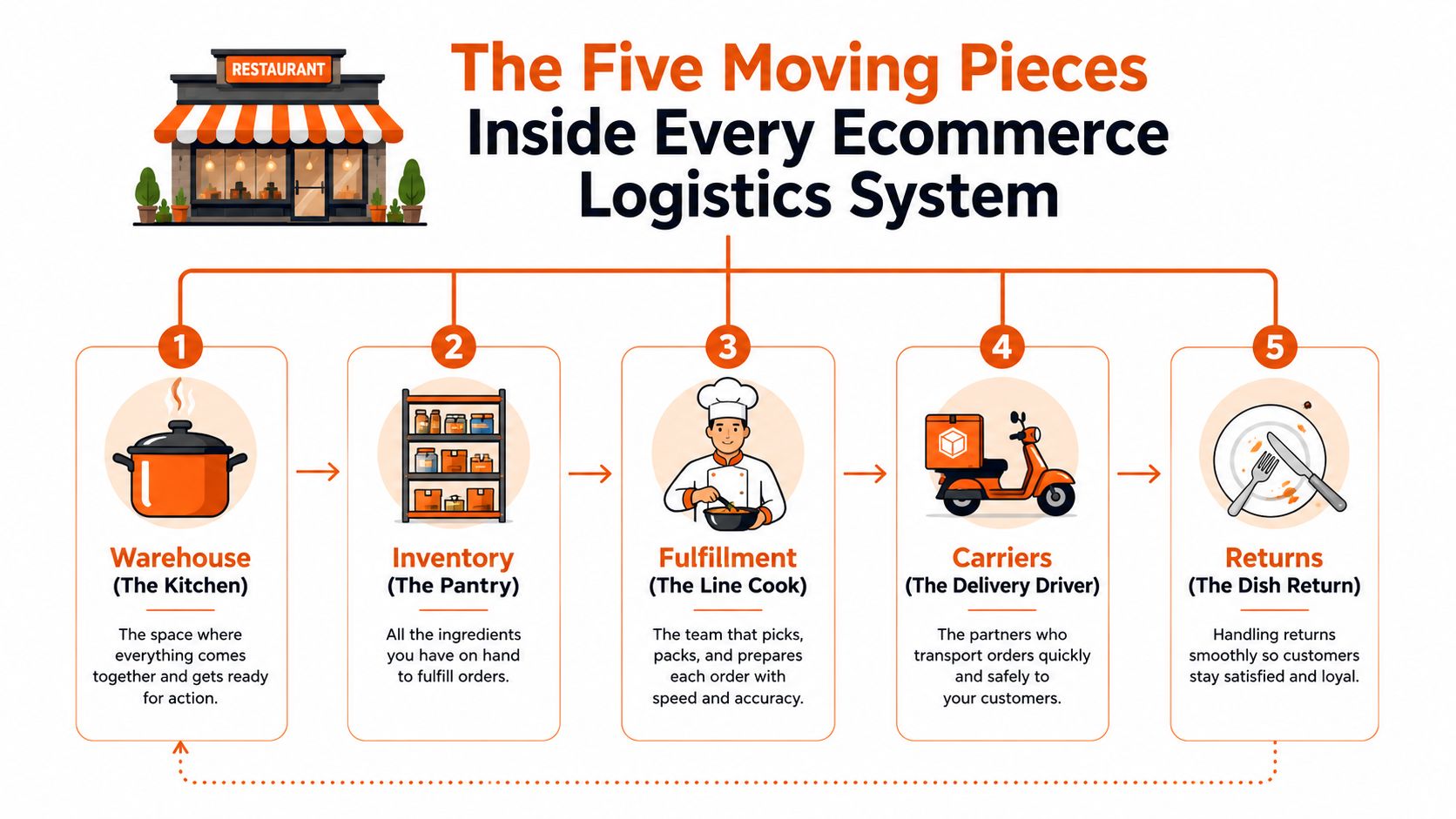
Think restaurant, not software. The warehouse is your kitchen, inventory is your pantry, fulfillment is the line cook, carriers are the delivery driver, and returns are the dish room nobody wants to staff. If any one of those slows down, the whole dinner service feels broken.
Warehouse and inventory
The warehouse is where product sits and where orders start moving. Inventory is what you have, what's already committed, and what's still on the way. If those two don't match, you sell stock you can't ship or you sit on dead product and wonder where the cash went.
Fulfillment and carriers
Fulfillment is the act of turning an order into a clean box with the right item, label, and insert. Carriers take that box from your dock to the buyer. The carrier can't rescue a slow warehouse, and a fast warehouse can't rescue a bad carrier handoff.
Returns
Returns are the messy part everyone wants to ignore. They're the plates coming back from the dining room. If your return flow is clumsy, you lose product, lose time, and lose another shot at a second purchase.
A useful way to judge any partner or tool is to ask which part of the restaurant it changes. If a platform claims to make everything faster, I want to know whether it helps the pantry, the line, the driver, or the dish room. If it helps none of those, it's a nice demo and a bad operating decision. For a peek at tools that sit closer to the process side, I'd also look at browse Genpire's supply chain features and compare them to your actual workflow.
The fastest fix in logistics usually creates pressure somewhere else. Faster shipping can expose a slower warehouse. Cheaper returns can create more customer service work. You need to see the whole line.
A 2024 logistics report found U.S. parcel transit time fell from 3.5 days in Q1 2022 to 2.19 days in Q4 2023, mostly because of tighter routing and denser networks rather than a single carrier change. That's the lesson. Speed usually comes from better system design, not from one magic switch. If you want a cleaner mental model for that, use the restaurant analogy before you buy another tool.
In-House, 3PL, Dropship, and FBA Compared Side by Side
You're not choosing between “good” and “bad” logistics. You're choosing which pain you want to carry. In-house gives you control and headache. A 3PL buys time. Dropship cuts inventory risk but gives you weak control. FBA is a bargain only when Amazon is a serious part of your sales mix.
| Model | Best at revenue stage | Main strength | Main risk |
|---|---|---|---|
| In-house | Very early stage, low order volume | Total control over packing, timing, and exceptions | Your team gets buried when volume jumps |
| 3PL | Early growth to steady scale | Less founder time spent on warehouse work | You lose some control and pay per order |
| Dropship | Testing demand or wide catalogs | Low inventory exposure | You don't control box quality, speed, or consistency |
| FBA | Brands with meaningful Amazon revenue | Fast Amazon-facing fulfillment | You tie operations to Amazon's rules and network |
If you're still learning what customers buy, in-house can be fine. Once orders start piling up, a 3PL often makes more sense because it stops your team from spending nights printing labels. I wouldn't use dropship for a brand I want to build around trust. It works when the catalog is broad and the stakes are low. It gets ugly when the customer expects consistency and you can't control the box.
How I'd choose in practice
If you're shipping a handful of orders a week, keep it simple and stay close to the process. If your founder time is getting eaten by pick lists, shipping errors, and truck bookings, move to a 3PL before the mess compounds. If Amazon is already a meaningful channel, FBA can make sense, but only if you're willing to let that channel dictate part of your operation. For a direct comparison of marketplace trade-offs, the Amazon FBA vs FBM guide is worth your time.
My blunt take: don't choose the model that sounds efficient. Choose the one that protects your attention while keeping customer promises intact.
The model that wins is the one that fits your stage, not your ego. Early founders often want control because it feels cheaper. Then they spend that saved money fixing mistakes. That's not efficiency, that's unpaid labor.
Where Shipping Costs Really Come From in an Ecommerce Order
Most founders stare at the shipping label and miss the rest of the bill. That's how margin gets eaten. The label is only one slice of the cost stack, and often not the one hurting you most.
Shipping is usually the loudest line item. Statista reports that shipping accounts for nearly 90% of total order fulfillment costs, and that the share of last-mile delivery costs in total shipping costs rose to over 50% between 2018 and 2023. Other industry data puts last-mile delivery at 30% to 50% of total ecommerce logistics costs, which is why the final mile gets so much attention.
There are more line items than postage
One recent industry summary says the average cost to fulfill a single online order, excluding shipping, is $15 to $20, and labor makes up 25% to 35% of total ecommerce logistics expenses. That is the part founders miss. If your pack team is slow, your boxes are oversized, or your returns pile up, you can burn through margin before the package even leaves the dock. Use the landed cost computation guide if you want to stop guessing at what each order really costs.
Here's the clean way to approach it:
- Pick and pack labor: the people time it takes to handle each order.
- Packaging materials: boxes, mailers, tape, inserts, void fill.
- Warehousing fees: storage, handling, and related space charges.
- Outbound shipping: the carrier bill that everyone notices first.
- Customer service and other losses: reships, damage, misships, and support work.
A shipping label that looks cheap can still be the expensive option if it creates more damage or more customer complaints. I'd rather pay a little more for the right route than save pennies and spend hours on apologies. The best founders read logistics as a unit economics problem, not a postage problem.
Simple test: if you don't know your cost to fulfill per order, your cost to ship per order, and your return rate, you're flying blind.
The KPI Dashboard a Real Operator Watches
Vanity metrics don't help you. I want four numbers on a simple spreadsheet, and I want them every week. They tell you where the delay lives and which partner is causing it.
The four metrics that matter
Time-in-transit measures the time from carrier pickup to customer delivery. Order-to-ship time measures how long your team takes from purchase to label. Ship-to-deliver time measures the actual carrier journey after the package leaves your dock. Lead-time variability tells you how inconsistent the whole chain is from order to arrival.
Shipium's guidance is useful here because it says to split inbound transit time and supplier lead times by vendor or manufacturer instead of calling everything “late.” That's the right habit. If a supplier is slow, you fix procurement. If the warehouse is slow, you fix labor or slotting. If transit is uneven, you look at routing and carrier mix. Don't mash those together.
How to use the dashboard
I'd build the dashboard straight from Shopify, your 3PL portal, and carrier tracking exports. No fancy system needed at first. You just need clean dates.
- Time-in-transit: compare pickup scan to delivery scan.
- Order-to-ship time: compare order timestamp to label creation or pickup.
- Ship-to-deliver time: compare handoff to delivery.
- Lead-time variability: look for the spread between your fast orders and your slow ones, then find the common cause.
If you can't separate these numbers, you'll blame the wrong partner. That's how brands keep paying for the same mistake twice. A warehouse problem can look like a carrier problem when you don't track the handoff.
Operator habit: review the slowest orders first. Outliers tell you more than averages do.
Three Beliefs That Quietly Drain Your Margin
A lot of early brands repeat shipping advice that sounds smart and costs them money. I'd throw out three beliefs fast. They make sense at a dinner table, then they turn into margin leaks.
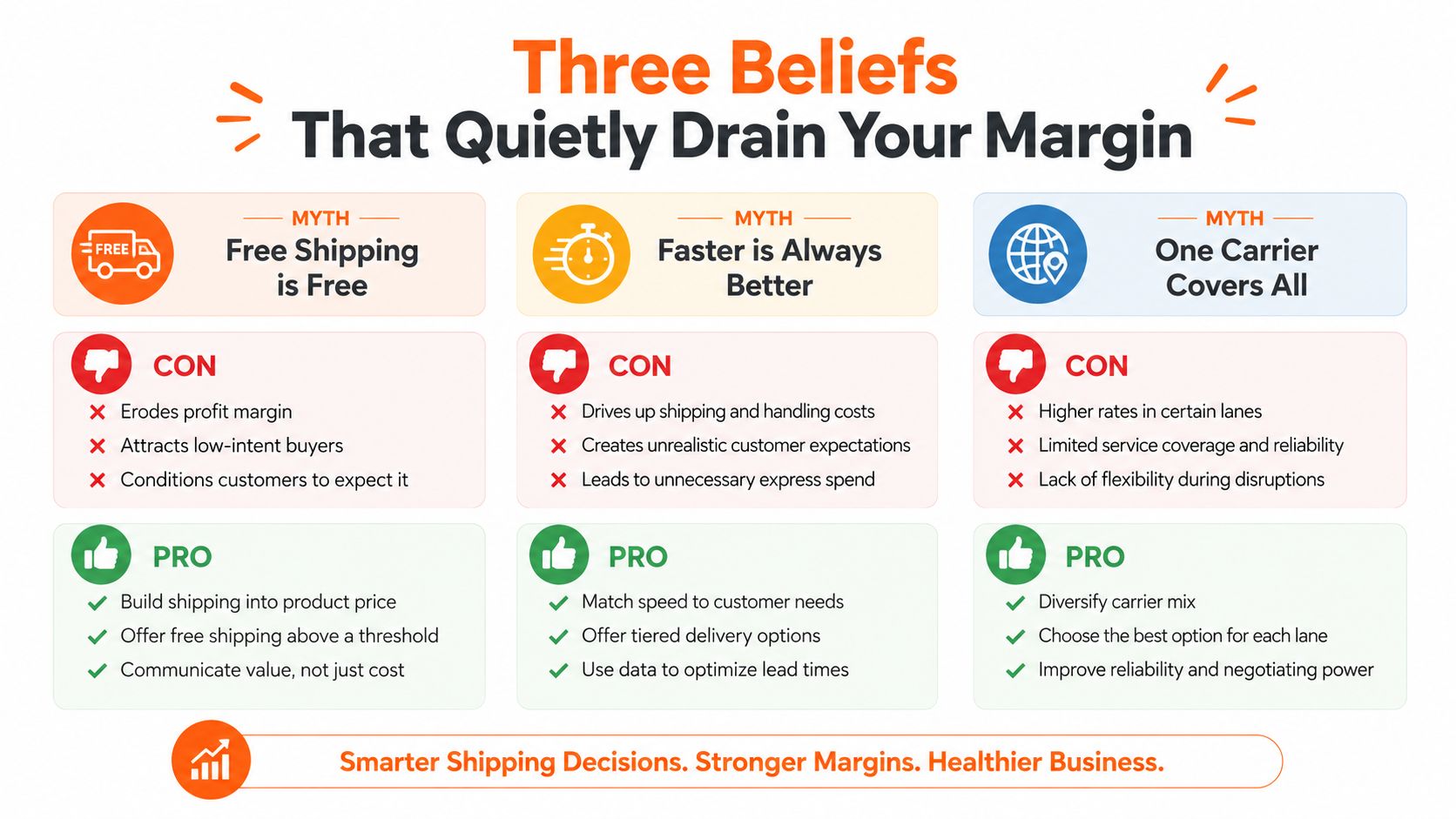
Free shipping is free
It isn't. You either bake the cost into product price, absorb it in margin, or hide it inside a slower, cheaper service that hurts the customer. If you want to run free shipping, do it with your eyes open and your math on paper. Otherwise you're just donating profit to the label printer.
Faster is always better
No. A promise you can keep beats a promise you can't. A clean four-day delivery is better than a shaky two-day promise that causes tickets and refunds. Customers forgive slower shipping more easily than they forgive broken expectations.
One carrier covers everything
That only works on paper. Bulky, fragile, or mixed-size catalogs need different handling than small parcels. Some carriers are built around sub-10 kg shipments, and once you get past standard size thresholds, options shrink and surcharges rise. That means your shipping strategy has to match the product class, not your hope.
For Midwest sellers, that matters even more because your catalog probably isn't neat and narrow. If you sell one lightweight item and one awkward oversized item, you're already running two logistics models. Don't pretend one rate card will solve both. Use your carrier mix by product type, and route harder items with the least drama, not the prettiest quote.
A Chicago and Midwest Founder Playbook for Ecommerce Logistics
Chicago gives you a real freight advantage if you use it with discipline. You sit near a dense carrier network, you can reach a lot of the country by ground without overthinking it, and you don't need to build a coast-to-coast story before your operation can support one. That's good news for a founder who wants fewer moving parts.
Start with one smart node
If I were building from Chicago, I'd begin with one Midwest warehouse that can cover most U.S. demand quickly by ground. That keeps inventory close enough to customers without spreading stock too thin. Once your order pattern starts stretching out and your service levels suffer, then I'd look at a second regional node. Don't open the second site because it feels mature. Open it because the math says you need it.
Freight choice matters too. If product comes through a port, or if you move cases from a local 3PL, you need to think about inbound freight as part of the system, not a separate headache. Then add carrier mix by job type. Use regional parcel when it makes sense, national parcel when coverage matters, and LTL freight for bulky shipments that don't belong in a parcel box.
Returns should come home to the Midwest
Returns routing is where a lot of brands waste money. If you sell from a Midwest hub, I'd send returns back to that same hub unless you have a strong reason not to. That keeps inspection, restock, and disposition in one place. It also keeps your return process from turning into a scattered mess across too many nodes.
My rule for Midwest founders: keep the first network simple, then widen it only when delay or freight cost forces the move.
A lot of brands think carrier speed is the whole game. It isn't. Warehouse placement, freight flow, and return routing matter just as much. If you get those right in Chicago, you can punch above your weight without building a giant operation.
Your First Ten Moves as a New Ecommerce Brand
Start with the boring decisions. They're the ones that save your margin later.
- Pick your warehouse plan. Keep it in-house if volume is tiny. Move to a 3PL when the manual work starts stealing founder time.
- Choose your carrier mix. Don't marry one carrier because the sales rep was charming.
- Write your returns policy early. If you wait, the first angry customer writes it for you.
- Set your KPI sheet. Track time-in-transit, order-to-ship, ship-to-deliver, and lead-time variability.
- Know your cost to fulfill. If you can't name it, you can't price responsibly.
- Know your cost to ship. The label is a line item, not the whole story.
- Watch your return rate. Returns tell you about product fit, packaging, and promises.
- Audit packaging. Oversized boxes waste money and space.
- Map one exception process. Decide who handles damage, misships, and delays.
- Revisit the setup after volume moves. What works at 50 orders a month can fail hard at 500.
If you want a hard rule, use this one. If you can't name your cost to fulfill, your ship time, and your return rate, you're not running ecommerce logistics yet, you're just shipping boxes.
If you want help turning that operating model into something you can run, visit Chicago Brandstarters. We help Chicago and Midwest founders trade guesswork for real operator thinking, and we do it with people who've been in the mess, not people selling slide decks.
Leave a Reply